What is the difference between bit depth and bitrate?
Bit DepthBit Depth
Understanding Bit Depth and Bitrate
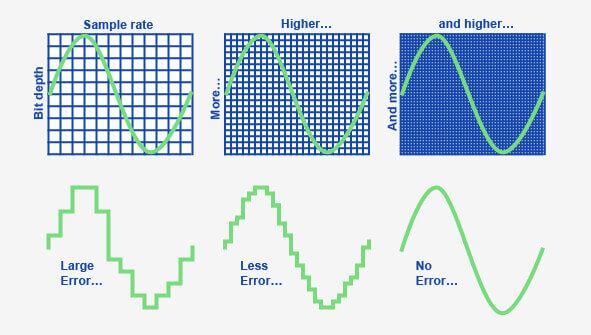
When it comes to audio and video files, there are two terms that are often used interchangeably: bit depth and bitrate. However, they are not the same thing. Bit depth refers to the number of bits used to represent each sample in an audio or video file, while bitrate refers to the amount of data transmitted per second.
Bit depth determines the number of possible values for each sample in a digital audio or video file. For example, an 8-bit audio file can have 256 possible values per sample, while a 16-bit file can have 65,536. The higher the bit depth, the more accurate the representation of the original sound or image.
On the other hand, bitrate refers to the amount of data transmitted per second in a digital file. In other words, it’s the rate at which data is encoded in a file. Higher bitrates typically mean higher quality files with more information, but also larger file sizes.
Audio Bit Depth vs Bitrate
When it comes to audio files, the bit depth and bitrate are both important factors in determining the quality of the sound. A higher bit depth means a more accurate representation of the original sound, while a higher bitrate means more data is transmitted per second, resulting in a higher quality sound.
However, it’s important to note that a higher bitrate does not necessarily mean a higher quality sound. If the original recording is of poor quality, increasing the bitrate will not improve the sound. In fact, it can actually result in larger file sizes with no improvement in sound quality.
Video Bit Depth vs Bitrate
Video files also have bit depth and bitrate, but they work slightly differently than in audio files. Bit depth determines the number of colors that can be represented in a video file, while bitrate determines the amount of data transmitted per second.
A higher bit depth means a wider range of colors can be represented in the video, resulting in a more accurate and vibrant image. However, a higher bitrate is also important for video files, as it determines the amount of detail that can be captured in each frame.
It’s important to find the right balance between bit depth and bitrate for video files, as increasing one can have a negative impact on the other. For example, a high bit depth with a low bitrate can result in a choppy or pixelated image, while a low bit depth with a high bitrate can result in a washed-out or blurry image.
Final Words
In conclusion, bit depth and bitrate are both important factors to consider when working with audio and video files. While they may seem similar, they serve different purposes and have different effects on the quality of the final product. It’s important to find the right balance between the two to ensure the best possible sound or image quality.
Keywords: audio bit depth, video bit depth, bit depth vs bitrate, bitrate definition, bitrate vs quality, audio quality, video quality, digital audio, digital video, file size, data transmission, accuracy, color representation, image quality, sound quality, audio recording, video recording, data encoding, pixelation, file format, media production, sound engineering, video editing, multimedia, digital media, technology, mp4gain, audio normalization, audio conversion, equalizer, windows, digital signal processing, dynamic
MPEG decoding is the process of converting compressed digital video data into a viewable format. This process is necessary because most digital videos are compressed to save space and reduce bandwidth requirements. Decoding MPEG involves using a special algorithm to decompress the data and extract the video and audio streams. Once the video and audio streams are separated, they can be played back on a computer or other device.
According to the book “Video Demystified” by Keith Jack, “Decoding MPEG requires a powerful processor and specialized hardware.” This is because the process is computationally intensive and requires a lot of processing power to be done in real-time. Many modern computers and mobile devices are capable of decoding MPEG on their own, but some may require specialized software or hardware to do so.
MPEG Decoder
An MPEG decoder is a piece of software or hardware that is designed to decode MPEG-encoded video files. Decoders come in many different forms, from standalone devices to software that can be installed on a computer. Most modern media players, such as VLC, have built-in MPEG decoders that can play back MPEG-encoded video files without the need for additional software.
As noted by the book “Digital Video Processing” by A. Murat Tekalp, “The quality of an MPEG decoder determines the quality of the video output.” This is because the decoding process can introduce artifacts and other issues that can degrade the quality of the video. It is important to use a high-quality decoder to ensure that the video is decoded correctly and looks its best.
Decoding Video Files
Decoding video files is an essential part of playing back digital video content. Many different video codecs are used to compress video data, and each requires a specific decoder to play back the content. MPEG is just one of many video codecs that are commonly used. Other popular codecs include H.264, HEVC, and AV1.
As stated by the movie “The Matrix”, “Unfortunately, no one can be told what decoding video files is. You have to see it for yourself.” While decoding video files may seem complicated, modern media players and other software have made the process much easier. With the right software and hardware, anyone can decode and play back digital video content with ease.
Final Words:
In conclusion, MPEG decoding is an essential process for playing back digital video content. Whether you are using a standalone device or a computer with specialized software, understanding how MPEG decoding works is important for getting the best possible video playback experience. If you’re looking for a high-quality MPEG decoder, consider using mp4gain to ensure that your video files are decoded correctly and look their best.
Digital video has revolutionized the way we capture, store, and share videos. With the rise of digital cameras, smartphones, and other video recording devices, digital video has become more accessible and popular than ever before. In this article, we will discuss the advantages of digital video and why it has become the preferred format for video production and consumption.
Higher Quality
One of the biggest advantages of digital video is the higher quality that it provides compared to analog video. Digital video has a higher resolution, which means that it can capture more detail and produce sharper images. It also has a wider color gamut, which means that it can display more colors and shades than analog video.
Greater Flexibility
Digital video also provides greater flexibility in terms of editing and distribution. With digital video, you can easily edit, crop, and manipulate footage using software, which is much easier than doing so with analog footage. You can also distribute digital video through a variety of channels, including social media, streaming platforms, and websites, which makes it more accessible to a wider audience.
Cost-Effective
Digital video is also more cost-effective than analog video. With digital video, you don’t need to purchase and develop film, which can be expensive. You can also store digital video on hard drives or cloud storage, which is much more affordable than storing physical media.
People Also Ask
What are the disadvantages of digital video?
While digital video has many advantages, it also has some disadvantages. One of the biggest disadvantages is that digital video can be prone to compression artifacts, which can reduce the quality of the video. Digital video also requires more storage space than analog video, which can be an issue if you have limited storage capacity.
What are the different types of digital video?
There are several different types of digital video, including MPEG, AVI, WMV, and MOV. Each type of digital video has its own strengths and weaknesses, and the best format to use will depend on your specific needs and preferences.
How has digital video changed the film industry?
Digital video has had a significant impact on the film industry. It has made it easier and more affordable for independent filmmakers to create high-quality films, and it has also allowed for more experimentation and creativity in terms of film production. Digital video has also made it easier for films to be distributed and marketed globally, which has opened up new opportunities for filmmakers and audiences alike.
Digital audio and video are types of data that we can store on a computer or other electronic device. They are made up of a series of numbers that represent the sound or image we want to save. This means that instead of using physical materials like film or tape to record sound or video, we can use a computer to store and manipulate digital versions of that data.
Digital Audio and Video
How is sound digitized?
Sound is a type of wave that travels through the air. When we want to digitize sound, we need to find a way to measure that wave and turn it into a series of numbers. We do this by using a device called a microphone, which converts sound waves into electrical signals that can be processed by a computer.
Here’s an example: imagine you’re at a concert and you want to record a song using your phone. You turn on the voice memo app and hold your phone up to the speakers. The microphone in your phone converts the sound waves from the speakers into electrical signals that are then turned into a digital audio file that you can listen to later.
How are multiple sounds combined into a single file?
When we record sound using a microphone, we’re not just capturing one sound at a time. We’re also picking up any other sounds that might be happening in the background, like people talking or the sound of a car driving by. So how do we store all of these different sounds in a single file?
The answer is that each sound is given its own “channel” in the digital audio file. Imagine that you have a stereo system with two speakers – one on the left and one on the right. When you record a song using your phone, the sound that’s coming out of the left speaker is saved in one channel of the audio file, while the sound that’s coming out of the right speaker is saved in another channel.
How are different instruments and voices saved in a single channel?
So now we know how to store multiple sounds in a digital audio file using different channels. But what if we want to save a song that has lots of different instruments and voices playing at the same time? How can we separate out all of those different sounds and make sure they’re saved correctly in the file?
The answer is that each sound is given its own “frequency” in the digital audio file. Think of it like a rainbow: just like how a rainbow has lots of different colors, sound has lots of different frequencies. When we record a song, we’re capturing all of those different frequencies at the same time.
So let’s say we’re recording a song that has a guitar, a bass, a drum set, and a singer. Each of those instruments and the singer’s voice has a different set of frequencies that make up its sound. The guitar might have a lot of high frequencies, while the bass might have a lot of low frequencies. When we record the song, we capture all of those frequencies at the same time and save them in the digital audio file.
How are timbres saved in a digital audio file?
The “timbre” of a sound refers to its unique quality or tone. For example, if you hear a trumpet and a violin playing the same note, you can still tell the difference between the two because they have different timbres. So how do we save the timbre of each instrument or voice in a digital audio file?
To save the timbre of each sound, we use a process called “sampling”. Sampling involves taking tiny snapshots of the sound wave at regular intervals and saving those snapshots as numbers in the digital audio file. The more snapshots we take, the more accurately we can capture the unique timbre of each sound.
Here’s an example: let’s say we’re recording a piano playing a single note. We take 44,100 snapshots of the sound wave per second and save each snapshot as a number in the digital audio file. When we play back the file, the computer reads those numbers and uses them to recreate the sound of the piano note. Because we took so many snapshots per second, we’re able to capture all of the nuances of the piano’s timbre and make it sound like a real piano.
How are noises and other sounds saved in a digital audio file?
When we record sound using a microphone, we’re not just capturing the sounds we want to hear – we’re also capturing any background noise that might be happening. This can include things like people talking, cars driving by, or birds chirping. So how do we deal with all of that extra noise when we save the sound as a digital file?
One way to deal with background noise is to use a process called “noise reduction”. This involves analyzing the digital audio file and looking for parts of the sound that are consistent over time – like the sound of a fan running or the hum of a fluorescent light. The computer can then remove those consistent sounds from the file, leaving behind just the sounds we want to hear.
Another way to deal with background noise is to use a process called “EQ” (short for “equalization”). EQ allows us to boost or cut certain frequencies in the sound to make it sound better. For example, if there’s a lot of low-frequency rumble in a recording, we can use EQ to cut out some of those frequencies and make the sound clearer.
What is digital video?
Digital video is similar to digital audio, but instead of capturing sound waves, we’re capturing images. When we record a video, we’re capturing a series of still images (or frames) at regular intervals and saving them as a digital file.
How are videos saved in digital format?
To save a video in digital format, we need to capture a series of still images (or frames) and save them as a digital file. We do this using a device called a camera, which captures light from the scene we’re filming and turns it into an electrical signal that can be processed by a computer.
Here’s an example: imagine you’re filming a video of your dog playing in the park. You hold up your phone and hit the record button. The camera in your phone captures a series of still images (or frames) of your dog playing and saves them as a digital video file that you can watch later.
How are multiple images combined into a single video file?
When we capture a video, we’re capturing a series of still images (or frames) at regular intervals. To create a smooth video, we need to combine all of those frames into a single file. This is done using a process called “video compression”.
Video compression works by looking for parts of the image that are similar from frame to frame and only saving the parts that are different. For example, if you’re filming a video of a person sitting in a chair, the background behind them might not change much from frame to frame, so the computer can save that part of the image just once and only save the parts that are changing (like the person’s movements).
By only saving the parts of the image that are changing, we’re able to save space and create smaller video files that are easier to store and share. However, too much compression can make the video look blurry or pixelated. So, it’s important to find a balance between file size and video quality when compressing videos.
How do we add sound to a digital video file?
To add sound to a digital video file, we use a process called “audio syncing”. Audio syncing involves combining the digital audio file (which we learned about earlier) with the digital video file so that the sound matches up with the images.
Here’s an example: let’s say you’re filming a concert and you want to create a video of one of the songs. You record the video using your camera and the audio using a separate recording device. When you go to edit the video, you import both the digital audio file and the digital video file into your editing software. Then, you use audio syncing to line up the audio with the video so that the sound matches up with the images.
Conclusion
In conclusion, digital audio and video are complex subjects, but they can be explained in a way that a 6-year-old can understand. Digital audio involves converting sound waves into numbers that can be saved in a digital file. We use sampling to capture the unique timbre of each sound, and we use noise reduction and EQ to deal with background noise. Digital video involves capturing a series of still images (or frames) and saving them as a digital file. We use video compression to combine those frames into a single file and audio syncing to add sound to the video. By understanding these concepts, we can appreciate the technology behind the digital media that we enjoy every day.