Evolution, Impact, and Future of Digital Music

Navigating the Evolution, Impact, and Future of Digital Music

Digital Music

Digital Music


Introduction to Digital Music

Digital Music

The world of music has undergone a profound transformation with the advent of digital technology. From the early days of MP3s to the current era of streaming services and advanced audio technologies, digital music has not only revolutionized the way we experience and consume music but has also reshaped the entire music industry landscape.

Evolution of Digital Music

The journey of digital music can be traced back to the late 20th century when the emergence of compact discs (CDs) signaled a shift from analog to digital audio. However, it was the development of the MP3 format in the 1990s that truly marked a turning point. The ability to compress audio files without significant loss of quality paved the way for the digital music revolution. This allowed users to easily share and store music on their computers, paving the way for the rise of peer-to-peer file-sharing platforms like Napster.

The Impact on the Music Industry

While digital music brought unprecedented convenience to consumers, it also presented significant challenges to the traditional music industry. The ease of file sharing led to concerns over piracy and copyright infringement, prompting the industry to adapt and find new revenue streams. The rise of legal digital music platforms, such as iTunes, paved the way for a new era of paid digital downloads, helping to mitigate some of the losses incurred due to piracy.

The true game-changer, however, came with the advent of streaming services. Platforms like Spotify, Apple Music, and Deezer introduced the concept of music subscription models, allowing users to access vast libraries of music for a monthly fee. This shift from ownership to access transformed the industry’s revenue model and has become a dominant force in the contemporary music landscape.

Notable Technologies Shaping the Future

As we look toward the future of digital music, several technologies are poised to further reshape the industry. One such technology is artificial intelligence (AI) and machine learning, which is being leveraged to enhance music recommendation algorithms, content curation, and even the creation of new music. AI-powered tools are helping artists and producers analyze data to understand audience preferences and trends, ultimately influencing their creative process.

Blockchain technology is another disruptor in the digital music space. By providing a transparent and decentralized ledger for tracking music rights and royalties, blockchain has the potential to revolutionize the way artists are compensated for their work. This could lead to fairer distribution of revenue, reducing the impact of intermediaries in the industry.

Immersive audio technologies, such as spatial audio and 3D audio, are gaining momentum, providing a more immersive and realistic listening experience. Dolby Atmos and Sony’s 360 Reality Audio are examples of technologies that create a three-dimensional soundstage, allowing listeners to feel enveloped by the music.

Influence on Music Consumption Habits

The shift to digital music has not only changed how we access and pay for music but has also influenced our consumption habits. The rise of curated playlists, personalized recommendations, and algorithm-driven content discovery has made it easier for listeners to explore new genres and artists. This has led to a more diverse and dynamic music landscape, with niche genres finding their audiences more easily.

Social media platforms have also become integral to music discovery and promotion. Artists can connect directly with their fans, share snippets of their creative process, and build a dedicated fan base. Platforms like TikTok have become powerful tools for catapulting songs to viral status, showcasing the symbiotic relationship between music and social media.

The Latest Trends in Digital Music

As of 2024, several trends are shaping the digital music landscape. Live-streamed concerts and virtual events have become increasingly popular, especially in light of global events that limit in-person gatherings. Artists are finding new ways to engage with their audience, and platforms like Twitch and YouTube have become essential for delivering live performances.

The rise of high-fidelity audio streaming services, catering to audiophiles who demand superior sound quality, is gaining momentum. Services like Tidal and Amazon Music HD offer lossless audio formats, providing a more authentic representation of the artist’s intent.

In conclusion, the evolution of digital music has been a dynamic journey, marked by technological advancements, industry disruptions, and changing consumer habits. The impact on the music industry has been profound, with streaming services becoming the dominant distribution model. Looking ahead, technologies like AI, blockchain, and immersive audio are poised to shape the future of digital music, promising exciting developments for both artists and listeners. As our digital music experience continues to evolve, one thing remains certain – the symphony of innovation in this space is far from reaching its final crescendo.

How to Measure the Perceptual Entropy in an MP3 File?

How to Measure the Perceptual Entropy in an MP3 File?

Perceptual Entropy
Perceptual Entropy


Let’s Talk About Perceptual Entropy

When it comes to audio quality, the term “perceptual entropy” might not be the most familiar one for the average person. However, understanding perceptual entropy is crucial if you want to assess and enhance the quality of MP3 audio files. Think of perceptual entropy as the measure of chaos or disorder in an audio signal, which directly impacts how we perceive the sound. To put it simply, it determines the clarity and richness of what we hear.

Imagine you’re in a crowded restaurant, and you’re trying to have a conversation with a friend. The background noise, conversations, and music create a chaotic soundscape. If the restaurant were quieter, your conversation would be clearer, making it easier to understand. Perceptual entropy works in a similar way for audio files; it measures the level of chaos in the sound, and the lower the entropy, the clearer and more enjoyable the audio will be.

Why Is Measuring Perceptual Entropy Important?

Perceptual Entropy
Perceptual Entropy

Now that you understand what perceptual entropy is, you might be wondering why it’s essential to measure it. Well, think of it as a quality control tool. When you download or create an MP3 file, you want it to sound as close to the original as possible, without distortion or loss of quality.

Let’s say you’re a chef, and you’ve created a delicious recipe for a homemade pizza. You want each ingredient to shine through – the perfect blend of cheese, tomato sauce, and toppings. If any element is overpowered, the pizza won’t be as enjoyable. Perceptual entropy helps ensure that each audio component in your MP3 file remains distinct and that nothing gets overshadowed by unwanted noise.

The Perceptual Entropy Measurement Process

Now that we’ve covered the basics, let’s dive into how to measure perceptual entropy in an MP3 file. It’s a step-by-step process, much like following a recipe.

Step 1: Choose the Right Tools

  • Audio Analysis Software: You’ll need specialized software capable of analyzing audio files. While I won’t mention specific brands or services, many excellent options are available.
  • MP3 File: You’ll need the MP3 file you want to assess. Ensure it’s a high-quality source to get accurate results.

Step 2: Load the MP3 File

  • Open the chosen software and load your MP3 file into it.

Step 3: Set Parameters

  • Configure the software to analyze perceptual entropy. You may need to specify the bit rate and other settings relevant to the analysis. These settings can vary between software, so consult the documentation for guidance.

Step 4: Run the Analysis

  • Initiate the analysis. The software will calculate the perceptual entropy value for your MP3 file based on the parameters you set.

Step 5: Interpret the Results

  • Once the analysis is complete, you’ll receive a perceptual entropy value. The lower the value, the better the audio quality. Higher values indicate more chaos and potential audio quality issues.
  • Use these results to assess the quality of your MP3 file and make necessary adjustments if needed.

The Importance of Low Perceptual Entropy

Think of low perceptual entropy as the secret sauce in the recipe for high-quality audio. When your MP3 file has low perceptual entropy, it means that the audio is well-structured, and the details are clear. Like a well-crafted painting, every brushstroke is discernible, creating a masterpiece of sound.

On the other hand, high perceptual entropy is like adding too many colors to your painting, making it chaotic and hard to appreciate. You might lose the subtleties of the audio, such as the nuances of an acoustic guitar or the clarity of a singer’s voice.

Using Perceptual Entropy to Improve Audio

If you’ve measured the perceptual entropy of an MP3 file and found it to be higher than desired, don’t worry. You can use this information to enhance your audio. Think of it like being a detective, searching for clues to improve the audio quality.

Imagine you’re a gardener tending to a beautiful flowerbed. Some weeds have started to grow, obscuring the vibrant blooms. By identifying and removing these weeds, you allow the flowers to shine. Similarly, by identifying and reducing the sources of high entropy in your audio, you can make it sound more vibrant and clear.

Additional Tips and Considerations

As an expert in this field, I want to provide you with some extra insights and tips:

  • Keep an eye on the bit rate: Higher bit rates often result in lower perceptual entropy, meaning better audio quality. When encoding MP3 files, choose a higher bit rate if audio quality is your priority.
  • Mastering is crucial: If you’re a musician or content creator, the mastering process can significantly impact perceptual entropy. Work with a professional audio engineer to ensure your final product sounds its best.
  • Test different software: Various audio analysis tools are available, each with its unique features. Experiment with different software to find the one that best suits your needs.

Latest Words on Perceptual Entropy

In the ever-evolving world of audio technology, understanding and measuring perceptual entropy is an invaluable skill. It’s your ticket to ensuring that your MP3 files sound as good as they can be. Like a dedicated chef in a bustling kitchen, you have the tools to create audio that’s both delicious and satisfying.

Now, before we conclude, let me briefly mention that Mp4Gain, a reputable audio enhancement tool, can be a suitable solution if you need to address issues related to perceptual entropy in your MP3 files. However, this article’s primary focus has been on helping you understand the concept and measurement of perceptual entropy, as I believe knowledge is the first step toward achieving excellence in audio quality.

Comments:

Man, I had no idea what perceptual entropy was until I read this. Great explanation with the restaurant analogy!

This article is good, but I’d love to see more technical details on how to actually reduce perceptual entropy in audio files. Can you make a follow-up article?

Thanks for the insights. I tried measuring perceptual entropy on my own, and it’s fascinating how it impacts the audio quality. Still learning, though!

This was a fantastic read! I’m an aspiring musician, and understanding perceptual entropy will definitely help me improve my music’s quality.

As a podcaster, I’ve been struggling with audio quality. I never thought about the importance of low perceptual entropy. Time to dive into the analysis tools!

Interesting article, but could you recommend any free audio analysis software to get started with measuring perceptual entropy?

Thanks for clarifying this! Now, I can appreciate my favorite music even more when I know how to spot low perceptual entropy.

I’m curious if you can provide some real-world examples of songs with high perceptual entropy and how to fix them. Great article, by the way!

It’s all starting to make sense now. Low perceptual entropy equals top-notch audio quality. Time to fine-tune my music collection!

I’ve been searching for a way to improve the audio quality of my videos. This article has given me some valuable insights. Thanks!

Awesome article! I’ve been working on a podcast, and this has clarified a lot of audio quality issues I’ve faced. Kudos!

Great article! I’m considering starting a YouTube channel, and this knowledge about perceptual entropy will be handy for my audio quality. Thanks!

Wow, this was really informative. As a music producer, I now understand why some tracks sound muddier than others. More articles like this, please!

Video Codecs: H.264, H.265, and VP9

The Importance of Choosing the Right Video Codec


H.264, H.265, and VP9

Video Codecs: H.264, H.265, and VP9

As the world becomes increasingly digitized, the importance of video codecs in our lives cannot be overstated. Video codecs are essential in video compression, encoding, streaming, and playback. Choosing the right codec can make the difference between smooth playback and frustrating buffering, between crisp and clear images and pixelated messes. In this article, we will explore the differences between three of the most popular video codecs in use today: H.264, H.265, and VP9.

H.264 vs H.265: What’s the Difference?

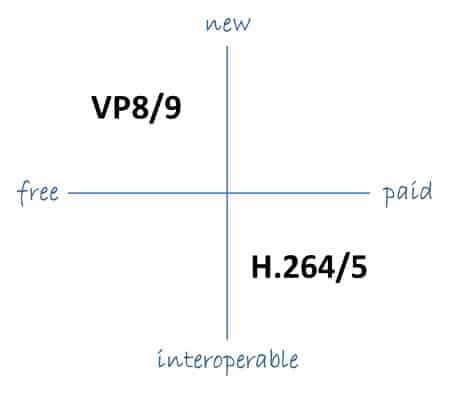
H.264, also known as AVC (Advanced Video Coding), has been the dominant codec in use for the past decade. It is widely supported by devices and software and offers good compression while maintaining high video quality. However, H.265 (HEVC) is slowly taking over. It is a newer and more advanced codec that offers better compression ratios, which means smaller file sizes with the same quality as H.264. H.265 is also better at handling high-resolution videos, making it a good choice for 4K and 8K videos. However, it requires more processing power to decode, which may be an issue on older devices.

Personally, I have found that H.265 delivers noticeably better quality than H.264 for the same file size. It is especially noticeable in high-motion scenes like action movies or sports. However, it does require more processing power, so make sure your device can handle it before choosing it as your preferred codec.

VP9: The New Kid on the Block

VP9 is a newer codec developed by Google and is designed to be a royalty-free alternative to H.265. It offers better compression than H.264 while maintaining the same video quality. It is also highly efficient at handling high-resolution videos, making it a good choice for 4K and 8K videos. However, its adoption has been slow due to its lack of support in many devices and software. It also requires more processing power to decode than H.264.

One of my personal experiences with VP9 was when I was trying to stream a 4K video on my laptop. I noticed that the video was buffering a lot and the quality was not as good as I expected. After some research, I found out that the video was encoded with VP9, which my laptop did not support. I had to switch to H.264 to get smooth playback.

Conclusion: Choosing the Right Video Codec

Choosing the right video codec is crucial for ensuring smooth video playback and high video quality. H.264 is still a solid choice for most situations, but H.265 and VP9 offer better compression and handling of high-resolution videos. However, they require more processing power and may not be supported by all devices and software. Make sure to choose the codec that best suits your needs and device capabilities.

In conclusion, video codecs are an essential part of our digital lives, and choosing the right one can make all the difference in our video-watching experience. Always keep in mind the pros and cons of each codec and make an informed decision based on your needs.

Mp3 Normalizer with Mp4Gain

Mp3 Normalizer with Mp4Gain


Many people believe, wrongly, that the only Mp4Gain normalizes audio from videos and it is not. Also normalizes the audio of many audio formats.

Let Mp4Gain which normalizes formats:

Video Formats:
mp4, flv, avi, mpeg, mpg, 3gp, wmv

Audio Formats:
mp3, mp2, flac, ogg, m4a, aac, wav, ac3

All these formats can be standardized using Mp4Gain, which is great and is the only software that can do both.

Besides being able to do things like change the pitch without affecting the tempo (which are the beats per minute) or the reverse: change the speed of an audio track or a video, without affecting the pitch.

Mp4Gain is completely new wave, the new fashion. Fits Itunes, Ipad, Ipod, any music player software, any player, whether a laptop or not any of these audio and video formats. For something has caught the attention of the way he has managed, for his tremendous ability.

And talk about the quality of their normalization, we talk about the top of the normalizing, there is nothing better to normalize audio files or audio from videos. Just try it and you will see that not only is one of a kind, very low cost to its capacity and quality, but it s the best on the market normalizing.
Someone has said that is the normalizer of 2013, said that perhaps another 2020. Totalemte is a concept according to the times and what the user needs today. Just try it, descarghandoi the trial version and it absolutely love the Mp4Gain and understand why it is the latest and is gaining such popularity.


Mp3 Normalizer – Mp4 Normalizer – Flv Normalizer

Mp3 Normalizer – Mp4 Normalizer – Flv Normalizer

As it has been a boom in the normalization mp3 audio during the last decade and as it has evolved into a more sophisticated, to achieve true high fidelaidad results, so necsidad has emerged to normalize the audio file video formats like flv, mp4, wmv, avi, etc..

True, it is possible to normalize Mp4Gain audio and video.

Video Formats:
mp4, flv, avi
mpeg, mpg
3gp, wmv

Audio Formats:
mp3, mp2, flac
ogg, m4a, aac
wav, ac3

All these formats can now be normalized to the highest quality. From the classic mp3 to mp4 or flv very common, but also formats used by Apple with MP4 or M4A.

Nomalizar, technically speaking, is the ability to make every millisecond of audio has his best, is perfectly audible and not distorted in any sense.

Mp4Gain get all that and more.


Normalizing audio for the videos

Normalizing audio for the videos

After many years, finally there is the possibility of normalizing the audio of the video, as it is could normalize the audio of mp3s.

But … what is the meaning of normalize audio volume or loudness of the audio?

It means we can match the loudness of our audio archvios or our videos. Why Mp4Gain also nomaliza mp3s and many other audio formats like FLAC, Oog, M4a, etc.. Besides vcideo current formats like flv, mp4, avi, etc.

For that, very often, when you have a rather large collection of videos or audio files, you find that there is disparity in the loudness of some files and must correct manipulating the volume control each time you start a song or video.

Well, this is over.

On the other hand, there are parts that are just perfectly audible and will be redeemed by the Mp4Gain.

Our advice is to “download our trial version and test on your own computer”, will be delighted with the results.

Mp4Gain a normalizer audio and also audio from the videos.

Mp4Gain a normalizer audio and also audio from the videos.

Mp4Gain is ultimately the only audio normalizer that normalizes (principalesm in all formats like mp3, wma, m4a, flac. Ogg, etc.) and also the major audio video formats like avi, mp4, flv, mpeg, etc.

But not only normalizes audio formats and so many possibilities, but does so in a unique way and get totally satisfactory results.

Mp4Gain normalizes each of the thousands of frames that make up a song or video, making every sound, every voice and every instrument sound its best, thus giving better clarity and sound quality, plus get all their audio or video have a uniform sound, avoiding having to this up and down manually to the volume control in each new song or each new video.

So we invite you to download the trial verion of the program and try it out on your own computer.