Video Codecs: H.264, H.265, and VP9


Free Download Mp4Gain
picture

The Importance of Choosing the Right Video Codec

 

H.264, H.265, and VP9

Video Codecs: H.264, H.265, and VP9

As the world becomes increasingly digitized, the importance of video codecs in our lives cannot be overstated. Video codecs are essential in video compression, encoding, streaming, and playback. Choosing the right codec can make the difference between smooth playback and frustrating buffering, between crisp and clear images and pixelated messes. In this article, we will explore the differences between three of the most popular video codecs in use today: H.264, H.265, and VP9.

H.264 vs H.265: What’s the Difference?

H.264, also known as AVC (Advanced Video Coding), has been the dominant codec in use for the past decade. It is widely supported by devices and software and offers good compression while maintaining high video quality. However, H.265 (HEVC) is slowly taking over. It is a newer and more advanced codec that offers better compression ratios, which means smaller file sizes with the same quality as H.264. H.265 is also better at handling high-resolution videos, making it a good choice for 4K and 8K videos. However, it requires more processing power to decode, which may be an issue on older devices.

Personally, I have found that H.265 delivers noticeably better quality than H.264 for the same file size. It is especially noticeable in high-motion scenes like action movies or sports. However, it does require more processing power, so make sure your device can handle it before choosing it as your preferred codec.

VP9: The New Kid on the Block

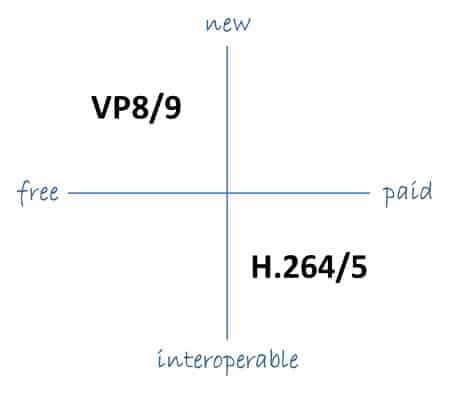
VP9 is a newer codec developed by Google and is designed to be a royalty-free alternative to H.265. It offers better compression than H.264 while maintaining the same video quality. It is also highly efficient at handling high-resolution videos, making it a good choice for 4K and 8K videos. However, its adoption has been slow due to its lack of support in many devices and software. It also requires more processing power to decode than H.264.

One of my personal experiences with VP9 was when I was trying to stream a 4K video on my laptop. I noticed that the video was buffering a lot and the quality was not as good as I expected. After some research, I found out that the video was encoded with VP9, which my laptop did not support. I had to switch to H.264 to get smooth playback.

Conclusion: Choosing the Right Video Codec

Choosing the right video codec is crucial for ensuring smooth video playback and high video quality. H.264 is still a solid choice for most situations, but H.265 and VP9 offer better compression and handling of high-resolution videos. However, they require more processing power and may not be supported by all devices and software. Make sure to choose the codec that best suits your needs and device capabilities.

In conclusion, video codecs are an essential part of our digital lives, and choosing the right one can make all the difference in our video-watching experience. Always keep in mind the pros and cons of each codec and make an informed decision based on your needs.


Free Download Mp4Gain
picture


Mp4Gain Main Window
picture


Mp4Gain Features
picture


Free Download Mp4Gain
picture

Sound digitization – Part 2

Sound digitization – Part 2

Sound digitization

Now to the practical problems. First of all, it must be taken into account that the memory of the computer is not infinite, so each time it is digitized it is necessary to find some kind of compromise between the quality (which depends directly on the parameters used during the digitization) and the volume occupied by the digitized signal.

Digital Sound

Second, according to Kotelnikov’s theorem, the sampling frequency sets the upper limit of the frequencies of the digitized signal, that is, the maximum frequency of the spectral components is equal to half the sampling frequency of the signal. Simply put, to get complete information about sound in the frequency band up to 22050 Hz, sampling with a frequency of at least 44.1 kHz is required.

There are other issues and nuances associated with digitizing sound. Without going into the details, we note that in the “digital sound”, due to the discretion of the information about the amplitude of the original signal, various noises and distortions appear (the phrase “there are such and such frequencies and noises in digital sound” means that when this sound is converted back from digital to analog, the aforementioned frequencies and noises will be present in your sound). So, for example, jitter (jitter) – noise that appears as a result of the fact that the sampling of the signal during sampling does not occur in absolutely equal time intervals, but with some deviations. That is, if, for example, you are sampling at a frequency of 44.1 kHz, the samples are not taken exactly every 1/44100 of a second, but sometimes a little earlier and then a little later. And since the input signal is constantly changing, such an error leads to the “capture” of an inaccurate signal level. As a result, some jitter and distortion may be felt during playback of the digitized signal. The appearance of jitter is the result of a non-absolute stability of the analog to digital converters. To combat this phenomenon, highly stable clock generators are used. Another annoyance is the crushing noise … As we said, by quantifying the amplitude of the signal, it is rounded to the nearest level. This inaccuracy results in a “dirty” sound.

A little reference: the standard parameters for recording audio CDs are as follows: sampling frequency – 44.1 kHz, quantization level – 16 bits. Said parameters correspond to 65536 (2 16) levels of amplitude quantization when their values ​​are taken 44100 times per second.

In practice, the digitization process (sampling and quantization of the signal) remains invisible to the user: all the basic work is carried out by various programs that give the appropriate commands to the driver (operating system control routine) of the sound card. . Any program (be it built-in Windows Recorder or a powerful sound editor) capable of recording an analog signal on a computer somehow digitizes the signal with certain parameters that may be important in further work with the recorded sound, and for this reason It is important to understand how the digitization process is carried out and what factors influence its results.

H.264 OR H.265? Part 2

H.264 OR H.265? Part 2

H.265 / HEVC Codec

Optimized H.264 encoding technologies

Despite the above arguments, the main reason we believe that H.265 will not become the dominant encoding solution anytime soon is the simple lack of demand – several innovative vendors have implemented optimized H.264 encoding technologies. and the need for H .265 remains simply no. This fact can be called “a solution to a problem that has not yet arisen”.

Optimized H.264 technologies use predictive coding to reduce the bit rate spent on an unchanging background image.

Since the launch of H.264 technology in 2003, the security industry has been developing high-performance video encoders in an effort to improve image quality for video surveillance systems. Add to this the growing popularity of high-quality video, increasing demands for bit rate and resolution, and it becomes clear that the cost of the components of the system as a whole has increased. The large amount of video data captured by CCTV cameras means that users must invest in increasing storage requirements.

Predictive coding
How is the H.264 codec improved? First, basic research on video compression is being done in various industries. For example, in any video from cameras, users first pay attention to moving objects and then to the static part of the image. If the background does not change, it can be encoded as a keyframe. Optimized H.264 technologies use predictive coding to reduce the bit rate spent on a static background image. By applying this predictive coding throughout the system, users save significant bandwidth and storage costs.

Noise reduction
Another important element of H.264 optimization is noise reduction.

Noise or unwanted electrical signal displayed in the video stream is serious interference to the digital video signal. This leads to the fact that many strange pixels appear in the background of the image, caused by fluctuations in light, temperature or other signals in the air. But optimized H.264 technologies using mining algorithms suppress most of the noise by encoding the foreground object in the image at a higher bit rate relative to the background image. The result: sharp, color-accurate images.

Long-term bit rate control
Finally, the bitrate requirements for a particular scene can fluctuate throughout the day. For example, in a typical street scene at night, there is little movement in the foreground, so the bitrate requirements are low. During the day, the demands are greatly increased by vehicles and pedestrians moving in the foreground and in the background. Modern H.264 encoding technologies manage this timing by calculating the overall average bit rate and then automatically assigning the required bit rate at the time of day when needed. This happens at the level of the decoder set points. Here, the main benefit of long-term bitrate control is that users have the ability to accurately predict their video storage requirements in order to measure the required storage size.

***

Today, these advantages of H.264 exceed what the H.265 standard offers. Among other things, H.264 has other advantages: compatibility with existing systems, lower cost of production, a wider range of products in which the codec can be applied, and less patent risk.

Video compression designs tend to adhere to a cycle of approximately 10 years. In 1994, the MPEG2 format was introduced. H.264 was released in 2003 and H.265 was released in 2013. In this case, the historical context is important because video encoding standards respond not only to technological change, but also to trends in the video industry. When the MPEG2 format was the standard, the industry focused mainly on DVD players and TV resolutions where this format was used. The emergence of H.264 coincided with the introduction of HD technology, advanced IT technologies, and the mobile Internet.

H.264 uses include HD digital TV, Internet video, mobile video, CCTV, Blu-ray, and more. Since H.265 is just entering the scene, we believe it will be the most widely used in ultra-HD technology. development and cloud storage applications.

H.264 OR H.265? The Future Of Video Compression Technologies

H.264 OR H.265? The Future Of Video Compression Technologies

CODEC H.265

Video compression technology has been a stumbling block in video surveillance design since the advent of the Internet Protocol (IP) in the 1990s.

H.265

Since then, video encoding standards have gone through many stages of research. Today, the industry’s attention is focused on the H.265 or HEVC (High Efficiency Video Coding) compression standard. It is the next version after H.264, which is currently the dominant IP video encoding technology. We will try to find out what your prospects are today and in the future.

The integration of H.265 technology may be hampered by the availability of optimized H.264, better encoding for CCTV systems.

H.265: understand what and why
The H.265 standard is a significant step forward in video encoding. One of its advantages is that it doubles the compression efficiency of H.264. So when streaming images of similar quality, H.265 uses only half the bit rate of the previous codec. This dramatically reduces bandwidth and storage requirements, allowing better use of both hardware and software. Users, in fact, get more features at a lower cost. Because of this, most hardware manufacturers support the implementation of the H.265 compression standard for video surveillance. Very soon we will be able to see H.265 as the next standard.

But despite all the advantages, H.265 is still far from being massively adopted. The question arises: can users somehow optimize image transmission before the revolution in the field of video surveillance occurs? After all, the popularity of high-definition video is growing, and demand creates supply.

Recent advancements for the current H.264 codec optimize bitrate in three ways: predictive encoding, noise suppression, and “long-term” bitrate control. This has resulted in a 75% reduction in memory requirements for H.264. Due to these innovations and some other factors, it is very likely that in the next 5 to 10 years, both standards will peacefully coexist in the market.

Barriers to H.265 adoption
The integration of H.265 technology is likely to be hampered by the availability of optimized H.264 encoding, as well as the cost of upgrading existing systems to H.265. Additional complications will also arise with the change in production processes for the launch of equipment that supports H.265 and with patents, which we will talk about later. In principle, H.264 remains a viable and viable standard for the vast majority of CCTV systems. Today it fully fulfills its functions and certainly quite well.

At the higher cost, users should be sure that the upgrade to H.265 is really worth it.

Limitations of laboratory tests
In testing by the Joint Collaborative Team on Video Coding (JCT-VC), the compression ratio of H.265 has doubled compared to previous H.264. But unsurprisingly, these tests were conducted in a laboratory setting and are far from many of the difficulties that arise in the process of actually using the standard.

Real-time encoding with a balance between algorithm complexity and compressibility is what one wants to see in the development of H.265. In practice, the compressibility of the H.265 codec may not provide a 100% improvement over H.264, even though this has been claimed.

The H.264 standard has been implemented for more than 10 years in the industry in which it has evolved, with the support of all chipset manufacturers and with access to a wide variety of encoders and decoders. This has been tried and tested in practice. In this sense, H.265 technology has a lot to make up for.

Patent price
Another problem that can hinder the massive distribution of the H.265 standard is the need to acquire a patent. Many business owners already have a patent for H.264, whereas H.265 was not very common in the industry in its early days, and the companies that own it are unrelated. Low demand for the new standard results in a much higher patent cost, a key issue that security companies must seriously consider, how this will affect production and, as a result, price to the end user. When introducing a new standard, price really matters, especially if users have to replace both the front and rear of the system to benefit from improved video compression. Paying several times more

H.264 compared to H.265

H.264 compared to H.265

H.265 VS H.264

One of the main decisions in the use and design of video surveillance systems is the choice of codec. The correct choice and setting of the codec allows you to achieve the optimal balance between the quality of the resulting image and the efficiency of video transmission over the network.

H.264 vs H.265

The most common video surveillance codec is H.264. And although it is demanding in the computational part of CCTV, it allows you to compress video of a high enough quality for transmission over a local network or the Internet. But progress does not stop, and in 2012 the first chip capable of encoding a video signal in H.265 format was presented at the Mobile World Congress. This codec, according to the creators, is capable of halving the size of the resulting file compared to a file compressed with the H.264 codec. Such statements could not fail to arouse interest among manufacturers of video surveillance systems. This is understandable – the end result of using a more efficient codec should be direct savings. The widespread use of this codec in the market has not yet been observed, but the first cameras compatible with H.265 have already started to appear in Russia.

Assistive technologies such as Zipstream (created by Axis Communications) and H.264 + (Hikvision) are also capable of reducing network bandwidth and video storage requirements. There are many articles on the net that describe tests, comparisons of the quality of codecs with each other, manufacturers give many arguments in favor of their solutions. We decided to see in practice if all these technologies really work, if they can be effective competitors for the new H.265 codec.

H.265 codec
First, a little theory.

H.265, or HEVC (High Efficiency Video Coding in English), is a video compression format that uses more efficient algorithms compared to H.264 / MPEG-4 AVC. ITU-T Recommendation H.265 and ISO / IEC 23008-2 MPEG-H Part 2 have been jointly developed by the ITU-T Video Coding Expert Group (VCEG) and the MPEG Moving Picture Expert Group . The standard recommendation was developed in response to the increasing demand for higher compression rates for moving images for a wide variety of applications, such as webcasting, data transmission, video conferencing, digital storage, and television broadcasting.

To be honest, we walked in circles around the H.265 codec for a long time, not knowing which side to approach. There were many difficulties. The main one is that the cameras that support it can be counted on one hand. We took BEWARD B2250 and ActiveCam. Also, it turned out to be not so easy to play the recorded video stream compressed with the new codec, as manufacturers use modified codecs and the standard playback tools gave them up. The only player that did not refuse to play the received files is VLC Player. We started recording video under different conditions, changed the bitrate, plunged the scene into darkness, but the size of the video stream remained the same for H.264 and H.265. As well as the quality of the image, which could not be discerned with the naked eye.

Until the lowest quality of the resulting image from the cameras was established, the bit rate was 200 kbps, it was then that the fundamental difference between the two codecs became visible. The new codec works differently from the old one. H.265 is capable of encoding 64×64 pixel blocks, which improves encoding efficiency and reduces decoding time. In practice, a video stream encoded with the H.265 codec, at the same bit rate, provides more details than H.264. With the maximum setting (bit rate 8000 kbps and above), this is impossible to notice, but at the minimum (200 kbps), the difference is obvious.

Where are the savings? And you can save traffic and file space by reducing the bit rate of the H.265 codec and obtaining an image comparable to that of the compressed H.264 codec. Will the file size in H.265 be 50% smaller than that of files compressed with the H.264 codec? That is unlikely.

Most likely, the H.265 codec works well when using video surveillance features such as license plate recognition, as at the maximum setting the image is more detailed. However, it is not possible to test this theory in practice; There are still no similar solutions on the market that work with a video stream using a compressed H.265 codec. And until the new codec began to massively take over the market, vendors are actively introducing new technologies that lower the video bit rate without a significant difference in image quality. They all work well with the standard H.264 codec.

COMPRESSION AND VIDEO FORMATS

COMPRESSION AND VIDEO FORMATS

In the world of digital video production and distribution, few topics are as complicated and confusing as the choice of format to use.

There are many reasons.

First of all, it must be said that not all video formats are compatible with all digital platforms.

This can lead to major problems with the input, output, upload and download of the required files.

Therefore, one cannot generally speak of the “best video format”.

video formats

A lot depends on what you need and which platform you should use.

Second, video formats can cause big problems because there are so many of them.

And to make things even more complicated, a large number of these formats are now largely out of date.

In this article I will reveal everything I know about this topic.

I have to be honest: for me, like most filmmakers, this has always been a difficult topic.

I still remember the hours I spent with my editor trying to figure out which video format could best be sent to the manufacturer.

video formats

I will never forget the call in the middle of the night from one of the most famous Mediaset producers who yelled at me: “Hello Francesco, you cannot see the file you just sent me.”

I hung up and after banging my head against the wall, I called the editor to tell him what had happened.

Finally, you need to realize that a video format is more than its file extension.

The term “video format” per se confuses people because it contains two different components: the codec and the container.

With that premise, we can get to the heart of this article, which, believe me, was really hard to write.

1) Let’s start with the vocabulary

First, here is a list of the most commonly used words:

A) FRAME / RATE SPF

The number of frames per second.

I recently wrote an article on this topic, which you can find here.

B) VIDEO SIZE

This data is used to measure the width and height of the video.

The most common measurements are (in pixels):

426 x 240 (240p)
640 x 360 (360p)
854 x 480 (480p)
1280 x 720 (720p)
1920 x 1080 (1080p)
2560 x 1440 (1440p)
3840 x 2160 (2160p)

C) PROPORTIONS

The aspect ratio of an image describes the proportional relationship between width and height.

D) CODEC

Codecs are programs that digitally encode and decode data, making it easy to store and reproduce.

When it comes to codecs, it basically means that our video file has been compressed.

After compression, this file must be stored in a container, which we will discuss later.

There are different types of codecs, e.g. B. the recording codec.

This is the software that your camcorder uses to compress your movie files.

Then there is the export codec, which is instead the format we assigned to our output video.

Finally we have the codec for the master in which we will save our final project.

The most common codecs are:

MJPEG
MPEG-4
H264
H265
WMV
PRO RES
DNxHD

Let’s see them together:

MPEG-4

The ‘MPEG-4 is one of the most popular codecs in the world.

It was introduced in late 1998 and is mainly used for applications such as video telephony or digital television, for streaming films over the Internet and for storing CD-ROMs.

The advantage of MPEG-4 is, in fact, the ability to compress a two-hour video on a CD for a high quality result.

Thanks to this, MPEG-4 has become very popular with users around the world.

Today, MPEG-4 is compatible with a wide range of devices, from satellite television to cell phones.

H264

The H264 is part of the latest generation of codecs and offers high quality videos with relatively low bit rates.

The standard offers up to double MPEG-4 compression.

In addition to improving the quality of perception, the H.264 standard can deliver high quality DVD-Videos with less than 1 Mbit / s.

Personally, I use H264 for the videos that I upload to YouTube.

H265

L ‘H265, also known as High Efficiency Video Coding or HEVC, is the latest in a long line of video codecs.

Like its predecessor, the H264, the H265 was developed by the ITU-T Video Coding Expert Group for the broadcasting industry.

Compression is great for H264, but is used for resolutions of SD, HD and 4K films.