H.265 codec, let’s find out the advantages


Free Download Mp4Gain
picture

The H.265 video codec represents the latest type of video compression present today in video surveillance products whose development has been driven by the increasing demand for high definition resolutions, the rapid development of imaging technology and, in particular , by UHD standards that include resolutions such as 4K UHD and 8K UHD.

H265 Practical applications

In modern video surveillance applications, such as commercial companies, public places and large-scale industrial areas, the main goal is to find the perfect link between decoding and data storage. Apparently, the introduction and development of the H.265 standard offers vast possibilities for improvement in the video surveillance industry while also tackling issues such as lack of network bandwidth or the quality of data transmission.

Compared with old coding standards like MPEG and H.264, H.265 can double the data compression ratio, improving the quality of videos with a low bit rate. Also, it supports 4K UHD resolution.

Ultimately, we can say that H.265 is capable of reducing the data rate required to encode high definition video by almost 50%. The same goes for the bitrate, which can be reduced by about 40% compared to FullHD. This enables the IP camera to deliver smooth video with low bandwidth, which in turn leads to a reduction in storage space.

Finally, the H.265 codec offers several benefits for devices using a 4G mobile connection.

The H.265 codec is mainly characterized by the following aspects:

Higher compression efficiency than H.264. With the same resolution, H.265 has a lower bit rate than H.264.
Supports high definition video formats.
It supports 20 to 60 frames per second for video decoding and has the same flexibility as H.264 with a maximum support of 172 fps.

Although H.265 encoding is of recent development, it is already present in many video surveillance products such as IP cameras and NVRs with maximum resolutions supported up to 4K.


Free Download Mp4Gain
picture


Mp4Gain Main Window
picture


Mp4Gain Features
picture


Free Download Mp4Gain
picture

What is the future of the video compression standard? Differences between H.264 and H.265

Recordings available on the Internet and real-time broadcasts have become two of the main sources of communication today. H.264 is one of the video compression formats that enables this visual and digital revolution. Just analyze the amount of time you spend in front of broadcast channels or portals. In 2017, the average number of hours observed daily worldwide is one billion. In 2016, 500 million hours were counted. In just one year, the results doubled.

H.265 vs H.264

If the H.264 video compression format is capable of supporting and offering quality to so many people every day of the year, the same is true for surveillance and monitoring technologies. Video compression is as important for YouTube as it is for an IP CCTV system. Basically, video compression is done using technologies that allow captured data to be intelligently transmitted. To do this, they reduce the amount of information that is similar and that would be just an additional burden on the files.

H265 vs H264

The Importance of Standards in Video Compression

Video compression uses techniques that will make files less burdensome, without interfering with the quality and, above all, the accuracy of the information. Precisely because it prioritizes the maintenance of visual characteristics, it is so essential to know what technologies are used. Choosing one format or another can directly affect the sharpness and loading of images. Since you don’t need to keep all the data, the suggestion is to use an industry standard. Until then, H.264, also called advanced video encoding (AVC), is the predominant one.

H.264 is considered one of the most adaptable and high-level formats. However, there is already what would be its evolution, H.265 or High Efficiency Video Coding (HEVC). Both are standardized and approved by the responsible institutions. That is, they are two official standards. Before talking about the benefits that H.265 adds to video compression, it’s important to note that both are standards that will make partners and vendors maintain identical prerequisites. What guarantees compatibility and more options for the clients.

H.264: what are the advantages of video compression?

Video compression is based on a technology that analyzes images captured within frames. It is like looking at a photo and identifying what data is relevant and what is not. For example, if there are an equal number of frames that are not noticeable, they are discarded. For that to happen, there is a forecast that uses a “comparison basis”. The deleted image is opposed to what serves as a parameter and, with that, one perceives what is altered. Only changes in relation to the base frame remain. Those with the same values ​​are not considered in the encoding, which reduces the size and number of pixels.

When using macroblock comparison, where each frame is decomposed and compared until it finds compatibility or modifications. Therefore, the similar ones are eliminated, or rather, the frame of reference is maintained. In H.264, macroblocks are used, with the division of images and, consequently, their segmentation into more blocks. Replays are considered redundancies and pixels do not count within video compression. What has changed with H.265?

H.265: what is the main change?

H.265 has a potential for video compression that significantly outperforms H.264, using less bandwidth and maintaining quality delivery. For this reason, you can stream higher-level content with the same amount of bandwidth that the other uses to do the same with more compact data.

There has been an evolution in compression, streaming and support capabilities, although H.265 uses the same video compression technique explained above. Macroblocks that make comparisons between divided frames of the same frame with a standard reference. So why is such a relevant technological advance?

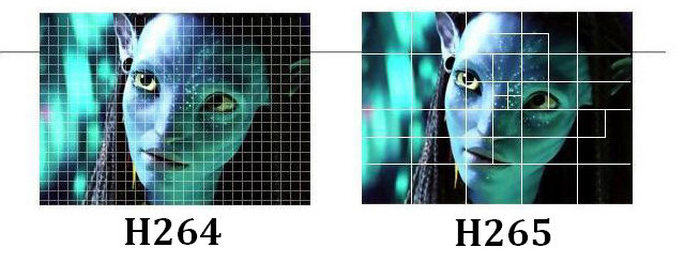
The key issue for H.265 is the strategic use of macroblocks. There is also compatibility between similar pixels between frames, but with greater flexibility. There is no fixed area, it all depends on the type of image and your need. Greater attention to detail is paid only when necessary, making video compression even higher and more effective by reducing pixels and bytes.

In H.264, macroblocks do not exceed a 16-pixel standard, which are not best suited for certain situations and images. In H.265, there is an increase in the size of the blocks up to 64 pixels.

COMPRESSION AND VIDEO FORMATS

COMPRESSION AND VIDEO FORMATS

In the world of digital video production and distribution, few topics are as complicated and confusing as the choice of format to use.

There are many reasons.

First of all, it must be said that not all video formats are compatible with all digital platforms.

This can lead to major problems with the input, output, upload and download of the required files.

Therefore, one cannot generally speak of the “best video format”.

video formats

A lot depends on what you need and which platform you should use.

Second, video formats can cause big problems because there are so many of them.

And to make things even more complicated, a large number of these formats are now largely out of date.

In this article I will reveal everything I know about this topic.

I have to be honest: for me, like most filmmakers, this has always been a difficult topic.

I still remember the hours I spent with my editor trying to figure out which video format could best be sent to the manufacturer.

video formats

I will never forget the call in the middle of the night from one of the most famous Mediaset producers who yelled at me: “Hello Francesco, you cannot see the file you just sent me.”

I hung up and after banging my head against the wall, I called the editor to tell him what had happened.

Finally, you need to realize that a video format is more than its file extension.

The term “video format” per se confuses people because it contains two different components: the codec and the container.

With that premise, we can get to the heart of this article, which, believe me, was really hard to write.

1) Let’s start with the vocabulary

First, here is a list of the most commonly used words:

A) FRAME / RATE SPF

The number of frames per second.

I recently wrote an article on this topic, which you can find here.

B) VIDEO SIZE

This data is used to measure the width and height of the video.

The most common measurements are (in pixels):

426 x 240 (240p)
640 x 360 (360p)
854 x 480 (480p)
1280 x 720 (720p)
1920 x 1080 (1080p)
2560 x 1440 (1440p)
3840 x 2160 (2160p)

C) PROPORTIONS

The aspect ratio of an image describes the proportional relationship between width and height.

D) CODEC

Codecs are programs that digitally encode and decode data, making it easy to store and reproduce.

When it comes to codecs, it basically means that our video file has been compressed.

After compression, this file must be stored in a container, which we will discuss later.

There are different types of codecs, e.g. B. the recording codec.

This is the software that your camcorder uses to compress your movie files.

Then there is the export codec, which is instead the format we assigned to our output video.

Finally we have the codec for the master in which we will save our final project.

The most common codecs are:

MJPEG
MPEG-4
H264
H265
WMV
PRO RES
DNxHD

Let’s see them together:

MPEG-4

The ‘MPEG-4 is one of the most popular codecs in the world.

It was introduced in late 1998 and is mainly used for applications such as video telephony or digital television, for streaming films over the Internet and for storing CD-ROMs.

The advantage of MPEG-4 is, in fact, the ability to compress a two-hour video on a CD for a high quality result.

Thanks to this, MPEG-4 has become very popular with users around the world.

Today, MPEG-4 is compatible with a wide range of devices, from satellite television to cell phones.

H264

The H264 is part of the latest generation of codecs and offers high quality videos with relatively low bit rates.

The standard offers up to double MPEG-4 compression.

In addition to improving the quality of perception, the H.264 standard can deliver high quality DVD-Videos with less than 1 Mbit / s.

Personally, I use H264 for the videos that I upload to YouTube.

H265

L ‘H265, also known as High Efficiency Video Coding or HEVC, is the latest in a long line of video codecs.

Like its predecessor, the H264, the H265 was developed by the ITU-T Video Coding Expert Group for the broadcasting industry.

Compression is great for H264, but is used for resolutions of SD, HD and 4K films.