Video Codecs: H.264, H.265, and VP9


Free Download Mp4Gain
picture

The Importance of Choosing the Right Video Codec
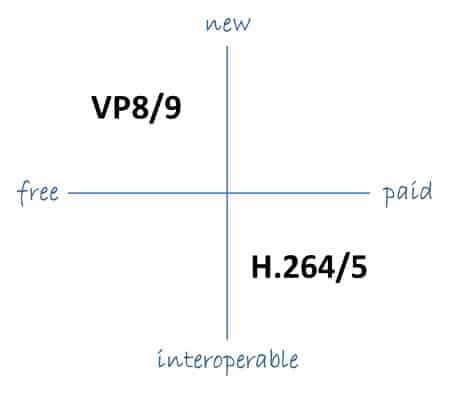

 

H.264, H.265, and VP9

Video Codecs: H.264, H.265, and VP9

As the world becomes increasingly digitized, the importance of video codecs in our lives cannot be overstated. Video codecs are essential in video compression, encoding, streaming, and playback. Choosing the right codec can make the difference between smooth playback and frustrating buffering, between crisp and clear images and pixelated messes. In this article, we will explore the differences between three of the most popular video codecs in use today: H.264, H.265, and VP9.

H.264 vs H.265: What’s the Difference?

H.264, also known as AVC (Advanced Video Coding), has been the dominant codec in use for the past decade. It is widely supported by devices and software and offers good compression while maintaining high video quality. However, H.265 (HEVC) is slowly taking over. It is a newer and more advanced codec that offers better compression ratios, which means smaller file sizes with the same quality as H.264. H.265 is also better at handling high-resolution videos, making it a good choice for 4K and 8K videos. However, it requires more processing power to decode, which may be an issue on older devices.

Personally, I have found that H.265 delivers noticeably better quality than H.264 for the same file size. It is especially noticeable in high-motion scenes like action movies or sports. However, it does require more processing power, so make sure your device can handle it before choosing it as your preferred codec.

VP9: The New Kid on the Block

VP9 is a newer codec developed by Google and is designed to be a royalty-free alternative to H.265. It offers better compression than H.264 while maintaining the same video quality. It is also highly efficient at handling high-resolution videos, making it a good choice for 4K and 8K videos. However, its adoption has been slow due to its lack of support in many devices and software. It also requires more processing power to decode than H.264.

One of my personal experiences with VP9 was when I was trying to stream a 4K video on my laptop. I noticed that the video was buffering a lot and the quality was not as good as I expected. After some research, I found out that the video was encoded with VP9, which my laptop did not support. I had to switch to H.264 to get smooth playback.

Conclusion: Choosing the Right Video Codec

Choosing the right video codec is crucial for ensuring smooth video playback and high video quality. H.264 is still a solid choice for most situations, but H.265 and VP9 offer better compression and handling of high-resolution videos. However, they require more processing power and may not be supported by all devices and software. Make sure to choose the codec that best suits your needs and device capabilities.

In conclusion, video codecs are an essential part of our digital lives, and choosing the right one can make all the difference in our video-watching experience. Always keep in mind the pros and cons of each codec and make an informed decision based on your needs.


Free Download Mp4Gain
picture


Mp4Gain Main Window
picture


Mp4Gain Features
picture


Free Download Mp4Gain
picture

H.265 vs H.264 video format comparison. What is HEVC and AVC?

H.265 vs H.264 video format comparison. What is HEVC and AVC?

H.264 vs H.264

H.265 (HEVC), unlike H.264 (AVC), is becoming the most widely used format for compressing video and recording 4K / 8K UHD content, not to mention HD / SD video. Upgrading 4K and 8K video challenges the current H.264 compression standard, as it can no longer encode Ultra HD video at a satisfactory bit rate than HD content.

h.264 vs h.265

As a result, the next-generation HEVC video compression standard gains an advantage over AVC due to better compression efficiency. This allows for a 50% reduction in bit rate, but provides the same video quality.

This post shows the differences between the two standards based on file size, bandwidth usage, bitrate, quality, and compatibility.

What is H.265 (HEVC)?
H.265 is also known as High Efficiency Video Coding (HEVC). This format is twice as efficient as H.264 when encoding. It halves the transmission speed at the same quality level as its predecessor. Designed for next-generation HDTV displays and content capture systems that have progressive frame rates and resolutions, as well as improved image quality in terms of noise levels, color spaces, and dynamic range.

What is H.264 (AVC)?
H.264 or MPEG-4 AVC is a video encoding format that is currently one of the most widely used to compress and deliver video content. AVC saves the bit rate by 50% or more compared to its predecessor MPEG-2. It has a wider range of applications covering all compressed videos, from low bit rate streaming applications (YouTube, iTunes, Vimeo, Facebook, Instagram) to various HDTV broadcasts via terrestrial, cable and satellite TV. It is also widely used for Blu-ray discs, DVDs, IP networks, and digital cinema applications with virtually lossless encoding.

Comparison of video compression formats
Compression efficiency
H.265 differs from H.264 in compression efficiency. HEVC doubles the encoding efficiency of its predecessor. This means that the H.265 codec saves about 50% bit rate for the same encoding quality. Specifically, the average bit reduction for H.265 is 64% at 4K UHD, 62% at 1080p, 56% at 720p, and 52% at 480p. So if you download a movie in H.265 and play it on an Android iPhone, 50% of the mobile device memory will be saved. And the quality of the film will not suffer!

H.265 vs H.264 format comparison – compression efficiency

Broadband
H.265 also beats H.264 in terms of bandwidth usage. Because the HEVC algorithm uses efficient encoding, it promises a reduction of around 40-50% in the transmission bandwidth required to compress video (eg 720p) with the same quality. Typically, 4K H264 (AVC) streaming requires 32 Mbps of bandwidth, while 4K HEVC video is only 15 Mbps. Thus, it is possible to enjoy 4k videos smoothly even with a congested network connection.

To sum it up, let’s say avi is a heavyweight file with high quality image and audio, best suited for DVDs and home PCs.

Mp4 is a lightweight file that doesn’t require a lot of processing power to play, suitable for watching videos in a browser and on smartphones.