Lossless music: where do you find content?


Free Download Mp4Gain
picture

With MP3 a few more years away, there’s no doubt that it will increasingly be abandoned in favor of lossless or, in the Molière language, lossless formats. At a time when even the iPhone is becoming FLAC compatible, let’s see how it is maintained by default and where to find content.

flac format

MP3 is a big step back in terms of audio quality. The success is mainly due to its practicality, as it took up little space on our thin hard drives and portable players (something that sometimes looked like a smartphone but was only used for music!). easily traded on a very slow website.

The format has evolved over the years, increasing the bit rate previously limited to 128 kbps to 320 kbps. Compression still overwrites the details of the sound and increasing the bit rate increases the file size, but the rendering is “almost satisfactory”.

Therefore, MP3 and other compression formats (AAC, Ogg Vorbis, etc.) are not the absolute evil, but lag behind CD quality.

Compared to them, FLAC and ALAC, among others, offer compressed lossless playback. Music files are 3-5 times larger than MP3, but offer minimal CD quality (16 bit, 44.1 kHz). Better yet, they are capable of playing high-resolution music (see our high-resolution article), the encoding of which is traditionally 24-bit / 96 kHz or even 192 kHz. At a time when Internet speed and storage are less of a concern, losses are bound to gain the upper hand and make the good news easier to find.

Walkman compatible with high-resolution files includes a DAC. They are a great way to have an audiophile player at home and on the go.

Lossless purchase and streaming

The non-exhaustive list below will lead you to certain platforms where you can drink without loss. Do not hesitate to tell us your good plans, we will integrate them into the article!

Quobuz: One of the ardent pioneers and advocates of high-resolution lossless formats is the French site Quobuz. Offers the purchase of FLAC files on CD or in high resolution. Subscribing to your entire catalog on FLAC 16bits / 44.1 kHz equates to $ 19.99 per month.

7digital: from CD-quality FLAC with 24-bit high resolution via MP3 at 320 kbps; 7digital offers the format option in its impressive catalog. No subscription, just buy, but on top.

Tidal: This streaming site is the answer of the artists on Spotify and Deezer. More concerned about the rendering because titles are encoded lossless, it pays the authors more. FLAC’s CD quality subscription formula is € 19.99, but the site is also starting to offer 24-bit transmission on 44.1 or 48 kHz thanks to an encoding format called MQA (Master Quality Authenticated) that can be encapsulated in a FLAC file .

Spotify and Deezer: The two music streaming giants are gradually switching to lossless music. A CD-quality Spotify Hi-Fi offer (16-bit / 44.1 kHz) instead of the 320 kbps Vorbis codec is being tested with some privileged subscribers. There is no official announcement or award yet, but it is only a matter of time. Deezer, for its part, offers a Hi-Fi formula with CD quality as part of a partnership with Sonos.

Homemade: FLAC is so emerging that we almost forget the obvious. And if we want to get files as CD, we start … buying the CD! Sometimes they are cheaper than their dematerialized equivalent. Then you can convert with software like CDex, Foobar 2000, Exact Audio Copy, etc.

Many other more specialized sites sell high resolution music: Super HiRez, HDtracks, ProStudioMasters. Some are not even concerned with compression, they offer record masters digital masters. A way to get closer to the artist’s intentions!

The equipment to enjoy lossless music.

The public is increasingly moving towards audiophile products.
Anywhere, iOS 11 or Android smartphones can decode a FLAC file. Some present their sound quality as the Honor 9, the Meizu Pro 6 Plus, the HTC U11, but in order to restore the sound scale and naturalness, it is recommended to use an analog converter.

The DAC, both portable and integrated into your stereo system, reproduces the sound spectrum better. More faithful, better defined, refines the spaciousness and richness of the details of each instrument.

These DACs, as they are called, come in a variety of sizes. Some are mobile phones, such as Audioquest’s DragonFly, which can be connected to a mobile (using an adapter) or a computer.


Free Download Mp4Gain
picture


Mp4Gain Main Window
picture


Mp4Gain Features
picture


Free Download Mp4Gain
picture

Does MP3 affect the sound quality?

The compression of songs affects the quality, but the losses are not necessarily audible.

mp3 audio quality

Is compression of MP3 songs harmful to the sound quality? Whether it is HD music or “normal” definition, the question of compression remains. The advantage is that the weight of the songs is reduced, so they take up less space in the memory of a phone or a portable music player. With standard MP3 compression, a music album ranges from 500 MB to 45 MB.

But by the way, the music is damaged. The sound seems a little less natural, less precise, less dynamic. Some of the audio information is literally destroyed. It doesn’t always sound good, but for some songs the difference is clear until everyone will notice.

mp3 quality

Fortunately, you can improve the quality of an MP3 song by compressing it with less force. The loss of sound quality becomes less clear, but in return the song weighs more. MP3 isn’t the only compressed music format that corrupts music. The most famous competitors are AAC, Ogg Vorbis and WMA. MP3 is not the most efficient compression format, this title applies to the Ogg Vorbis, but it is still a good option. All music players can play MP3 and online record stores prefer this format.

Lossless compression

However, some music lovers are reluctant to MP3. They swear by “nondestructive” compression, which does not remove sound information. The music has been completely preserved: we hear absolutely no difference. The best known non-destructive formats are Flac, APE and Alac. Unfortunately, not all electronic devices can play music recorded in these formats. Few artists offer their music in “non-destructive” compression. And the weight of the parts thus compressed is still very heavy. An album quickly reaches several hundred megabytes. However, the Flac stands out as the reference format for the most demanding music lovers.

Is it reasonable to keep using MP3? This remains a smart choice for most music lovers, as long as they choose an appropriate compression ratio. Which one to choose: 192 kbit / s, 256 kbit / s or 320 kbit / s? The stronger the compression, the lighter the number, but the lower the quality. With 128 kbit / s, the sound has clearly deteriorated, most of us can hear it. At 192 kbit / s, degradation becomes difficult for most of us to observe except for some rare numbers.

With 256 kbit / s, you have to have a musical ear and good sound equipment to make the difference. With 320 kbit / s, you need a well-trained ear and highly accurate audio equipment to make a difference. We only see a difference in quality in certain titles and only in certain passages. Therefore, most of us can settle for 192 kbit / s recording. Music lovers should expect a minimum of 256 kbit / s. And professionals will choose formats of 320 kbit / s or ‘lossless’.

MP3: quality standard?

For many, dematerialized music rhymes with illegally downloaded MP3.

If this comment is often true, since illegal music sharing platforms have made mp3 the primary format for music playback, you obviously need not limit yourself to the single mp3 format.

Mp3

MP3: birth of a format

The MP3 was democratized on the music exchange platforms of the time like Napster, Kazaa, Emule … in the late 90’s and for good reason they allowed you to download an entire album in a few minutes by compressing the music and thus shrinking the files.

Therefore, it is the need to exchange files and shorten the download time (remember we were paying the internet at that time according to your connection time …) making the development of mp3 essential and for many synonymous with dematerialized music.

The MP3 principle is therefore simple and attractive on paper: enable file sharing by drastically reducing the weight of files (more than 90%), and only by keeping what the human ear can do. listen, that is, the frequencies between 20 Hz and 20 kHz.

MP3: bad reputation

Unfortunately, the main consequence of this thin race is that the quality deteriorates: every mp3 has a compression level. The higher it is, the more the musical signal is cut off: this is called destructive compression: we eliminate all information that is considered useless and impossible to return.

Mp3

Therefore, during this period there was the spread of the famous 128 kbps MP3: this figure indicates the amount of information in the file and therefore its quality, the higher and better the sound will be. Therefore, some sort of standard has gradually been established around this bit rate of 128 kbps (kilobits per second), since it is inseparable as the quality of the CD at 1411 kbps.

mp3 – Napster

The Napster interface, one of the first illegal music sharing programs. Note the music ratio at 128 kbps (see less …)

It is clear that we do not reduce the amount of musical information by 90% with impunity and the results are often poor, the quality of the mp3 with 128 kbps is much lower and perfectly noticeable from the original CD. Then the new bit rates of 160 kbps, 192 kbps, 256 kbps and 320 kbps came to maximum, then “VBR” formats for “Variable Bit Rate” and against CBR (constant bit rate)) used earlier: we decreased the bit rate at rest and increased if necessary.

Therefore, we can see that it is difficult to pronounce the MP3 format in general: the results will be very different between a 128 kbps CBR mp3 and a 320 kbps VBR and, to a large extent, for the latter, for the price of one double weight.

Alternatives to MP3

MP3 is not the only dematerialized music format, it is first necessary to divide the compression formats into two categories:

Destructive Compression Formats: We remove content to reduce its size

MP3: the readable standard for 100% of music devices released in 20 years

AAC: Used by Apple in the iTunes music store (Apple Audio Codec), almost as universal as MP3

Ogg Vorbis: a free, efficient yet non-standard format

WMA: Microsoft format, not very standard either, except on Windows PC (can Microsoft have anything to do with it?)

Non-destructive compression formats: we compress the data for storage and decompress it when reading, therefore the sound reproduction is lossless, but it generates files 3 times larger:

FLAC: Free Lossless Audio Codec, it is somewhat the equivalent of Ogg in that it is royalty free and has established itself as the current standard for non-destructive formats (lossless in English)

ALAC: The Apple version of FLAC, which has also been in free form for some time, has the advantage of being compatible with the brand’s products and computers and offers the same benefits as FLAC.

The promise of H.264

High quality video at a low bit rate: the promise of H.264

With the growing number of video surveillance equipment manufacturers using H.264 compression technology in their digital cameras, encoders and recorders, end users hope that the technology can reduce the effects of multiple video transmissions on the network while improving vast recording capacity

H.264

Also known as MPEG-4 Part 10, the H.264 format is a codec standard for digital video, completed in 2003, which promises to compress video data at a very low bit rate while preserving video. High Quality. Today, many CCTV systems are forced to sacrifice bandwidth and expensive network storage space. However, if H.264 keeps its promise, the resources used today can stream and store more video streams with higher frame rates and better resolution.

h264

Anixter’s Infrastructure Solutions Lab recently ran several tests to compare the differences in bandwidth usage between H.264 and MJPEG video streams to a camera that supports both compression technologies.

Result:

In tests with little or no motion, the video stream used only 10% of the bandwidth of an equivalent MJPEG video stream. During high-motion tests, the difference in network bandwidth consumption was smaller but still significant.

Results

The laboratory discovered significant differences in the use of network resources between the two compression methods. When the camera saw little or no movement, the H.264 compressed video transmission used about 10% of the network bandwidth required for an equivalent MJPEG compressed video transmission. In tests with a high degree of movement, the H.264 transmission used more bandwidth, so the difference in network resource consumption was smaller but still significant. There is the biggest potential difference in terms of network usage at high frame rates. The differences are not so great for low frame rates.

Video quality observations

Videos taken with each of the two compression methods were examined using the same cameras, lenses and displays. The qualitative evaluation of the laboratory engineers revealed a slight difference in quality between them. The laboratory estimates that the H.264 video has a quality equivalent to about 95% of that produced with MJPEG compression technology.

It has also been observed that the strobe effect of certain shaded or raster patterns could significantly increase the bit rate of the compressed H.264 video stream compared to scenes without such patterns. When these patterns took up much of the camera’s field of view, they appeared to represent a large motion area for the camera’s encoding engine, resulting in an increase in the amount of data required for image transfer. However, these extraordinary peaks did not reach the level of the resources required to transmit and store an equivalent sequence in MJPEG.

Conclusions

Video streams encoded with the H.264 compression method have significantly reduced network storage requirements compared to streams compressed in MJPEG. Even if these tests do not measure the storage space required to record these images, there is a direct link between the use of network bandwidth for compressed data transfer and the storage space required for capturing this data. For IT and security administrators, the lab recommends using H.264 compression technology to reduce the bandwidth load of network video transmissions while increasing storage space for the same amount of Live Video.

Most people cannot distinguish between a mid-quality mp3 and the original wav

Girl listening music


A month ago, NPR (US Public Radio) posted a quiz online that invited you to guess which better quality song clip was recorded. Then the listener had to choose between three passages of the same song, each encoded in MP3 128 kbit / s, MP3 320 kbit / s and WAV (Spotify offers free, paid and Tidal or Qobuz respectively). A month later, the site publishes the results obtained by those who participated and in fact it seems difficult to determine the quality of a song’s file. Overall, about a third chose MP3 128, another third chose MP3 320, and the last third chose the uncompressed (best quality) WAV file. Only 1.6% of the participants were able to find the WAV file in all six songs. The majority (29.7%) found only two of the six correct answers. This can be explained by the team of the participants.


A good half used headphones, while 20% used their device’s speakers, often of very poor quality. Ultimately, only 10% of users tested with equipment containing a DAC (a digital / analog converter). It is clearly the best way to notice the loss of certain frequencies and the distortion effect of MP3 compression.

Listening music

ORIGINAL ARTICLE 4 JUNE 2015:


Are your ears sharp enough to recognize the quality of an audio file? Certainly not if we believe in this NPR questionnaire, American public radio. The principle is simple: on a website she offers you the opportunity to listen to three identical fragments from six songs. One extract is compressed in MP3 at 128 kbit / s, another in MP3 at 320 kbit / s and the latter is encoded in WAV format, so without any loss of sound. It is up to you to find where the WAV file is hidden for each example in this questionnaire, most faithfully to the original sound of the recording. When writing metro news and with several people around us trying, the best result was three out of six correct answers. The test was conducted with standard computer speakers, high-end headphones (more than 300 euros) and high-fidelity hi-fi installations (tube amplifier linked to a digital / analog converter and Cabasse speakers).

The result: the average human ear sees no difference. A common marketing argument in recent months. What undermine the arguments of many manufacturers and music streaming services (Sony, Qobuz, Tidal …), which largely depend on the quality of their equipment or files offered to their subscribers. The Japanese manufacturer is therefore the champion of this trend, thanks in particular to the label “High Resolution Audio”.

This NPR test actually emphasizes the limits of this strategy based on audio quality. With most equipment sold at affordable prices (headphones, Bluetooth speakers, etc.), you cannot hear the difference between files. With high-end equipment, the difference only pops into your ears if you listen at a very high volume. This is often where the boundary of the MP3 format appears, with distortion that worsens the sound. You just saved 5,000 euros, don’t thank us.

A better volume level (like the one the Mp4Gain achieves, really makes people listen to the audio as better quality).

What exactly is an MP3 music file?

Mp3 is a method of compressing digitally stored music. Uncompressed storage of a stereo digital music file takes up a lot of disk space. An average of 10 MB of disk space per minute of recorded music.

However, if you compress a music file and save it as MP3, only a tenth of the original file size remains.

mp3 quality

Since the introduction of the CD, music has been digitally recorded in the form of samples or measurements. Sound is no more or less than vibrating air. These vibrations are also known as sound waves. Sound waves can be measured, recorded and stored.

However, when creative sound waves are produced, there is music.

The number of vibrations per second determines the pitch of the sound. A large amount of vibration produces a high tone, a small amount of vibration produces a low tone.

The number of vibrations per second is expressed in Hertz. Human hearing can perceive sounds between 20 Hz and 20,000 Hz.

Once it has been scientifically established that to capture the highest tone, a measurement must be taken 44,100 times per second. Therefore, the number 44,100 is the sampling frequency expressed in hertz needed for a good quality recording.

In addition to the high and low tones, a piece of music also contains hard and smooth passages. The difference between the highest and smoothest passage is called the dynamic range. For dynamic range on a digitally recordable track, you can choose 256 steps (8 bits) between the softest and loudest part, or 65536 (16 bits).

The dynamic range is highest when recording with 16-bit samples or 65536 steps.

If we then add a calculation to this data, we see that it takes 44,100 measurements for a second of music. Each measurement (sample) is 16 bits (2 bytes) in size. That means that 1 second of music takes up 88,200 bytes or 88 KB of disk space.

But since we like to listen to music in stereo, we can multiply that number by 2. For example, a second of music in stereo already takes up 176 Kb of disk space and, as said, 10 MB per minute.

When a compressed MP3 file is made from an original music file, it is done with a lossy compression method.

Data is lost on lossy compression. With an MP3 file, this means that the information is outside the file that is beyond human hearing range.

For example, people are more sensitive to sounds between 2 kHz and 4 kHz. And we can’t hear loud, soft sounds at the same time. Therefore, only loud sound needs to be preserved. In technical terms, this is called psychoacoustic masking.

What determines the quality of an MP3?

The MP3 format was developed by the German research institute Fraunhofer ISS. In addition to taking advantage of the limitations of human hearing just mentioned, the format consists of a series of mathematical formulas. This allows you to reduce the original file by a factor of 3 to 12.

The amount of compression is related to the bit rate. Bit rate is the amount of data processed per unit time. This means, among other things, that the more data there is in a second, the larger the MP3 file will be. But also the sound quality of the mp3 will be better.

For speech, a bit rate of 64 to 96 kbps is sufficient. A bit rate of 128 kbps is used for a good quality music file. Excellent quality can be achieved with a bit rate of 192 kbps or higher, with a maximum bit rate of 320 kbps.

A bit rate of 192 kbps or higher is useful only if the recording quality of the track is also excellent.

Check the quality of an MP3

Unfortunately, the quality of MP3 music is not always good. This applies, for example, when an MP3 comes from a somewhat unknown source. But of course you can also make an MP3 from a recording that is not very good in itself.

Generally, if you create MP3s from music on your own CDs or other sound media, you can guarantee the quality of the MP3s simply by choosing the appropriate settings in the software you are using.

However, if you get MP3 music in other ways like downloading from the internet for free, it will be a slightly different story.

Then you have to settle for what you get. With the knowledge of this article, it is already much easier to distinguish a low quality MP3 from a good quality MP3.

Something that can be useful. Because there is not much good to do of poor quality.

In summary, we can say that a good MP3 meets the following requirements:

-The MP3 file must have a bit rate of 128 kbps.
A higher bit rate is only desirable for excellent recordings.
-The recording quality must be good.
-The recording quality can be checked by listening to each MP3 before buying and / or downloading it. Preferably with headphones. This gives you the best impression of sound quality.

The MP3s that you buy online, for example at the Apple Store, are usually of good quality. Usually, it is the MP3 files you download from other sources that you should carefully check and listen before using them.

Music you download from sources other than online stores will definitely end up in the Downloads folder.

You can check the MP3 music downloaded from the Internet as follows:

Launch File Explorer and navigate to the Downloads folder.
To display only MP3 files in File Explorer, type: * .mp3 in the search box. This search will show you all the files in the Downloads folder with the extension .mp3.
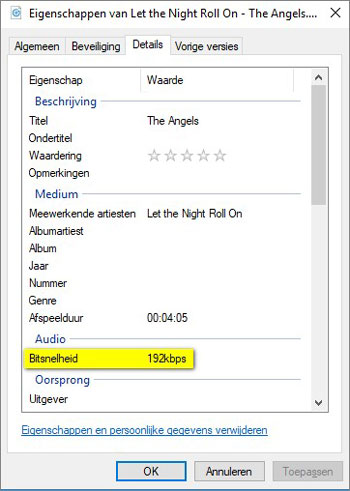
Right-click on the MP3 file you want to check and click Properties in the context menu that opens.
The [Music file name] property window is then displayed. The Details tab shows the exact bit rate of the MP3.

When you close the Properties window and double-click the selected MP3 file, the corresponding MP3 file will be loaded into your PC’s MP3 player and played.
That’s basically all you can do. A bad MP3 is impossible to improve on. Converting music to an MP3 file not only compresses but also removes data from the music file that you have been able to read.

And the lower the bit rate, the more data is generally lost and impossible to recover.

This means that when you have downloaded a low quality MP3 file, you have no choice but to search for a better quality MP3. The same goes for an MP3 whose recording quality is not very good.

Collecting the best possible MP3 files takes some effort. But this effort will be amply rewarded once you start listening to your favorite music, and the sound quality will certainly contribute to the actual enjoyment of the music.

Convert FLAC to MP3: what about bit rate?

If you’re the proud owner of a high-quality FLAC file music library, don’t worry about the bit rate (sample rate). But for lossy formats like MP3 or AAC, it is the bit rate that determines the sound quality. The previous default value was 128 kbps, today you just need to convert to 320 kbps. Almost any converter that converts from FLAC to MP3 should offer this setting.

flac

Opinions differ about the bit rate: some do not hear the difference between an MP3 with 128 kbps and an MP3 with 320 kbps, others do. But if you start with a FLAC file, you should get the most out of your file and convert more than a few kilobits per second (kbps).

mp3 quality

FLAC or MP3: do you hear the difference?

It’s a topic worth discussing, like in the hi-fi world: is there a difference between FLAC and MP3 files? The answer: yes, certainly!

If you don’t hear a difference, it’s not so much the file format, but the computer the song is playing on. If you listen to the same song in MP3 and FLAC format, you will notice a clear difference. A FLAC file simply contains more information. If you play this in a good installation, you will clearly hear the added value. Take the test yourself!

Hi-fi enthusiasts speak deeper. Music sounds fuller and more realistic. The best test is to switch between FLAC and MP3, because switching back to MP3 exposes gaps in the soundtrack. These frequencies are really beyond the audible range of people, or so they thought, but they still seem to be perceived.

However, the MP3 quality is sufficient for use in an MP3 player or smartphone. Although you can hear even finer nuances of the sound through the headphones, you can test it at home. Ambient volume also plays a role when traveling.

Lossless formats, such as the open source FLAC format, are the new standard. In terms of quality, they are comparable to a conventional CD, but take up much less storage space. This is made possible by a “smarter” compression process: while storing the same amount of digital information as on a CD, you save up to 30 percent more space. Therefore, if you want to digitize your CD collection, today it is important to use a lossless format like FLAC.

FLAC files not working? Make them compatible

However, there is also a small drawback to the FLAC format. Many playback devices, such as MP3 players, cannot play FLAC files, only MP3 files. However, it is not necessary to buy a new MP3 player with FLAC support. The audio converter (Mp4Gain), which converts FLAC files to MP3 files, can be found in this website

Once you download Mp4Gain, you can quickly convert your FLAC files to MP3. Then you can use them on a suitable MP3 player or similar device.

Do you know what is the best audio format? (for musicians and listeners)

Maybe you are a musician who has had the hard work of learning sound theory, writing and arranging your music, practicing, recording, and now you want to show your work to the world. What is the best audio format to distribute your recording? Or maybe you are a music lover looking for the best way to organize your collection. It may be that your collection comes from CDs or vinyl or even digitally downloaded. What is the best audio format to store your collection?

vinyl

Choosing the right file format is important. On the one hand, the selected format affects the fidelity of the sound. However, the selected format also limits which devices can play your files. In this guide, we explain the different audio formats available, what they offer and how they are used in the best possible way. First, let’s understand what digital audio files are.

In short, what is the best audio format for you?
To choose the best audio file format you need, think about the purpose of each file. Here are some common uses with suggestions for the best audio formats for each:

If you are an artist …


Do you record a CD with your work? WAV! Conventional CDs use WAV, so export your music from DAW to Wav (or other lossless and then convert properly) and use these files to burn to CD. If you compress CDs from a factory, export in wav but in the original sampling rate and bit depth settings. Leave these settings to them.
Do you share your music with the public? Lossy! You want a smaller file size and maximum compatibility with them from your listeners. Any device plays an MP3 file and is easy to share online.
Should you distribute your music with Magroove or another aggregator for streaming services and online music stores? Streaming services have their own conversion systems, and each one works in a different format (the vast majority, lossy), so you probably won’t get a lossless song. Get a good mp3 that survives encoding (and is easier to load) and save Lossless versions somewhere, whether burning to CD or distributing to acts overseas!
If you are a listener or a collector …
Are you archiving your music? FLAC with maximum compression! A lossless compressed format such as FLAC or ALAC lets you store your files efficiently without losing sound quality. Records in the original multimedia format settings. CD, for example, 16-bit, 44.1 kHz.
Do you digitize music from a vinyl? Record at least in a lossless format. Read about the recording / conversion settings, especially sample rate and bit depth, and understand what lossless quality you need.

The best formats for listening to audio quality

We recently explained to you the difference between analog and digital audio, and how the latter has become ubiquitous thanks to the advent of modern audio production and reproduction technologies.

But what constitutes the quality of a digital archive? Which format is most suitable? What is it for? How do I choose?

audio quality

To better understand and enable you to choose the most optimized format for your use, find out here what defines the quality of a digital audio file, the various audio file formats, and the current listening options (streaming or download) that is linked to modes of connection (wireless or wired) to your audio system.

What are the parameters for creating a digital audio file?
There are 3 main parameters: sampling (expressed in Hz), bit depth (expressed in bits) and the number of channels.

Sampling (expressed in Hz)

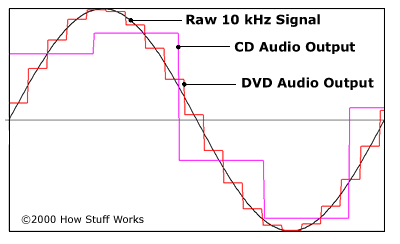
A sound is characterized by an amplitude that varies as a function of time. To represent a sound digitally, the amplitude of the signal is recorded at regular time intervals, in which a digital value is assigned to each recording.

The value of each sample is stored in a file. The greater the number of copies recorded per. Second, the greater the accurate and faithful acoustic signal.

For a better understanding, the sampling rate of a digital file can go up to 192 kHz, corresponding to 192,000 samples taken per second. Second, or one sample taken every 0.0003 second.

For an audio signal it is necessary to have a sampling frequency greater than or equal to 44 100 Hz, this value is considered the current standard.

Digital Audio Basics: Sample Rate and Bit Depth

Bit depth (in bits):

Bit depth marks the accuracy of the sample values. For example, we can code 8, 16, 24 or 32 bits. The higher the bit depth, the greater the number of values ​​per Sample, and the more accurate the sample and sound reproduction will be of quality.

The number of possible values ​​is expressed in exponential 2 (2 n), where n is the number of binary digits encoded to restore the accuracy of the signal.

For your convenience, an 8-bit encoded file has 8 or 256 possible values ​​per. Sample. For a 32-bit file, there will be 2 32 = 4,294,967,296 possible values ​​per. Sample. The most common sample value for a digital file or CD is 16 bits or 65,536 values ​​per. Sample.

Note that this value depends on the initial recording of the music. It is not useful to convert a song recorded by a musician to 24 bits if it was originally recorded in 16 bits, for example.