
Today, the cinema is of impressive quality, both in terms of visual effects and sound design. In addition, the domestic representation of the same evolves thanks to the technical possibilities of Blu-ray, capable of containing from 27 GB of data (for individual layers) to 128 GB (for quadruple layers). In comparison, the DVD only stores 4.7 GB (one layer) to 17.08 GB (double layer and double sided, very rare).
Home cinema audio systems should not be beat as they allow you to play audio tracks with 192 kHz sampling rates and lossless 24-bit resolution (no loss of quality due to conversion) on systems like Dolby True HD oDTS-HD Master Audio. Currently, therefore, it is possible to watch a movie in your living room, almost like in theaters. We are far from the VHS cassette of “simple” stereo time streaming.

How about music?
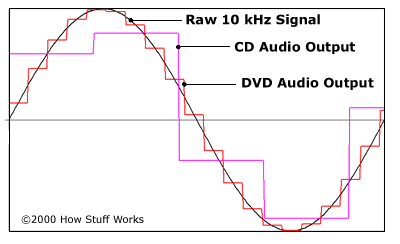
For its part, the music industry has regressed for some time. Brief history … While until the 1980s songs were played primarily on vinyl records (also called microgroove records), it gradually made its way to compact disc (the CD). So we go from analog to digital. Great revolution and great success for this new support! However, despite its crystal-clear quality guaranteed without cracks (due to lightning and dust) and its long duration (74 min. And 33 seconds on a CD versus 20 to 30 minutes on either side of a 33 turn (1 / 3) and 5 minutes and 30 seconds on each side of 45 rpm) the compact disc was not unanimous. Your problem? First, its resolution. 16 Bit for 44.1kHz is little compared to the aforementioned values for Blu-Ray and with the analog properties of studio tape recording. Second, it is sometimes recognized to be relatively cold (even if nothing is proven and blind listening has revealed that it is a subjective impression). However, technically, the CD signal cannot accurately transcribe the original signal as can be seen in the diagram below. Therefore, we are dealing with a first potential loss of audio data.
Then came the mp3
MP3 allows you to compress the “assumed” source without quality loss to reduce file size. It is the ideal format for exchanging files on the Internet. Since the file can weigh 4, 8, 16 times less (or even more depending on the chosen configuration), the download time is considerably reduced. If you were familiar with Napstera in the early 2000s and 14,400 kbps modems, you knew how important file size was for transfers at the time. Since then, the speed of connections has evolved enormously, files would no longer need to be compressed during shipping. However, the mp3 with the reduced size continues to be used because it allows to put many songs on the different iPod type players or smartphones, the latter being relatively limited in disk space, most of the memory is occupied by the operating system, applications and Photos and Videos.
To compress the song and transform it into mp3 (and therefore reduce its size), it is necessary to delete the data from the original signal. The suppressed frequencies are intelligently removed in a passage where we don’t hear them. Finally … one more time “supposedly” … Because when we compare a 128kbps mp3 and the original .wav file, the difference is obvious most of the time (or rather should tell the ears). The size of an mp3 file converted to 128 kbps is 11 times smaller than the original. Therefore, there is necessarily some information that is removed from the base file. Here we notice this compression, it is especially in the treble where we can detect a certain loss of brightness (see TIDAL video without loss explained later in this article). The sound seems a little more muffled. The second most important and disturbing effect in my opinion is the creation of audio artifacts (non-existent in the original audio) that “pollute” the signal. It looks like a computer that would beep very quickly underwater. These become very audible during low volume passages. To avoid this as much as possible, we recommend that you scan your library at 320kbps or even 256kbps (if you have limited space) but not below the risk of losing a certain listening quality. In the following video you can listen to the same excerpt at different compression speeds ranging from 8 kbps to 320 kbps.

