The best formats for listening to audio quality


Free Download Mp4Gain
picture

We recently explained to you the difference between analog and digital audio, and how the latter has become ubiquitous thanks to the advent of modern audio production and reproduction technologies.

But what constitutes the quality of a digital archive? Which format is most suitable? What is it for? How do I choose?

audio quality

To better understand and enable you to choose the most optimized format for your use, find out here what defines the quality of a digital audio file, the various audio file formats, and the current listening options (streaming or download) that is linked to modes of connection (wireless or wired) to your audio system.

What are the parameters for creating a digital audio file?
There are 3 main parameters: sampling (expressed in Hz), bit depth (expressed in bits) and the number of channels.

Sampling (expressed in Hz)

A sound is characterized by an amplitude that varies as a function of time. To represent a sound digitally, the amplitude of the signal is recorded at regular time intervals, in which a digital value is assigned to each recording.

The value of each sample is stored in a file. The greater the number of copies recorded per. Second, the greater the accurate and faithful acoustic signal.

For a better understanding, the sampling rate of a digital file can go up to 192 kHz, corresponding to 192,000 samples taken per second. Second, or one sample taken every 0.0003 second.

For an audio signal it is necessary to have a sampling frequency greater than or equal to 44 100 Hz, this value is considered the current standard.

Digital Audio Basics: Sample Rate and Bit Depth

Bit depth (in bits):

Bit depth marks the accuracy of the sample values. For example, we can code 8, 16, 24 or 32 bits. The higher the bit depth, the greater the number of values ​​per Sample, and the more accurate the sample and sound reproduction will be of quality.

The number of possible values ​​is expressed in exponential 2 (2 n), where n is the number of binary digits encoded to restore the accuracy of the signal.

For your convenience, an 8-bit encoded file has 8 or 256 possible values ​​per. Sample. For a 32-bit file, there will be 2 32 = 4,294,967,296 possible values ​​per. Sample. The most common sample value for a digital file or CD is 16 bits or 65,536 values ​​per. Sample.

Note that this value depends on the initial recording of the music. It is not useful to convert a song recorded by a musician to 24 bits if it was originally recorded in 16 bits, for example.


Free Download Mp4Gain
picture


Mp4Gain Main Window
picture


Mp4Gain Features
picture


Free Download Mp4Gain
picture

HEARING TEST: DIFFERENT FROM DIFFERENT AUDIO FORMATS?

We find this published by NPR that challenges the ears as sharp as they are aware. There are many who do not distinguish between compressed mp3 audio files of the highest quality. But are you one of them? We suggest you test your knowledge. Be careful, the level is quite high.

If MP3 (MPEG Audio Layer-3) became known to everyone, it is not the only one available. This compressed format, though it has become the definitive standard, is not without its loss. They may not tell you anything, but the new title version of YouTube’s The XX that was converted to your phone lost a lot of feathers along the way. The weight of the file is reduced thanks to removing frequencies that the naked ear cannot hear (but necessary for good quality). No doubt what your cat hears when he jumps for no apparent reason. Fraud.

Neil Young Details 'Songs for Judy,' New 1976 Live Album - Rolling ...

To make things a little more complicated, there are two types of mp3. The difference is made to the extent of suppression of frequencies. All frequencies above 16 kHz are removed for MP3 128 Kbps (which you will find on pirate download sites, we saw you hanging out in The Pirate Bay), while frequencies from 18 kHz to 22 kHz are aggravated by mp3 320 Kbps (which is available at premium streaming platforms and legal buying platforms: yes, always pay, somehow). On YouTube, the most widely used way to listen to music is the quality of around 192 Kbps (though it is not an mp3 format but a derivative called AAC). When not compressed, a digital song is in WAV format, a high definition format that maintains all frequencies. The only lossless compression is FLAC (Free Lossless Audio Codec) … But these two will weigh too heavily on their tired processor. End of class.

A study by the University of Hong Kong recently showed that listening to music in a poor digital format can negatively impact our emotions and our condition. We know that listening to Celine Dion is depressing, but in fact there are varying degrees of exposure to depression. The study, which compares and listens to compressed music and better quality music, points to an amplification of negative reactions accompanied by a weakening of positive feelings for compressed music. So Céline Dion at 128 Kbps, is execution guaranteed? Yes, frequency scheduling adds a mysterious, scary or even sad look to songs because they lose their spaciousness. That shattered. The study was published in the Journal of the Audio Engineering Library and offers an explanation for this phenomenon: the parasitic background noise added to the low-quality song would amplify negative emotions. A bit like cracking of the Canal + encrypted, but more discreet.

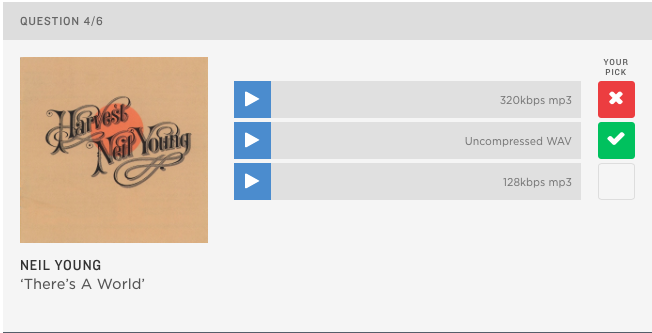
If you are curious, the NPR exam is the perfect way to challenge your hearing. Now that you have all the explanations in mind, we suggest that you test your knowledge of the records of Neil Young, Jay-Z, Katy Perry, Coldplay or Suzanne Vega. Just listen to all three excerpts and then select the track you think is the best quality. Show us that you are ready for the task.

This is the image of the test:

Click to do the test

Test