Why is Mp3 the most common format?


Free Download Mp4Gain
picture

MP3, or MPEG1 layer III as a whole, has certainly become the most widely used and qualitatively least promising music carrier since CD, and on a global scale. This is just a seemingly simple trick: as much music as possible in the least possible (storage) space; and, by extension, the shortest possible transmission time (for downloading and uploading). With that MP3, he killed two birds with one stone and that combination became a source of income.

Mp3

It is about data reduction, nothing more and nothing less, which required a technical approach different from the conventional method, which is based on sampling amplitudes, the precision of which is determined by the number of bits used to capture that amplitude. The bandwidth (“memory”) that the audio signal consumes is determined by three factors: 1. the number of samples taken per second (frequency); 2. the number of bits to record the amplitude (the so-called bit depth) and finally the length of the signal (time). From these three data the following calculation formula is established:

MP3

Memory = frequency x bit depth x time (per channel)

For the 16-bit audio CD, we already read about it in part I, the sample rate is 44.1 kHz. If we now put the previous formula aside, the result is:

Memory (CD) = 44,100 x 16 x 60 x 2 (channels, stereo) = 84,672,000 bits

or a little over 10 mb per minute. For a symphony with a play time of about an hour, this results in over 600MB in total. If we then look at the transmission speed of a standard modem (56 kb / s), it takes about half an hour to download music. By Eroica this would take 25 hours. Nobody wants to do that, aside from the increasing risk of signal outages during that absurdly long period. A good ADSL connection should take at least 2 hours, with an emphasis on the minimum, because the transmission speed depends on how busy the lines are and can be a fraction of what is specified. In any case, under very favorable conditions for Wagner’s Götterdämmerung, no less than one working day can be allocated. In short, another solution had to be found and it came in MP3 form.

Matter of algorithm

MP3 was developed in Germany in the late 1980s by the Fraunhofer Institute, which also owns the patents for that system. The original commission was to develop a high-quality audio system suitable for routing through the existing telephone network. So good sound through the phone. With its 2 x 64 kb / s bandwidth in duplex mode, ISDN seemed to be ideal as a starting point for such an audio concept. Fraunhofer succeeded with great success, but therefore the task was not to develop MP3, as it is now used all over the world in the field of music reproduction.

MP3 or MPEG-1 Layer III, is part of the MPEG, or Moving Picture Coding Experts Group as a whole, which was created to develop a standard for the encoded release of feature films, documentaries and audio. Audio, of course, was part of this, if only because an encoded movie without sound, of course, couldn’t. From its humble beginnings, the MPEG group grew to 350 experts representing no less than 250 companies and organizations in 20 countries. It also follows that the parties quickly agreed on a uniform approach and method of work, and thus the global standard to be used. But to prevent everyone from going their own way in MP3 development based on their own principles, an ISO standard was soon established on the basis of commonly formulated directives. Furthermore, the Internet has contributed greatly to the efficient work of the various groups within the MPEG model: technicians have the opportunity to easily exchange their findings and proposals through the MPEG ftp site. When a meeting takes place, the participants (mainly academics with technical backgrounds) are already well informed in advance. technicians have the opportunity to easily share their findings and proposals via the MPEG ftp site. When a meeting takes place, the participants (mainly academics with technical backgrounds) are already well informed in advance. technicians have the opportunity to easily share their findings and proposals via the MPEG ftp site. When a meeting takes place, the participants (mainly academics with technical backgrounds) are already well informed in advance.

World standards

MP3 is part of MPEG, or Moving Picture Coding Experts Group as a whole, which was created to develop a standard for the encoded release of feature films, documentaries, and audio.


Free Download Mp4Gain
picture


Mp4Gain Main Window
picture


Mp4Gain Features
picture


Free Download Mp4Gain
picture

WHAT IMPACT DOES BLUETOOTH HAVE ON THE AUDIO QUALITY?

Bluetooth Audio

A must-have brief on Bluetooth, from the basics to daily practice in audio land, was posted on HiFi.nl this summer. That raised a number of questions for readers, which, in short, are almost the same: “Great, that wireless connection, but what is left of the quality of the source file when you send audio over Bluetooth?”

Bluetooth Audio

We know that since the introduction of the current standard in the field of wireless connection, things have evolved considerably. While Bluetooth was never primarily intended to send or receive audio signals, but rather to allow hardware like the mouse and keyboard to communicate with each other, quite a few steps have been taken to exploit and enhance those capabilities. Consider Bluetooth version 4.0 and the arrival of the now-familiar aptX codec. However, the transfer is not (yet) loss-free. Is the quality of the source file sufficiently preserved with a wireless connection via Bluetooth? In other words, does it make sense to play FLAC instead of MP3, for example if you use Bluetooth to send the music to your speaker?

Codecs

The wired versus wireless discussion will likely always persist. After all, there are numerous hi-fi manufacturers that specialize in audio cables and tell a very good story about it (and besides, of course, there’s the good digital cable twist). When talking specifically about wireless audio over Bluetooth, there is always the element of compression. Due to the limited bandwidth of the connection, by definition there will be data compression and therefore loss of quality. (Not to mention, Bluetooth operates within the 2.4Ghz frequency that many other equipment in the house are also ‘connected’ to.)

aptX

The algorithm used also depends on the codecs supported by both the sender and the receiver. The only one that always works is low complexity subband encoding, or SBC. SBC is still used if, for example, the smartphone supports aptX, but the headphones do not; is the backup option. aptX, which has already done a lot to limit compromise, is certainly not the official standard and is still quite rare, regardless of the fact that there are so many different variants of su. What aptX also does exactly to ensure the ‘lossless CD quality’ of the connection is known only to the creator CSR and owner Qualcomm (you know, the American telecom giant), and their interpretation is, at best of the cases, vague. to name. In any case, the transport of audio data is still dependent on the bandwidth of the connection, which does not have the lossless qualities of transmission over optical cables, for example. The essence: With Bluetooth audio streaming, the audio stream is encoded with a lossy algorithm. After all, Bluetooth has insufficient bandwidth for lossless, let alone high resolution.

“It is always recommended to work with lossless FLAC or ALAC files”

Now what?

Well then there is loss of audio quality. And it’s no secret that hi-fi enthusiasts aren’t fans of compression. However, is the commitment so present that there is as much to horrify as with MP3? No, because thanks to innovations in the quality and bandwidth of a Bluetooth connection, much is being done to minimize the audible effect of compression, as this study shows between SBC, the younger aptX, and 320 mp3 Kbps. So the question is whether it can still be heard in an a / b test with, for example, optical cabling as an alternative. However, the main question is whether an a / b test with different source files via Bluetooth has any effect. The answer is really simple: do you prefer the loss of a good file or a less good file? After all: the better the source, given the (for the moment) inevitable but increasingly marginal loss of quality via Bluetooth, the better the end result. So it is always wise to work with lossless FLAC or ALAC files, because no matter what happens behind the scenes with Bluetooth streaming, you certainly won’t have to deal with double lossy compression, which is always a downside.

Finally, you have to put the Bluetooth app in perspective. After all, for many seasoned audiophiles, the above won’t be a discussion at all, for the simple reason that the listening room isn’t set up for an audio connection via Bluetooth (“Wired! Wired! “). Therefore, the use depends on the circumstances.

Is it possible to improve the quality of an MP3?

Thanks to MP3 we can listen to our favorite music everywhere. When you put your MP3s on a USB stick, you can listen to your favorite music in the car, for example. But you can also put MP3 music on your smartphone. Allowing you to listen to music whenever possible.

MP3 quality

But sadly, it still happens that the quality of an MP3 is not really what it should be. In this article, we look at the options to solve that problem. So that you can not only listen to music everywhere, but also enjoy it everywhere.

Mp3 quality

What exactly is an MP3 music file?

Mp3 is a method of compressing digitally stored music. Uncompressed storage of a stereo digital music file takes up a lot of disk space. An average of 10MB of disk space per minute of recorded music.

However, compressing a music file and saving it as MP3 will leave only one-tenth the size of the original file.

Since the introduction of the CD, music has been recorded digitally in the form of samples or measurements. Sound is neither more nor less than vibrating air. These vibrations are also known as sound waves. Sound waves can be measured, recorded, and stored.

However, when sound waves are produced creatively, then it is music.

The number of vibrations per second determines the pitch of the sound. A large amount of vibrations creates a high tone, a small amount of vibrations for a low tone.

The number of vibrations per second is expressed in hertz. The human ear can perceive sounds between 20 Hz and 20,000 Hz.

It was once scientifically discovered that in order to record the highest pitch, a measurement must be taken 44,100 times per second. Therefore, the number 44,100 is the sample rate in hertz that is required for good quality recording.

In addition to high and low tones, a piece of music also contains high and soft passages. The difference between the loudest and the softest passages is called the dynamic range. For the dynamic range of a piece of music to be recorded digitally, you can choose 256 steps (8-bit) between the softest part and the hardest part or 65536 steps (16-bit).

The dynamic range is highest when recording with 16-bit samples or 65536 steps.

If we then do some math with this data, we see that 44,100 measurements are needed for one second of music. Each measurement (sample) is 16 bits (2 bytes) in size. That means 1 second of music takes up 88,200 bytes or 88Kb of disk space.

But since we like to listen to music in stereo, we can multiply that number by 2. For example, one second of music in stereo takes up 176 Kb of disk space and therefore 10 MB per minute.

When a compressed MP3 file is created from an original music file, this is done using a lossy compression method.

Lossy compression causes data loss. With an MP3 file, this means that information is omitted from the file that is beyond the reach of the human ear.

Humans are most sensitive to sounds between 2 kHz and 4 kHz. And we cannot hear loud and soft sounds simultaneously. Therefore, it is only necessary to keep the loud sound. In technical terms, this is called psychoacoustic masking.

What determines the quality of an MP3?
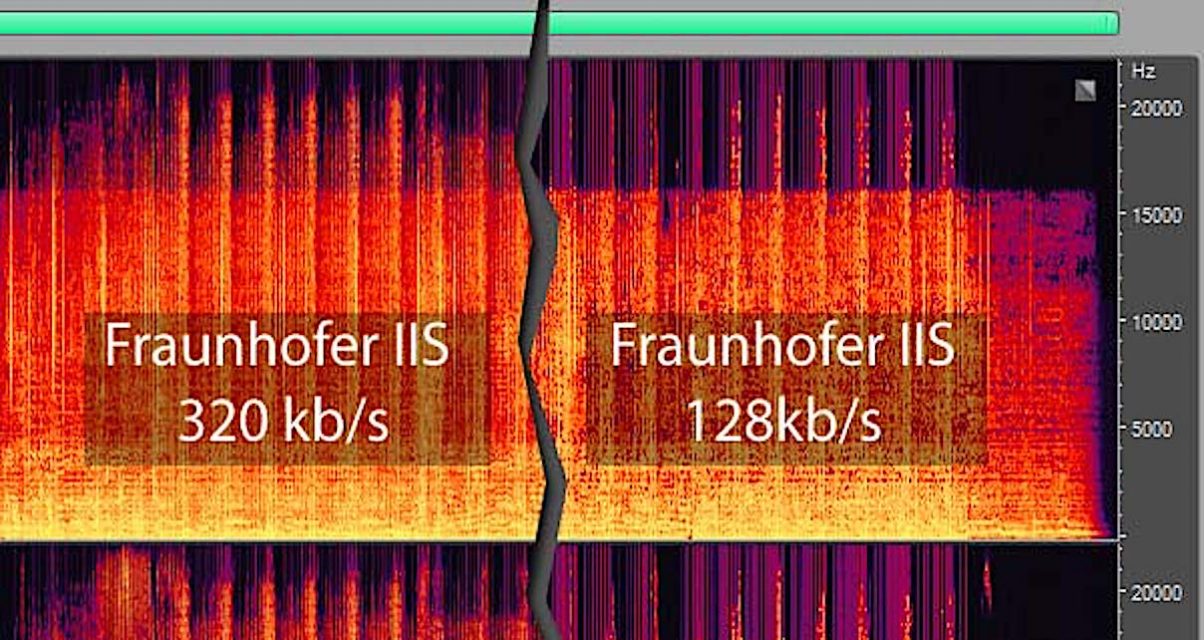
The MP3 format was developed by the German research institute Fraunhofer ISS. In addition to utilizing the limitations of human hearing just mentioned, the format consists of several mathematical formulas. This makes it possible to reduce the original file by a factor of 3 to 12.

The degree of compression is related to the bit rate. Bit rate is the amount of data that is processed per unit of time. This means, among other things, that the more data there is in one second of music, the larger the MP3 file will be. But also the better the sound quality of the MP3.

A bit rate of 64 to 96 kbps is enough to talk. A bit rate of 128 kbps is used for a good quality music file. Excellent quality can be achieved with a bit rate of 192 kbps or higher, with a maximum bit rate of 320 kbps.

A bit rate of 192 kbps or higher is only useful if the recording quality of the track is also excellent.

Obviously if you want the mp3 to sound even better, use Mp4Gain to mormalize mel volume, to correct the equalization and to make a series of changes or improvements.

TRUTHS ABOUT ANALOGUE VS. DIGITAL: VINYL VS. CD

Experts report on the topic of analog vs. Digital

Analog vs Digital

Which is better: the vinyl record or the CD, analog or digital? Generations of music lovers argue on this topic, but so do self-proclaimed experts. At this point, I’d like to let some real experts in your field speak up: sound engineers or sound engineers, people who deal with the subject on a daily basis. Here are some truths about record technology and how it really came about.

Analog vs digital audio

ABOUT DISCS, CDS AND RECORDINGS
First of all, a short note that the question asked at the beginning cannot be answered in this way. On the one hand, it has to be structured from a technical point of view, and on the other hand, it makes no sense to seriously compare two fundamentally different systems. However, there are approaches by many music lovers to compare the end results as a sound carrier.
In the end, I would like to return to the fact that there are many obstacles, most of which you have no idea. First, however, I will let the experts express their opinion, who know much more about the subject than the consumers. And in doing so, amazing aspects come to light that mainly illuminate the development of a vinyl recording, right from the beginning!

“The analog vs. digital discussion has been with me for many years, to be precise since 1982. That was when the CD was introduced. There was probably no sound engineer at the time who was not relieved that the CD arrived. Because in almost all technical respects, digital recording, assuming reasonable sampling accuracy, is clearly better.

Let’s take the signal-to-noise ratio: with the LP, you can consider yourself lucky to achieve 50 dB, with the CD – 80 dB. Or the wow and flutter: with the LP, it’s enough that the center hole is a bit too large (but still within the norm!), And a clear egg can be heard. With CD: neither measurable nor audible. Or take the channel separation: with the LP maybe 30 dB, with the CD 80 dB. And so. The exception may be the frequency response, the CD cuts hard at 20 kHz, the LP comes out “soft” and transmits perhaps up to 30 or 40 kHz, but much quieter.

The fact that many listeners and, meanwhile, many sound professionals, from musicians to sound engineers / technicians / teachers, turn to the LP again, has aesthetic and fundamental reasons, also philosophical. And there are many good ones. Digital is, for example, B. much more manipulable. Up to 100 cuts were found on an analog recording, mostly less, rarely more. 500 cuts are not uncommon on CD. Pitch correction, velocity change, sound manipulation, post-processing of individual tracks, synthetic spaces or even natural spaces, but artificially added, etc. etc.

It is also digitally interchangeable. An LP is unique, due to supposedly damaging technical weaknesses like creak, eggs, and noise. But what does technical weakness really mean in something like art? Isn’t it rather an advantage that not everything is so smooth and reproducible and that you have to fight hard to get a good result? The “clinical, sterile” sound of the CD is often criticized, it is not the weakness of the CD, but that of the LP, only that this incorruptibility also means lack of life.

Digital also means zack – track 17 and zack – track 9, while LP first means holding record in hand (haptic!), Admiring the cover / maybe running fingers over it, carefully removing record ( music is vulnerable and precious!), the hanging ceremony, taking your time and listening. In contrast, digital: next door, in the car, without emotions and without love.

Still, I find it difficult to say that one is better than the other. Like many others, I feel at home in both worlds. Digital can be intoxicating and addictive (if done right), analog too, just completely different. When it comes to my TACET label, we are pursuing a twofold approach: Producing with fervor and devotion to satisfy LP listeners. And equally fascinated and enthusiastic, working in a completely different way, suitable for digital sound carriers. “

Analog vs. Digital: Does vinyl sound better?

Music stored on vinyl is making a big comeback. The question of whether CDs, files, or music saved on vinyl sound “better” divides music fans. Sometimes the feeling arises that the toughest commentary battles on the web take place not between political camps, but between listeners of analog and digital music.

Analogversus Digital

It’s a shame, because almost everyone involved in these battles, which were fought with incredible vehemence, are united by their love of music. They belong to the minority of those who spend a lot of money on music, regardless of the medium they prefer. This battle is completely unnecessary and is mainly based on a misunderstanding or two different interpretations of what “good sound” means.

Analog vs Digital

“Good sound”: one expression, two meanings

Some say that something “sounds good” when the sound suits them. That is the musician’s point of view. A good example of this is the sound of a distorted electric guitar, a constituent element of rock music. It originated from the fact that a guitar amp was so loud that the actual sound of the guitar was destroyed beyond recognition by the overdriven amp. The result no longer sounds like a guitar, but the sound has been and continues to be liked by millions of people because it just “sounds good.”

Distorted but pleasing to the ears: the sound of a classic rock guitar.

Others use the term “good sound” as a synonym for “high fidelity,” meaning the most realistic reproduction of what the sound engineer heard when mixing a recording in the studio. This is what we call “high fidelity”.
By this definition, “good sound” means, at best, that the playback chain does not sound at all and that the sound changes as little as possible on its way from recording to playback. It’s called “High Fidelity”, not “Perfect Fidelity” because there can only be an approximation of the original sound.
And it is precisely this point that is the axis of the whole discussion. Logs were never a particularly good medium for hi-fi, but for decades they were the best medium that end users had access to. Until the CD arrived.

In terms of measurement technology, the record falls short
If one compares the CD and the disc under the criteria of “high fidelity”, the disc not only drops the straw, but is completely outperformed by the CD in terms of all the relevant criteria. Here are some examples.
Dynamic is the difference between the softest and loudest sound of a piece of music. While all digital media, including MP3, easily go up to 90 dB and can therefore even map the dynamic range of a large symphony orchestra, in practice the record barely achieves more than 40 dB. Enough for pop music, but even a well-received little jazz band like the one in our sound sample becomes a problem for the record. In quiet places, typical vinyl noise would be clearly audible.

Speaking of background noise: Typical vinyl noise, low-frequency rumble, and creaking caused by dust grains in the groove are also noticeable because they occur unevenly. The noise from a compact cassette is more constant, so the brain can filter it better. Digital recordings are virtually noise-free.
To present the purest music possible, all frequencies in the audible spectrum between 20 Hz and 20 kilohertz should be played at the same volume. With digital media, the frequency responses appear to have been drawn with a ruler. As a general rule of thumb, registers can linearly reproduce frequencies up to a maximum of 12 kilohertz and this only applies to the outermost slots at the beginning of a page. Due to the slowing down of the path speed towards the end of the groove, the highest transmission frequency drops more and more during the playing time of a disc, which, by the way, can be heard clearly. For the lower end of the spectrum, the deeper and louder the bass, the more space it needs in the groove, shortening the possible playing time. With LPs, you always have to find a compromise between bass level and playing time.

An important measure of the fidelity of a reproduction medium to sound is the distortion that is added to actual music. Especially in the low range, the register reaches values ​​that significantly change the original signal.
In principle, a pick-up system works like a microphone. Converts mechanical energy into electrical energy. This mechanical energy comes not only from the grooves of the record, but also from the sound of the speakers. The louder you listen to the music from the turntable, the more feedback you will hear. And feedback blurs impulses in music, like the sound of drums. At home with moderate volume it is more likely to be neglected, at a club not.
Thanks to these (and a few other) technical shortcomings, the record doesn’t even meet the requirements of the traditional DIN No. 45500 standard on all points, which has defined the official hi-fi standard since the 1960s.

Don’t die: rumors about digital technology

On the contrary, rumors and false statements about digital technology are still circulating, for which the problems of the beginnings of the compact disc and the blatant misunderstandings about how digitization works are responsible.
Over and over again you can read that digital technology covers a smaller frequency range than analog. That’s actually true in theory, because CDs, for example, are limited to the range between 20 Hertz and 20 Kilohertz with filters.
However, on the one hand this is exactly the range that our hearing can cover in principle, and on the other hand it is pure theory that analog technology can represent a higher frequency range. In practice, for example, the cutting tools with which music is scraped into the matrices that vinyl is made of, heat up very quickly to high frequencies with a high level and thus limit the frequency response upward.
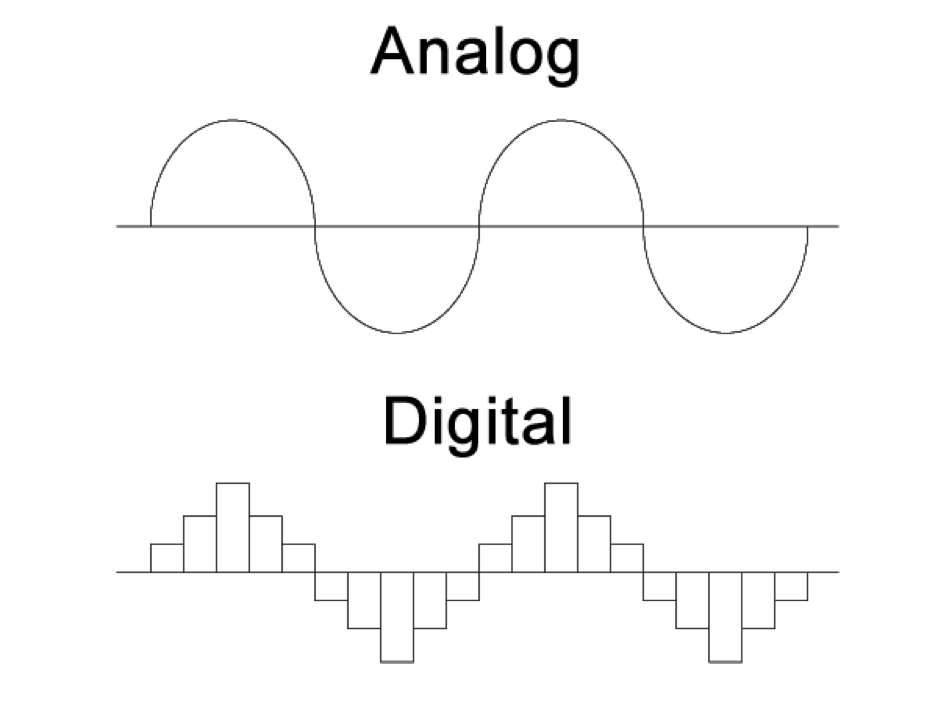
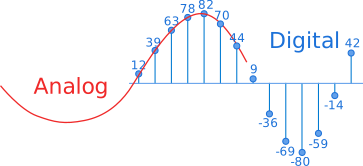
Friends of analog music storage like to deny digital technology the ability to display music correctly and that’s because of the discrete sampling. The waves that make up sounds are continuous events, whereas computers know only discrete states. The popular misunderstanding is that you can never fully capture the airwaves. After digitization, the waveforms would no longer be round, but staggered. But that is not right. The Niyquist-Shannon sampling theorem clearly states that the original signal can be restored exactly and not just roughly.
If all these facts are true and the record is so hopelessly inferior to the CD, why do so many people claim that the record “sounds better”?

Audio compression: facts, myths, and a blind test

Audio compression

When compressing, for example with MP3, there is a loss. But do you hear that? Where does good hearing end and where does esotericism begin? We verify the theory with a blind test, which you can do yourself.
Audio compression is a constant part of everyday life – almost always when you listen to music, it gets compressed. However, audio signal processing is difficult to understand for people who do not work in this field and who have adequate basic training. Consequently, in my impression, most people do not care at all or demonize MP3 and everything that has to do with compression.

MUSIC PRODUCTION WEEK: DAY 2, Compressor Tuesday: How to use compressors  and why? — Steemit

The question is: Are we depriving ourselves of a pleasant pleasure if we only listen to music on Spotify or YouTube? Or don’t you notice a difference with the best possible quality?

Numbers and what they say

Different measurement parameters say something about sound quality, but what exactly is it? The following is an overview of the factors as brief and clear as possible.

1. Bit rate

Bit rate tells you how many bits are processed per second. It is also called data transfer speed or bandwidth.

It makes intuitive sense: the more data that flows, the higher the sound quality. Bit rate is the most important measured variable in everyday life. However, the bitrate alone doesn’t say much about sound quality.

There are variable and constant bit rates. Today variable bit rates (abbreviated VBR) are mainly used. In “little happens” passages, more data can be compressed without audible loss, whereas a relatively large amount of data is stored in complex passages. The result is higher sound quality with the same file size. In the case of variable bit rates, the average is given as a value, sometimes also the maximum allowed.

2. Compression method

CAA compresses more efficiently than MP3, making it better quality than MP3 at the same bit rate. The same goes for Ogg Vorbis, which is used on Spotify.

Also the compression software that Encoder, has an impact on the quality. In the early days of MP3, 128 kbit / s songs often sounded terrible. Now they sound so much better because bad encoders are no longer used.

3. bit depth

Bit depth tells you how many bits a sample has. Therefore, it is also called the sampling depth. The more bits per sample, the more different volume levels can be stored.

This may remind you of photos and videos – there are bit depths too and they mean something similar.

The LG V30 can record * 10-bit videos **. What is the point? A direct comparison with our system camera VIDEO
mobile background
The LG V30 can record 10-bit videos. What is the point? A direct comparison with our system camera.
Which is better: * RAW or JPEG? **
background photo + video
Which is better: RAW or JPEG?
A CD has 16 bits per stereo channel. There is no fixed bit depth with MP3 and other compressed audio files. Bit depth hardly plays a role in normal everyday life, only in studio recordings. Sometimes 24-bit is also used there to get more out of the sound processing. However, in the end, the music is reduced to 16-bit because it can see the difference, according to acoustics experts I can’t hear anything.

.
4. Sampling frequency

The sample rate (also called the sample rate) is also irrelevant for normal music listeners. But it is important to understand how digital sound storage works in the first place. A CD has a sampling frequency of 44100 Hz or 44.1 kHz. Hertz is a unit of measurement that indicates something like “frequency per second”. In audio sampling, it means that the sound level is measured 44,100 times per second. The same applies here: when recording in the studio, higher values ​​make sense, but not in the final format.

Nyquist’s theorem: Many people believe that digital music is fundamentally a loss compared to a “real” (analog) sound wave. These discussions began when the CD was invented and immediately ridiculed by audio snobs as inferior to the record. But that can be refuted. The Nyquiste Theorem states that an audio curve can be completely reconstructed from individual points without any loss if the sample rate is high enough. And it also says how high the rate should be: twice the bandwidth. Since the human ear reaches a maximum of 20,000 Hz, this bandwidth is roughly selected. Hence the sample rate of just over 40,000 Hz.

5. Other factors

With all the technical measurement parameters, it should not be forgotten that the best values ​​are useless if the sound is already badly recorded. For example, if the sound engineer has not set the volume level high enough, dynamism is lost. The recording starts to creak when it gets louder afterwards. If the level is too high, the result is even worse: the recording is cluttered, rattles and scratches. Or a dynamic compressor alienates the result. Bad recordings are ubiquitous on YouTube and are also sold on CDs, for example for very old studio recordings or live concert recordings.

The quality of your headphones or speakers also has an influence. With faulty minijacks, you will barely hear a difference between 128 kbit / s MP3 and uncompressed music. Most likely with good boxes.

WAV, FLAC and more: the best audio formats for your music

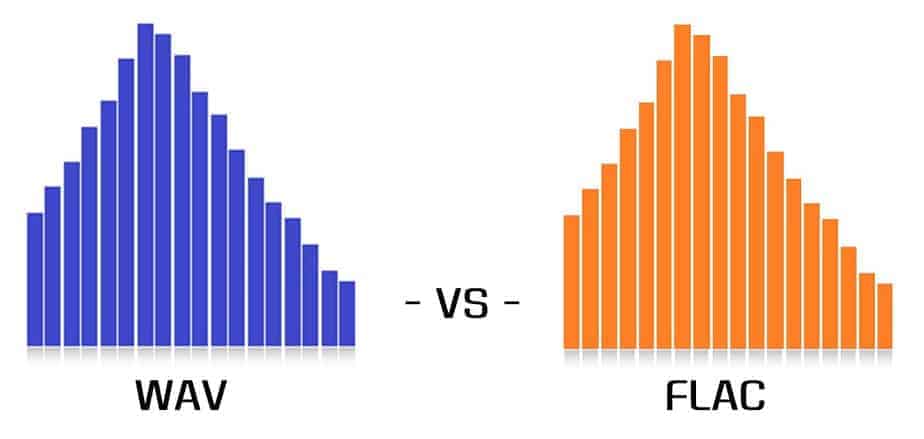
WAV vs FLAC

What audio format is best for music? Image: What audio format is best for music? Image: Unsplash
AAC is not the size of a battery, nor is FLAC an anti-aircraft weapon. With these and many other abbreviations, we find ourselves in the dense jungle of audio formats. In this guide, we’ll explain what these abbreviations mean, what each music file format is for, and which one is the best to use in your music collection.

WAV vs AIFF vs ALAC

Lossless uncompressed audio formats
In uncompressed audio formats, the analog source material was converted to a lossless digital format. Uncompressed and lossless means no information was lost during the transfer and you get the best possible sound quality, at the expense of storage space, of course.

PCM
PCM stands for Pulse-Code Modulation and represents a digital image of the raw audio signal. Since analog sound is in wave form, it must be “sampled” at certain intervals (pulses). This results in the sample rate (frequency in Hertz) and the bit rate (number of bits per sample). PCM is an uncompressed, lossless audio format that is closest to analog source.

Usage: Music Industry: Basis for Lossless Uncompressed Audio Formats

Wav
WAV (Waveform Audio File Format) is a standard developed by Microsoft and IBM in 1991 for various audio formats. This waveform audio file format is actually a file container that generally contains uncompressed audio signals in PCM format, allowing Windows and Mac systems to process them more easily.

The result is excellent sound quality, but also very high storage space requirements. Another disadvantage of the WAV format is that only rudimentary metadata (artist, album, song title) is available and can be saved. You cannot store an album cover, for example.

Use: Music CD, among others

TAD D1000mk2
The TAD D1000 MK2 can play SACD and thus reproduce high-resolution audio signals. | Image: TAD
AIFF
The AIFF (Audio Interchange File Format) was developed by Apple in 1988 and is Apple’s equivalent to the WAV container. Similar to this, AIFF can contain different audio formats and is populated with the PCM format by default.

Use: Apple systems

Lossless compressed audio formats
Those who do not want to produce CDs or have an infinite amount of storage space can switch to high resolution audio formats. They are used for Super Audio CD (SACD) and streaming services like Tidal and, thanks to very good codecs, they provide lossless compression.

DSD
DSD (Direct Stream Digital) follows a similar principle to PCM, but works differently. The DSD codec uses fewer bits at a much higher sample rate to reduce the storage space required for a music file.

Usage: super audio CD

FLAC
FLAC (Free Lossless Audio Codec) is considered a very good alternative to WAV. The format requires up to 50 percent less storage space and can store more metadata. This makes FLAC a popular format for the highest quality music downloads, but with the downside that it is not compatible with Apple’s iTunes.

Usage: Hi-Res Music Downloads for Standalone Apple Systems

A THE C
As is often the case, Apple has also developed its own alternative called ALAC (Apple Lossless Audio Codec). FLAC is considered the more efficient of the two formats, but with ALAC Apple users can also enjoy a lossless audio format.

Usage: High-resolution music downloads for Apple systems

MQA
Unlike the other formats, MQA (Master Quality Authenticated) is not a real audio format, but a codec system consisting of an encoder and a decoder. Behind this is a complex piece of software that, according to the developer, should be able to reproduce the original master quality of the studio.

Choose the correct audio format

Digital music: audio formats and their basic differences

Digital audio

The formats used to be clearly specified by the player. Those who had a VHS player bought VHS cassettes and those who had a Betamax payer, well, they were unlucky. It was similar a few decades later with Blu-ray and HD-DVD. If you could bet on the wrong horse with the respective playback devices, at least the purchase decision regarding the individual media was clearly defined. In the age of digital music, one has the advantage of a nearly universal player in the form of a computer and huge media libraries, but even more difficult because choosing the most sensible format in which to buy or convert your music is more versatile.

Digital Audio

What points determine the choice of the correct audio format?

First of all, of course, it should be noted that not all programs can play all formats. But especially DJ programs like Traktor or Virtual DJ deal with a variety of formats, which doesn’t make the decision for you at first and requires knowledge of other factors. The question of the correct format is particularly important for DJs, because individual formats differ significantly in terms of handling and quality! So now we want to explain to you where the differences lie between individual audio files so that later you can decide which format is the most suitable for you! We limit ourselves to the six common formats MP3, AAC, WAV, AIFF, FLAC and ALAC.

“To compress an MP3 file, what humans cannot hear is simply cut off.”

A distinction must first be made between simple files and cabinet files. Individual files contain little information beyond the song. Cabinet files are individual file packages that together form a meaningful whole. Here, for example, song texts or album covers, including the actual audio file, can be put together in one package. Additionally, there are different audio tracks that can be contained as individual files within the container, allowing for more accurate use of the audio material.

To individual audio formats: outdated variants

Everyone knows: MPEG1 Audio Layer III or just for short: MP3. The format developed by Moving Experts Group uses psychoacoustic findings to compress the original file. In other words: what the person doesn’t hear is simply cut off. Unfortunately, since this is only what humans with primitive audio technology cannot hear, the format not only requires little hard disk space, but also offers little acoustic enjoyment – loss of important audio information is characteristic of MP3.

In addition to the advantage of the small file size, the outdated format has the main disadvantage of clipped sound quality. What cannot be heard on small, private systems is quickly noticeable at clubs or festivals. The “thump” is missing because the dynamics of some frequencies are cut off, which means that the energy of the track does not reach the listener. If you still want to use MP3, you should definitely opt for encoding with 320 kBit / s, the maximum data rate supported by the MP3 format.

Another lossy format is AAC (Advanced Audio Coding) and it also comes from the ranks of the Moving Picture Experts Group. Similar to MP3, but with the help of a different technology, the audio signal is compressed simply by filtering out what the human ear presumably cannot perceive. AAC also saves a lot of storage space. However, thanks to the improved technology, it is possible to produce a significantly better sound experience than that reserved for MP3 even at lower data rates.

The most accurate error correction and the most efficient encoding algorithms create this superiority over an MP3 file with a comparable data rate. The efficiency of the algorithms is not only noticeable in the sound: with the same audio quality, AAC files are about a quarter smaller than their counterparts in MP3 format.

Digital audio formats

Digital Audio Formats

Now there are several formats, but a basic distinction is made between lossless and lossy formats and compressed or uncompressed formats. Lossy formats are always compressed, which means a reduction in required storage space, but at the expense of playback quality. Lossless compressed formats offer faithful playback with low memory requirements.

However, the savings are less than with lossy formats. Lossless and uncompressed formats offer true-to-original music reproduction, but require a comparatively large amount of storage space. In return, they sometimes support even higher resolutions than compressed formats.

digital audio formats

What are sample rates and bit depth?

When talking about the resolution of digital music, two numbers are often mentioned. For CD quality around 44.1 kHz and 16 bit. The first number is the sample rate of the file. Describes how often the computer or network player extracts a signal from the file and processes it. 44.1 kHz means that a certain amount of data is transmitted 44,100 times per second. This amount of data is described by the bit depth (also word depth), the second number.

At the quality described, 16 bits of data are transmitted 44,100 times per second. If you want to determine the actual amount of data per second, you need to multiply these two numbers and get 705,600 accordingly. Since this is a stereo file with 2 channels, this number should be taken twice.

With CD quality music, 1,411,200 bits per second or, for the sake of simplicity, 1,411.2 kilobits are transmitted. A good MP3 file only transmits 320 kbps, so it only contains about a third of the information on a CD. Compared to 192 kHz 24-bit files, even less.What is the difference between compressed and uncompressed formats?
Uncompressed formats like

WAV do not affect music in any way. Frequencies and information are stored exactly as they are read during encoding. Therefore, uncompressed formats require more storage space in the first place than compressed formats. However, compressed does not automatically mean lossy. Formats like Apple’s FLAC or ALAC save music losslessly as a WAV file. However, they pack existing data more neatly without removing any information, thus requiring less storage space. Normally, there should be no effects on music information.

Why aren’t MP3 files high fidelity?

The MP3 format was introduced in 1992. It was revolutionary for the time, because by encoding music in MPEG-Audio Layer III, the full name of the format, you could achieve file compression of at least 4: 1, usually even 10: 1, compared to the classic CD. . This is possible because encoding in MP3 format removes the parts of the original file that are considered the least useful.

You can never make an exact copy of a music file in MP3 format and you cannot add information that has been deleted. So there is no point in converting an MP3 back to a lossless format. The AAC format used by Apple also cuts information from the original file to save space during compression.

We speak here of lossy or in English also of “lossy”, in contrast to the formats without loss or “without loss”. Meanwhile, it doesn’t really make sense to use such formats anymore, as more storage space shouldn’t be a problem today, unlike in 1992. The sound quality of MP3s is also significantly lower than that of other formats, as only 320 kbps is transmitted here at best, usually only 192 kbps or 256 kbps.

What is metadata?

Metadata are files attached to a file that contain additional information. In the case of digital music, these typically include things like sample rate, bit depth, and file format. In the best case, information about the song title, artist, album, composer, track number, etc. is also attached to the file. Modern streaming clients display this information when they play games on their screen or in an app. Also, these hidden attachments are often responsible for how the music in memory is organized.

Why does digital music need to be normalized?

Why does digital music need to be normalized?

For younger consumers, the focus is often on the computer, which plays MP3s through the PC’s speakers. “They’re made to rumble a lot during games,” says “c’t” expert Zota. This can be useful when reproducing the explosions in a shooting game. However, when listening to music, such boxes disappoint.

Digital Music

Other consumers use their iPod with clip-on speakers, and mini systems like Bose’s “Wave Music System” are enjoying best-sellers. Of course, they cannot match the tonal volume of a full floor standing speaker.
monitor

Digital music

Those who decide to buy a high-quality music system generally turn to home theater systems. These are multi-channel systems with up to eight speakers and multiple power amplifiers. Their specialty is DVD playback, where they evoke powerful bass thanks to the subwoofers.

The viewer also physically experiences an earthquake in the movie because the shelves begin to shake. Solo: Compared to pure stereo systems, some home theater systems are disappointing. Some subwoofers are too inaccurate to play music. Above all, the quality is significantly more expensive compared to stereo systems. “The budget has to be divided into many more individual parts than with a stereo system,” says Besic, specialist in “Stereoplay”. For 1000 euros there is a decent stereo, but only a lousy home theater system. According to GfK, Germans spend an average of just over 400 euros on complete home theater systems, and 800 euros if these consist of the individual components of an amplifier, CD player and speaker cabinets.

Music producers flatten recordings

But it’s not just bad speakers that degrade sound quality. Music producers also contribute. They have been making their songs louder and louder since the mid-1990s. In pop, hip hop, rock, and electronic dance music, there are practically no quiet passages. At the same time, musical recordings have lost their dynamism. The mids are emphasized, but very high and fine sounds, as well as very deep bass, are often missing. The idea behind it: the songs should appear and assert themselves against loud advertising on the radio or background noise in the pub.

Additionally, sound engineers increasingly manipulate the sound of rock bands and pop singers with just a few clicks. Engineers use computer programs to smooth the edges and eliminate the smallest errors. For example, the pitch of the song is fine-tuned later; and hand-played drums sound accurate after computer processing, but like a machine and somehow always the same. Not much remains of the musicians’ own sound.

“In addition, the generally short time due to lower budgets also plays a role. In the past, you had much more production time, which of course was reflected in the end result in better quality and creativity, ”says Gerhard Wölfle, director of Dorian Gray Studios in Eichenau, near Munich. Wölfle has recorded CDs with the bands Guano Apes, Reamonn and The Donots. In the past, around six weeks of production time was the guideline for such albums. Today, studio professionals are satisfied when the music industry and artists spend half their time on them. Gerhard Wölfle says: “The excessive volume due to the massive use of compressors and limiters definitely gives many productions to the rest”.

An excellent example of an extremely loud album is the album “What People Say I Am, That’s What I’m Not” by English band Arctic Monkeys from 2006. The fully adjusted mix quickly rose to the top of audience favor. . The single “I bet you look good on the dance floor” (see the band’s MySpace profile) became a number one hit.

All this has generated a problem in matters such as the loudness of the music, which almost necessarily must be normalized to get them to sound at a similar volume.

Mp4Gain is the perfect choice to get a boost to the loudness of a song or to make all instruments sound clearly and audible.

Mp4Gain offers the latest technology and algorithms to make your music sound great today.