MP3 encoder


Free Download Mp4Gain
picture

MP3 encoder

Mp3 Encoder
Mp3 Encoder

1. MP3 Encoder FAQ

Mp3 Encoder
Mp3 Encoder

: what is an MP3 encoder?
An MP3 encoder is a piece of software that uses the MP3 codec algorithm (compression/decompression) to create mp3 files. Most encoders only convert
a WAV file to an MP3 file, although many can convert other formats such as WMA, Real Audio, Ogg, etc.

There are only a few standalone encoders, and a lot of software also only uses 4 main encoding engines, largely due to
to Fraunhofer Gesellschaft patents and various companies helping with ISO sources. Although no company owns the license, the
Developers must pay expensive license fees no matter what proprietary MP3 encoder they use. Major MP3 encoding engines include: LAME (
non-ISO source), BladeEnc, Fraunhofer, and Real Networks’ Xing encoder.

– How does the MP3 encoder work?
The core technology under MPEG-Layer 3 is included in the MP3 encoder. The decoding process uses a series of algorithms and rules to compress audio.
The encoder also detect sounds that occur at the same time
and they try to rule out any that might be “masked” or “inaudible” by other sounds.

– What is a good MP3 encoder?
Xing is the fastest encoder in terms of speed, but the worst in quality. For smaller file sizes, Fraunhofer FastEnc
offers the best quality. LAME is a very good encoder, and one version is faster than the previous one, BladeEnc
it is the best quality for large files, but very slow.

2. Dissection of MP3 files
In addition to proficiency in using the basic features of the MP3 encoder, ordinary users do not need to know how the internal structure of the MP3 file is encoded, just like the situation when
face JPEG or DOC files. Out of morbid curiosity, here’s an X-ray view of an MP3 file:

– Box header
As mentioned above, MP3 files are made up of thousands of “frame frames”, each frame containing a part (second part) of valuable audio data.
for the decoder to reconstruct the audio data. The first part above is the box header. (Frame Header), which consists of 32-bit metadata related to the
later data, see the figure below. The MP3 header begins with an 11-bit “sync timing” block, which allows the player to seek and lock the first
legal framework available, which is useful in MP3 streaming, which can quickly move or jump ID3 from the playback source block to a normal one.
position . However, simply detecting synchronized blocks is theoretically not enough, so it is necessary to check the header.

– transmission lock
MP3 was originally designed for broadcast, and as a result it became important that the MP3 receiver could be synchronized with the signal at any part of the broadcast,
so the frame header is placed at the beginning of any frame transmission, so when an MP3 receiver “tunes” to a data stream, it picks up the
signal instantly and you can play it immediately. Interestingly, this fact makes it possible to cut MPEG files into small segments, each of which can be played independently. But unfortunately
not possible in 3-layer (MP3) files, where frames often depend on other frames, so you can’t just
Edit .

– Frames per second
Just as the movie industry has a standard for the number of frames per second in film to ensure proper viewing on any projector,
A similar standard is used in the MP3 standard, regardless of the file’s bitrate, MPEG-1 A frame in the file is 26 ms, approximately 38 fps frames per second. If the bit rate
is , the frame size is correspondingly larger, and vice versa. Also, the number of samples contained in an MP3 frame is constant, 1152 samples per frame.

The total size of any given frame can be calculated with the following formula:

FrameSize = 144 * BitRate / (SampleRate + Padding).


Free Download Mp4Gain
picture


Mp4Gain Main Window
picture


Mp4Gain Features
picture


Free Download Mp4Gain
picture

Why is Mp3 the most common format?

MP3, or MPEG1 layer III as a whole, has certainly become the most widely used and qualitatively least promising music carrier since CD, and on a global scale. This is just a seemingly simple trick: as much music as possible in the least possible (storage) space; and, by extension, the shortest possible transmission time (for downloading and uploading). With that MP3, he killed two birds with one stone and that combination became a source of income.

Mp3

It is about data reduction, nothing more and nothing less, which required a technical approach different from the conventional method, which is based on sampling amplitudes, the precision of which is determined by the number of bits used to capture that amplitude. The bandwidth (“memory”) that the audio signal consumes is determined by three factors: 1. the number of samples taken per second (frequency); 2. the number of bits to record the amplitude (the so-called bit depth) and finally the length of the signal (time). From these three data the following calculation formula is established:

MP3

Memory = frequency x bit depth x time (per channel)

For the 16-bit audio CD, we already read about it in part I, the sample rate is 44.1 kHz. If we now put the previous formula aside, the result is:

Memory (CD) = 44,100 x 16 x 60 x 2 (channels, stereo) = 84,672,000 bits

or a little over 10 mb per minute. For a symphony with a play time of about an hour, this results in over 600MB in total. If we then look at the transmission speed of a standard modem (56 kb / s), it takes about half an hour to download music. By Eroica this would take 25 hours. Nobody wants to do that, aside from the increasing risk of signal outages during that absurdly long period. A good ADSL connection should take at least 2 hours, with an emphasis on the minimum, because the transmission speed depends on how busy the lines are and can be a fraction of what is specified. In any case, under very favorable conditions for Wagner’s Götterdämmerung, no less than one working day can be allocated. In short, another solution had to be found and it came in MP3 form.

Matter of algorithm

MP3 was developed in Germany in the late 1980s by the Fraunhofer Institute, which also owns the patents for that system. The original commission was to develop a high-quality audio system suitable for routing through the existing telephone network. So good sound through the phone. With its 2 x 64 kb / s bandwidth in duplex mode, ISDN seemed to be ideal as a starting point for such an audio concept. Fraunhofer succeeded with great success, but therefore the task was not to develop MP3, as it is now used all over the world in the field of music reproduction.

MP3 or MPEG-1 Layer III, is part of the MPEG, or Moving Picture Coding Experts Group as a whole, which was created to develop a standard for the encoded release of feature films, documentaries and audio. Audio, of course, was part of this, if only because an encoded movie without sound, of course, couldn’t. From its humble beginnings, the MPEG group grew to 350 experts representing no less than 250 companies and organizations in 20 countries. It also follows that the parties quickly agreed on a uniform approach and method of work, and thus the global standard to be used. But to prevent everyone from going their own way in MP3 development based on their own principles, an ISO standard was soon established on the basis of commonly formulated directives. Furthermore, the Internet has contributed greatly to the efficient work of the various groups within the MPEG model: technicians have the opportunity to easily exchange their findings and proposals through the MPEG ftp site. When a meeting takes place, the participants (mainly academics with technical backgrounds) are already well informed in advance. technicians have the opportunity to easily share their findings and proposals via the MPEG ftp site. When a meeting takes place, the participants (mainly academics with technical backgrounds) are already well informed in advance. technicians have the opportunity to easily share their findings and proposals via the MPEG ftp site. When a meeting takes place, the participants (mainly academics with technical backgrounds) are already well informed in advance.

World standards

MP3 is part of MPEG, or Moving Picture Coding Experts Group as a whole, which was created to develop a standard for the encoded release of feature films, documentaries, and audio.

How a Suzanne Vega song was used to develop the MP3

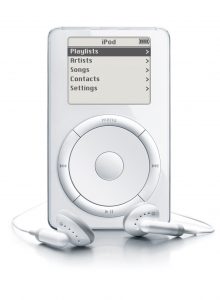
The triumphant advancement of MP3 music began with the first iPod, which was introduced by Apple on October 23, 2001.

The First iPod

German researchers invented the revolutionary MP3 format two decades ago. Now engineers are working on the audio technology of the future. Now they are being honored for their pioneering work.

Suzanne Vega - Tom's Diner

The MP3 music format is one of Germany’s most successful innovations. It is used around the world to store, transfer, and play music, audio books, and other digital audio products.

Three engineers who participated in the development of MP3 were awarded the Eduard Rhein Prize for Technology in Munich. Karlheinz Brandenburg, Bernhard Grill and Jürgen Herre share the prize, which is endowed with 30,000 euros.

Why the song “Tom’s Diner” was important to the development of MP3 and what innovations in audio technology can be expected, explains Professor Brandenburg, director of the Fraunhofer Institute for Digital Media Technology in Ilmenau.

Die Welt: Suzanne Vega’s song “Tom’s Diner” plays a special role in your career. Do you still have the song in your ears?

Karlheinz Brandenburg: Of course (hums the tune). As a doctoral student, he had developed a new method for storing music at a very low data rate. When I started writing all this, I read in a hi-fi magazine that “Tom’s Diner” is used to test high-quality music systems. I was curious what my algorithm, the forerunner of MP3, would do with this music. The result was amazing. Suzanne Vega’s voice sounded very husky and she seemed to be singing duet with herself. Very bad.

Die Welt: What consequences did that have for your doctoral thesis?

Brandenburg: I ​​wrote it down anyway and mentioned that the “Tom’s Diner” algorithm doesn’t work. It took years to understand what was happening. However, with a few tricks it was possible to encode this song to sound perfect.

Die Welt: Several researchers participated in the development of MP3. What was your most important contribution?

Brandenburg: I ​​am often credited with introducing a model of the psychoacoustic properties of the sense of hearing. But that already existed. My contribution was more technical – the way I converted various voice, image and video encoding algorithms and combined them in such a way that the integration of the psychoacoustic model was very easy and low bit rates were achieved for the circumstances. could.

Die Welt: How did the name MP3 come about?

Brandenburg: The official name of this data compression method is “MPEG Audio Layer 3”, a standard that has been defined by Moving Pictures Experts Group. Layer 3 is one of the three modes. Layer 2 was used in DAB digital radio, for example. Our team at the Fraunhofer Institute for Integrated Circuits (IIS) in Erlangen relied on the Internet from the beginning. The compressed music was saved on the hard drives of the PC. The Windows 3.1 operating system expected files to have three-digit extensions. So after a short consultation on July 14, 1995, we decided to add the final mp3 to the compressed audio files. There is a reference to MPEG and also to Layer 3.

Die Welt: A few years later, you could see people everywhere listening to music with MP3 players.

Brandenburg: Exactly. At first I shrugged off the name of the MP3 player, because mp3 was actually a final file. But I quickly realized that MP3 players are a good name for these devices.

History of the mp3 well explained.

In the late 1980s, MPEG (“Moving Image Expert Group”) joined the “International Organization for Standardization” (ISO), or “International Organization for Standardization”. Its function is to develop compression standards for audio and video. In the last year of the decade, Karlheinz Brandenburg presented the OCF algorithm (“Optimal coding in the frequency domain”) in his doctoral thesis. OCF already has several features of what would become MP3.

MPEG Layer 3

1990s: The key year of that decade is 1991, as this is the date the OCF algorithm is perfected, resulting in an extremely powerful codec, called ASPEC (“A Dptive Spectral Perceptual Entropy Coding”), with contributions from the University of Hannover, AT&T and Thomson, who had already proposed in 1989 that ASPEG be adopted by MPEG as the coding standard.

MPEG Layer 3

Understand the algorithm as a script capable of performing a certain task or, to put it simply, how it would explain to a tourist how to get to the nearest shopping center.
After receiving numerous different proposals, including the one from ASPEC, and another one called MUSICAM, MPEG performs several format tests and suggests the creation of a family of coding schemes, which we could define as “the three layers”, based on codecs ASPEC and MUSICAM. They are: Layer 1, which is a variation of MUSICAM, but of low complexity; Layer 2, which is an improved version of MUSICAM; and Layer 3, completely based on ASPEC.

Because Layer 2 has low complexity, DAB (“Digital Audio Broadcasting” or “Digital Audio Broadcasting”) chooses it as the standard for streaming digital music. Layer 3, on the other hand, due to its great complexity and, therefore, greater efficiency in encoding and compression, is the format of choice for audio transmission over ISDN (“Digital Service Network”) lines. Integrated “or” Integrated Services Digital Network “).

Keep in mind that at this point no one has dreamed of using Layer 3 to distribute digital music to end users. In fact, end users were happy and content, very busy filling the shelf (and emptying their pockets) with the super-revolutionary newcomer CDs.
After some tweaking and adding improvements to the ASPEC codec, the new format was almost ready to be officially standardized. In December 1991, the technical development of the MPEG-1 standard was completed, and Layer 3 enables music encoding with a quality almost identical to that of CD. MP3 was born, but still without the name we know today.

The pioneers had no idea that in 2009 it would be possible for end users to standardize songs to their liking.

In 1992, MPEG completed the first compression standard, MPEG-1, with the three-tier family. As layer 3 is the most efficient. Subsequently, the music in the format would begin to populate the very limited hard drives of the time, transferring over the Internet through the miraculous 28.8 kbps modems. The format explosion had begun, and its creators had no idea of ​​the repercussions the technology would have.

Still, in 1995 alone, the name MP3 was unanimously suggested, voted, and approved. Files encoded in MPEG-1 Layer 3 must have the extension “.mp3”. Until now, the codec was only managed by its developers, but in 1995, it was released for the PC platform and distributed as shareware.

In the late 1990s, MP3 would hit the home user’s home, like a tsunami of compressed music. Hundreds of people now had their eyes sparkling as they could listen to their favorite songs without having to change CDs multiple times. The Internet kept pace with the growth and further facilitated the dissemination of MP3 information.

In 1998 Diamond Multimedia surprises the world with the launch of the Rio 100 in the United States (remember?). Being able to upload your music downloaded from the Internet or ripped from CD was not yet cheap, but it was becoming part of the wish lists of music lovers around the world. The hunting season was opened by the MP3 player. Everyone wanted to have one. Everyone wanted to be able to download songs and take them with them, listen to them in the car, on the bus, in short, anywhere.