The bitrate and its relationship with the audio quality in an MP3


Free Download Mp4Gain
picture

The bitrate and its relationship with the audio quality in an MP3

The bitrate and its relationship with the audio quality in an MP3

The bitrate is a measure of the amount of audio information that is encoded per second in a compressed audio file, such as an MP3. Bit rate is measured in kilobits per second (kbps).

The bitrate and its relationship with the audio quality in an MP3

The higher the bitrate, the higher the audio quality. However, a larger file size will also be required to store the same amount of audio time. Therefore, it is important to choose a suitable bitrate to balance quality and file size.

For music files, a bitrate of at least 128 kbps is recommended for decent sound quality. However, if you want higher sound quality, you can go for a higher bitrate, such as 256 kbps or even 320 kbps.

For voice audio files, a bit rate of 64 kbps is sufficient for clear sound quality. However, if you want higher sound quality, you can go for a higher bitrate, such as 96 kbps or 128 kbps.

In short, bitrate is an important factor in the audio quality of an MP3 file. It is important to choose a suitable bitrate to balance quality and file size.

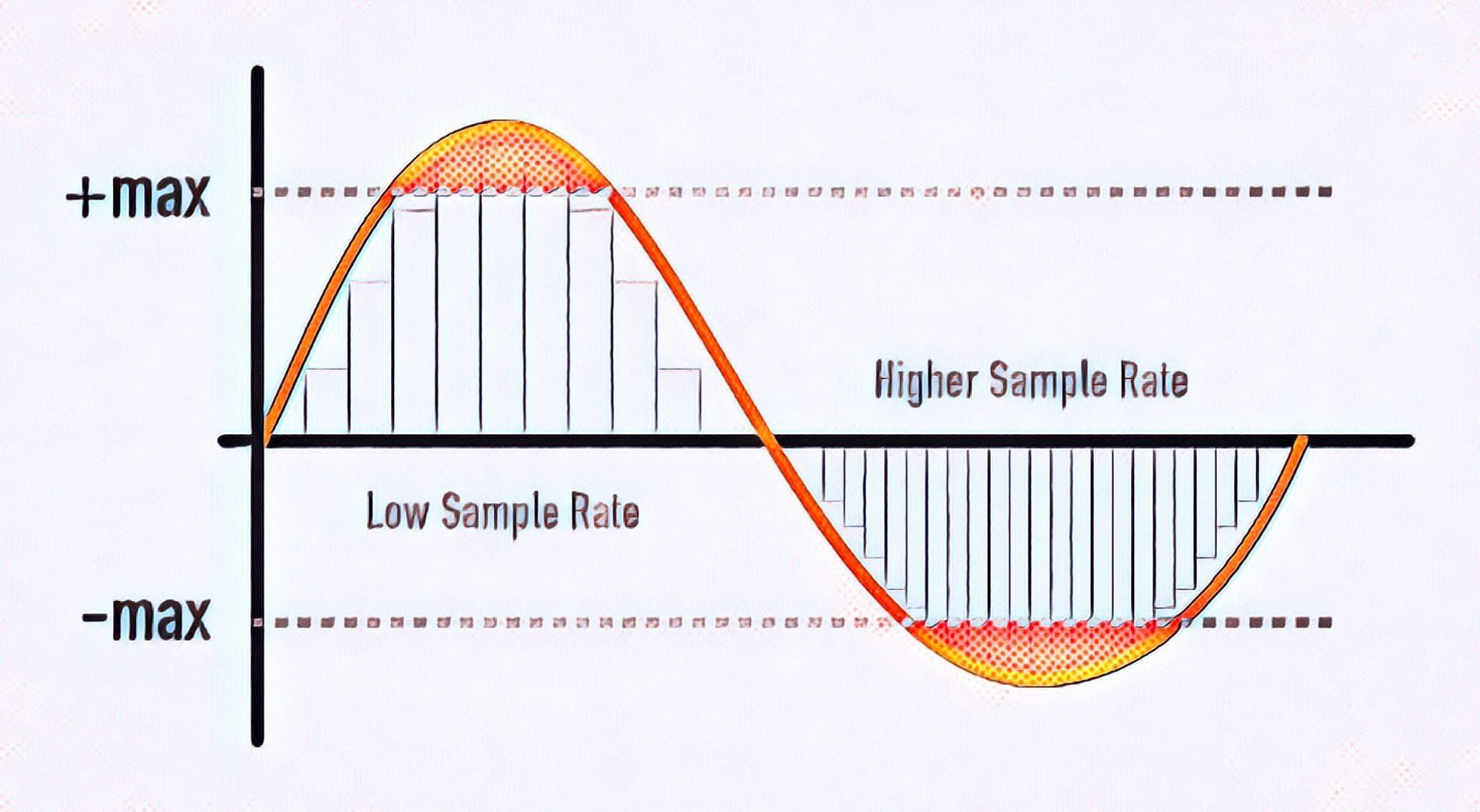
Also, it’s important to note that bitrate isn’t the only factor that affects the audio quality of an MP3. Other important factors include the sample rate and the number of channels. The sample rate refers to the number of times the sound is measured per second, while the number of channels refers to the number of audio channels in the file.

For example, an audio file with a bit rate of 128 kbps and a sample rate of 44.1 kHz and 2 audio channels will have higher sound quality than a file with the same bit rate but a sample rate of 22 kHz and 1 audio channel.

In conclusion, if you want to get the best audio quality from an MP3 file, it’s important not only to choose a suitable bitrate, but also to consider the sample rate and number of channels. It is advisable to choose an optimal combination of these factors to obtain the best sound quality.

In addition, it is important to mention that there are other audio formats, such as WAV, FLAC, AIFF, which, unlike MP3, are not compressed, which means that they do not lose audio quality to the compression process. However, these formats often have much larger file sizes than compressed formats like MP3.

So, if you want the best audio quality, it’s recommended to use uncompressed formats like WAV or FLAC, but it’s also important to consider storage space and compatibility with different devices and audio players. In case of opting for compressed formats, it is important to choose an appropriate bitrate and take into account other factors such as the sampling frequency and the number of channels.

In summary, bitrate is an important factor in the audio quality of an MP3 file, but it is not the only factor to consider. It is important to choose a suitable bitrate, as well as take into account the sample rate and the number of channels to obtain the best sound quality. In addition, there are other uncompressed audio formats that offer higher sound quality, but also have a larger file size.



Free Download Mp4Gain
picture


Mp4Gain Main Window
picture


Mp4Gain Features
picture


Free Download Mp4Gain
picture

mp3 audio format, the most popular

mp3 audio format, the most popular

mp3 audio format, the most popular

With the rapid development of file compression technology, MP3 has become the most popular music format today.

mp3 audio format, the most popular

MP3 File Format Analysis MP3 file data is made up of multiple frames, and the frame is the smallest unit of the MP3 file. Each frame consists of a frame header, additional information, and sound data. The playback time of each frame is 0.026 seconds, and its duration varies with the bit rate. Some MP3 files have extra bytes at the end to store description information for non-audio data. The structure of the MP3 file is shown in Figure 2. 3.1 Frame header format The frame header is 4 bytes long. For fixed bitrate MP3 files, the frame header format of all frames is the same. The data structure is as follows: typedef FrameHeader{ unsigned int sync:11;//Sync information unsigned int version:2 ;//version unsigned int layer:2;//layer unsigned int protection:1;//CRC check unsigned int bitrate:4;//unsigned bitrate int frequency:2;//unsigned frequency int padding:1;//unsigned frame length setting int private:1;//unsigned reserved word int mode:2; //unsigned channel mode int mode extension:2;//unsigned extended mode int copyright:1;//unsigned copyright int original:1 ;//unsigned original logo int emphasis:2;//emphasis mode }HEADER, *LPHEADER; See Table 1 for a description of the 4 byte frame header. Table 1 Explanation of the use of MP3 frame header bytes Name Length (bits) Description Synchronization information 11 All bits in the 1st and 2nd byte are 1, and the 1st byte is always FF. Version 200-MPEG 2. 5 01-undefined 10-MPEG 2 11-MPEG 1 layer 2 00-undefined 01-Layer 3 10-Layer 2 11-Layer 1 CRC check 1 0-check 1-no check Bit rate 4 The third bit Tuple sampling rate, the unit is kbps, such as MPEG-1 Layer 3, 64 kbps, the value is 0101. Frequency 2 Sampling frequency, for MPEG-1: 00-44.1 kHz 01-48 kHz 10 -32 kHz 11-setting frame length undefined 1 is used to set the length of the file header, 0-no setting, 1-setting, the specific setting calculation method see below. Reserved word 1 is not used. Channel Mode 2 The fourth byte indicates the channel, 00-Stereo 01-Joint Stereo 10-Dual Channel 11-Mono Expansion Mode 2 Only used when the channel mode is 01. Copyright 1 Whether the file is legal or not, 0-Illegal 1-Original logo legal 1 If original, 0-Not original 1-Original emphasis method 2 Used for classification of sound compensation after noise reduction and compression, which is rarely used and is it may not work in the future. 00-Undefined 01-50/15ms 10-Reserved 11-CCITT J.17 MP3 frame length depends on bit rate and frequency, the calculation formula is: frame length = 144×bit rate∕ frequency+padding For example: bit rate is 64kbps, frequency is 44.1kHz, when padding is 1, frame length is 210 bytes. After the table header there is additional information of variable length. For standard MP3 files, their length is 32 bytes, followed by compressed audio data, which will be decoded when the decoder reads here. For Constant Bit Rate (CBR) MP3 files, not all frames are the same length, and some frames may be one or more bytes longer. There is also Variable Bitrate (VBR) MP3, to minimize the length of MP3 file and ensure sound quality, compared to CBR file, except for the first frame, the rest is the same. The first frame of VBR does not contain audio data and its length is 156 bytes, which is used to store information such as standard audio frame header (4 bytes), VBR file identifier, frame number, number file byte, etc. See table 2 for the description of the structure. Table 2 Description of the first byte of the frame structure of the VBR 1-4 file The same standard sound frame header as CBR 5-40 Store the logo of the VBR file “Xing” (58 69 6E 67), the specific position of this logo depends on the adopted MPEG standard and the sound depends on the channel mode.

mp3 audio format, the most popular

mp3 audio format, the most popular

mp3 audio format, the most popular

With the rapid development of file compression technology, MP3 has become the most popular music format today.

mp3 audio format, the most popular

The encoder transforms the original sound into the frequency domain through a hybrid filter bank. Using a psychoacoustic model, it is estimated that it may be sufficient to be The perceived noise level is then quantized and converted to Huffman coding to form an MP3 bitstream. The decoder is much simpler and its task is to extract the sound signal from the encoded spectral line components through inverse quantization and inverse transformation.
2.4 Modified Discrete Cosine Transform Modified Discrete Cosine Transform (MDCT) refers to converting a set of time-domain data to frequency-domain data for time-domain variation. MDCT is an enhancement of the DCT algorithm. The first fast algorithm is the Fast Fourier Transform (FFT), but FFT has operations on complex numbers and MDCT are all operations on real numbers, which is convenient for programming. When compressing audio data, first divide the original audio data into fixed blocks, and then perform forward MDCT (Forward MDCT) to convert the value of each block into MDCT 512 coefficients. When decompressing, the reverse MDCT (Reverse MDCT) The 512 coefficients are restored to the original sound data, and the original sound data before and after are inconsistent, because redundant and irrelevant data are removed during the compression process. The FMDCT transformation formula is: k=0, 1,…, N/2-1 where N is the length of the transformation window, that is, the number of sample points per block, N=8, 16 ,… ., 1024, 2048. n0=(N/2+1)/2, X(n) is the value in the time domain, X(k) is the value in the frequency domain. If N takes 1024 points, it will become 512 frequency domain values. The IMDCT transformation formula is: 4 Modified Discrete Cosine Transform Modified Discrete Cosine Transform (MDCT) refers to converting a set of time-domain data to frequency-domain data to learn the changes in the domain. weather. MDCT is an enhancement of the DCT algorithm. The first fast algorithm is the Fast Fourier Transform (FFT), but FFT has operations on complex numbers and MDCT are all operations on real numbers, which is convenient for programming. When compressing audio data, first divide the original audio data into fixed blocks, and then perform forward MDCT (Forward MDCT) to convert the value of each block into MDCT 512 coefficients. When decompressing, the reverse MDCT (Reverse MDCT) The 512 coefficients are restored to the original sound data, and the original sound data before and after are inconsistent, because redundant and irrelevant data are removed during the compression process. The FMDCT transformation formula is: k=0, 1,…, N/2-1 where N is the length of the transformation window, that is, the number of sample points per block, N=8, 16 ,… ., 1024, 2048. n0=(N/2+1)/2, X(n) is the value in the time domain, X(k) is the value in the frequency domain. If N takes 1024 points, it will become 512 frequency domain values. The IMDCT transformation formula is: 4 Modified Discrete Cosine Transform Modified Discrete Cosine Transform (MDCT) refers to converting a set of time-domain data to frequency-domain data to learn the changes in the domain. weather. MDCT is an enhancement of the DCT algorithm. The first fast algorithm is the Fast Fourier Transform (FFT), but FFT has operations on complex numbers and MDCT are all operations on real numbers, which is convenient for programming. When compressing audio data, first divide the original audio data into fixed blocks, and then perform forward MDCT (Forward MDCT) to convert the value of each block into MDCT 512 coefficients. When decompressing, the reverse MDCT (Reverse MDCT) The 512 coefficients are restored to the original sound data, and the original sound data before and after are inconsistent, because redundant and irrelevant data are removed during the compression process. The FMDCT transformation formula is: k=0, 1,…, N/2-1 where N is the length of the transformation window, that is, the number of sample points per block, N=8, 16 ,… ., 1024, 2048. n0=(N/2+1)/2, X(n) is the value in the time domain, X(k) is the value in the frequency domain.

mp3 audio format, the most popular

mp3 audio format, the most popular

mp3 audio format
mp3 audio format

With the rapid development of file compression technology, MP3 has become the most popular music format today.

mp3 audio format
mp3 audio format

High-quality music quickly spreads to all parts of the world with the arrangement of 0 and 1, shaking people’s hearts. What is MP3? The full name of MP3 is MPEG Audio Layer 3. It is an efficient computer audio coding scheme. It converts audio files into smaller files with .MP3 extension with a higher compression ratio and basically maintains the sound quality of the file. original. MP3 is part of the ISO/MPEG standard. The ISO/MPEG standard describes audio compression using a high-performance perceptual coding scheme. This standard has been continuously updated to meet the pursuit of “high quality and small quantity”, and now has formed MPEG Layer 1, Layer 2. Layer 3 three audio encoding and decoding schemes. The compression rate of MPEG Layer 3 can reach from 1:10 to 1:12. A 1M MP3 file can be played for 1 minute, while a 1 minute CD-quality WAV file (44100Hz, 16bit, 2ch, 60sec) occupies 10M of space, so Calculated, the time The playback time of a 650M MP3 disc should be more than 10 hours, while the playback time of a CD with the same capacity is about 70 minutes. The advantages of MP3 are unmatched by CD. 2 Analysis of the principle of MP3 2.1 MPEG audio standard MPEG (Moving Picture Experts Group) is a moving picture expert group under ISO, and the MPEG standard formulated by it is widely used in various multimedia. MPEG standards include video and audio standards, among which MPEG-1, MPEG-2, MPEG-2 AAC, and MPEG-4 audio standards have been developed. The MPEG-1 and MPEG-2 standards use the same family of audio codecs: Layer 1, 2 and 3. A new feature of MPEG-2 is the use of low sample rate expansion kits to reduce data traffic , and another feature is the multi-channel expansion kit, which increases the number of main channels to five. Fraunhofer IIS and AT&T released the MPEG-2 AAC (MPEG-2 Advanced Audio Coding) standard in 1997 to significantly reduce data traffic. The MDCT (Modified Discrete Cosine Transform) algorithm adopted by MPEG-2 AAC, The sampling frequency can be between 8 KHz and 96 KHz, and the number of channels can be between 1 and 48. MPEG Audio Layer 1, 2 and 3 use the same filter bank, bitstream structure, and header information, and the sample rate is either 32 KHz, 44.1 KHz, or 48 KHz. Layer 1 is designed for DCC (digital compact cassette) digital compression tape, the data rate is 384 kbps, and layer 2 has made a compromise between complexity and performance, and the data rate has been reduced to 256 kbps- 192kbps. Layer 3 was designed for low data rate from the beginning, and the data rate is 128Kbps-112Kbps. Layer 3 adds MDCT transform, which makes its frequency resolution 18 times higher than that of Layer 2. Layer 3 also uses information averaging similar to MPEG video entropy coding to reduce redundant information. The vast majority of MP3 uses the MPEG-1 standard. 2.2 The purpose of audio compression The MP3 format began in the mid-1980s, and the Fraunhofer Institute in Erlangen, Germany, was committed to high-quality, low-data-rate audio coding. Let’s look at an example: You want to sample a song you like that is about 4 minutes long, store it on a disc, and sample it in CD-quality WAV format at a sample rate of 44.1 kHz, which means receiving 44100 per second. , stereo, each sample data is 16 bits (2 bytes), so the space occupied by this song is: 44100×2 channels x2 bytes x60 seconds x4 minutes=40.4MB If you download this song from the Internet, assume the transmission speed is of 56kbps, the download time is: 40.4x106x8/56x103x60=96 minutes. Even a 1M broadband network takes more than 5 minutes. It can be seen that audio compression is especially important to reduce the storage space of audio data. 2.3 MP3 encoding and decoding MP3 audio compression involves encoding and decoding in two parts. Encoding is turning the data in a WAV file into a highly compressed bitstream, and decoding is taking the bitstream and reconstructing it into a WAV file. MP3 uses a distortion algorithm called Perceptual Audio Coding. The frequency range of sound perceived by the human ear is from 20 Hz to 20 kHz. MP3 cuts out a lot of redundant and irrelevant signals.

MP3 encoder

MP3 encoder

Mp3 Encoder
Mp3 Encoder

1. MP3 Encoder FAQ

Mp3 Encoder
Mp3 Encoder

: what is an MP3 encoder?
An MP3 encoder is a piece of software that uses the MP3 codec algorithm (compression/decompression) to create mp3 files. Most encoders only convert
a WAV file to an MP3 file, although many can convert other formats such as WMA, Real Audio, Ogg, etc.

There are only a few standalone encoders, and a lot of software also only uses 4 main encoding engines, largely due to
to Fraunhofer Gesellschaft patents and various companies helping with ISO sources. Although no company owns the license, the
Developers must pay expensive license fees no matter what proprietary MP3 encoder they use. Major MP3 encoding engines include: LAME (
non-ISO source), BladeEnc, Fraunhofer, and Real Networks’ Xing encoder.

– How does the MP3 encoder work?
The core technology under MPEG-Layer 3 is included in the MP3 encoder. The decoding process uses a series of algorithms and rules to compress audio.
The encoder also detect sounds that occur at the same time
and they try to rule out any that might be “masked” or “inaudible” by other sounds.

– What is a good MP3 encoder?
Xing is the fastest encoder in terms of speed, but the worst in quality. For smaller file sizes, Fraunhofer FastEnc
offers the best quality. LAME is a very good encoder, and one version is faster than the previous one, BladeEnc
it is the best quality for large files, but very slow.

2. Dissection of MP3 files
In addition to proficiency in using the basic features of the MP3 encoder, ordinary users do not need to know how the internal structure of the MP3 file is encoded, just like the situation when
face JPEG or DOC files. Out of morbid curiosity, here’s an X-ray view of an MP3 file:

– Box header
As mentioned above, MP3 files are made up of thousands of “frame frames”, each frame containing a part (second part) of valuable audio data.
for the decoder to reconstruct the audio data. The first part above is the box header. (Frame Header), which consists of 32-bit metadata related to the
later data, see the figure below. The MP3 header begins with an 11-bit “sync timing” block, which allows the player to seek and lock the first
legal framework available, which is useful in MP3 streaming, which can quickly move or jump ID3 from the playback source block to a normal one.
position . However, simply detecting synchronized blocks is theoretically not enough, so it is necessary to check the header.

– transmission lock
MP3 was originally designed for broadcast, and as a result it became important that the MP3 receiver could be synchronized with the signal at any part of the broadcast,
so the frame header is placed at the beginning of any frame transmission, so when an MP3 receiver “tunes” to a data stream, it picks up the
signal instantly and you can play it immediately. Interestingly, this fact makes it possible to cut MPEG files into small segments, each of which can be played independently. But unfortunately
not possible in 3-layer (MP3) files, where frames often depend on other frames, so you can’t just
Edit .

– Frames per second
Just as the movie industry has a standard for the number of frames per second in film to ensure proper viewing on any projector,
A similar standard is used in the MP3 standard, regardless of the file’s bitrate, MPEG-1 A frame in the file is 26 ms, approximately 38 fps frames per second. If the bit rate
is , the frame size is correspondingly larger, and vice versa. Also, the number of samples contained in an MP3 frame is constant, 1152 samples per frame.

The total size of any given frame can be calculated with the following formula:

FrameSize = 144 * BitRate / (SampleRate + Padding).

Why are MP3 bitrates often multiples of 32? (power of 2) part 2

Why are MP3 bitrates often multiples of 32? (power of 2) part 2

MP3 Bitrate
MP3 Bitrate

Depending on the resource, VBR can be encoded by changing the bitrate between a fixed rate above each frame, or by sharing the available bits in adjacent frames (effectively producing a non-standard bitrate for the two frames combined).

MP3 Bitrate
MP3 Bitrate

the fixed frame depends on the sampling rate, 1152 samples per frame. There is no limit to the size of the frame itself, nor to the base 2 size of the frame (ie 417 bytes for a 128 kbit/s MP3 sampled at 44.1 kHz).

In the end, a file encoded at 126kbps will sound worse than a file encoded at 128kbps, and similarly a file encoded at 131kbps will sound better. However, MP3s are encoded according to the compression psychoacoustic model of a specific encoder. The amount by which a file sounds “better” or “worse” at a given bitrate largely depends on the algorithm used to implement the model, but in general higher bitrates allow for more data, presumably for rebuild a more accurate original transmission. audio signal

Why are MP3 bitrates often multiples of 32? (power of 2)

Why are MP3 bitrates often multiples of 32? (power of 2)

MP3 Bitrate
MP3 Bitrate

Some people say:

MP3 Bitrate
MP3 Bitrate

I understand why multiples of 2 often show up on computers since they are binary, but I can’t figure out how the most common mp3 bitrates (64kbps, 128kbps, 160kbps, 192kbps, 256kbps, 320kbps, etc.) also tend to follow this rule.

Since MP3 is just a sequential encoding of sound waves, why is it important to represent each second in kilobits divisible by 2?
Does a music player like iTunes continue to read the file and play the encoded sound regardless of the second limit, or does it read the file every second?
In the latter case, reading a 256kbps file requires reading slightly fewer memory pages than a 257kbps file, but the player can always read 256KB chunks, regardless of their bitrate, and just process them automatically. incremental, right, Bar?
Are 128kbps MP3 songs popular simply because it’s a generally accepted bitrate, or do they really have any advantages over 126kbps and 131kbps files, apart from a very slight difference in quality/file size?

For constant bit rate (CBR) encoding, the MPEG-1 Audio Layer III standard specifies standard bit rates of 32, 40, 48, 56, 64, 80, 96, 112, 128, 160, 192, 224, 256 and 320 kbit/second. There are a few others defined in the MPEG-2 standard, but they are also multiples of 2 (actually all multiples of 8 in the range 8 to 160 – see the table called “Bitrate Index” in the link above) .

Technically, there is nothing that limits the MP3 bitrate to a multiple of 2, since variable bitrate encoding can be used, or a custom bitrate can be achieved using some flags not used in the MPEG specification ( although this must be implemented manually). . In order for MP3 to be MPEG-compliant, and therefore compatible with most MP3 decoders, it must have a bitrate defined by the specification, so all CBR-encoded MP3 files have a bitrate of two.

Audio bit rate, bit rate

Audio bit rate, bit rate

Mp3 bitrate
Mp3 bitrate

Bit rate refers to the number of bits (bits) transmitted per second. The unit is bps (Bit per second) The higher the bit rate, the faster the data transmission speed.

Mp3 bitrate
Mp3 bitrate

Bitrate in sound refers to the amount of binary data per unit of time after converting an analog sound signal to a digital sound signal, which is an indirect measure of audio quality.


Bitrate refers to the sampling rate at which digital sound is converted from analog to digital format. The higher the sampling rate, the better the quality of the restored sound. As a benchmark for the efficiency of digital music compression, bit rate indicates the rate of the number of bits bps (bit per second, bits per second) transmitted per unit of time (1 second). Kbps (in layman’s terms is 1000 bits per second) is usually used as the unit. The bit rate of digital music on CD is 1411.2 kbps (that is, to burn 1 second of CD music, 1411.2 × 1024 data bits are required), the high BIT RATE of the digital music file music means that it should be processed in a unit of time (1 second) The amount of data (BIT) is large, which means that the sound quality of the music file is good. However, when the BITRATE is high, the file size increases, which will take up a lot of memory capacity. The most commonly used bitrate for music files is 128 kbps, and MP3 files can generally use 8 to 320 kbps. In the same way, most of them are 32-256 Kbps. Of course, the wider the rate, the better, but 320 Kbps is the highest level at the moment.


Bitrate calculation formula
The basic algorithm is: [Bit rate] (kbps)=[file size] (bytes) X8/[time] (seconds)/1000

Special algorithm for audio files: [bit rate] (kbps) = [quantization sample point] (kHz) × [bit depth] (bit/sampling point) × [number of channels] (typically 2)

For example, the D5 drive has a capacity of 4.3G, which takes into account different audio formats, so it is calculated as 600M (so the remaining capacity is 4.3*1000-600=3700M), so the video file should not be larger than 3.7G, in this example, take The capacity of the video file is 3.446G, and the length of the video is 100 minutes (6000 seconds). The calculation result: the bit rate is approximately equal to 4933kbps.

What is a good bitrate guide for mp3 files? Part 2

What is a good bitrate guide for mp3 files? Part 2

Mp3 Bitrate
Mp3 Bitrate

To produce high-quality MP3 files of classical and jazz music, the optimal bitrate depends on the characteristics of the song.

Mp3 Bitrate
Mp3 Bitrate

Smooth jazz can usually be copied at 192kbps to create a good balance between file size and diminishing returns, although 256kbps may sound better in a home entertainment center. A classical orchestra should be 256kbps for a portable player, but if you want to burn a CD at home or in your car, a 320kbps file might be a better option.

For saturated music such as hard rock, metal, arena, pop, electronic and house music, 320 kbps will provide the best results. The higher the number of bits per second, the more complex acoustic envelope will be preserved.

If possible, it’s best to create MP3 files with variable bit rates. This allows the encoding program to determine if a particular frame of music requires the full bit rate. Otherwise, the program will reduce data retention for that frame, resulting in a smaller file without sacrificing quality. Forcing the program to “oversample” frames can produce artifacts.

While this article is intended as a general guide, he or she may be equally satisfied with a lower bitrate for a particular song or songs in general. Many factors affect our ability to judge the quality of music, not only the devices we use but also our activities while listening to it. For example, for those who listen to MP3 files while exercising or taking a walk, external noise can make it more difficult to tell the difference in quality. Conversely, audiophiles may prefer to sample at 320kbps, regardless of their equipment, type of music, or listening habits.

If you create your own MP3 files, there are other settings that affect quality. LAME is an excellent MP3 encoder that is free and has many graphical interfaces as the interface for this popular command line program. LAME allows users to adjust many settings to generate high-quality MP3 files in seconds. You can also experiment with various bitrates in your source file to find the best subjective balance between quality and file size.

What is a good bitrate guide for mp3 files?

What is a good bitrate guide for mp3 files?

Mp3 Bit Rate
Mp3 Bit Rate

(a good bitrate guideline for mp3 files?)

Mp3 Bit Rate
Mp3 Bit Rate

MP3 files are compressed audio files created from audio formats such as wave (.wav). Wave files replicate analog recordings and digital sound files at the expense of large file size, while MP3 files sacrifice some quality for a smaller footprint. There are several factors that mitigate the quality sacrifice during the conversion process. With the correct bitrate and settings, MP3 files can provide very high quality results, making them very close to the original wave files when played on portable audio players.

An mp3 player.

The balance between file size and quality is somewhat subjective. For audiophiles, any difference is noticeable. Others may simply not be able to tell the difference between a high quality MP3 file and a raw wave source. In many cases, the nuances of the sound environment will only become clearer when played through a high-quality stereo system.

MP3s are compressed digital music files that sacrifice quality for file size.
MP3 files are primarily targeted at portable audio players. In this field, high-quality MP3 files are played with incredible sound due to their small file size. With the limited memory of portable players, it makes sense that one would want MP3 files to be as small as possible while maintaining the highest possible quality.

For this, one of the most important factors when creating MP3 files is the bit rate. In general, the more bits per second that are preserved from the original file, the higher the quality of the MP3 and the larger the file size. Lower bit rates reduce size and quality. The idea is to use the bitrate for maximum realism without saving unnecessary data, which just creates larger files with no noticeable difference to the ear.

For voice recordings such as lectures or language lessons saved to waveforms, a bit rate of 32 kilobits per second (kbps) is acceptable, although 64 kbps may offer better quality, depending on the source. At 32 kbps, the sound may sound “flat”, but that’s understandable. A 64 kbps MP3 file created from a voice recording should sound nearly identical to the original.

Desaturated acoustic music with simple arrangements should work fine at 192kbps bitrate. You can choose 256 kbps if the music will be played on a high quality device. Music that falls into this category includes folk, boy band songs, easy listening, and folk music. There are also works by many classic artists such as James Taylor, Linda Longstadt, Jonny Mitchell, and Simon Garfunkel.