The bitrate and its relationship with the audio quality in an MP3


Free Download Mp4Gain
picture

The bitrate and its relationship with the audio quality in an MP3

The bitrate and its relationship with the audio quality in an MP3

The bitrate is a measure of the amount of audio information that is encoded per second in a compressed audio file, such as an MP3. Bit rate is measured in kilobits per second (kbps).

The bitrate and its relationship with the audio quality in an MP3

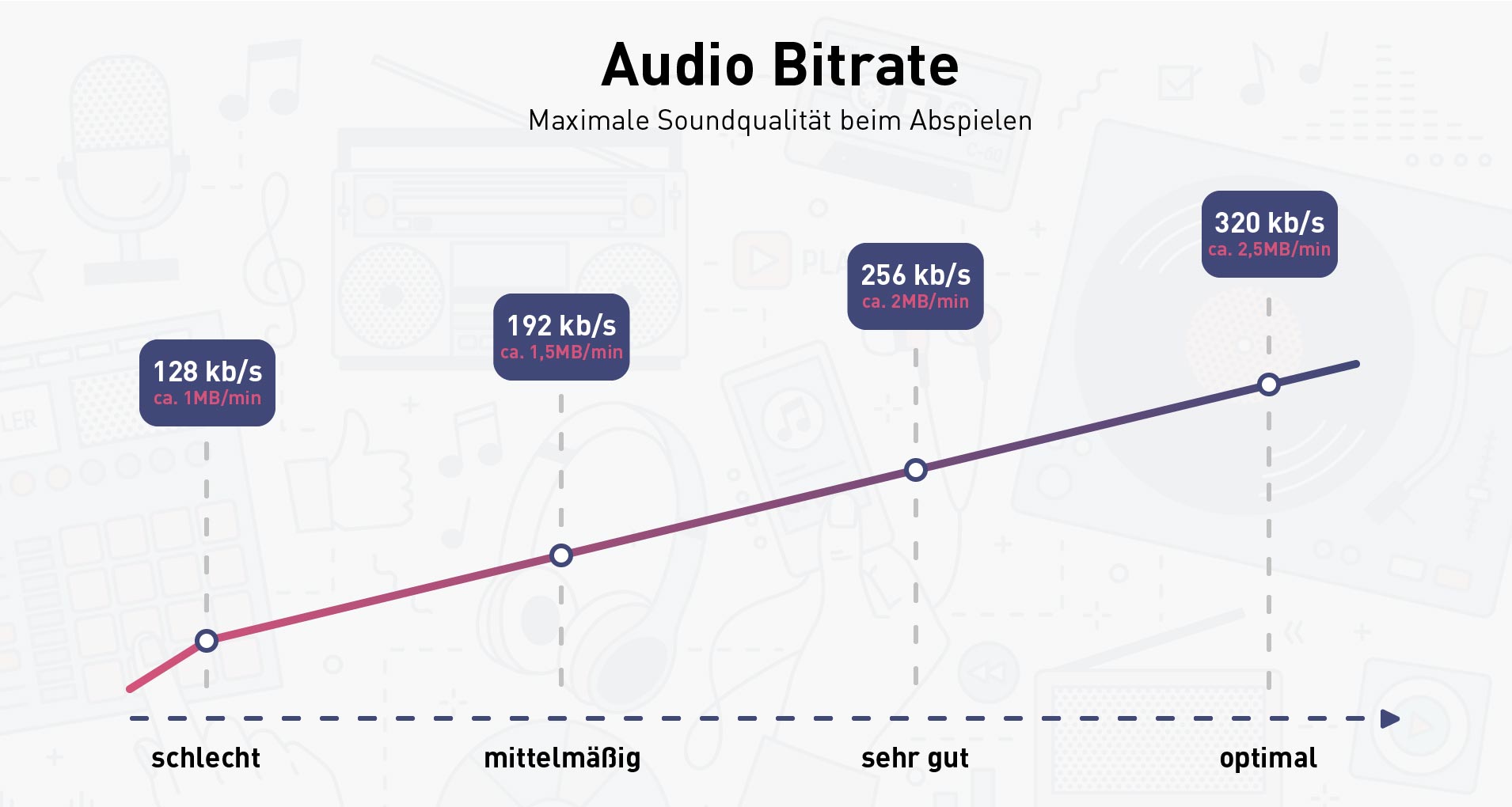
The higher the bitrate, the higher the audio quality. However, a larger file size will also be required to store the same amount of audio time. Therefore, it is important to choose a suitable bitrate to balance quality and file size.

For music files, a bitrate of at least 128 kbps is recommended for decent sound quality. However, if you want higher sound quality, you can go for a higher bitrate, such as 256 kbps or even 320 kbps.

For voice audio files, a bit rate of 64 kbps is sufficient for clear sound quality. However, if you want higher sound quality, you can go for a higher bitrate, such as 96 kbps or 128 kbps.

In short, bitrate is an important factor in the audio quality of an MP3 file. It is important to choose a suitable bitrate to balance quality and file size.

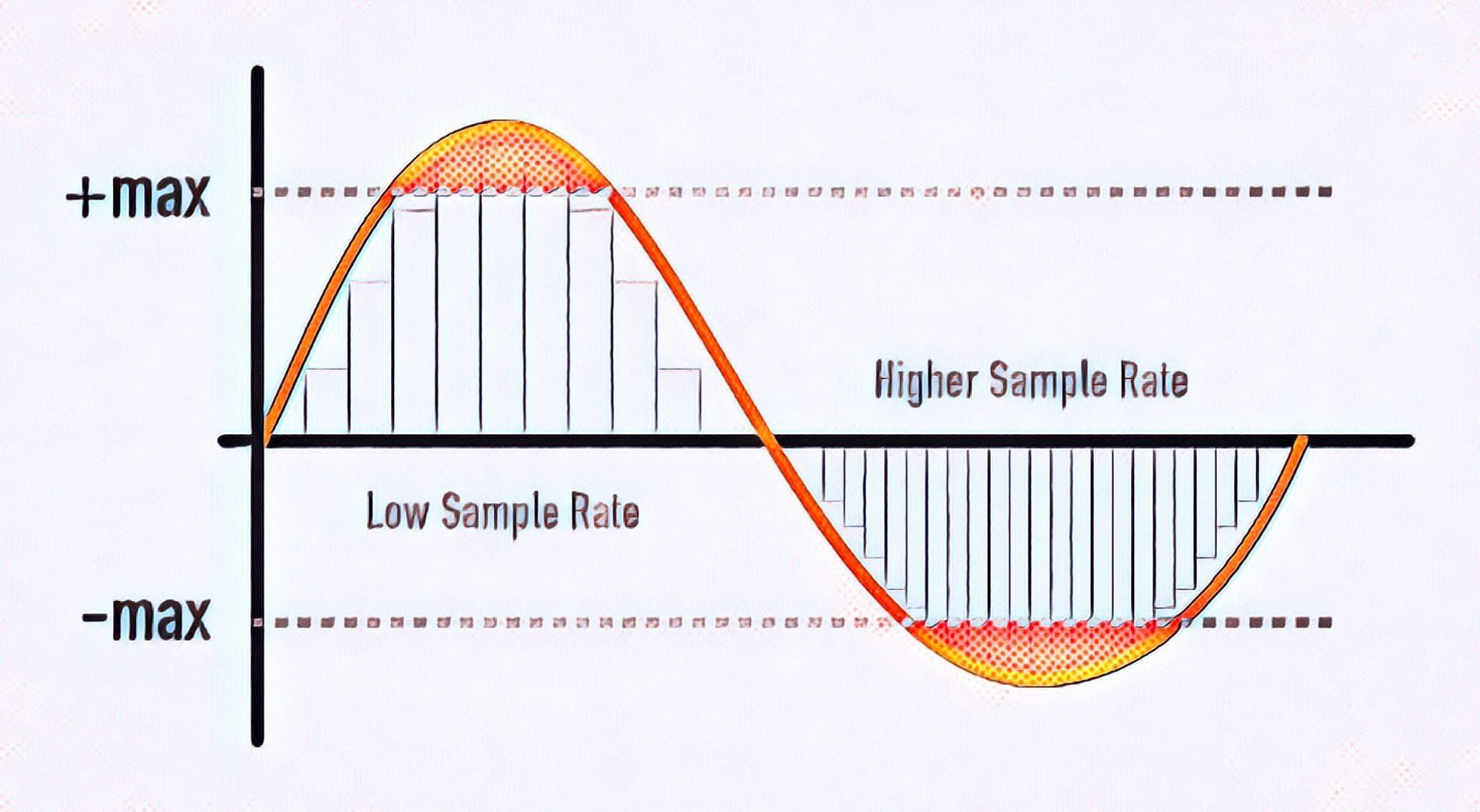
Also, it’s important to note that bitrate isn’t the only factor that affects the audio quality of an MP3. Other important factors include the sample rate and the number of channels. The sample rate refers to the number of times the sound is measured per second, while the number of channels refers to the number of audio channels in the file.

For example, an audio file with a bit rate of 128 kbps and a sample rate of 44.1 kHz and 2 audio channels will have higher sound quality than a file with the same bit rate but a sample rate of 22 kHz and 1 audio channel.

In conclusion, if you want to get the best audio quality from an MP3 file, it’s important not only to choose a suitable bitrate, but also to consider the sample rate and number of channels. It is advisable to choose an optimal combination of these factors to obtain the best sound quality.

In addition, it is important to mention that there are other audio formats, such as WAV, FLAC, AIFF, which, unlike MP3, are not compressed, which means that they do not lose audio quality to the compression process. However, these formats often have much larger file sizes than compressed formats like MP3.

So, if you want the best audio quality, it’s recommended to use uncompressed formats like WAV or FLAC, but it’s also important to consider storage space and compatibility with different devices and audio players. In case of opting for compressed formats, it is important to choose an appropriate bitrate and take into account other factors such as the sampling frequency and the number of channels.

In summary, bitrate is an important factor in the audio quality of an MP3 file, but it is not the only factor to consider. It is important to choose a suitable bitrate, as well as take into account the sample rate and the number of channels to obtain the best sound quality. In addition, there are other uncompressed audio formats that offer higher sound quality, but also have a larger file size.


Free Download Mp4Gain
picture


Mp4Gain Main Window
picture


Mp4Gain Features
picture


Free Download Mp4Gain
picture

Why are MP3 bitrates often multiples of 32? (power of 2)

Why are MP3 bitrates often multiples of 32? (power of 2)

MP3 Bitrate
MP3 Bitrate

Some people say:

MP3 Bitrate
MP3 Bitrate

I understand why multiples of 2 often show up on computers since they are binary, but I can’t figure out how the most common mp3 bitrates (64kbps, 128kbps, 160kbps, 192kbps, 256kbps, 320kbps, etc.) also tend to follow this rule.

Since MP3 is just a sequential encoding of sound waves, why is it important to represent each second in kilobits divisible by 2?
Does a music player like iTunes continue to read the file and play the encoded sound regardless of the second limit, or does it read the file every second?
In the latter case, reading a 256kbps file requires reading slightly fewer memory pages than a 257kbps file, but the player can always read 256KB chunks, regardless of their bitrate, and just process them automatically. incremental, right, Bar?
Are 128kbps MP3 songs popular simply because it’s a generally accepted bitrate, or do they really have any advantages over 126kbps and 131kbps files, apart from a very slight difference in quality/file size?

For constant bit rate (CBR) encoding, the MPEG-1 Audio Layer III standard specifies standard bit rates of 32, 40, 48, 56, 64, 80, 96, 112, 128, 160, 192, 224, 256 and 320 kbit/second. There are a few others defined in the MPEG-2 standard, but they are also multiples of 2 (actually all multiples of 8 in the range 8 to 160 – see the table called “Bitrate Index” in the link above) .

Technically, there is nothing that limits the MP3 bitrate to a multiple of 2, since variable bitrate encoding can be used, or a custom bitrate can be achieved using some flags not used in the MPEG specification ( although this must be implemented manually). . In order for MP3 to be MPEG-compliant, and therefore compatible with most MP3 decoders, it must have a bitrate defined by the specification, so all CBR-encoded MP3 files have a bitrate of two.

What is a good bitrate guide for mp3 files?

What is a good bitrate guide for mp3 files?

Mp3 Bit Rate
Mp3 Bit Rate

(a good bitrate guideline for mp3 files?)

Mp3 Bit Rate
Mp3 Bit Rate

MP3 files are compressed audio files created from audio formats such as wave (.wav). Wave files replicate analog recordings and digital sound files at the expense of large file size, while MP3 files sacrifice some quality for a smaller footprint. There are several factors that mitigate the quality sacrifice during the conversion process. With the correct bitrate and settings, MP3 files can provide very high quality results, making them very close to the original wave files when played on portable audio players.

An mp3 player.

The balance between file size and quality is somewhat subjective. For audiophiles, any difference is noticeable. Others may simply not be able to tell the difference between a high quality MP3 file and a raw wave source. In many cases, the nuances of the sound environment will only become clearer when played through a high-quality stereo system.

MP3s are compressed digital music files that sacrifice quality for file size.
MP3 files are primarily targeted at portable audio players. In this field, high-quality MP3 files are played with incredible sound due to their small file size. With the limited memory of portable players, it makes sense that one would want MP3 files to be as small as possible while maintaining the highest possible quality.

For this, one of the most important factors when creating MP3 files is the bit rate. In general, the more bits per second that are preserved from the original file, the higher the quality of the MP3 and the larger the file size. Lower bit rates reduce size and quality. The idea is to use the bitrate for maximum realism without saving unnecessary data, which just creates larger files with no noticeable difference to the ear.

For voice recordings such as lectures or language lessons saved to waveforms, a bit rate of 32 kilobits per second (kbps) is acceptable, although 64 kbps may offer better quality, depending on the source. At 32 kbps, the sound may sound “flat”, but that’s understandable. A 64 kbps MP3 file created from a voice recording should sound nearly identical to the original.

Desaturated acoustic music with simple arrangements should work fine at 192kbps bitrate. You can choose 256 kbps if the music will be played on a high quality device. Music that falls into this category includes folk, boy band songs, easy listening, and folk music. There are also works by many classic artists such as James Taylor, Linda Longstadt, Jonny Mitchell, and Simon Garfunkel.

What is bit rate? Knowledge of the MP3 audio format.

What is bit rate? Knowledge of the MP3 audio format.


bit rate
bit rate

Digital audio formats are audio signals that are recorded, processed, and reproduced in digital form.

bit rate
bit rate

The emergence of digital audio formats is to meet the needs of high-fidelity playback, storage and transmission. Simply put, early analog audio formats had issues with playback distortion and glitches due to media wear. Since the advent of the CD, digital format audio files have become popular, but another problem has arisen: the limitation of the storage volume, and the CD still has the phenomenon of wear. Saving to hard drive (relatively longer storage time) is not a good solution when storage media (mainly hard drives) are still expensive at the time. The rise of the Internet has created a requirement for long-distance file transmission. Under the restriction of bandwidth, the demand to reduce file size has become more intense. All this has led to the generation of lossy compressed digital audio formats from external factors!

In terms of internal factors, with the improvement of computing and coding capabilities, the progress of various acoustic psychological models has promoted the emergence of various lossy compressed digital audio formats. Some of the most commonly used audio formats in MP3 players are briefly introduced below: MP3 (CBR, VBR, ABR), WMA, WAV, ADPCM, and the emerging audio formats AAC, ASF, and OGG.

Before introducing various digital audio formats, let’s clarify one concept: bitrate.

In the field of computing, all information is digitized. Bit is the smallest unit of data in a computer, it refers to a number of 0 or 1, which is a mathematical binary number, a “0” or “1” , is a bit. For example, when we say a 2-digit number, it means that it is a two-digit binary number, and there are 4 combinations of “00”, “01”, “10” and “11”, which represent 0, 1, 2 and 3 is four numbers.

The video format conversion bit rate

The video format conversion bit rate

video format conversion bit rate

Image quality, i.e. clarity, is a combination of several factors, in addition to bit rate and resolution, including frame rate.

video format conversion bit rate

Video formats basic knowledge quote: We tell you about MKV, MP4, H.265, bitrate, color depth, etc. – 4K Knowledge Encyclopedia – 4K China Forum – 4K123!

This tutorial is meant to cover some basic video and audio concepts and terminology. You can answer the following frequently asked questions in more detail:
do
What is the difference between these MP4/MKV formats? Which image is better?
How is the video bitrate calculated? Why is it the same 1080p video, some big and some small?
In what format is the image information stored in the video? Is it the same red, green and blue as the monitor?
What exactly does 8bit/10bit mean? Why is it necessary to watch 10-bit video on an 8-bit monitor?
yuv420/444 What do these signs mean? Which is better?
What exactly do lines, planes, textures mean? Why does the video have high and low frequency?
The higher the bitrate, the better the video quality?
This tutorial will be described in detail in the following modules:
1. Encapsulation format (MP4/MKV…) vs media format (H.264/FLAC/AAC…)
2. Basic video parameters: resolution, frame rate and bit rate
3 Image rendering method: RGB model vs YUV model
4, color depth
5, medium chroma sampling
6, low frequency and high frequency in space: plane, texture and line
7, low frequency and high frequency over time: dynamic8
, clarity and brief description

image quality 1. Packet format (MP4/MKV…) vs. media format (H.264/FLAC/AAC…)
MP4+MKV is the most common type of video files you download. These files are actually similar to a package and their suffix is ​​the packaging method of the package. These packages contain video (image only), audio (sound only), subtitles, etc. When the player is playing, please unpack the package first.(The professional term is called separation/division), take out the video, audio, etc., and then play it.

Since they’re just one package, that means the suffix doesn’t guarantee what’s inside or how much. Each element of the package, we call it a track, generally has the following:

Video (Video): In general, there should be, but there are exceptions, such as external audio track in mka format, in fact, there is no mkv video. Please note that when we talk about video, we do not include sound.
Audio (audio): Generally speaking, there should be, but in some cases it is muted, so there is no need to bring it.
Chapter: The segment information that came with the original Blu-ray disc. If the file is checked out, you can see the effect with the chapters in the player:
.potplayer right click screen, option-play-show marker/chapter marker in progress bar.mpc -hc
right click screen, option-setting-on Progress bar shows chapter mark subtitles
(Subtitles): Sometimes the file comes with subtitles, and the subtitles are not directly embedded in the hard subtitles of the video, so they are packed together in the packing container.
Others may have attachments etc which are not listed one by one. There is not necessarily a single track for each type, as MKVs with multiple audio tracks are often seen.

Each track has its own format. For example, it is often said that the video is H.264, the audio is AAC, these are the formats of each track.
Common video formats are H.264 (can be subdivided into 8bit/10bit), H.265 (currently also subdivided into 8bit/10bit), RealVideo (common in early rm/rmvb), VC- 1 (Microsoft-led, common in wmv). Basically H.264=AVC=AVC1, H.265=HEVC.
There are four common audio formats: FLAC/ALAC/TrueHD/DTS-HD MA, which are lossless, and AAC/MP3/AC3/DTS (Core), which are four lossy.

MKV vs MP4, the main differences are:

1. MKV supports encapsulation of FLAC as audio, while MP4 does not. But MP4 can also encapsulate lossless audio tracks (like ALAC, although it is generally believed that the efficiency of ALAC is not as good as FLAC)
2. MKV supports encapsulation of subtitles in ASS/SSA format, but MP4 does not. The subtitles produced by the general subtitle group are in ASS format, so internal subtitles are more common in the MKV format.
3. MP4 is an industry standard and its compatibility with video editing software and playback devices is generally better than MKV. That’s why vcb-s basically chooses the MP4 package for those videos that are optimized for mobile devices.
Beyond that, the two formats are largely interchangeable. For example, they all admit

What is the bitrate of the mp4 video?

What is the bitrate of the mp4 video?

Mp4 Bitrate

The mp4 video bitrate is usually set to around 800.

mp4 bit rate

The basic algorithm is: bit rate (kbps) = file size (KB) * 8 / time (seconds), for example, D5 disk, the capacity is 4.3G, which takes into account the different audio formats, it is calculated as 600M, (so the remaining capacity is 4.3*1024-600=3803.2M), so the video file should be no more than 3.7G.

And if the capacity of the video file is 3.446G and the length of the video is 100 minutes (6000 seconds), the calculation result: the bit rate is approximately equal to 4818kbps (3.446*1024*1024*8/6000= 4817,857).

Bit Efficiency:

1. The bit rate in sound refers to the amount of binary data per unit time after converting the analog sound signal into a digital sound signal, which is an indicator to indirectly measure the audio quality. The principle of bitrate in video is the same as in sound, both refer to the amount of binary data per unit of time after the analog signal is converted to a digital signal.

2. In channel coding, a source data block of symbol size K is mapped to a codeword of symbol size N through coding, and K/N becomes the code rate, where assumes that the symbol table before and after encoding does not change.

The frame rate of 29.97 is the best.

usually:

1080*720 split resolution is about 5000K;

720*576 resolution is about 3500K;

640*480 resolution is about 1500K.

Extended information:

Some code rate principles:

1. Bitrate is proportional to quality, but file size is also proportional to bitrate.

2. If the bitrate exceeds a certain value, it has little effect on the image quality.

3. DVD capacity is limited, whether it is 4.3G standard, overdubbed or D9, there are limits. The information in the computer is represented by binary 0 and 1, and each 0 or 1 is called a bit, which is represented by a lowercase b, that is, bit (bit); uppercase B is byte, ie byte, one byte = Eight bits, ie 1B=8b; the capital K in front means 1024, that is, 1024 bits (Kb) or 1024 bytes (KB). Indicates the size of the file, usually using bytes (KB) to indicate the size of the file.

What is the bit rate in a Mp4?

What is the bit rate in a Mp4?

Mp4 Bitrate

Bit rate, also known as data transfer rate, is measured in seconds and determines the rate at which data travels through a communications network. Both video and audio have bit rates, and understanding what that is will help you better deal with your media.

Mp4 Bitrate

1. What is video bit rate (MP4)?

Video bit rate is defined as the number of bits that are processed and the unit is measured in bits per second. This is the speed at which the video is streaming at any given time. The higher the bitrate of mp4, the greater the data transfer at any given time. The exact bit rate of a video can be determined based on the device it will be played on. Good quality video on the web has a bit rate of about 2 Mbps, while standard definition DVDs have a bit rate of 6 Mbps.

2. What is the audio bit rate (MP3)?

The audio bit rate is defined as the number of bits that are used for the playing time per unit to represent the audio after encoding the source. It is defined as the degree of compression used to encode files in the audio aspect. The higher the MP3 bit rate, the better the sound quality and file size.

Part 2. How to choose the right bitrate for your video / audio
After examining the definition of video and audio bit rate, you should know how to choose the correct bit rate for your video or audio files. Since bit rate is related to the quality and size of your video and audio, it is important to choose and change the bit rate for your file. The two most frequently asked questions are listed below:

1.What is a good 1080p bitrate to upload to YouTube?

For YouTube uploads, the recommended video bit rate for a 1080p file is 8 Mbps for standard frame rates (24, 25, and 30). For high frame rates (48, 50, 60), the recommended bit rate for 1080p files is 12 Mbps.

2. What is the best bit rate for iTunes Audio?

Music files in the iTunes store are encoded in 256 kbps AAC by default. Previously, the bitrate of an iTunes song was 128 kbps and now it is 256 kbps. AAC codec files support up to 320 kbps.

Part 3. How to Change Video Bitrate with Simple Steps
There are many ways to compress a video, for example change the video resolution, trim the unwanted part, and convert the video format. However, changing the video bitrate is also a good option.