How digital compression works. Part 4
Record labels are good too: contrary to what music lovers expected, they didn’t take full advantage of the new high-definition format. The studios did not record music from the master tape in DSD, instead taking a digital recording in PCM, remixing and processing everything in a row: limiters, compressors, noise-shaping dithering, and various digital filters. The result was a sound so sterile and dry that even CD Audio could have sounded much better. In this way, listeners’ trust in SACD and, at the same time, in new formats in general was undermined.
INFO
Unfortunately, with vinyl records, this vicious practice continues to this day: studios print vinyl from a digital recording, even if they have the recording on the master tape. So on modern vinyl it can easily be 44.1 x 16.
DSD
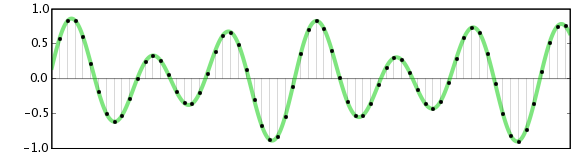
What is DSD? This is a one-bit stream with a very high sample rate compared to PCM. Also, DSD uses a different type of modulation, PDM (Pulse Density Modulation) – pulse density modulation. Sound recording in this format is done by a one-bit analog-to-digital converter, now these ADCs based on sigma-delta modulation are used everywhere. The recording process looks like this: while the amplitude of the wave increases, the ADC output is a logical unit, when the amplitude decreases, the output is a logical zero, there can be no average value. It is compared with the previous value of the wave amplitude.
DSD achieves significant advantages over PCM:
more precisely, draw a wave;
greater immunity to noise;
an easier way to switch and transmit a digital stream;
In theory, it is possible to reduce the cost by simplifying the DAC circuit, but due to backward compatibility, manufacturers are unlikely to accept it.
Originally, SACDs used the DSD x64 format with a sample rate of 2822.4 kHz. The 44.1 kHz audio CD sample rate was taken as the basis, increased 64 times, hence the name x64. The following DSDs are currently in use:
x64 = 2822.4 kHz;
x128 = 5644.8 kHz;
x256 = 11 289.6 kHz;
x512 = 22,579.2 kHz;
declared DSD x1024.
DXD
There is a certain intermediate format between PCM and DSD called DXD – Digital eXtreme Definition. This is, in fact, high definition PCM: 352.8 kHz or 384 kHz with 24 or 32 bit quantization. It is used in studies for the processing and subsequent mixing of materials.
But this approach is flawed: first, it doesn’t allow you to use all the benefits of DSD, and second, the file size is larger than DSD. Currently, flagship DACs on the I2S input accept a PCM data stream with a sample rate of up to 768 kHz and a bit depth of up to 32 bits. It’s scary to even consider how much hard drive space an album will take up at this resolution.
DSD has practically separated from SACD. Now, the DSD format can often be found packaged in files with the DSF and DFF extensions. Many turntables have been released with the ability to record in DSF and DFF, lovers of good sound are increasingly digitizing vinyl records in DSD format. But in recording studios, nobody wants to invest in unpopular formats, so they continue to rivet the sound with minimum wages: 44.1 × 16.
DSD switching and data transmission
To transfer a digital stream to DSD, a three-pin connection scheme is used:
DSD clock pin (DCLK) – sync;
Data input pin DSD Lch (DSDL) – left channel data;
Data input pin DSD Rch (DSDR): right channel data.
Unlike I2S, DSD data transmission is extremely simplified. DCLK sets the clock rate of the bit sync, and the left and right channel data is transmitted sequentially through the DSDL and DSDR pins, respectively. Here there are no adjustments, recording and playback in DSD is done little by little. This approach provides the closest approximation to the analog signal, and due to the high frequency, quantization noise is reduced and reproduction precision is increased by an order of magnitude.
PDO
DoP is often used to carry DSD data streams, so it is worth mentioning. DoP is an open standard for transferring DSD data over PCM frames (DSD over PCM). The standard was created to pass a stream through controllers and devices that do not support direct DSD streaming (not DSD native).
The principle of operation is as follows: in a 24-bit PCM frame, the upper 8 bits are padded with ones; this means that DSD data is currently being transmitted. The remaining 16 bits are sequentially filled with DSD data bits.






:max_bytes(150000):strip_icc()/analog-vs-digital-audio-a-585ae54a3df78ce2c3f0e6c6.jpg)