History of Digital Audio Part 2


Free Download Mp4Gain
picture

History of Digital Audio Part 2

Digital Audio

Different formats use different methods of audio compression, but bit rate still plays a role as a measure of audio quality. The sample rate also plays an important role and the number of hertz shows how many parts per second the file is divided into. The lower limit of the sample rate for audio files is 44.1 kHz (44100 Hz), if it is lower, it is not sufficient.

digital audio

VBR vs CBR

Constant Bit Rate (CBR) and Variable Bit Rate (VBR) are two methods of obtaining Bit Rate. Constant bitrate means that you set a certain bitrate for the entire file, and with a variable bitrate, its value changes throughout the entire music file as needed.

CBR is like packing something in a larger box than necessary, and VBR packs in a box that matches the outline of its contents. People often use an overestimated bit rate of 320 kbps, when this is not necessary, often a VBR of 192 kbps is sufficient. By ear, you are unlikely to feel a difference.

DRM

DRM (Digital Rights Management) is the most terrible invention since the nuclear bomb and is best left untouched. Music stores primarily use DRM protection to protect it from illegal copying and use.

DRM files are not compatible with all players and you may forget to transfer files in MSC / UMS mode with them. DRM-protected music is usually in WMA or AAC formats. In short, the use of DRM only creates additional problems for people.


Free Download Mp4Gain
picture


Mp4Gain Main Window
picture


Mp4Gain Features
picture


Free Download Mp4Gain
picture

History of digital audio
History of digital audio

digital audio

By its nature, sound is an oscillatory movement of particles in an elastic medium that propagates in the form of waves. After it became clear that sound represents such vibrations, the idea came up of recording them by repeating the shape on solid material.

DIGITAL AUDIO

So, in 1877, Thomas Edison created a phonograph, a device for the mechanical recording and reproduction of sound. And in 1888, the German E. Berliner invented the gramophone – the era of gramophone records began, which became the first massive carriers of audio information.

Thomas Edison and his phonograph

FIG. Inventor Thomas Edison and His Record Making: The Phonograph

Having studied the laws of electromagnetism, man made successful experiments to convert sound waves into electromagnetic waves and preserve them. This is how magnetic tape appeared, which became widespread in the middle of the 20th century.

For digital technology to store, process, and reproduce sound, it is converted to digital format by an analog-to-digital converter (ADC), which converts an analog signal into a sequence of numbers. This is called Pulse Code Modulation (PCM).

It happens like this: the ADC measures the amplitude of an analog signal many times per second and outputs the results in the form of numbers. However, the measurement result does not exactly match a continuous electrical signal: it depends on the number of measurements and their precision.

The frequency at which the measurements are taken is called the sample rate, and the precision of the amplitude measurements indicates the number of bits used to indicate the result of the measurement. This parameter is called the bit depth. For example, if the sampling frequency is 44.1 kHz, this means that the signal is measured 44 100 times in one second.

For the analog signal to be accurately reconstructed from its samples, the sample rate must be twice the maximum audio frequency. That is, if the analog signal contains frequency components from 0 Hz to 20 Hz, then the frequency of its sampling must be at least 40 kHz.

Digital audio formats

Of course, for digitized sound to be stored, transmitted, and converted, there must be certain digital sound standards – audio formats. Today, there are many such formats, each of which uses its own sound processing algorithm. They also differ in the information carriers.

The most popular and widespread in the field of home use today are ordinary music CDs – CDs. There are also relatively new recording formats, Super Audio Compact Disk (SACD) and DVD-Audio (or simply DVD-A). In addition, formats that use digital data compression have become widespread.

The most popular among them is MPEG-1/2 / 2.5 Layer 3 (MP3). Microsoft also did not stay away from the sound industry, as it developed its own compression algorithm, WMA, which is also actively promoted in the market.

New audio file formats appear every year, but no player on the market supports the playback of all formats.

In fact, the term MP3 player is only correct for players that support the MP3 format. Let’s see what’s what in audio formats.

Before looking at the various audio file formats (codecs), let’s take a look at a few terms.

Bitrate

Bit rate is the space required for 1 second of music. With a bit rate of 128 kbps (kilobits per second) = 16 kbps (kilobytes per second), approximately 5 megabytes are needed for 5 minutes of music.

The higher the bit rate, the higher the quality of the music. But this as long as the bit rate of the original format is higher than the bit rate of the encoded format. By compressing a CD to MP3 at 320 kbps, you get better sound quality than 128 kbps, but converting from 128 kbps to 320 kbps will not improve the quality and may even degrade it.

Often times a 128kbps bit rate masquerades as CD quality, but this is not actually the case. If you have enough high-quality equipment, you will hear it immediately. Manufacturers like to give an estimate of the number of songs that go into a player at a very low bit rate, and many consumers are unaware that audio files vary in size. Therefore, you should not rely on the numbers in the advertisements, in fact, much less the songs in your collection can fit in the player.

Compression

Uncompressed audio takes up a lot of space. To reduce the size of audio files in formats such as MP3, programs cut off the part of the frequency range that the human ear cannot hear.

Hardware for processing digital audio – Part 4

Hardware for processing digital audio – Part 4

digital audio processing

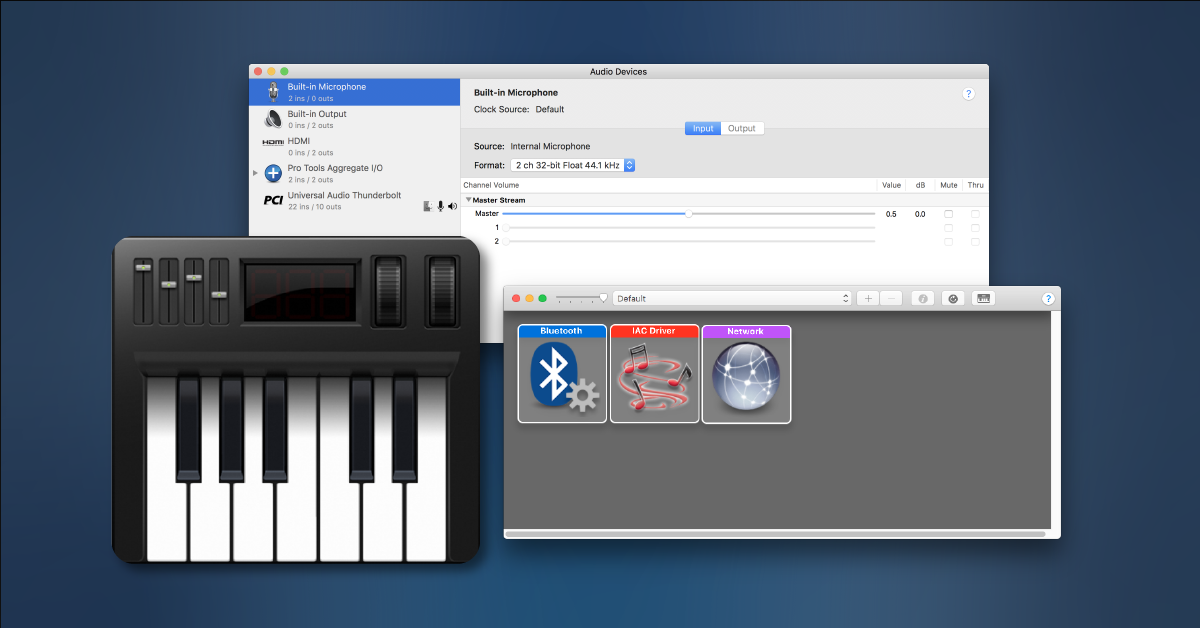
As a practical example of a MIDI device, consider a conventional MIDI keyboard.

DIGITAL AUDIO PROCESSING MAC

Simplified, a MIDI keyboard is a shortened grand piano keyboard in a housing that contains a MIDI interface that allows you to connect it to other MIDI devices, such as a MIDI synthesizer, that is installed on your computer’s sound card. With special software (for example, a MIDI sequencer), you can turn a MIDI synthesizer into play mode, for example, on a grand piano, and by pressing the keys on a MIDI keyboard, you can hear the sounds of a piano from line. Naturally, the matter is not limited to the grand piano: in the GM standard there are 128 melodic instruments and 46 percussion instruments. Additionally, using a MIDI sequencer, you can record notes played on a MIDI keyboard on a computer for further editing and arrangement, or simply to print notes.

It should be noted that since MIDI data is a set of commands, music written using MIDI is also recorded using synthesizer commands. In other words, a MIDI score is a sequence of commands: what note to play, what instrument to use, how much and how much it will sound, etc. Familiar MIDI files (.MID) are more than just a collection of such commands. Naturally, since there are a large number of MIDI synthesizer manufacturers, the same file can sound differently on different synthesizers (because the instruments themselves are not stored in the file, there are only instructions to the synthesizer on which instruments to play. while the differences synths may sound different).

Let’s go back to the consideration of sound cards. As we have already clarified what MIDI is, we cannot ignore the characteristics of the hardware synthesizer built into the sound card. A modern synthesizer, most often, is based on the so-called “wave table” – WaveTable (in short, the principle of operation of such a synthesizer is that the sound in it is synthesized from a set of recorded sounds dynamically superimposing them and change of sound parameters), before the main synthesis type was FM (Frequency modulation: sound synthesis generating simple sinusoidal oscillations and mixing them). The main characteristics of a WT synthesizer are: the number of instruments in the ROM and their volume, the presence of RAM and its maximum volume, the number of possible signal processing effects, as well as the possibility of channel-by-channel effect processing. . (of course, in the case of an effects processor), the number of oscillators that determines the maximum number of voices in polyphonic mode (polyphonic) and, perhaps most importantly, the standard by which the synthesizer is manufactured (GM , GS or XG). By the way, the amount of memory of the synthesizer is not always a fixed value. The thing is that recently synthesizers have stopped having their own ROM, but use the main RAM of the computer: in this case, all the sounds used by the synthesizer are stored in a file on disk and, if necessary, are they read into RAM.

Hardware for processing digital audio – Part 3

Hardware for processing digital audio – Part 3

digital audio processing

A MIDI synthesizer is a synthesizer that meets the requirements of the standard that we will now talk about. MIDI is a generally accepted specification related to the organization of a digital interface for musical devices, which includes a standard for hardware and software.

Digital Audio Processing

This specification is intended to organize a local area network of electronic instruments (Fig. 7). MIDI devices include a variety of musical instruments and hardware that meet MIDI requirements. Therefore, a MIDI synthesizer is a musical instrument, generally intended to synthesize sound and music, and also conforming to the MIDI specification. Let’s briefly see why there is a separate class of devices called MIDI.

The fact is that the implementation of sound processing software is often associated with drawbacks due to various technical characteristics of this process. Even leaving sound processing operations on a sound card or any other equipment, many different problems remain. First, it is often desirable to use hardware synthesis of musical instrument sounds (at least because a computer is too general an instrument, often only a hardware sound and music synthesizer is needed, nothing more). Second, software sound processing is often accompanied by time delays, while concerted work requires instantaneous reception of the processed signal. For these and other reasons, they resort to the use of special equipment for processing, and not computers with special programs. However, when using equipment, there is a need for a single standard that allows devices to connect to each other and combine. It was these prerequisites that led several leading companies in the musical equipment field to approve the first MIDI standard in 1982, which was subsequently continued and continues to this day. What, ultimately, is a MIDI interface and the devices included in it from a personal computer’s point of view?

Hardware: These are installed on the sound card: a synthesizer of various sounds and musical instruments, a microprocessor that controls and controls the operation of MIDI devices, as well as several standardized connectors and cables for connecting additional devices.
Programmatics is a MIDI protocol, which is a set of messages (commands) that describe various functions of the MIDI system and with which communication (information exchange) between MIDI devices takes place. The messages can be considered as a means of remote control.
The scope of this article does not allow us to delve into the description of MIDI in particular, it should be noted, however, that with respect to sound synthesizers, MIDI sets strict requirements for their capabilities, the sound synthesis methods used in them. , as well as for the synthesis control parameters. Furthermore, in order for music created on one synthesizer to be easily transferred and played successfully on another, several standards have been established for the matching of instruments (voices) and their parameters on various synthesizers: the General MIDI (GM) standard, General Synth (GS) and eXtended General (XG). The basic standard is GM, the other two are its logical extensions and extensions.

Hardware for processing digital audio – Part 2

Hardware for processing digital audio – Part 2

Digital Audio Processing

4. Mixing unit. On sound cards, the mixing unit provides adjustment of:

DIGITAL AUDIO PROCESSING

signal levels of the line inputs;
MIDI input and digital audio input levels;
the level of the general signal;
panorama
doorbell.
Let us consider the most important parameters that characterize sound boards and sound-music. The most important characteristics are: maximum sample rate in record mode and in playback mode, maximum sample rate or bit depth (maximum quantization level) in record and playback mode. Furthermore, since sound cards also have a synthesizer, the parameters of the installed synthesizer also refer to its characteristics. Naturally, the higher the quantization level that the card is capable of encoding the signals, the better the signal quality. All modern sound card models are capable of encoding a signal with a 16-bit level. One of the important features is the ability to simultaneously play and record audio streams. Function cards play and record simultaneously is called full duplex (full duplex). There is another characteristic that often plays a decisive role when buying a sound card: the signal-to-noise ratio (Signal-to-noise ratio, S / N). This indicator affects the purity of the signal recording and playback. The signal-to-noise ratio is the ratio between the signal power and the noise power at the output of the device; this indicator is generally measured in dB. A good ratio is 80 to 85 dB; ideal – 95-100 dB. However, it should be noted that the quality of playback and recording is strongly influenced by interference (interference) from other components of the computer (power supply, etc.). As a result, the signal-to-noise ratio may deteriorate. In practice, there are many methods to solve this problem. Some suggest grounding the computer. Others, to protect the sound card from interference as much as possible, “pull” it out of the computer case. However, it is very difficult to completely protect yourself from interference, as even the map elements themselves are created by floating above each other. They are also trying to fight this by filtering every item on the board. But no matter how much effort is made to solve this problem, it is impossible to completely eliminate the influence of external interference.

Another equally important characteristic is the non-linear distortion coefficient, or total harmonic distortion, THD. This figure also critically affects the clarity of the sound. The non-linear distortion coefficient is measured in percentage: 1% – “dirty” sound; 0.1% – normal sound; 0.01%: pure Hi-Fi sound; 0.002% – High Fidelity Sound – Hi-End .. Non-linear distortion is the result of inaccuracy in restoring the signal from digital to analog. Simplified, the process of measuring this coefficient is carried out as follows. A pure sine signal is supplied to the input of the sound card. At the output of the device, a signal is taken, the spectrum of which is the sum of the sinusoidal signals (the sum of the original sinusoid and its harmonics). Then, using a special formula, the quantitative ratio of the original signal and its harmonics obtained at the output of the device is calculated.

What is a MIDI synthesizer? The term “synthesizer” is commonly used to refer to an electronic musical instrument in which sound is created and processed, changing its color and characteristics. Naturally, the name of this device comes from its main purpose – sound synthesis. There are only two main methods of sound synthesis: FM (frequency modulation) and WT (wave table). Since we cannot dwell on them in detail here, we will describe only the main idea of ​​the methods. FM synthesis is based on the idea that any oscillation, even the most complex, is essentially the sum of the simplest sinusoids. Thus, it is possible to superimpose signals from a finite number of sinusoid generators and, by changing the frequencies of the sinusoids, obtain sounds similar to the real ones. Wavetable synthesis is based on a different principle. Sound synthesis using this method is achieved by manipulating the prerecorded (digitized) sounds of real musical instruments. These sounds (called samples) are stored in the permanent memory of the synthesizer.

Hardware for processing digital audio

Hardware for processing digital audio

Digital Audio Processing

An important part of the conversation about sound has to do with hardware.

Digital Recording

There are many different devices for audio processing and input / output. With regard to an ordinary personal computer, one should dwell on sound cards in more detail. Sound cards can be divided into sound, music and zvukomuzykalnye. By design, all sound cards can be divided into two groups: main (installed on the computer motherboard and providing audio data input and output) and daughter (they have a fundamental structural difference from main boards ; most of the time they are connected to a special connector located on the main board). Daughter cards are most often used to provide or extend the capabilities of a MIDI synthesizer.

Sound, music and sound cards are created in the form of devices inserted into the motherboard slot (or already integrated from scratch). Visually, they usually have two analog inputs: line and microphone, and several analog outputs: line outputs and a headphone output. Recently, the cards have also been equipped with a digital input and output, which provides audio transmission between digital devices. The analog inputs and outputs usually have connectors similar to the headphone jacks (1/8 ”). Generally, the sound card has a little more than two inputs: analog CD, MIDI, and other inputs. Unlike the mic and line inputs, they are not located on the back panel of the sound card, but on the card itself; there may be other inputs, for example to connect a voice modem. The digital inputs and outputs are usually S / PDIF (digital signal transfer interface) with a corresponding connector (S / PDIF stands for Sony / Panasonic Digital Interface – Sony / Panasonic digital interface). S / PDIF is a “home” version of the more complex professional standard AES / EBU (Audio Engineering Society / European Broadcast Union). The S / PDIF signal is used to digitally transmit (encode) 16-bit stereo data at any sample rate. In addition to the above, sound-music cards have a MIDI interface with connectors for connecting MIDI devices and joysticks, as well as for connecting a daughter music card (although recently the ability to connect the latter has become a rarity). Some sound card models are equipped with a front panel for user convenience,

Let’s define several basic blocks that make up the sound and sound-music boards.

1. Digital signal processing block (codec). This block is used for analog-to-digital and digital-to-analog conversions (ADC and DAC). This block determines the characteristics of the card, such as the maximum sample rate for recording and playback of a signal, the maximum quantization level, and the maximum number of processed channels (mono or stereo). To a large extent, the characteristics of noise also depend on the quality and complexity of the components of this block.

2. Synth Block. Present on musical cards. Made on the basis of FM or WT synthesis, or both at the same time. It can work both under the control of its own processor, and under the control of a special controller.

3. Interface block. Provides data transfer over various interfaces (eg S / PDIF). A purely sound card often lacks this block.

4. Mixing unit. On sound cards, the u

Advantages and Disadvantages of Digital Sound Part 2

Advantages and Disadvantages of Digital Sound Part 2

Digital Sound

Information on all CD types is stored frame by frame and each frame has a header by which it can be identified.

Digital Sound

However, different types of CDs have different structures and use different frame-marking techniques. Since computer CD-ROM drives are designed to read primarily data CDs (I must say that there are several varieties of the data CD standard, each of which complements the basic CD-DA standard), they often fail to they can do it correctly “browse” audio CD. where the method of marking frames is different from that of data CDs (on audio CDs, the frames do not have a special heading, and to determine the offset of each frame, you must follow the information in the table). This means that if, when reading a data CD, the drive easily “navigates” the disc and will never mix frames, then when reading from an audio CD, the drive cannot orient itself clearly, so if, for example , a scratch or dust appears, it may lead to reading the wrong frame, and as a result, skipping or breaking the sound. The same problem (the inability of most drives to position themselves correctly on CD-DA) is the cause of another unpleasant effect: copying information from an audio CD causes problems even when working with fully saved discs due to the fact that the “correct orientation on the disc” is entirely up to the reader and cannot be clearly controlled by software.

The ubiquitous distribution and further development of the aforementioned lossy audio encoders (MP3, AAC, and others) has opened up the widest possibilities for audio distribution and storage. Modern communication channels have been able to send large amounts of data in a relatively short time, but the slowest is still the data transfer between the end user and the communication service provider. Telephone lines, through which most users connect to the Internet, do not allow fast data transfer. It goes without saying that it will take a long time to transfer such volumes of data, which are occupied by uncompressed audio and video information. However, the advent of lossy encoders that provide 10 to 15 times compression made the transmission and exchange of audio data a daily activity for all Internet users and removed all barriers created by weak communication channels. In this regard, it must be said that digital mobile communications, which are developing by leaps and bounds today, are largely due to lossy coding. The fact is that the protocols for transmitting audio over mobile communication channels operate on roughly the same principles as known music encoders. Therefore, further development in the field of audio coding invariably leads to a decrease in the cost of data transmission in mobile systems, from which the end user only benefits: communication becomes cheaper, new opportunities appear, the battery life of mobile devices is extended, etc. . To a lesser extent, lossy encoding helps save money on the purchase of discs of your favorite songs; today you just have to go to the internet and there you can find almost any song that interests you. Of course, this situation has long been an “eyesore” for record companies: in front of their noses, instead of buying records, people exchange songs directly over the Internet, turning the gold mine that once It was in a low-profit business, but this is already a matter of ethics and finances. One thing is certain: you can’t do anything about it, and you can’t stop the boom in Internet music sharing, sparked precisely by the advent of lossy encoders. And this only plays in the hands of a common user. This state of affairs has long been an eyesore for record companies – right under their noses, instead of buying records, people trade songs directly over the internet, turning the old gold mine into a bass business. benefits, but this is already a matter of ethics and finances. One thing is certain: you can’t do anything about it, and you can’t stop the boom in Internet music sharing, sparked precisely by the advent of lossy encoders. And this only plays into the hands of an ordinary user.

Advantages and disadvantages of digital sound

Advantages and disadvantages of digital sound

digital sound

From the point of view of a normal user, there are many benefits: the compactness of modern storage media allows you, for example, to transfer all the disks and records in your collection to a digital representation and save for many years in three small ones.

Digital Sound

one-inch hard drive or on a dozen or two CDs; you can use special software and thoroughly “clean” old records from reels and records, removing noise and crackle from their sound; It can also not only correct the sound, but also beautify it, add richness, volume, restore frequencies. In addition to the listed manipulations with sound at home, the Internet also comes to the rescue of the audio lover. For example, the network allows people to share music, listen to hundreds of thousands of different Internet radio stations, and also to show your sound creativity to the public, and for this you only need a computer and the Internet. And finally, recently, a large number of various portable digital audio equipment has appeared, the capabilities of which even for the most average representative often make it easy to carry a collection of music with a duration equivalent to tens of hours on the road. . .

From a professional’s point of view, digital audio offers truly endless possibilities. If the previous radio and sound studios were located on several tens of square meters, now they can be replaced by a good computer, which surpasses ten of those studios combined in capabilities and is much cheaper than one in terms of cost. This removes many financial barriers and makes recording more accessible to both the professional and the simple amateur. Modern software lets you do what you want with sound. Previously, various sound effects were achieved with the help of ingenious devices that did not always live up to technical thinking or were simply handcrafted devices. Today, the most complex and hitherto unimaginable effects are achieved by pressing a couple of buttons. Of course,

Of course, digital technology has its drawbacks, too. Many (professionals and amateurs) note that the analog sound was heard with greater intensity. And this is not just a tribute to the past. As we said before, the digitization process introduces a certain error in the sound, in addition, various digital amplifier equipment introduces the so-called “transistor noise” and other specific distortions. Perhaps there is no precise definition of the term “transistor noise”, but we can say that they are chaotic oscillations in the high frequency region. Although the human hearing aid can perceive frequencies up to 20 kHz, it appears that the human brain picks up higher frequencies. And it is on a subconscious level that a person still feels analog sound cleaner than digital.

However, the digital representation of data has an indisputable and very important advantage: with a saved medium, the data it contains does not distort over time. If the magnetic tape becomes degaussed over time and the recording quality is lost, if the record is scratched and pops and crackles are added to the sound, then the CD / hard disk / electronic memory is readable (if preserved) or not , and there is no aging effect. It is important to note that we are not talking about audio CDs here (CD-DA is a standard that establishes the parameters and format for recording on audio CDs), since even though it is a carrier of digital information, the effect of aging still won’t get away. This is due to the peculiarities of storing and reading audio data from an audio CD.

Digital Audio Storage Methods – PART 2

Digital Audio Storage Methods – PART 2

Digital Audio

Due to the use of the new SBR (Spectral Band Replication) technology, the codec performs notably better than other formats at low bit rates; however, the quality of encoding at medium and high bit rates is generally inferior to the quality of almost all the codecs described. Therefore, MP3 Pro is more suitable for streaming audio over the Internet, as well as creating previews of songs and music. however, the quality of encoding at medium and high bit rates is often lower than the quality of almost all the codecs described.

Digital Audio

Therefore, MP3 Pro is more suitable for streaming audio over the Internet, as well as creating previews of songs and music. however, the quality of encoding at medium and high bit rates is often lower than the quality of almost all the codecs described. Therefore, MP3 Pro is more suitable for streaming audio over the Internet, as well as creating previews of songs and music.

Speaking of the methods of storing sound in digital form, one cannot help but remember the data carriers. The familiar audio CD, which appeared in the early 1980s, has become mainstream in recent years (which is associated with a sharp reduction in the cost of media and drives). And before that, digital data carriers were magnetic tape cassettes, but not ordinary ones, but specially designed for so-called DAT recorders. Nothing extraordinary: tape recorders are like tape recorders, but the price for them has always been high, and that pleasure was not too difficult for everyone. These recorders were used primarily in recording studios. The advantage of such recorders is that despite the use of familiar media, the data on them was stored in digital form and there was practically no loss during reading / writing on them (which is very important for studio processing and recording. sound storage). Today, a large number of different storage media have appeared, in addition to the usual compact discs. The media are improved and every year they become more accessible and compact. This opens up great opportunities in the field of creating mobile audio players. Today a large number of different models of portable digital players are already on sale. And we can assume that this is far from the peak of the development of this type of technology. This opens up great opportunities in the field of creating mobile audio players. Today a large number of different models of portable digital players are already on sale. And we can assume that this is far from the peak of the development of this type of technology. This opens up great opportunities in the field of creating mobile audio players. Today a large number of different models of portable digital players are already on sale. And we can assume that this is far from the peak of the development of this type of technology.

Digital audio storage methods

Digital audio storage methods

digital audio

There are many different ways to store digital audio. As we said, digitized sound is a set of signal amplitude values ​​taken at regular intervals. Thus, first, a block of digitized audio information can be written to a file “as is”, that is, a sequence of numbers (amplitude values). In this case, there are two ways to store information.

DIGITAL AUDIO

The first is PCM (Pulse Code Modulation), a method of digitally encoding a signal by recording the absolute values ​​of the amplitudes (there are signed or unsigned representations). In this way, the data is recorded on all audio CDs.

The second method – ADPCM (Adaptive Delta PCM – adaptive relative pulse code modulation) – records signal values ​​not at all, but in relative changes in amplitudes (increments). Second, you can compress or simplify the data so that it takes up less memory than when it was written “as is.” There are also two ways here.

Lossless Data Encoding (Lossless Encoding) – is an audio encoding method that enables data recovery from a fully compressed stream. This method of data compaction is used when it is essential to maintain the quality of the original data. For example, after mixing sound in a recording studio, the data should be saved to the file in its original quality for possible later use. Today’s lossless encoding algorithms (for example, Monkeys Audio) can reduce the volume of data occupied by 20-50%, but at the same time ensure one hundred percent recovery of the original data from the data obtained after compression. Such encoders are a kind of data archivers (such as ZIP, RAR and others), only designed for audio compression.

There is also a second encoding path, which we will dwell on in a little more detail, lossy data encoding (lossy encoding). The purpose of such encoding is to achieve the sound similarity of the reconstructed signal to the original by any means with the least possible amount of packed data. This is achieved through the use of various algorithms that “simplify” the original signal (eliminating “unnecessary” details for the hearing impaired), leading to the fact that the decoded signal is no longer identical to the original, but only sounds similar. There are many compression methods, as well as programs that implement these methods. The most famous are MPEG-1 Layer I, II, III (the latter is the well-known MP3), MPEG-2 AAC (advanced audio encoding), Ogg Vorbis, Windows Media Audio (WMA), TwinVQ (VQF), MPEGPlus, TAC and others. On average, the compression ratio provided by such encoders is in the range of 10-14 (times). It should be noted that at the heart of all lossy encoders is the use of the so-called psychoacoustic model, which is simply involved in “simplifying” the original signal. More precisely, the mechanism of such encoders analyzes the coded signal, in the process of which the signal sections are determined, in certain frequency regions of which there are nuances inaudible to the human ear (masked or inaudible frequencies), after which are removed. of the original signal. Therefore, the degree of compression of the original signal depends on the degree of its “simplification”; Strong compression is achieved by “aggressive simplification” (when the encoder “considers” various nuances unnecessary), such compression naturally leads to strong quality degradation, as not only imperceptible but also significant sound details can be removed .

As we said, there are a lot of modern lossy encoders. The most common format is MPEG-1 Layer III (known as MP3). The format gained its popularity quite deservedly: it was the first widespread codec of its kind, achieving such a high level of compression with excellent sound quality. Today, there are many alternatives to this codec, the choice is up to the user. Unfortunately, the scope of the article does not allow us to provide tests and comparisons of existing codecs here, however, the authors of the article will allow themselves to provide some information that is useful when choosing a codec.

So the advantages of MP3 are the widespread use and a fairly high encoding quality, which is objectively improved thanks to the development of various MP3 encoders by enthusiasts (for example, the Lame encoder). A powerful alternative to MP3 is the Microsoft Windows Media Audio codec (.WMA and .ASF files).