
What audio format is best for music? Image: What audio format is best for music? Image: Unsplash
AAC is not the size of a battery, nor is FLAC an anti-aircraft weapon. With these and many other abbreviations, we find ourselves in the dense jungle of audio formats. In this guide, we’ll explain what these abbreviations mean, what each music file format is for, and which one is the best to use in your music collection.
Lossless uncompressed audio formats
In uncompressed audio formats, the analog source material was converted to a lossless digital format. Uncompressed and lossless means no information was lost during the transfer and you get the best possible sound quality, at the expense of storage space, of course.
PCM
PCM stands for Pulse-Code Modulation and represents a digital image of the raw audio signal. Since analog sound is in wave form, it must be “sampled” at certain intervals (pulses). This results in the sample rate (frequency in Hertz) and the bit rate (number of bits per sample). PCM is an uncompressed, lossless audio format that is closest to analog source.
Usage: Music Industry: Basis for Lossless Uncompressed Audio Formats
Wav
WAV (Waveform Audio File Format) is a standard developed by Microsoft and IBM in 1991 for various audio formats. This waveform audio file format is actually a file container that generally contains uncompressed audio signals in PCM format, allowing Windows and Mac systems to process them more easily.
The result is excellent sound quality, but also very high storage space requirements. Another disadvantage of the WAV format is that only rudimentary metadata (artist, album, song title) is available and can be saved. You cannot store an album cover, for example.
Use: Music CD, among others
TAD D1000mk2
The TAD D1000 MK2 can play SACD and thus reproduce high-resolution audio signals. | Image: TAD
AIFF
The AIFF (Audio Interchange File Format) was developed by Apple in 1988 and is Apple’s equivalent to the WAV container. Similar to this, AIFF can contain different audio formats and is populated with the PCM format by default.
Use: Apple systems
Lossless compressed audio formats
Those who do not want to produce CDs or have an infinite amount of storage space can switch to high resolution audio formats. They are used for Super Audio CD (SACD) and streaming services like Tidal and, thanks to very good codecs, they provide lossless compression.
DSD
DSD (Direct Stream Digital) follows a similar principle to PCM, but works differently. The DSD codec uses fewer bits at a much higher sample rate to reduce the storage space required for a music file.
Usage: super audio CD
FLAC
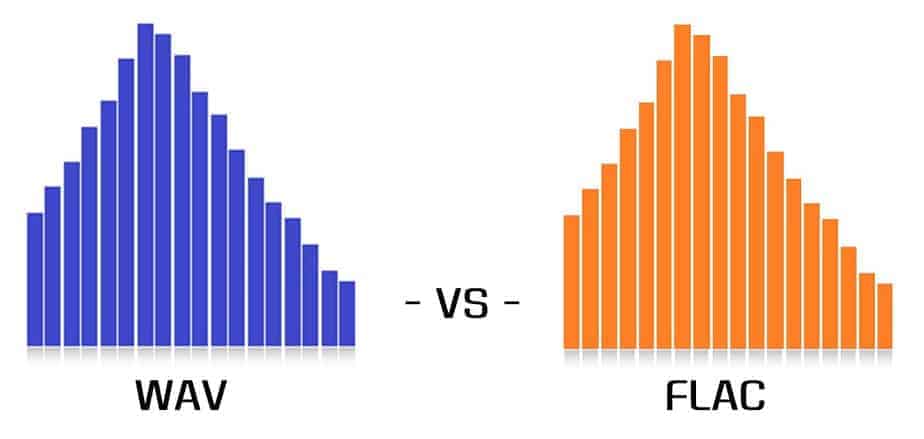
FLAC (Free Lossless Audio Codec) is considered a very good alternative to WAV. The format requires up to 50 percent less storage space and can store more metadata. This makes FLAC a popular format for the highest quality music downloads, but with the downside that it is not compatible with Apple’s iTunes.
Usage: Hi-Res Music Downloads for Standalone Apple Systems
A THE C
As is often the case, Apple has also developed its own alternative called ALAC (Apple Lossless Audio Codec). FLAC is considered the more efficient of the two formats, but with ALAC Apple users can also enjoy a lossless audio format.
Usage: High-resolution music downloads for Apple systems
MQA
Unlike the other formats, MQA (Master Quality Authenticated) is not a real audio format, but a codec system consisting of an encoder and a decoder. Behind this is a complex piece of software that, according to the developer, should be able to reproduce the original master quality of the studio.


