About digital sound. Digital sound


Free Download Mp4Gain
picture

About digital sound. Digital sound

digital sound

Recently, the capabilities of multimedia equipment have grown significantly, but for some reason this area has not received enough attention.
Digital sound

The average user suffers from a lack of information and is forced to learn only from his own experience and mistakes. With this article we will try to eliminate this annoying misunderstanding. This article is aimed at a common user and aims to help you understand the theoretical and practical foundations of digital sound, to identify the basic possibilities and techniques of its use.

What exactly do we know about the sound capabilities of a computer, other than the fact that our home computer has a sound card and two speakers? Unfortunately, probably due to insufficient literature or for some other reason, but the user, in most cases, is unfamiliar with anything other than the built-in Windows audio input / output mixer and recorder. The only use of a sound card that a common user finds is to play sound in games and listen to a collection of audio. And after all, even the simplest sound card installed in almost every computer can do much more: it opens up wide opportunities for everyone who loves and is interested in music and sound, and for those who want to create your own music, a sound card. it can become an omnipotent tool. To find out what the computer can do in the field of sound, you just need to take an interest, and you will be presented with opportunities that, perhaps, you did not even know about. And all this is not as difficult as it might seem at first glance.

Some facts and concepts that are difficult to do without:

According to the theory of the Fourier mathematician, a sound wave can be represented as a spectrum of frequencies included in it.

About digital audio (digital audio)

The frequency components of the spectrum are sinusoidal oscillations (so-called pure tones), each of which has its own amplitude and frequency. Therefore, any vibration, even the most complex shape (for example, a human voice), can be represented as the sum of the simplest sinusoidal vibrations of certain frequencies and amplitudes. And vice versa, generating different vibrations and superimposing them on each other (mixing, mixing), you can get different sounds.

Note: The hearing aid / human brain is capable of distinguishing between frequency components of 20 Hz and ~ 20 kHz (upper limit may vary based on age and other factors). Also, the lower limit fluctuates a lot depending on the intensity of the sound.

Digitization of sound and its storage on a digital carrier

“Normal” analog sound is represented on analog equipment by a continuous electrical signal. The computer operates with data in digital form. This means that the sound on the computer is also represented in digital form. How does the analog to digital conversion work?

Digital sound is a way of representing an electrical signal using discrete numerical values ​​of its amplitude. Let’s say we have a good quality analog audio track (by saying “good quality” we will assume a silent recording that contains spectral components from the entire audible frequency range, roughly 20 Hz to 20 KHz) and we want to “feed” it into a computer. (that is, digitize) without loss of quality. How to achieve it and how does digitization occur? A sound wave is a kind of complex function, the dependence of the amplitude of a sound wave on time. It would seem that since it is a function, you can write it to a computer “as is,” that is, describe the mathematical form of the function and store it in the computer’s memory. However, this is practically impossible, since sound vibrations cannot be represented by an analytical formula (like y = x2, for example). There is only one way left: to describe the function by storing its discrete values ​​at certain points. In other words, at each moment you can measure the value of the amplitude of the signal and write it down as numbers. However, this method also has its drawbacks, as we cannot record the amplitude values ​​of the signal with infinite precision and we have to round them.


Free Download Mp4Gain
picture


Mp4Gain Main Window
picture


Mp4Gain Features
picture


Free Download Mp4Gain
picture

ADVANTAGES AND DISADVANTAGES OF DIGITAL SOUND

ADVANTAGES AND DISADVANTAGES OF DIGITAL SOUND

DIGITAL SOUND

Digital sound opens up truly endless possibilities. If the previous radio and sound studios were located on several tens of square meters, they can now be replaced by a good computer, which, in terms of capabilities, exceeds ten of those studios combined, and at a cost many times cheaper than one.

Digital sound

This removes many financial barriers and makes sound recording more accessible to both the professional and the amateur. Modern software lets you do what you want with sound. Previously, various sound effects were achieved with the help of ingenious devices that did not always live up to technical thinking or were simply handcrafted devices. Today, the most complex and hitherto unimaginable effects are achieved by pressing a couple of buttons. Of course,

From the point of view of an ordinary user, there are many benefits: the compactness of modern storage media allows you to transfer all disks and records to a digital representation and store them for many years on a small three-inch hard disk or a dozen or two CDs; you can use special software and thoroughly “clean” old records from reels and discs, removing noise and crackle from their sound; You can also not only correct the sound, but also beautify it, add richness, volume, restore frequencies. The Internet also comes to the rescue of the audio hobbyist: the network allows people to share music, listen to hundreds of thousands of different Internet radio stations and show their sonic creativity to the public, all that is needed is a computer and the Internet.

Of course, digital technology also has its drawbacks. Many people noticed that the analog sound was heard with more life. And this is not just a tribute to the past: the digitization process introduces a certain error in the sound, in addition, various digital amplifiers introduce the so-called “transistor noise” and other specific distortions. There is no precise definition of the term “transistor noise”, but we can say that they are chaotic oscillations in the high frequency region. Although the human hearing aid is capable of perceiving frequencies up to 20 kHz, it appears that the human brain picks up higher frequencies. And it is on a subconscious level that a person still feels analog sound cleaner than digital.

“Normal” analog sound is represented on analog equipment as a continuous electrical signal. The computer operates with data in digital form. This means that the sound on the computer is also represented in digital form.

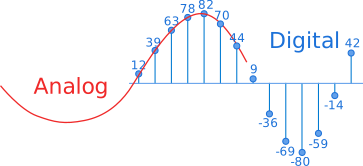
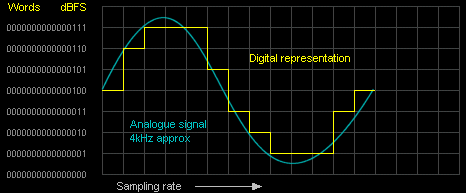
Digital sound is a way of representing an electrical signal by means of discrete numerical values ​​of its amplitude; Signal digitization involves two processes: a sampling process (sampling) and a quantization process. The sampling process is the process of obtaining the values ​​of the converted signal values ​​at specific intervals. Digitization is fixing the amplitude of the signal at regular intervals and recording the amplitude values ​​obtained in the form of rounded digital values ​​(since the amplitude values ​​are continuous, it is not possible to record the exact value of the amplitude of the signal to a finite number, so we resort to rounding). The recorded signal amplitude values ​​are called samples. Obviously, the more often we take amplitude measurements (the higher the sampling frequency) and the less we round the obtained values ​​(more quantization levels), the more accurate the digital representation of the signal that we will obtain will be. The digitized signal can be saved as a set of successive amplitude values.

Quantization is the process of replacing the actual values ​​of the signal with approximate values ​​with some precision.

Sound processing should be understood as various transformations of sound information to change some characteristics of sound. Sound processing includes methods for creating various sound effects, filtering, as well as methods for cleaning the sound of unwanted noise, changing the timbre, etc. This whole huge set of transformations ultimately boils down to the following basic types:

1. Amplitude transformations. They are carried out on the amplitude of the signal and lead to its amplification / attenuation or change according to some law in certain parts of the signal;

2. Frequency conversions. They are performed on the frequency components of sound: the signal is presented in the form of a frequency spectrum at regular intervals, the necessary frequency components are processed, for example, filtering and inverse “folding” of the signal from the spectrum to the wave;

Analog vs. Digital: Does vinyl sound better?

Music stored on vinyl is making a big comeback. The question of whether CDs, files, or music saved on vinyl sound “better” divides music fans. Sometimes the feeling arises that the toughest commentary battles on the web take place not between political camps, but between listeners of analog and digital music.

Analogversus Digital

It’s a shame, because almost everyone involved in these battles, which were fought with incredible vehemence, are united by their love of music. They belong to the minority of those who spend a lot of money on music, regardless of the medium they prefer. This battle is completely unnecessary and is mainly based on a misunderstanding or two different interpretations of what “good sound” means.

Analog vs Digital

“Good sound”: one expression, two meanings

Some say that something “sounds good” when the sound suits them. That is the musician’s point of view. A good example of this is the sound of a distorted electric guitar, a constituent element of rock music. It originated from the fact that a guitar amp was so loud that the actual sound of the guitar was destroyed beyond recognition by the overdriven amp. The result no longer sounds like a guitar, but the sound has been and continues to be liked by millions of people because it just “sounds good.”

Distorted but pleasing to the ears: the sound of a classic rock guitar.

Others use the term “good sound” as a synonym for “high fidelity,” meaning the most realistic reproduction of what the sound engineer heard when mixing a recording in the studio. This is what we call “high fidelity”.
By this definition, “good sound” means, at best, that the playback chain does not sound at all and that the sound changes as little as possible on its way from recording to playback. It’s called “High Fidelity”, not “Perfect Fidelity” because there can only be an approximation of the original sound.
And it is precisely this point that is the axis of the whole discussion. Logs were never a particularly good medium for hi-fi, but for decades they were the best medium that end users had access to. Until the CD arrived.

In terms of measurement technology, the record falls short
If one compares the CD and the disc under the criteria of “high fidelity”, the disc not only drops the straw, but is completely outperformed by the CD in terms of all the relevant criteria. Here are some examples.
Dynamic is the difference between the softest and loudest sound of a piece of music. While all digital media, including MP3, easily go up to 90 dB and can therefore even map the dynamic range of a large symphony orchestra, in practice the record barely achieves more than 40 dB. Enough for pop music, but even a well-received little jazz band like the one in our sound sample becomes a problem for the record. In quiet places, typical vinyl noise would be clearly audible.

Speaking of background noise: Typical vinyl noise, low-frequency rumble, and creaking caused by dust grains in the groove are also noticeable because they occur unevenly. The noise from a compact cassette is more constant, so the brain can filter it better. Digital recordings are virtually noise-free.
To present the purest music possible, all frequencies in the audible spectrum between 20 Hz and 20 kilohertz should be played at the same volume. With digital media, the frequency responses appear to have been drawn with a ruler. As a general rule of thumb, registers can linearly reproduce frequencies up to a maximum of 12 kilohertz and this only applies to the outermost slots at the beginning of a page. Due to the slowing down of the path speed towards the end of the groove, the highest transmission frequency drops more and more during the playing time of a disc, which, by the way, can be heard clearly. For the lower end of the spectrum, the deeper and louder the bass, the more space it needs in the groove, shortening the possible playing time. With LPs, you always have to find a compromise between bass level and playing time.

An important measure of the fidelity of a reproduction medium to sound is the distortion that is added to actual music. Especially in the low range, the register reaches values ​​that significantly change the original signal.
In principle, a pick-up system works like a microphone. Converts mechanical energy into electrical energy. This mechanical energy comes not only from the grooves of the record, but also from the sound of the speakers. The louder you listen to the music from the turntable, the more feedback you will hear. And feedback blurs impulses in music, like the sound of drums. At home with moderate volume it is more likely to be neglected, at a club not.
Thanks to these (and a few other) technical shortcomings, the record doesn’t even meet the requirements of the traditional DIN No. 45500 standard on all points, which has defined the official hi-fi standard since the 1960s.

Don’t die: rumors about digital technology

On the contrary, rumors and false statements about digital technology are still circulating, for which the problems of the beginnings of the compact disc and the blatant misunderstandings about how digitization works are responsible.
Over and over again you can read that digital technology covers a smaller frequency range than analog. That’s actually true in theory, because CDs, for example, are limited to the range between 20 Hertz and 20 Kilohertz with filters.
However, on the one hand this is exactly the range that our hearing can cover in principle, and on the other hand it is pure theory that analog technology can represent a higher frequency range. In practice, for example, the cutting tools with which music is scraped into the matrices that vinyl is made of, heat up very quickly to high frequencies with a high level and thus limit the frequency response upward.
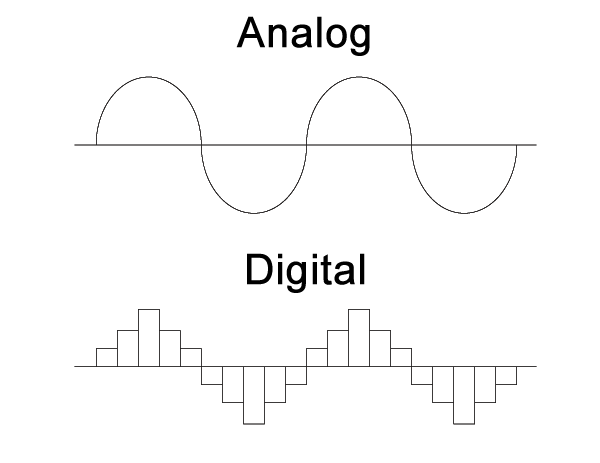
Friends of analog music storage like to deny digital technology the ability to display music correctly and that’s because of the discrete sampling. The waves that make up sounds are continuous events, whereas computers know only discrete states. The popular misunderstanding is that you can never fully capture the airwaves. After digitization, the waveforms would no longer be round, but staggered. But that is not right. The Niyquist-Shannon sampling theorem clearly states that the original signal can be restored exactly and not just roughly.
If all these facts are true and the record is so hopelessly inferior to the CD, why do so many people claim that the record “sounds better”?

Analog – Digital

Analog  Digital

When we talk about the Internet and the current technological “machines” (mobile phone, camera, tablet, computer) we always speak of “digital” and, sometimes, we contrast this term with “analog”. But what exactly these words mean and what they refer to, many times we ignore, perhaps also because it is not relevant for us and is based on being able to use “digital” for what we need without investigating it so much.

Analog Digital

“Analog” and “digital” are terms that are constantly encountered when talking about technologies (old and new). In common sense, “analog” is associated with a meaning of “old” or “past” or “low quality”; “Digital”, on the other hand, is synonymous with “new” or “innovative” or “quality”. This common sense distinction is not true.
One thing to keep in mind when addressing these issues is that the definitions of the two terms are one thing (what do they mean, where do they come from, …) and the operational implications they have (because we use one and not the other, as the consequences, implications, results …). As if to say, one thing is the universal law of gravity (with which the sun also has to do) and another is to stay in the sun to warm up and tan.
Another thing to keep in mind is that everything that is under the Digital / Analog issue is not something of our days, its essence was not born with the advent of “new” technologies; here it is one of the oldest problems in human thought and refers to philosophical disquisitions and to the issue of “continuous” and “discrete” variables. But we won’t dwell on these.

As for the definitions. ..
First of all, we must bear in mind that when we talk about Analogue and Digital we refer to ways of representing the measure of a quantity (they are “attributes of a quantity”), to ways in which the quantities we are considering vary (such as a audio signal, a video signal, color,….).

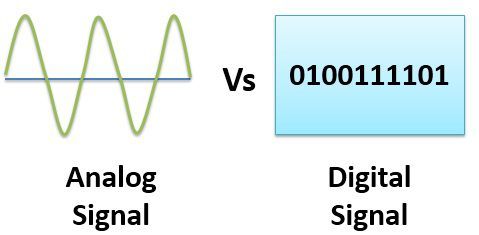
Analogous thing is a continuously varying quantity: an analog variable can take an infinite number of values ​​(for example, the distance between two points in space can take an infinite number of values).

Digital is a quantity that varies “step by step”: a digital variable can take only a finite number of values ​​(the duration of a day; for example, it can take only one of the 85,000 values ​​if we use the “second” unit, a of the 850 thousand values ​​if we use tenths of a second or one of the 8 million and 500 thousand if we use hundredths of a second; many possibilities but still finite, determined).

We can deduce that the concept of analog can be associated with a condition of continuity, that is, in a probable path something moves by changing its location through infinite positions and defining them as infinite we exclude the possibility of being able to number them.
With digital instead, the same path would be divided into stages (steps) and even if it is very small and numerous, it would always be possible to determine the amount.

Practice

Let us now turn to the practical implications of these two ways of representing physical quantities.
Until recently, all the data with which they organized audio or video recordings, static images, data transmissions such as radio, television, telephone were organized in the form of analog signals because the instruments that detected them “. The surfaces” on which they were recorded and the channels through which they were transported were mechanical and made specifically for that type of signal, in fact, they were the same as that signal.
Let’s think about color: the colors we see in a landscape are nothing more than a well-organized set of blue, red and green lights in their infinite shades; its representation through a photograph is based on the combination of blue, red and green pigments (therefore physical objects). We can say that the representation of a landscape through a photographic print is an analog representation of reality.

With the arrival of electronics (which has to do with physical quantities transformed and processed into electrical signals), physical quantities begin to be represented through electrical signals. Initially, these electrical signals were of the analog type (electronics that use continuous signals, signals that can assume an infinite range of possible values, that is, analog signals); later and a special type of signal has been used that can assume only some values ​​among the infinitely possible, in fact it can only assume two values: the presence or absence of the signal. If we look at the basic level of any computer application we will realize that we have a very long series of numbers “one” and “zero” where “one” is the presence of the signal and “zero” its absence.
This is “digital” electronics; digital because it uses signals that are not continuous but “in jumps”.