Analog and digital video


Free Download Mp4Gain
picture

Analog and digital video
Analogic video

Analog video is the oldest method of transmitting video signals. One of the first video formats based on the analog method was composite video.

Analogic

Composite analog video combines all video components (luminance, color, time, etc.) into a single signal. By combining these elements into a single signal, the quality of composite video is far from perfect. As a result, we have inaccurate color reproduction, insufficiently clear image, and other quality loss factors. Composite video quickly gave way to component video, in which multiple video components are represented as separate signals.

The fact is that the human eye, in addition to the light-sensitive elements active at high illumination and perceiving reference colors (R, G, B), has elements that are active even in almost complete darkness and fix only the illumination of the object. As a result, the brightness of the object is much more important to perception than its color characteristics.

Furthermore, the volume of information transmitted is important: the smaller the volume, the cheaper and simpler the transmission systems are. You can reduce the amount of information by reducing the amount of color data. Therefore, in television, not one RGB signal is transmitted and received, but brightness Y and two color difference signals U and V, with U = RY and V = BY. In this case, it is not necessary to code all three colors. It is enough to specify two of them, and the third is easily calculated by arithmetic operations. U and V can have twice the resolution of Y.

However, all the above formats are still essentially analog and therefore have a major drawback: when copying, the shot is always inferior in quality to the original. Loss of quality when copying video material is similar to photocopying: the copy is never as clear and vivid as the original. The inherent disadvantages of analog video led to the development of the digital video format. Unlike analog video, which loses quality when copied, each digital video copy is the same as the original.

Interesting Facts About Analog Video

Analog video is a type of video used on television. The image on the screen is created when a beam of electrons moves across a screen covered with a phosphor, a material that emits light of a certain wavelength, that is, a certain color. This process is called scanning and it goes through lines (horizontal) and squares (vertical). To get moving videos, you need to scan multiple frames per second. In televisions, the frames change at a rate of several tens per second. A single image is made up of scan lines that are reproduced in two sets called fields.

In television, an interlaced method is used to form an image on the screen, in which during the first scan cycle of the screen using an electron beam, an image of odd lines is formed, and for the second, the lines pairs, as a result, a complete picture frame is formed from two half frames (fields). The use of this imaging method is due to the need to narrow the spectrum of the television signal. Although these frame rates and scan lines can create smooth motion, they do not eliminate video flicker.

Television standards

Currently three main color television standards are used:

American NTSC (National Television Standards Committee – National Television Standards Committee), the number of lines per frame 525, 60 Hz;
German PAL (Line alternating phase – lines with variable phase), the number of lines per frame 625, frequency 50 Hz;
French SECAM, the number of lines per frame is 525, the scanning frequency is 50 Hz, in Russia the SECAM D / K modification is adopted.
The standards differ in the modulations used and the carrier and subcarrier values.

Digital video at a glance

Digital video is an image or series of images in which information is stored in digital form. It uses digital signals and standards other than international ones to transmit and display images used in analog video.

When creating digital video, the problem arises of converting an analog signal to digital. The standards for video digitization adopted in modern technology are: 10 bits – the digitization depth, 13.5 MHz – the luminance signal sampling rate, 6.75 MHz – the sampling rate of two channels of color difference.

Recently, there has been a trend towards the fusion of television and computer video.


Free Download Mp4Gain
picture


Mp4Gain Main Window
picture


Mp4Gain Features
picture


Free Download Mp4Gain
picture

What is meant by analog and digital?

The terms “analog” and “digital” are used to distinguish two
large families of electronic circuits.

Analog and digital

Analog circuits are those that handle signals that vary
continuously and must be reproduced as accurately as possible
possible. For example, a vocal amplifier is a typical device
fully analog in which the signal produced by the microphone
is processed and amplified but should not be modified in its
essential components to ensure “fidelity” of reproduction.

Analog Music in a Digital World

Digital circuits (from the English word “digit” which can be translated as
digit or number, and therefore are also called “numeric”),
instead, they deal with signals that can only have two states, usually indicated
by the numerical values ​​0 and 1, which in within the circuits correspond
two clearly differentiable signal values:
for example, 0 may correspond to a voltage
between 0 and 0.2 volts, while the value 1 at a voltage between 4.5 and 5 volts.
An element that can assume only two states represents a “bit” of information.
Most of the components of a common personal computer are made
with digital circuits.

In reality, many of today’s electronic devices
They adopt mixed technologies, part analog and part digital.
Consider, for example, a compact disc player. The sign that
represents the engraved piece is stored in the form typically
digital: a succession of microscopic areas that can be opaque
or reflective, each area corresponds to a value of 0 or 1 depending on whether
it is opaque or reflective.
The sequence of values ​​0/1 constitutes a digital representation
the acoustic signal, so the first part of the reproduction circuit
uses digital techniques.

To play the original sound,
the sequence of bits must first be transformed into an analog signal and this step is done
a particular circuit called a “digital / analog converter” that has
the purpose of translating the sequence of bits into an electrical signal
which is “Analogous” to the acoustic signal originally produced by the instruments
that played the piece that is being recorded.

Then the analog signal can be amplified (by a circuit
analog, of course) and sent to the speakers for playback
acoustics.

Rather, consider a
fully analog recording and playback system: a magnetic recorder.
In this case, the magnetic tape in the cassette “stores” the signal
acoustics in the form of variations in the intensity of magnetization,
that is, the intensity of
magnetization along the magnetic tape is proportional to the signal
original acoustics. In this sense, the trend of
magnetization is “analogous” to the trend of the acoustic signal.

The player simply transforms the variation in the magnetic field
“read” on tape in a “similar” variation of an electrical signal
which is then amplified and reproduced as an acoustic signal.

Analog – Digital

Analog  Digital

When we talk about the Internet and the current technological “machines” (mobile phone, camera, tablet, computer) we always speak of “digital” and, sometimes, we contrast this term with “analog”. But what exactly these words mean and what they refer to, many times we ignore, perhaps also because it is not relevant for us and is based on being able to use “digital” for what we need without investigating it so much.

Analog Digital

“Analog” and “digital” are terms that are constantly encountered when talking about technologies (old and new). In common sense, “analog” is associated with a meaning of “old” or “past” or “low quality”; “Digital”, on the other hand, is synonymous with “new” or “innovative” or “quality”. This common sense distinction is not true.
One thing to keep in mind when addressing these issues is that the definitions of the two terms are one thing (what do they mean, where do they come from, …) and the operational implications they have (because we use one and not the other, as the consequences, implications, results …). As if to say, one thing is the universal law of gravity (with which the sun also has to do) and another is to stay in the sun to warm up and tan.
Another thing to keep in mind is that everything that is under the Digital / Analog issue is not something of our days, its essence was not born with the advent of “new” technologies; here it is one of the oldest problems in human thought and refers to philosophical disquisitions and to the issue of “continuous” and “discrete” variables. But we won’t dwell on these.

As for the definitions. ..
First of all, we must bear in mind that when we talk about Analogue and Digital we refer to ways of representing the measure of a quantity (they are “attributes of a quantity”), to ways in which the quantities we are considering vary (such as a audio signal, a video signal, color,….).

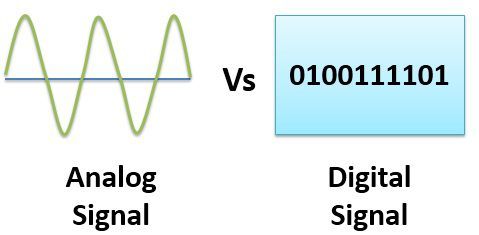
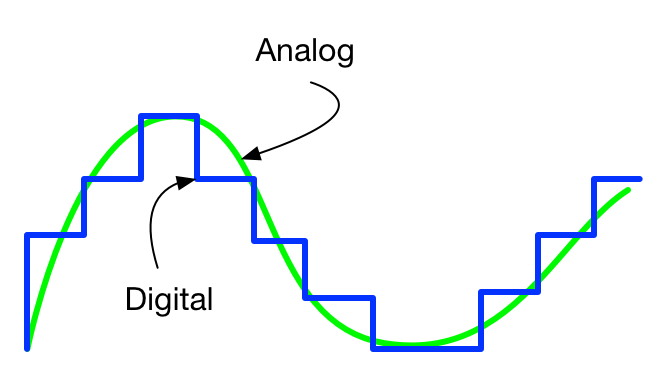
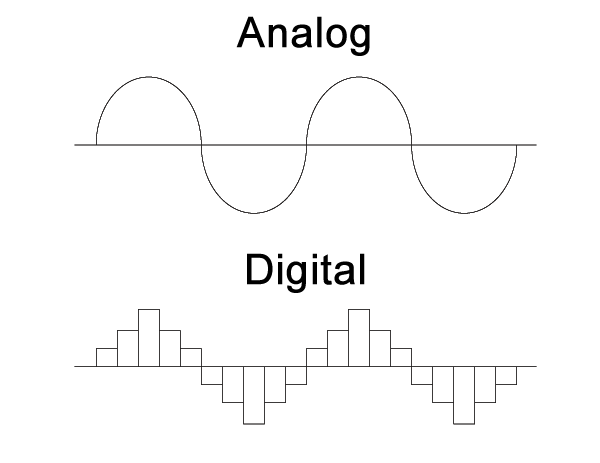
Analogous thing is a continuously varying quantity: an analog variable can take an infinite number of values ​​(for example, the distance between two points in space can take an infinite number of values).

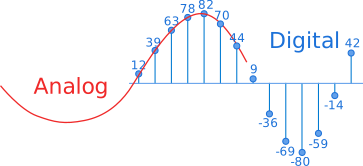
Digital is a quantity that varies “step by step”: a digital variable can take only a finite number of values ​​(the duration of a day; for example, it can take only one of the 85,000 values ​​if we use the “second” unit, a of the 850 thousand values ​​if we use tenths of a second or one of the 8 million and 500 thousand if we use hundredths of a second; many possibilities but still finite, determined).

We can deduce that the concept of analog can be associated with a condition of continuity, that is, in a probable path something moves by changing its location through infinite positions and defining them as infinite we exclude the possibility of being able to number them.
With digital instead, the same path would be divided into stages (steps) and even if it is very small and numerous, it would always be possible to determine the amount.

Practice

Let us now turn to the practical implications of these two ways of representing physical quantities.
Until recently, all the data with which they organized audio or video recordings, static images, data transmissions such as radio, television, telephone were organized in the form of analog signals because the instruments that detected them “. The surfaces” on which they were recorded and the channels through which they were transported were mechanical and made specifically for that type of signal, in fact, they were the same as that signal.
Let’s think about color: the colors we see in a landscape are nothing more than a well-organized set of blue, red and green lights in their infinite shades; its representation through a photograph is based on the combination of blue, red and green pigments (therefore physical objects). We can say that the representation of a landscape through a photographic print is an analog representation of reality.

With the arrival of electronics (which has to do with physical quantities transformed and processed into electrical signals), physical quantities begin to be represented through electrical signals. Initially, these electrical signals were of the analog type (electronics that use continuous signals, signals that can assume an infinite range of possible values, that is, analog signals); later and a special type of signal has been used that can assume only some values ​​among the infinitely possible, in fact it can only assume two values: the presence or absence of the signal. If we look at the basic level of any computer application we will realize that we have a very long series of numbers “one” and “zero” where “one” is the presence of the signal and “zero” its absence.
This is “digital” electronics; digital because it uses signals that are not continuous but “in jumps”.