MIDI and digital sound: pros and cons


Free Download Mp4Gain
picture

MIDI and digital sound: pros and cons

Digital Audio

The WAVE format is one of many, but it is far from the only format for recording digital audio.
Digital Audio

Unlike MIDI data, digital audio data is actually sound recorded in thousands of units called samples. Digital data represents the amplitude (or volume) of a sound at discrete moments. The sound of digital data is independent of the playback device and therefore always sounds the same. But you have to pay for this with large volumes of sound files.

MIDI data is to digital data what vector graphics are to bitmaps. In other words, MIDI data depends on the audio playback devices and digital data is independent. Just as the appearance of vector graphics depends on the printer or monitor screen, the sound of MIDI files depends on the MIDI device to play these files. Similarly, a melody played on a concert piano will sound different from a normal piano. Digital data, on the other hand, is identical and independent of the reproduction system. The MIDI standard is similar in this respect to the PostScript standard and allows you to control instruments in understandable language.

Compared to digital sound, MIDI has the following advantages:

MIDI files take up less memory and the size of these files does not affect sound quality. On average, MIDI files are 200 to 1000 times smaller than digital files and therefore take up a small amount of RAM, disk space and do not require large CPU resources.

In some cases, MIDI files sound better than digital audio files. In this case, the sound source of the MIDI files must be of high quality.

You can change the length of MIDI files by changing the tempo of the sound, while maintaining the quality and volume of the sound. MIDI data can be easily edited, even at the single note level. You can manipulate small segments of a MIDI song (with millisecond precision), which is not possible with digital audio.

The main disadvantage of a MIDI file comes from its merits. Since MIDI data is not sound itself, playback will be as accurate as the device for playing the MIDI data is identical to the device used to create the original file. Even the sound of a MIDI instrument according to the General MIDI standard depends on the electronic playback device and the method used. MIDI sound is not used for voice playback.

The main advantage of digital audio over MIDI sound is that the reproduction quality of digital sound is always constant, and here MIDI sound is inferior to digital sound. There are two reasons why you should work with digital audio:

A wider selection of programs and systems that support working with digital sound.

The preparation and creation of digital sound elements does not require knowledge of music theory, which cannot be said for MIDI data.

Sound tips
Voice recording from microphone
Any book devoted to multimedia necessarily contains a section on microphone sound recording. In addition, the Sound Recorder (Phonograph) program, which is included in the standard Windows distribution, is usually used for this. Working with it is described in detail in the attached help file. It is easy to use and we will not dwell on it in detail.

The microphones come in condenser and dynamic microphones. Capacitors are more expensive, they give better sound, but your connection must be compatible with a sound card. And the vast majority of sound cards are designed for dynamic microphones.

Another important characteristic of a microphone is its directivity. The microphones are omni-directional (they have the same sensitivity to sound in all directions), unidirectional (they have the highest sensitivity to sound coming from the front), and bi-directional (more sensitive to sound coming from the front and rear). A unidirectional microphone is usually the best option, as it eliminates background noise. But it is more expensive than omni-directional microphones and is more sensitive to choppy breath sounds.

Be sure to pay attention to the impedance (impedance) of the microphone. The optimal value is around 600 ohms.

Therefore, we recommend a 600 ohm dynamic omni-directional microphone.


Free Download Mp4Gain
picture


Mp4Gain Main Window
picture


Mp4Gain Features
picture


Free Download Mp4Gain
picture

Differences between analog and digital audio

Differences between analog and digital audio

Analog vs Digital

Sound information. Sound is a wave that travels through air, water, or other medium with a continuously changing intensity and frequency.

Digital vs. Analog

A person perceives sound waves (air vibrations) with the help of hearing in the form of sound of varying volume and pitch. The greater the intensity of the sound wave, the louder the sound, the higher the frequency of the wave, the higher the pitch of the sound (Fig. 1.1).

Dependence of the volume and pitch of the sound on the intensity and frequency of the sound wave.

The human ear perceives sound at a frequency of 20 vibrations per second (low sound) to 20,000 vibrations per second (high sound).

A person can perceive sound in a wide range of intensities, in which the maximum intensity is 1014 times greater than the minimum (one hundred thousand billion times). A special unit of “decibels” (dbl) is used to measure the volume of sound (Table 5.1). Decreasing or increasing the sound volume by 10 dB corresponds to a decrease or increase in sound intensity by 10 times.

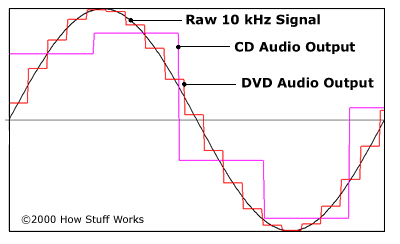
Provisional discretization sound. In order for a computer to process sound, a continuous audio signal must be converted to a discrete digital form using time sampling. A continuous sound wave is divided into separate small time sections, for each section a certain value of sound intensity is set.

Therefore, the continuous dependence of the loudness of the sound at time A (t) is replaced by a discrete sequence of loudness levels. On the graph, this appears to replace a smooth curve with a sequence of “steps” (Fig. 1.2).

Sync Audio Sampling

Sampling frequency. A microphone connected to the sound card is used to record analog sound and convert it to digital format. The quality of the digital sound obtained depends on the number of measurements of the sound volume level per unit of time, that is, the sampling frequency. The more measurements that are made in 1 second (the higher the sampling frequency), the more accurately the “ladder” of the digital audio signal repeats the curve of the dialogue signal.

The audio sample rate is the number of sound volume measurements in one second.

The audio sample rate can vary between 8000 and 48000 sound volume measurements per second.

Audio encoding depth. Each “step” is assigned a specific value for the sound volume level. Loudness levels of sound can be viewed as a set of possible states N, for which a certain amount of information I is required, which is called audio coding depth.

Audio encoding depth is the amount of information required to encode the discrete volume levels of digital audio.

If the encoding depth is known, then the number of digital audio loudness levels can be calculated using the formula N = 2I. Let the audio encoding depth be 16 bit, then the number of sound volume levels is:

N = 2I = 216 = 65536.

During the encoding process, each sound volume level is assigned its own 16-bit binary code, the lowest sound level will correspond to the code 0000000000000000 and the highest – 1111111111111111.

The quality of digitized sound. The higher the sampling frequency and depth of the sound, the better the sound of the digitized sound. The lowest quality of digitized sound, corresponding to the quality of telephone communication, is obtained at a sampling rate of 8000 times per second, a sampling rate of 8 bits, and by recording an audio track (“mono” mode). The highest quality of digitized sound, corresponding to the quality of an audio CD, is achieved with a sampling rate of 48,000 times per second, a sampling rate of 16 bits and the recording of two audio tracks (stereo mode) .

It should be remembered that the higher the quality of the digital sound, the greater the volume of information in the audio file. You can estimate the volume of information in a digital stereo sound file with a duration of 1 second with an average sound quality (16 bits, 24,000 measurements per second). To do this, the encoding depth must be multiplied by the number of measurements in 1 second and multiplied by 2 (stereo sound):

16 bits × 24,000 × 2 = 768,000 bits = 96,000 bytes = 93.75 KB.

Sound editors. Sound editors allow you not only to record and play sound, but also to edit it. Digitized sound is presented in sound editors visually, so copying, moving, and deleting parts of the audio track can be easily performed with the mouse. Also, you can layer tracks

Analog and digital video

Analog and digital video

Analogic video

Analog video is the oldest method of transmitting video signals. One of the first video formats based on the analog method was composite video.

Analogic

Composite analog video combines all video components (luminance, color, time, etc.) into a single signal. By combining these elements into a single signal, the quality of composite video is far from perfect. As a result, we have inaccurate color reproduction, insufficiently clear image, and other quality loss factors. Composite video quickly gave way to component video, in which multiple video components are represented as separate signals.

The fact is that the human eye, in addition to the light-sensitive elements active at high illumination and perceiving reference colors (R, G, B), has elements that are active even in almost complete darkness and fix only the illumination of the object. As a result, the brightness of the object is much more important to perception than its color characteristics.

Furthermore, the volume of information transmitted is important: the smaller the volume, the cheaper and simpler the transmission systems are. You can reduce the amount of information by reducing the amount of color data. Therefore, in television, not one RGB signal is transmitted and received, but brightness Y and two color difference signals U and V, with U = RY and V = BY. In this case, it is not necessary to code all three colors. It is enough to specify two of them, and the third is easily calculated by arithmetic operations. U and V can have twice the resolution of Y.

However, all the above formats are still essentially analog and therefore have a major drawback: when copying, the shot is always inferior in quality to the original. Loss of quality when copying video material is similar to photocopying: the copy is never as clear and vivid as the original. The inherent disadvantages of analog video led to the development of the digital video format. Unlike analog video, which loses quality when copied, each digital video copy is the same as the original.

Interesting Facts About Analog Video

Analog video is a type of video used on television. The image on the screen is created when a beam of electrons moves across a screen covered with a phosphor, a material that emits light of a certain wavelength, that is, a certain color. This process is called scanning and it goes through lines (horizontal) and squares (vertical). To get moving videos, you need to scan multiple frames per second. In televisions, the frames change at a rate of several tens per second. A single image is made up of scan lines that are reproduced in two sets called fields.

In television, an interlaced method is used to form an image on the screen, in which during the first scan cycle of the screen using an electron beam, an image of odd lines is formed, and for the second, the lines pairs, as a result, a complete picture frame is formed from two half frames (fields). The use of this imaging method is due to the need to narrow the spectrum of the television signal. Although these frame rates and scan lines can create smooth motion, they do not eliminate video flicker.

Television standards

Currently three main color television standards are used:

American NTSC (National Television Standards Committee – National Television Standards Committee), the number of lines per frame 525, 60 Hz;
German PAL (Line alternating phase – lines with variable phase), the number of lines per frame 625, frequency 50 Hz;
French SECAM, the number of lines per frame is 525, the scanning frequency is 50 Hz, in Russia the SECAM D / K modification is adopted.
The standards differ in the modulations used and the carrier and subcarrier values.

Digital video at a glance

Digital video is an image or series of images in which information is stored in digital form. It uses digital signals and standards other than international ones to transmit and display images used in analog video.

When creating digital video, the problem arises of converting an analog signal to digital. The standards for video digitization adopted in modern technology are: 10 bits – the digitization depth, 13.5 MHz – the luminance signal sampling rate, 6.75 MHz – the sampling rate of two channels of color difference.

Recently, there has been a trend towards the fusion of television and computer video.

Digital sound vs. analog sound: what’s the difference?

It is very common to hear about digital sound. This wave of digital sound comes from the late 1970s, when digital media began to appear on the market, further solidifying with the arrival of CD in 1983. Leading brands would begin to announce digital sound as the great revolution in Sound. Recently, however, many have decided to go back to vinyl or even analog cassette tapes and claim that the sound of analog media is superior to that of digital media. But who is right?

Digital and Analog Audio

First, let’s establish that, when we talk about digital sound versus analog sound, we are mainly talking about the media where that sound is stored and the encoding used in those media. With that, we can start by classifying them by saying the following:

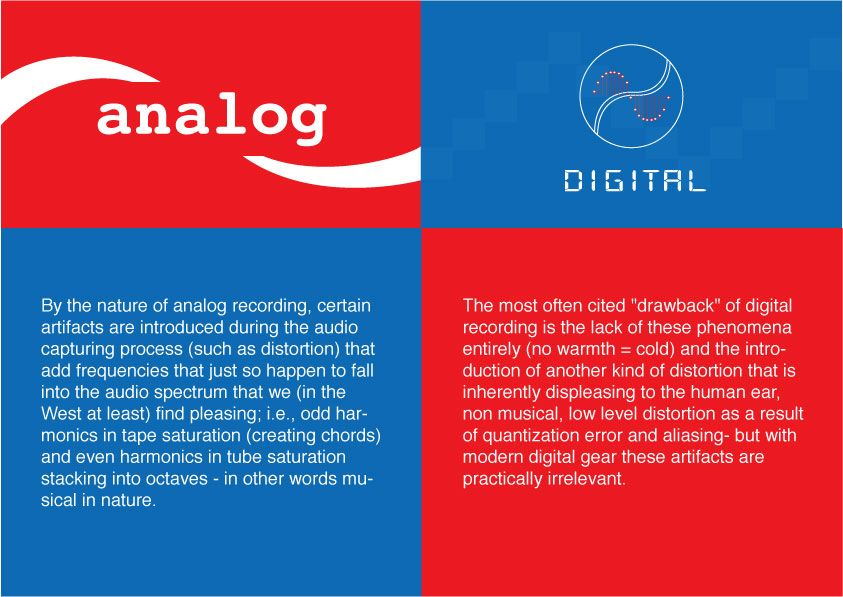
Analog sound is all that sound placed in uninterrupted media, creating a change in the media that is analogous to the phenomenon of sound. In the case of vinyl, a groove similar to the electrical signal generated in the microphone is created. In the case of magnetic tape, there is a change in the magnetic field analogous to the electrical signal generated at the microphone.

Analog and Digital audio

Digital sound is all that sound placed on media encoded in binary code. This encoding transforms the microphone signal into a digital code that follows various parameters, such as the Nyquist theorem, sample rate, bit depth, bit rate, interpolation, etc. In future publications, we will study each of these characteristics. Examples of digital media are: CD, SD memory cards, SSD, HDD, DAT … In short, everything that can store a digital code.

Some authors argue that all sound is analog. However, according to the previous definition we will establish that the sound, in itself, is natural. Each natural sound that reaches the microphone becomes analog by generating an electrical signal. And each microphone will start as analog. There are some digital microphones, but these are nothing more than microphones that have an analog / digital converter in their structure, making the sound emitted digital. In addition, all speakers also output analog sound only, since even if the source is digital, it will be necessary to perform a digital / analog conversion in any situation.

That is, the sound has to be analog at any given moment in the capture / playback chain, but it doesn’t necessarily have to be digital. That’s why many argue that analog sound is “pure” and, according to some people, “better”. However, there are several advantages to digital media. For example, digital media is more accurate, has a better differentiation between channels, is more compact and cheaper.

In productive terms, digital media outperforms analog media in several ways. Therefore, it is quite rare today to find analog sound in film and music. The logistical approach between analog and digital is different and many artists maintain that the use of analog media directly influences creation, since many feel that in analog there is a greater intimacy between the artist and the physical phenomenon. But in general, we can associate this intimacy only with the subjective factor. Analog is more expensive and offers a result that can be copied to digital.

On the other hand, there is a good advantage for analog media: durability. In general, vinyl and tape, if well maintained, have greater durability than CDs, DVDs, or HDDs. Until now, we still do not have a digital medium that has proven to be resistant to time (with the exception, perhaps, of DAT). Also, the way the viewer relates to the media is very important. In this case, the imperfections of analog media can make it more intimate and the precision of digital media can make it cold and impersonal. It goes for each one.

The most important topic of discussion on this topic in the world of audiophilia is related to CDs vs. Vinyls, a point that we will address in greater depth in some future publications. But for now, this is what we have about digital sound versus analog sound.