Analog and digital video


Free Download Mp4Gain
picture

Analog and digital video
Analogic video

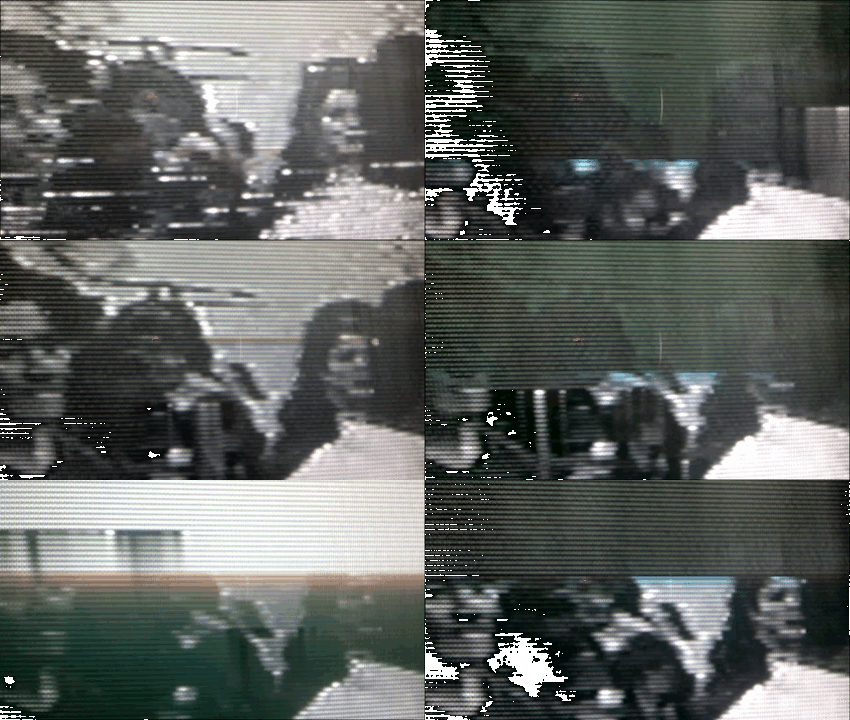
Analog video is the oldest method of transmitting video signals. One of the first video formats based on the analog method was composite video.

Analogic

Composite analog video combines all video components (luminance, color, time, etc.) into a single signal. By combining these elements into a single signal, the quality of composite video is far from perfect. As a result, we have inaccurate color reproduction, insufficiently clear image, and other quality loss factors. Composite video quickly gave way to component video, in which multiple video components are represented as separate signals.

The fact is that the human eye, in addition to the light-sensitive elements active at high illumination and perceiving reference colors (R, G, B), has elements that are active even in almost complete darkness and fix only the illumination of the object. As a result, the brightness of the object is much more important to perception than its color characteristics.

Furthermore, the volume of information transmitted is important: the smaller the volume, the cheaper and simpler the transmission systems are. You can reduce the amount of information by reducing the amount of color data. Therefore, in television, not one RGB signal is transmitted and received, but brightness Y and two color difference signals U and V, with U = RY and V = BY. In this case, it is not necessary to code all three colors. It is enough to specify two of them, and the third is easily calculated by arithmetic operations. U and V can have twice the resolution of Y.

However, all the above formats are still essentially analog and therefore have a major drawback: when copying, the shot is always inferior in quality to the original. Loss of quality when copying video material is similar to photocopying: the copy is never as clear and vivid as the original. The inherent disadvantages of analog video led to the development of the digital video format. Unlike analog video, which loses quality when copied, each digital video copy is the same as the original.

Interesting Facts About Analog Video

Analog video is a type of video used on television. The image on the screen is created when a beam of electrons moves across a screen covered with a phosphor, a material that emits light of a certain wavelength, that is, a certain color. This process is called scanning and it goes through lines (horizontal) and squares (vertical). To get moving videos, you need to scan multiple frames per second. In televisions, the frames change at a rate of several tens per second. A single image is made up of scan lines that are reproduced in two sets called fields.

In television, an interlaced method is used to form an image on the screen, in which during the first scan cycle of the screen using an electron beam, an image of odd lines is formed, and for the second, the lines pairs, as a result, a complete picture frame is formed from two half frames (fields). The use of this imaging method is due to the need to narrow the spectrum of the television signal. Although these frame rates and scan lines can create smooth motion, they do not eliminate video flicker.

Television standards

Currently three main color television standards are used:

American NTSC (National Television Standards Committee – National Television Standards Committee), the number of lines per frame 525, 60 Hz;
German PAL (Line alternating phase – lines with variable phase), the number of lines per frame 625, frequency 50 Hz;
French SECAM, the number of lines per frame is 525, the scanning frequency is 50 Hz, in Russia the SECAM D / K modification is adopted.
The standards differ in the modulations used and the carrier and subcarrier values.

Digital video at a glance

Digital video is an image or series of images in which information is stored in digital form. It uses digital signals and standards other than international ones to transmit and display images used in analog video.

When creating digital video, the problem arises of converting an analog signal to digital. The standards for video digitization adopted in modern technology are: 10 bits – the digitization depth, 13.5 MHz – the luminance signal sampling rate, 6.75 MHz – the sampling rate of two channels of color difference.

Recently, there has been a trend towards the fusion of television and computer video.


Free Download Mp4Gain
picture


Mp4Gain Main Window
picture


Mp4Gain Features
picture


Free Download Mp4Gain
picture

Differences between analog and digital sound

Which is better, analog or digital sound?
Is there really a difference?
Do you need a very expensive audio equipment to notice the differences?
And does it really matter?

digital audio

Before entering the discussion, we should take a quick look at what makes a sound digital or analog. It all has to do with how a sound is recorded. An analog sound recording copy is a continuous electronic signal.

Currently, advances in conversion methods to transform analog to digital have improved the quality of digital recordings. Some people say that there is no distinction between digital and analog mode. Others disagree – sometimes with passion. Music lovers – people who want the highest possible quality in sound systems – insist that analog systems provide better sound.

analog recording

What are the real differences in the real sound of analog and digital recordings?

DIGITAL SOUND HISTORY

BEFORE THE 1970s, MUSICIANS RECORDED WITH ANALOG RECORDING EQUIPMENT.

Microphones that record the sound and generate an analog wave that other devices could transfer directly to the appropriate media (usually magnetic tape). Assuming that the musician uses reliable equipment, the recorded sound was a faithful representation of the original sound.

With digital recording, codecs convert analog waves into digital signals. There are many different types of equipment that can convert from analog to digital. Some audio studios record analogically on an original master tape, and then transfer the sound to a digital format. Others use special equipment to record directly in digital.


The first digital recordings sacrificed fidelity, or sound quality, in favor of reliability. One of the drawbacks of an analog format is that analog media tend to wear out quickly. Vinyl records can be deformed or scratched, and this can dramatically affect the sound quality. The magnetic tape eventually wears out and is vulnerable to magnets, which can erase or destroy the information stored on the tape. Digital media such as compact discs can reproduce sound indefinitely, and are more durable.

ANALOG VS DIGITAL

Some music lovers believe that digital recordings fall short when it comes to reproducing sound accurately. They use intricate language, and jargon, to describe the capabilities or deficiencies of an audio system. Most of his criticisms deal with the frequency of sound.

Humans can hear sounds ranging from 20 hertz (Hz) to 20 kilohertz (kHz). The frequency of a sound wave corresponds to our perception of the height of a sound. The higher the frequency, the greater the tone we hear.


Sound lovers describe the sound quality of an audio system with respect to different frequencies by using terms such as full, warm and airy. A full or warm sound comes from a system that reproduces low frequencies well. An airy sound means that the music played gives the listener the impression that the instruments are in a spacious environment and usually refers to the sounds in the high frequency range.

Some music lovers say vinyl albums perform better at lower frequencies, which means they provide a warm sound. They argue that compact discs are not as accurate in the reproduction of sounds in this range. Others insist that there is no detectable difference between a well-produced digital file and a good-looking vinyl record.

If the artist uses an analog format to create the original recording, then an analog copy is the best. That is because there would be no need to convert the sound from analog to digital. The copy must be an exact representation of the original track. But if the artist uses digital recording, then it would be better to buy the album on CD.

The perception of musical quality is subjective. Two people who listen to the same music, with the same equipment, may have different opinions regarding the quality of the recording.

ANALOG AND DIGITAL SIGNS

Sound is, of course, an analog signal. An analog signal is continuous, which means there are no breaks or interruptions. The digital signals are not continuous. Specific values ​​are used to represent the information. In the case of sound, a sound wave is represented as a series of values ​​that represent tone and volume over the length of the recording.

Some argue that analog recording methods are better at capturing a faithful sound image. Digital recordings can lose subtle nuances. But as digital recording processes improve, digital devices can use higher speeds with greater precision. Although the signal is not yet continuous, the high frequency can create a sound similar to the original source.

 Another advantage of digital media over analog.

You can make as many copies of the original sound file as you want, without harming it. Over time, even a master analog recording will not sound as good as the original sound. But nothing corrupts a digital file, which will remain the same, no matter how much time has passed or the number of copies made.

ANALOGUE AND DIGITAL SOUND TODAY

Today, the technology in the audio recording industry is so advanced that many sound engineers will tell you that there is no detectable difference between analog and digital recordings. Even if you were to use the best sound equipment, you will not be able to identify one medium or another just by listening to the sound. Many music lovers agree and affirm that the analog format remains supreme.