
The terms “analog” and “digital” are used to distinguish two
large families of electronic circuits.
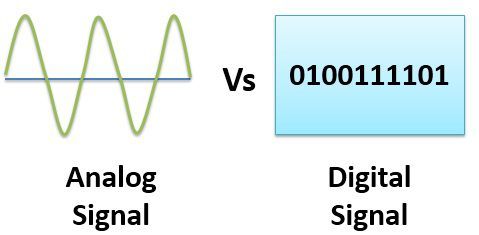
Analog circuits are those that handle signals that vary
continuously and must be reproduced as accurately as possible
possible. For example, a vocal amplifier is a typical device
fully analog in which the signal produced by the microphone
is processed and amplified but should not be modified in its
essential components to ensure “fidelity” of reproduction.
Digital circuits (from the English word “digit” which can be translated as
digit or number, and therefore are also called “numeric”),
instead, they deal with signals that can only have two states, usually indicated
by the numerical values 0 and 1, which in within the circuits correspond
two clearly differentiable signal values:
for example, 0 may correspond to a voltage
between 0 and 0.2 volts, while the value 1 at a voltage between 4.5 and 5 volts.
An element that can assume only two states represents a “bit” of information.
Most of the components of a common personal computer are made
with digital circuits.
In reality, many of today’s electronic devices
They adopt mixed technologies, part analog and part digital.
Consider, for example, a compact disc player. The sign that
represents the engraved piece is stored in the form typically
digital: a succession of microscopic areas that can be opaque
or reflective, each area corresponds to a value of 0 or 1 depending on whether
it is opaque or reflective.
The sequence of values 0/1 constitutes a digital representation
the acoustic signal, so the first part of the reproduction circuit
uses digital techniques.
To play the original sound,
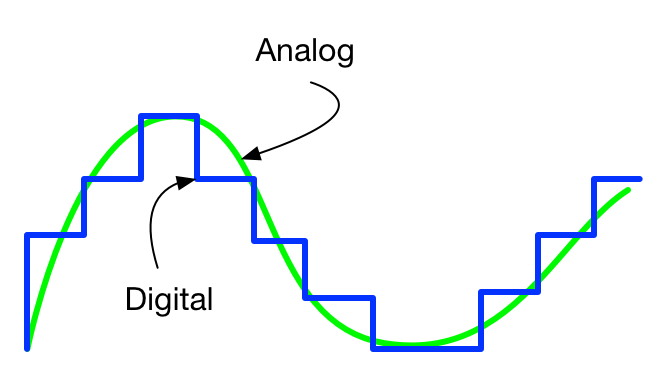
the sequence of bits must first be transformed into an analog signal and this step is done
a particular circuit called a “digital / analog converter” that has
the purpose of translating the sequence of bits into an electrical signal
which is “Analogous” to the acoustic signal originally produced by the instruments
that played the piece that is being recorded.
Then the analog signal can be amplified (by a circuit
analog, of course) and sent to the speakers for playback
acoustics.
Rather, consider a
fully analog recording and playback system: a magnetic recorder.
In this case, the magnetic tape in the cassette “stores” the signal
acoustics in the form of variations in the intensity of magnetization,
that is, the intensity of
magnetization along the magnetic tape is proportional to the signal
original acoustics. In this sense, the trend of
magnetization is “analogous” to the trend of the acoustic signal.
The player simply transforms the variation in the magnetic field
“read” on tape in a “similar” variation of an electrical signal
which is then amplified and reproduced as an acoustic signal.

