Analog Audio and Digital Audio


Free Download Mp4Gain
picture

Analog Audio and Digital Audio
Analog vs Digital Audio

A sound wave is a kind of complex function, the dependence of the amplitude of a sound wave on time.

Analog Audio vs. Digital Audio

The information contained in the acoustic wave is not determined by the parameters of the medium in which the elastic wave propagates, and the oscillation parameters (amplitude and frequency, tone and harmonics).

Any form of recording (mechanical and Skye, magnetic, optical, laser) is based on the previous conversion of the sound wave into an alternating electrical current with the same parameters of the oscillations (via microphone).

Analog sound is represented on the device as a continuous electrical signal.

Sound quality depends on the fidelity of the waveform, which is very difficult to maintain.

Until 1982, the world was consuming “canned music” only from analog media: vinyl records and magnetic tapes.

Good vinyl records, played with good equipment, offered excellent sound quality, which unfortunately deteriorated a little with each listening due to mechanical wear as the stylus moved along the sound groove and into the dust that permeated everything.

Tape recorders required precision read heads and high tape feed speeds to reproduce smoothly. Over time, the tape demagnetized, the magnetic layer crumbled.

But the main disadvantage of analog audio recording is the inevitable loss of quality when copying.

The mystery of trigonometry

According to the theory of the mathematician Jean Baptiste Fourier, a sound wave can be represented as a spectrum of frequencies included in it.

The frequency components of the spectrum are sinusoidal oscillations (pure tones), each of which has its own amplitude and frequency.

According to Kotelnikov’s theorem, any vibration, even the most complex shape (for example, a human voice), can be recovered unambiguously and without loss from its discrete samples taken with a frequency equal to its doubled maximum frequency.

Vladimir Aleksandrovich Kotelnikov (1908-2005) – a prominent Soviet and Russian scientist in the field of radio engineering, radiocommunication and radio astronomy.

Observation . The finite duration signal has an infinitely wide spectrum. Therefore, when a signal with a finite duration is sampled, it is impossible to recover it from the samples without loss of quality.

Digitization of audio information

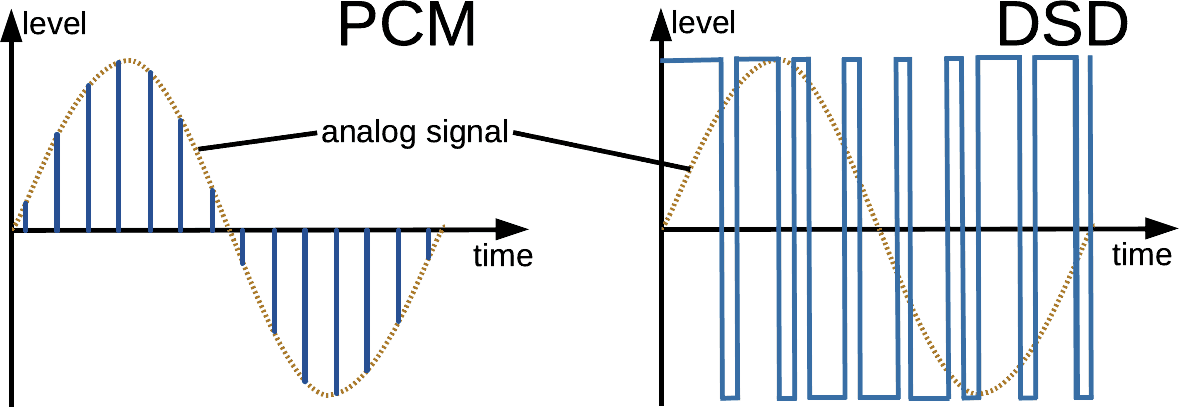
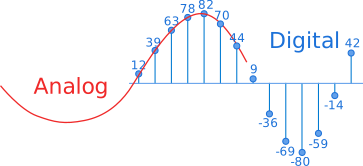
The digitization of sound is the recording of the amplitude of the signal at certain intervals and the recording of the amplitude values ​​obtained in the form of rounded digital values.
Any computer includes a motherboard, an audio adapter (sound card).

Sound cards include: ADC (analog to digital converter), synthesizer, mixer, DAC (digital to analog converter) amplifier s, MIDI interface port for gaming devices.

To record digital sound, the ADC produces:

temporal sampling of a continuous signal (determines the value of the amplitude of the signal with the frequency necessary to recreate its original shape = twice the maximum frequency of the sound wave);

quantization by the levels of the measured signal values ​​(determines the number of fixed values ​​(levels, gradations) of the amplitude of the signal);

signal coding (writing in a binary number system).

The reverse operation is performed by the DAC (digital to analog converter).

Bitrate

Bit rate (bit rate): literally bits of information of the transmission rate.

The bit rate is the effective information transmission rate through the channel (the transmission rate of “useful information”, in addition to the service information) expressed in kilobits per second (kilobits per second, kbps).

In lossy compression video and audio transmission formats, the bit rate parameter expresses the degree of compression of the stream and thus determines the size of the channel for which the data stream is compressed.

P-mode compression data stream:

with constant bit rate (constant bit rate, CBR) – The required bit rate is initially set, which does not change throughout the file. It makes it possible to predict the final file size quite accurately, but it does not provide an optimal size / quality ratio for musical works, the sound of which changes dynamically over time.

with variable bit rate (VBR): the codec changes the value of the bit rate based on the desired quality level according to the psychoacoustic model. It offers the best quality of the output file, but its size is unpredictable (it may differ several times).

with an average bit rate (ABR): a hybrid of constant and variable bit rates: the user sets the bit rate in kbit / s and the program varies it within certain limits.


Free Download Mp4Gain
picture


Mp4Gain Main Window
picture


Mp4Gain Features
picture


Free Download Mp4Gain
picture

Analog – Digital

Analog  Digital

When we talk about the Internet and the current technological “machines” (mobile phone, camera, tablet, computer) we always speak of “digital” and, sometimes, we contrast this term with “analog”. But what exactly these words mean and what they refer to, many times we ignore, perhaps also because it is not relevant for us and is based on being able to use “digital” for what we need without investigating it so much.

Analog Digital

“Analog” and “digital” are terms that are constantly encountered when talking about technologies (old and new). In common sense, “analog” is associated with a meaning of “old” or “past” or “low quality”; “Digital”, on the other hand, is synonymous with “new” or “innovative” or “quality”. This common sense distinction is not true.
One thing to keep in mind when addressing these issues is that the definitions of the two terms are one thing (what do they mean, where do they come from, …) and the operational implications they have (because we use one and not the other, as the consequences, implications, results …). As if to say, one thing is the universal law of gravity (with which the sun also has to do) and another is to stay in the sun to warm up and tan.
Another thing to keep in mind is that everything that is under the Digital / Analog issue is not something of our days, its essence was not born with the advent of “new” technologies; here it is one of the oldest problems in human thought and refers to philosophical disquisitions and to the issue of “continuous” and “discrete” variables. But we won’t dwell on these.

As for the definitions. ..
First of all, we must bear in mind that when we talk about Analogue and Digital we refer to ways of representing the measure of a quantity (they are “attributes of a quantity”), to ways in which the quantities we are considering vary (such as a audio signal, a video signal, color,….).

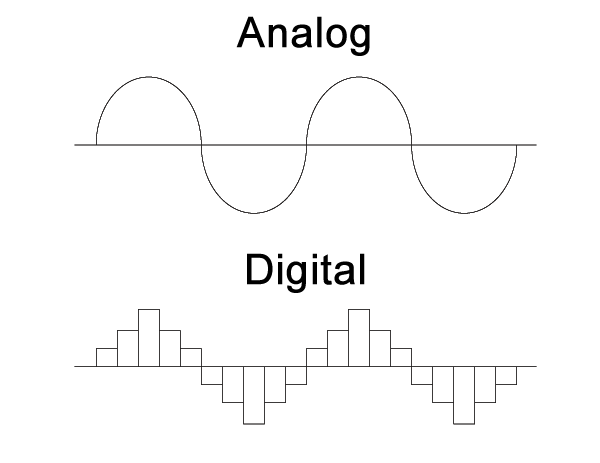
Analogous thing is a continuously varying quantity: an analog variable can take an infinite number of values ​​(for example, the distance between two points in space can take an infinite number of values).

Digital is a quantity that varies “step by step”: a digital variable can take only a finite number of values ​​(the duration of a day; for example, it can take only one of the 85,000 values ​​if we use the “second” unit, a of the 850 thousand values ​​if we use tenths of a second or one of the 8 million and 500 thousand if we use hundredths of a second; many possibilities but still finite, determined).

We can deduce that the concept of analog can be associated with a condition of continuity, that is, in a probable path something moves by changing its location through infinite positions and defining them as infinite we exclude the possibility of being able to number them.
With digital instead, the same path would be divided into stages (steps) and even if it is very small and numerous, it would always be possible to determine the amount.

Practice

Let us now turn to the practical implications of these two ways of representing physical quantities.
Until recently, all the data with which they organized audio or video recordings, static images, data transmissions such as radio, television, telephone were organized in the form of analog signals because the instruments that detected them “. The surfaces” on which they were recorded and the channels through which they were transported were mechanical and made specifically for that type of signal, in fact, they were the same as that signal.
Let’s think about color: the colors we see in a landscape are nothing more than a well-organized set of blue, red and green lights in their infinite shades; its representation through a photograph is based on the combination of blue, red and green pigments (therefore physical objects). We can say that the representation of a landscape through a photographic print is an analog representation of reality.

With the arrival of electronics (which has to do with physical quantities transformed and processed into electrical signals), physical quantities begin to be represented through electrical signals. Initially, these electrical signals were of the analog type (electronics that use continuous signals, signals that can assume an infinite range of possible values, that is, analog signals); later and a special type of signal has been used that can assume only some values ​​among the infinitely possible, in fact it can only assume two values: the presence or absence of the signal. If we look at the basic level of any computer application we will realize that we have a very long series of numbers “one” and “zero” where “one” is the presence of the signal and “zero” its absence.
This is “digital” electronics; digital because it uses signals that are not continuous but “in jumps”.

ANALOGUE AND DIGITAL

The essential

Analog and digital are two methods of transporting and storing data. (audio, photo, video …). Analog was born with the onset of electricity, while digital appeared more recently in the computer age.

Analogue and Digital

The analogical principle is to reproduce the signal to be recorded (audio, video …) in a similar way in a medium (magnetic in general). For example, when recording an audio signal in an analog system, the signal present on the tape will follow the same amplitudes (“the same curve”) as the sound wave (with more or less fidelity): the characteristic pressure variations of a sound wave will result in variations of an electrical signal. Therefore, the electrical amplitude of the analog signal will be the more or less faithful image of the signal to be recorded (audio, video, etc.)

analogue vs digital

In digital, the analog signal to record becomes digital thanks to an analog> digital converter. After this conversion, the signal is just a sequence of “0” and “1”, that is, a signal with two amplitudes instead of infinity in analog.

Once in this form, the signal can be copied and transmitted losslessly because instead of transporting a signal whose amplitude should faithfully vary from the original, it carries a signal consisting of only two amplitudes (for example, 0 = 0 volts and 1 = 5 volts). So when a parasite disturbs an analog signal, digitally this parasite will have no effect: for example, a parasite that adds 0.2v disturbance will deteriorate an analog signal, while this same parasite on a digital signal will have no effect because 0v + / – 0.2v will always be considered = “0”.

Therefore, the digital signal is an analog signal made up of two possible levels (for example, “0” = 0v and “1” = 5v) and when the analog signal moves away from these two voltages, it does not matter because all the signals close of 0v will be considered = “0” and any signal close to 5v will be = “1” with a voltage threshold between the two resulting in exceptional immunity against parasites and exemplary ease of making perfect copies (clones) of this signal type.

After digital transport and storage, any signal (video or audio) must return to its original analog form. For example, an audio signal will be converted from digital to analog and then amplified; in fact, our ears cannot hear digitally! ! !

It should be noted that digital is only used (in the case of an audio or video signal) for the transport and storage of data.

2 / Analog VS Digital and data compression.

So we have just seen that digital is not a commercial device, it is the support of all new technologies, but should we consider that digital is definitely better than analog?

I would try to answer yes, but it is necessary to moderate this judgment and that for two reasons: compression and sampling.

* / Digital compression:

Converting a signal to digital is not without problems: the bandwidth occupied by a signal once digitized is greater than its analog equivalent. When dealing with very bulky data, such as video, the processing is very cumbersome; Therefore, it is necessary to use a compression algorithm intended to reduce the amount of information by reducing the quality of the signal. All of the compressions used for video or audio rely on human perception to make this drop in quality little or not noticeable to humans. But the problem is that we often tend to want to compress the signal too much and the degradation becomes noticeable (case of GSM phones, MP3 <128kbit / s, mpeg-1 videos …)

For example, a high-quality audio signal recorded on a high-end cassette deck (analog) will be of better quality than a 112kbit / s mp3, because a large amount of information has been suppressed at 112kbit / s to satisfy the 112kbit / s imposed bit rate.

On the other hand, in an analogous way, the concept of copy generation intervenes: one copy will be less good than the original, one copy of the copy will lose a little more … After 10 or 20 copies of copies, the signal is totally deteriorated and cannot be used. In digital, a copy is often a clone of the original, so in theory you can make countless copies that are strictly the same quality as the original. I am talking about theory because errors can occur during a digital copy, often due to the state of the media. This is the case when copying an audio CD digitally (from your CD-ROM drive to your hard drive, for example): when a scratch or failure occurs, the information will not be copied and will be replaced by the correction system errors due to “extrapolated” data make this defect go unnoticed; In this case, the digital copy will no longer be identical to the original.

Which is better, analog or digital audio?

Which is better, analog or digital audio? Is there really a difference? Do you need very expensive audio equipment to make a difference? Really matters?

analog versus digital

Before we get to the heart of the matter, we should take a quick look at what makes a sound digital or analog. This is how a sound is recorded. A copy of an analog sound recording is a continuous electronic signal.

Today, advances in analog-to-digital conversion methods have improved the quality of digital recordings. Some say that there is no distinction between digital and analog mode. Others disagree, sometimes with passion. Music lovers, those who want the best possible quality in public address systems, insist that analog systems provide better sound.

What are the differences between analog and digital recordings? Read on to find out.

analog vs digital

History of digital sound.

Before the 1970s, music was recorded with analog recording equipment. The microphones they used recorded sound and generated an analog waveform that other devices could transfer directly to the appropriate medium, which was generally a magnetic tape. Assuming the musician wore reliable equipment, the recorded sound was a faithful representation of the original sound.

With digital recording, sound engineers can convert analog waveforms to digital signals. There are many different types of equipment that can be converted from analog to digital. Some studios record analog sound on the original master tape and then transfer it in digital format. Others use special equipment to record digitally directly.

The first digital recordings sacrificed fidelity, or sound quality, in favor of reliability. One of the disadvantages of the analog format is that analog media tends to wear out quickly. Vinyl records can become deformed or scratched, which can significantly affect sound quality. The magnetic tape eventually wears out and is vulnerable to magnets, which can erase or destroy the data stored on the tape. Digital media like CDs can be played indefinitely and are more durable.

Analog versus digital

Some music lovers believe that digital recordings are insufficient when it comes to accurately reproducing sound. They use complex language and jargon to describe the capabilities and flaws of an audio system. Most of his criticisms relate to the frequency of the sound.

Humans can hear sounds ranging from 20 hertz (Hz) to 20 kilohertz (kHz). The frequency of a sound wave corresponds to our perception of the tone of a sound. The higher the frequency, the higher the pitch we hear.

Audiophiles describe the sound quality of an audio system at different frequencies using terms like full, warm, and airy. A full or warm sound comes from a system that reproduces low frequencies well. An aerial sound means that the music played gives the listener the impression that the instruments are in a spacious environment and generally refers to sounds in the high frequency range.

Some music lovers say that vinyl albums are better at low frequencies, which means they provide warm sound. They claim that CDs are not as accurate in reproducing sounds in this range. Others insist that there is no detectable difference between a well-produced digital file and a vinyl in good condition.

If the artist uses an analog format to create the original recording, an analog copy is preferable. In fact, there would be no need to convert sound from analog to digital. The copy must be an exact representation of the original track. But if the artist uses digital recording, it is better to buy the album on CD.

The perception of musical quality is subjective. Two people listening to the same music, with the same equipment, may have different opinions on the quality of the recording.

Differences between analog and digital sound: analog and digital

Analog and digital signals
The sound is of course an analog signal and the analog signal is continuous. Therefore, there is no rest or interruption. Digital signals are not continuous. Specific values ​​are used to represent the information. In the case of sound, a sound wave is represented by a series of values ​​that represent pitch and volume for the duration of the recording.

Differences between analog and digital sound

Normally, we associate analog to past and digital to present and even future. But how have technologies evolved in recent years in the field of sound? What has been improved? What remains the same?

In digital systems, the changes between analog and digital are very evident by the binary system, composed exclusively of ones and zeros. On the other hand, in analogs the changes are progressive and gradual, maintaining continuity at all times.

Advantages of analog music over digital

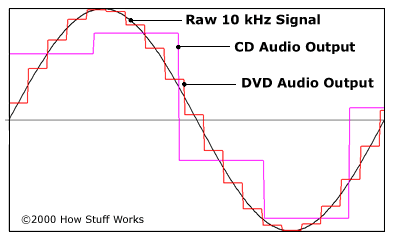
In the field of recording and music reproduction, to pass the analogue as vinyl or cassette to digital support, to audio files such as MP3 or FLAC, we need a whole conversion system. The analog signal is sampled and various samples are taken from it that are converted to the binary system in order to create a sequence as similar as possible to the original. The point is that it is impossible to take infinite samples and that is why the changes are more abrupt than when listening to an analog recording.

digital vs analogic

Disadvantages of analog music

The most obvious weak point is conservation. It is clear that cassette tapes or vinyl are much more fragile than for example a FLAC file that we have uploaded to the Internet cloud where there is not even physical support. Wear due to the use of analog media is also a notable drawback compared to digital systems. However, the most differentiating is the possibility of copying. For example, the copy of a digital file is accurate and two exactly the same files are created as many times as we want. On the other hand, the same does not happen with analogue media. The original is distorted as copies are made. Of course, digitized music is much easier to modify.

Advantages of analog vs. digital music

Extrapolated to the world of recording and playing music, something similar happens. The interpretation of a live song is an analog process, because the human being and its surroundings are. It can be faithfully collected on analog media such as vinyl or cassette tapes.

To transfer it to digital media, such as a CD or audio files such as MP3 or FLAC, a whole conversion system is required. The analog signal is sampled. That is, various samples are taken from it that are converted to the binary system to create a sequence as similar as possible to the original. The problem is that it is not possible to take infinite samples, therefore the changes are more abrupt than when listening to an analog recording.

digital vs analogic

Disadvantages of analog music

How could it be otherwise, analog support music also has its less good side. The most obvious is conservation: cassette tapes or vinyls are much more fragile than a FLAC file uploaded to the internet cloud, which because it does not have, it has no physical support. Not one that the user has to worry about, at least. Wear due to the use of analog media is also a handicap against digital systems.

However, the most differentiating is the possibility of copying. While the copy of a digital file is accurate and reliable, creating two exactly the same files over and over again, the same does not happen with analog media. If a copy is made of an original cassette tape, and of that copy another copy, and so on, the audio is filled with noise, distorting with respect to the original.

The conflict of opinions in this regard arises with regard to manipulation. Digitized music is much easier to modify – with programs such as Fruity Loops, Reason or Virtual DJ -, sometimes managing to dispense with the analog part – the interpretation of a song to record it – to create digital native music with prerecorded samples. As you can see in unvideo »where the Belgian Stromae explains how he created” in a minute “his musical success Alors on Danse.

On the other hand, there are those who consider that the manipulation of music is an advantage of digitalization and those who consider that, if a track has not been interpreted to be recorded, the music loses its soul. It is a matter of opinions.