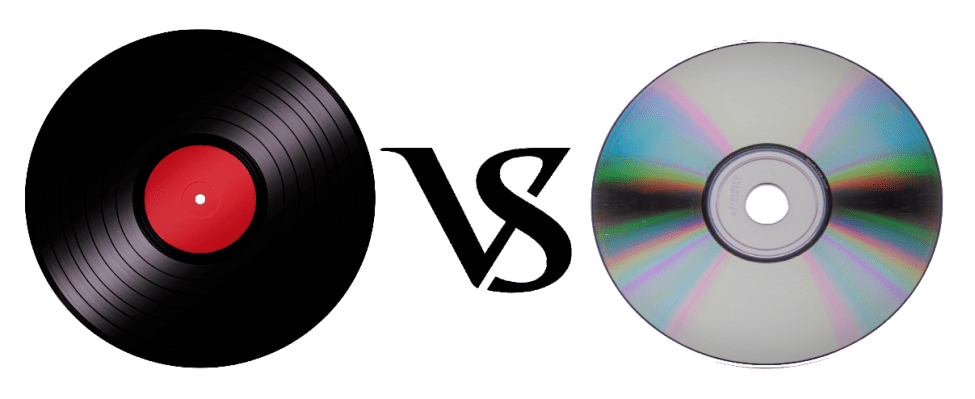
Analog vs Digital Audio


Free Download Mp4Gain
picture

Analog vs Digital Audio: Understanding the Differences

Analog vs Digital Audio

Analog Audio: The Old School Sound

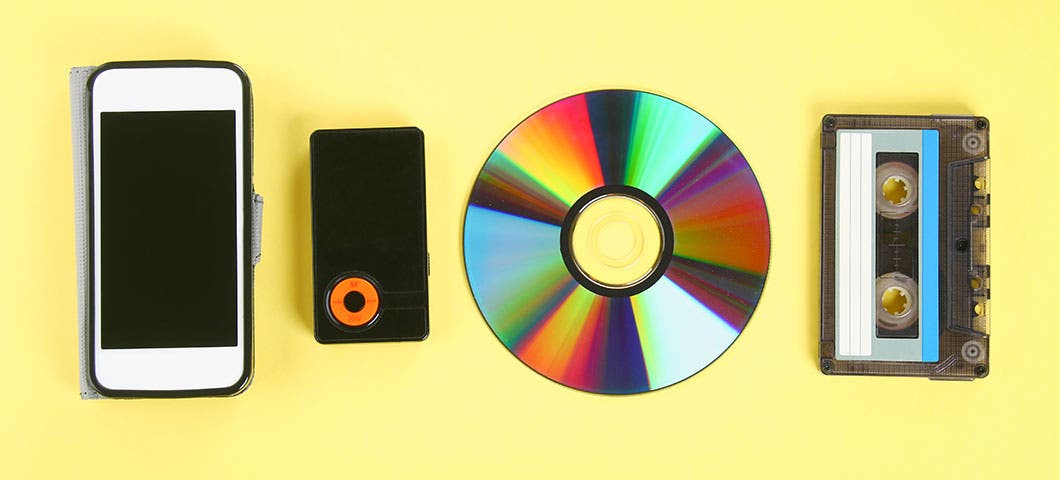
Analog audio refers to a sound signal that is continuous and unbroken. It is the old school way of recording sound, and it has been around for a long time. In the early days of audio recording, analog technology was the only option. Record players, cassette tapes, and reel-to-reel tapes were all analog formats that produced a unique sound.

One of the main advantages of analog audio is the warmth and depth of the sound. Analog recordings have a certain character that digital recordings simply can’t match. As author Salman Rushdie once said, “Analog is warm, digital is cold.”

However, analog audio is also subject to degradation and noise. Over time, the signal can deteriorate, resulting in a loss of quality. Analog recordings also tend to have more background noise and hiss than digital recordings.

Digital Audio: The Modern Sound

Digital audio, on the other hand, is a more modern method of recording sound. It involves converting sound waves into a series of numbers that can be stored and manipulated. The digital format has become increasingly popular in recent years, and it is now the standard for most audio recordings.

One of the main advantages of digital audio is its precision and clarity. Digital recordings are much more accurate and can reproduce sound with much greater fidelity than analog recordings. They are also immune to the degradation and noise that can affect analog recordings.

However, some people argue that digital recordings lack the warmth and character of analog recordings. As musician Jack White once said, “Digital sounds like it has a condom on it.”

Analog vs Digital: Which is Better?

So, which is better, analog or digital? The truth is, it depends on who you ask. Some people prefer the warmth and character of analog recordings, while others prefer the precision and clarity of digital recordings.

At the end of the day, the choice between analog and digital comes down to personal preference. Both formats have their advantages and disadvantages, and it ultimately comes down to what kind of sound you prefer.

Conclusion: The Best of Both Worlds

At mp4gain.com, we understand the importance of sound quality. That’s why we’ve developed a powerful audio normalization and conversion software that can work with both analog and digital formats. Our software can help you get the best of both worlds by optimizing your audio for clarity and warmth.

As technology continues to evolve, we can expect to see new and innovative ways of recording and manipulating sound. But no matter what the future holds, we will always be dedicated to providing our customers with the highest quality sound possible.

Final Words:

In the end, whether you prefer analog or digital audio comes down to personal preference. Both formats have their advantages and disadvantages, and it’s up to you to decide which one is best for you. But with the right tools and techniques, you can achieve great sound quality no matter what format you choose.


Free Download Mp4Gain
picture


Mp4Gain Main Window
picture


Mp4Gain Features
picture


Free Download Mp4Gain
picture

Analog Sound vs Digital Sound: Understanding the Differences

Analog Sound vs Digital Sound: Understanding the Differences

Analog & Digital Sound

Have you ever wondered why some music sounds better than others? It might have to do with the way the sound was recorded. There are two main ways to record sound: analog and digital. Let’s explore the differences between these two methods and why they affect the sound of your music.

Digital vs Analog Sound

Analog Sound

Analog sound is a continuous wave that is recorded on a physical medium such as a vinyl record or cassette tape. When you listen to an analog recording, the needle or tape head reads the wave and converts it into sound that you can hear through your speakers or headphones.

One of the benefits of analog sound is that it captures the natural warmth and richness of live music. This is because analog recording is a more direct representation of the sound waves. However, analog recordings are also more prone to wear and tear and can degrade over time, causing hisses, pops, and crackles in the sound.

Digital Sound

Digital sound, on the other hand, is recorded by converting the sound waves into a series of numbers that represent the amplitude and frequency of the wave. This digital representation of sound can then be stored on a computer or other digital device and played back at a later time.

One of the benefits of digital sound is that it is much more reliable and consistent than analog sound. Digital recordings are not subject to wear and tear like analog recordings and the sound quality remains unchanged over time. Additionally, digital sound can be easily edited and manipulated, making it possible to remove any unwanted noise or to enhance certain aspects of the sound.

The Differences in Sound Quality

Despite the many benefits of digital sound, some people argue that it does not have the same warmth and richness as analog sound. This is because digital sound is limited by the resolution of the recording, meaning that it cannot capture the full range of sound that an analog recording can.

Additionally, digital sound is often compressed to make it easier to store and transfer, which can result in a loss of sound quality. This is why some people prefer the sound of analog recordings, which they perceive as being more natural and musical.

Conclusion

In conclusion, the choice between analog and digital sound depends on your personal preferences and the way you listen to music. If you are looking for a more natural, warm sound, analog recordings might be the way to go. However, if you value convenience and reliability, digital sound is the way to go.

To get the best sound quality from your digital music files, it is important to use a high-quality software like Mp4Gain.

Audio digitization: how it works

Audio digitization: how it works

Audio digitization


How to translate sound into 0s and 1s without soul? . Let’s take a look at familiar devices: how computer sound, video, MP3s, streaming and streaming work, various algorithms, and more.

Audio digitalization


a bit of physics
Sounds are vibrations in the air. Like waves in the water, in the air. Air pressure enters the ear, which has sensitive parts that can subtly sense vibrations in the air. These vibrations are perceived by people as sounds. There is no sound in outer space because there is no air.

frequency. The faster the vibration, the weaker the sound we perceive. A person perceives vibrations that range between 20 and 20,000 vibrations per second. In other words, this is called the oscillation frequency: Hertz. That is, the range we hear is from 20 Hz to 20 kHz.

By comparison, dogs hear frequencies from 40 Hz to 60 kHz, so humans don’t perceive a dog’s whistle, but dogs can hear it. The sound of a dog whistle is only in the 23-54 kHz range.

amplitude. The stronger the vibration, the stronger the sound and vice versa. You can think of this as the height of the waves on the surface of the pond: there may be small ripples (soft sounds) or there may be large powerful waves.
Divide the sound into segments.


Now let’s do this: We divide the second part into 4 parts and find the magnitude value for each part:


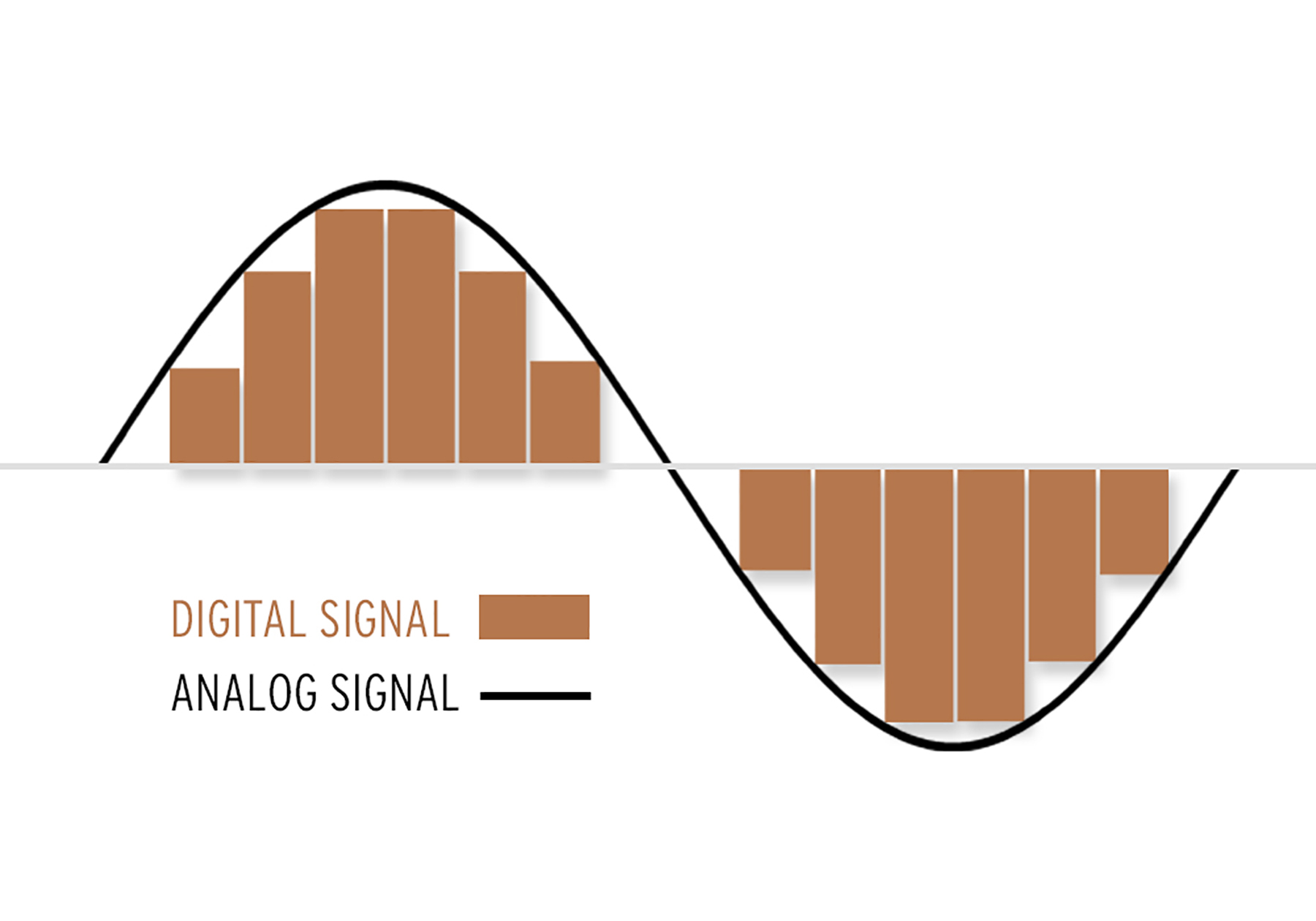
We measure the state of the quadratic wave in one second. This is called sampling.

We measured the magnitude of each of the four points and, in relative terms, we got four numbers: +30, -50, -50 and -60. In theory, if we were to pass current and apply these four voltages to the speaker, we would be able to reproduce the same sound. But there are several problems:

• Since we only measure in four places, all oscillation is lost.
• We ended up with a very distorted sound compared to the original.

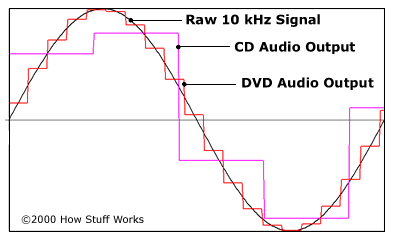
Sampling at a rate of 4 is too little for the sound. To get at least intelligible speech, one second must be divided into 8,000 segments, and for music, 41,000 segments are usually sufficient.

Let’s increase the sample rate: cut the sound into smaller parts in the same unit of time:


Measurements are now more accurate and the resulting sound is more natural.

convert to number
After dividing the sound into small segments and measuring the amplitude value of each segment, we can record it in table form:

Time ⠀⠀⠀⠀⠀ Amplitude

0.01 seconds. ⠀⠀⠀⠀ 5

0.02 seconds. ⠀⠀⠀⠀ 7

0.03 seconds. ⠀⠀⠀⠀ 10

If we divide the whole sound into equal segments, then the time cannot be written, since we know how it changes, it is enough to write the amplitude value on a line:

5 7 10 … −21

Analog or digital audio?

Analog or digital audio?

Analog vs. Digital Audio

Mechanical, electromechanical, optical, and magnetic recording were originally analog recording methods: recording and reproducing sound vibrations in their natural form (waves).

ANALOG vs. DIGITAL AUDIO

Many people believe that there is no better sound recording than analog. The warm analog sound of the magnetic tape is the standard of the best audio recordings for all mankind. Everyone from Elvis Presley and the Beatles to the latest electronic musicians have used and are using analog tape recording or emulation to create their music.

But analog recording is not the most accurate way to record sound. Rather the most beautiful. Analog sound is pleasant to the human ear due to the presence of “warm” harmonics, which are, in fact, distortions of sound. The most accurate sound recording principle today is digital recording.

The father of digital sound was 25-year-old Volodya Kotelnikov, who created it in 1933. The famous “report theorem” (also known as “Kotelnikov’s theorem” or “Nyquist-Shannon theorem). This theorem was the beginning of the creation of the principle of digitizing sound: encoding an audio signal into bits, that is, converting an analog signal into digital. It only took 49 years to create the CDs we know about. the world, it was only adopted in 1982.

A complete list of the types of digital sound recording in use today is digital magnetic recording (format: DAT cassette), magneto-optical recording (miniDisc format), laser recording (CD, SACD formats), digital recording optical (dolby digital)

The development of computers and digital technology has opened up enormous possibilities for processing and recording sound. Huge analog studios with countless multi-kilogram recording equipment, consoles, and sound processors are being replaced by virtual studios that fit into the computer’s system unit.

To process sound on a computer, it must first be recorded in digital, encoded format. The analog signal is encoded by an analog-to-digital converter (ADC). To play back the recording, you must reverse the digital-to-analog audio conversion using a digital-to-analog converter (DAC). The DAC and ADC are part of the computer sound card and other digital audio equipment. The quality of sound recording and playback is highly dependent on the quality of the DAC and ADC.

DAC and ADC

The main parameters of digital sound are sample rate and bit depth. Both the quality of the digitized sound and the size of the recorded file depend directly on them.

Sampling rate (sampling)

Analog recording begins by pressing the “record” button and ends by pressing the “stop” button. Digital recording is discreet. It consists of many recording fragments (samples) that follow one after another. The number of samples logged per second is the sample rate. It is calculated in hertz. The 44 100 Hz sampling rate (standard for CD) means that the audio signal is measured 44 100 times per second. The lower the sampling frequency, the smaller the frequency spectrum that is recorded. The higher the sampling frequency of the source material, the higher the quality and the larger the file size. When you talk on the phone, you only hear a small mid-range range. This is because the sample rate for phone calls is only 8,000 Hz. To transmit a range of frequencies that the average person’s ear hears and transmits home stereos: 40,000 Hz is sufficient. If the difference in sound quality between 32 and 44.1 kHz is obvious, then the higher the sampling frequency, the less perceptible or not at all perceptible to the ear the difference in quality between the two different frequencies will be. A higher sample rate describes sound more precisely, but at the same time describes those frequencies that the human ear can no longer hear, although changes in sound in the inaudible frequency range can still affect audible frequencies, so that studio recording is performed at a higher sample rate. Since consumer equipment is primarily designed to reproduce sound with a sample rate of 44.1 kHz, when the recording is ready, it is re-encoded to a generally accepted standard. If the difference in sound quality between 32 and 44.1 kHz is obvious, then the higher the sampling frequency, the less perceptible or not at all perceptible to the ear the difference in quality between the two different frequencies will be.

ANALOGUE AND DIGITAL

The essential

Analog and digital are two methods of transporting and storing data. (audio, photo, video …). Analog was born with the onset of electricity, while digital appeared more recently in the computer age.

Analogue and Digital

The analogical principle is to reproduce the signal to be recorded (audio, video …) in a similar way in a medium (magnetic in general). For example, when recording an audio signal in an analog system, the signal present on the tape will follow the same amplitudes (“the same curve”) as the sound wave (with more or less fidelity): the characteristic pressure variations of a sound wave will result in variations of an electrical signal. Therefore, the electrical amplitude of the analog signal will be the more or less faithful image of the signal to be recorded (audio, video, etc.)

analogue vs digital

In digital, the analog signal to record becomes digital thanks to an analog> digital converter. After this conversion, the signal is just a sequence of “0” and “1”, that is, a signal with two amplitudes instead of infinity in analog.

Once in this form, the signal can be copied and transmitted losslessly because instead of transporting a signal whose amplitude should faithfully vary from the original, it carries a signal consisting of only two amplitudes (for example, 0 = 0 volts and 1 = 5 volts). So when a parasite disturbs an analog signal, digitally this parasite will have no effect: for example, a parasite that adds 0.2v disturbance will deteriorate an analog signal, while this same parasite on a digital signal will have no effect because 0v + / – 0.2v will always be considered = “0”.

Therefore, the digital signal is an analog signal made up of two possible levels (for example, “0” = 0v and “1” = 5v) and when the analog signal moves away from these two voltages, it does not matter because all the signals close of 0v will be considered = “0” and any signal close to 5v will be = “1” with a voltage threshold between the two resulting in exceptional immunity against parasites and exemplary ease of making perfect copies (clones) of this signal type.

After digital transport and storage, any signal (video or audio) must return to its original analog form. For example, an audio signal will be converted from digital to analog and then amplified; in fact, our ears cannot hear digitally! ! !

It should be noted that digital is only used (in the case of an audio or video signal) for the transport and storage of data.

2 / Analog VS Digital and data compression.

So we have just seen that digital is not a commercial device, it is the support of all new technologies, but should we consider that digital is definitely better than analog?

I would try to answer yes, but it is necessary to moderate this judgment and that for two reasons: compression and sampling.

* / Digital compression:

Converting a signal to digital is not without problems: the bandwidth occupied by a signal once digitized is greater than its analog equivalent. When dealing with very bulky data, such as video, the processing is very cumbersome; Therefore, it is necessary to use a compression algorithm intended to reduce the amount of information by reducing the quality of the signal. All of the compressions used for video or audio rely on human perception to make this drop in quality little or not noticeable to humans. But the problem is that we often tend to want to compress the signal too much and the degradation becomes noticeable (case of GSM phones, MP3 <128kbit / s, mpeg-1 videos …)

For example, a high-quality audio signal recorded on a high-end cassette deck (analog) will be of better quality than a 112kbit / s mp3, because a large amount of information has been suppressed at 112kbit / s to satisfy the 112kbit / s imposed bit rate.

On the other hand, in an analogous way, the concept of copy generation intervenes: one copy will be less good than the original, one copy of the copy will lose a little more … After 10 or 20 copies of copies, the signal is totally deteriorated and cannot be used. In digital, a copy is often a clone of the original, so in theory you can make countless copies that are strictly the same quality as the original. I am talking about theory because errors can occur during a digital copy, often due to the state of the media. This is the case when copying an audio CD digitally (from your CD-ROM drive to your hard drive, for example): when a scratch or failure occurs, the information will not be copied and will be replaced by the correction system errors due to “extrapolated” data make this defect go unnoticed; In this case, the digital copy will no longer be identical to the original.

Which is better, analog or digital audio?

Which is better, analog or digital audio? Is there really a difference? Do you need very expensive audio equipment to make a difference? Really matters?

analog versus digital

Before we get to the heart of the matter, we should take a quick look at what makes a sound digital or analog. This is how a sound is recorded. A copy of an analog sound recording is a continuous electronic signal.

Today, advances in analog-to-digital conversion methods have improved the quality of digital recordings. Some say that there is no distinction between digital and analog mode. Others disagree, sometimes with passion. Music lovers, those who want the best possible quality in public address systems, insist that analog systems provide better sound.

What are the differences between analog and digital recordings? Read on to find out.

analog vs digital

History of digital sound.

Before the 1970s, music was recorded with analog recording equipment. The microphones they used recorded sound and generated an analog waveform that other devices could transfer directly to the appropriate medium, which was generally a magnetic tape. Assuming the musician wore reliable equipment, the recorded sound was a faithful representation of the original sound.

With digital recording, sound engineers can convert analog waveforms to digital signals. There are many different types of equipment that can be converted from analog to digital. Some studios record analog sound on the original master tape and then transfer it in digital format. Others use special equipment to record digitally directly.

The first digital recordings sacrificed fidelity, or sound quality, in favor of reliability. One of the disadvantages of the analog format is that analog media tends to wear out quickly. Vinyl records can become deformed or scratched, which can significantly affect sound quality. The magnetic tape eventually wears out and is vulnerable to magnets, which can erase or destroy the data stored on the tape. Digital media like CDs can be played indefinitely and are more durable.

Analog versus digital

Some music lovers believe that digital recordings are insufficient when it comes to accurately reproducing sound. They use complex language and jargon to describe the capabilities and flaws of an audio system. Most of his criticisms relate to the frequency of the sound.

Humans can hear sounds ranging from 20 hertz (Hz) to 20 kilohertz (kHz). The frequency of a sound wave corresponds to our perception of the tone of a sound. The higher the frequency, the higher the pitch we hear.

Audiophiles describe the sound quality of an audio system at different frequencies using terms like full, warm, and airy. A full or warm sound comes from a system that reproduces low frequencies well. An aerial sound means that the music played gives the listener the impression that the instruments are in a spacious environment and generally refers to sounds in the high frequency range.

Some music lovers say that vinyl albums are better at low frequencies, which means they provide warm sound. They claim that CDs are not as accurate in reproducing sounds in this range. Others insist that there is no detectable difference between a well-produced digital file and a vinyl in good condition.

If the artist uses an analog format to create the original recording, an analog copy is preferable. In fact, there would be no need to convert sound from analog to digital. The copy must be an exact representation of the original track. But if the artist uses digital recording, it is better to buy the album on CD.

The perception of musical quality is subjective. Two people listening to the same music, with the same equipment, may have different opinions on the quality of the recording.

Differences between analog and digital sound: analog and digital

Analog and digital signals
The sound is of course an analog signal and the analog signal is continuous. Therefore, there is no rest or interruption. Digital signals are not continuous. Specific values ​​are used to represent the information. In the case of sound, a sound wave is represented by a series of values ​​that represent pitch and volume for the duration of the recording.