What is digital audio?


Free Download Mp4Gain
picture

What is digital audio?
Digital Audio
Digital Audio

How does digital audio work?

Digital Audio
Digital Audio

What is the rate? Of course, I can’t directly explain to you that “rate is bitrate”. When you play sound files with some software, you should notice a small message. For example, “128Kbps”, “1411Kbps”… Some friends also know that under normal circumstances, the larger the number in front of “Kbps”, the better the sound effect, for example, CD is “1411Kbps”. So what exactly do these numbers represent? In a nutshell, how much data is converted into sound per second. The reason CDs sound better than MP3s is that CDs have more information per second than MP3s. For example, compared to a 1411 Kbps CD file, a 128 Kbps MP3 file can convert almost 12 times less data per second than a CD. For the same song, the CD is much more delicate to listen to (of course, there is a group of people in the crowd known as “mushrooms” who can feel that the effect is the same) MP3 expresses the same content with less data and, of course, its level of detail is not as good as that of a CD.


2. Sampling rate.


Sampling rate is also a very common term. The specific form is “XXHz”, where “XX” is a specific number. Such as “44100Hz (44.1KHz)”, “32000Hz (32KHz)” and so on. As mentioned above, digital audio files are made up of many “points”, so the sample rate is actually a standard “quantity” to collect these “points”. Obviously, the sampling rate of “44100 Hz” is higher than that of “32000 Hz”, so more points are collected per time unit (1 second). The more points per unit of time, the more complete the sound information and, of course, the closer to reality. So if the guaranteed rate is the same, the file “44100Hz” is better than “32000Hz” (of course, this is not absolute).


————————————————–


lossy compression


In fact, we are all familiar with lossy compressed audio sources. At present, popular lossy formats mainly include MP3, WMA, OGG, MP3pro, AAC, VQF, ASF, etc.


2.WMV format


The full name of WMA is WindowsMedia Audio, which is an audio format promoted by Microsoft. The WMA format achieves a higher compression ratio by reducing the data stream while maintaining sound quality. The compression ratio can usually reach 1:18, and the generated file size is only half of the corresponding MP3 file.


3.MP3 format


The full name of MP3 is MovingPicture Experts Group Audio Layer Ⅲ. In a nutshell, MP3 is an audio compression technology. Since the full name of this compression method is called MPEGAAudio Layer 3, people call it MP3 for short. It was born in 1993, and its “parents” are the German FaunhofeIIS and the French Thomson.


MP3 uses MPEGAudio Layer 3 technology to compress music into smaller files with a compression ratio of 1:10 or even 1:12. In other words, you can compress files to a smaller size with little loss of sound quality. And it keeps the original sound quality very well. It is precisely because of MP3’s small size and high sound quality that the MP3 format has become almost synonymous with online music. The MP3 format of music per minute is only 1 MB in size, so the size of each song is only 3-4 megabytes. Use an MP3 player to uncompress (decode) MP3 files in real time so that high-quality MP3 music can be played.


Free Download Mp4Gain
picture


Mp4Gain Main Window
picture


Mp4Gain Features
picture


Free Download Mp4Gain
picture

What is digital audio?

What is digital audio?

Digital Audio
Digital Audio

How does digital audio work?

Digital Audio
Digital Audio

In our daily lives, we listen to all kinds of music, and most of this music is transmitted in digital form, whether it is listened to or downloaded to a computer or played on an MP3 or CD player. Of course, you will often see various formats like MP3, WMV, APE, etc., but do you understand the meaning of these formats? Below I have compiled some of this content for you, I hope it helps you.


1. Introduction to digital music


Digital audio sources, that is, digital audio formats, first referred to CDs. After the CDs were compressed, a variety of formats suitable for playback on Walkmans were derived. These compressed formats can be divided into two categories: there is lossy and lossless compression. The compression mentioned here refers to converting the audio stream encoded in PCM or WAV format to other formats after special compression processing, so as to achieve the effect of reducing the file size. Lossy/Lossless refers to whether the sound signal retained in the new file is reduced compared to the original PCM/WAV format signal after compression.


PCM encoding is short for PulseCode Modulation, also known as Pulse Code Modulation, which is one of the digital communication encoding methods. The sampled value is rounded and quantized according to the hierarchical unit, and the sampled value is represented by a set of binary codes to represent the amplitude of the sampled pulse.

The final form of the digital audio signal is still made up of “0/1”. They can be any permutation and combination, such as “0001110101” or “11100001010”. Of course, different combinations have different effects. Seeing this, some friends should have noticed. If the sound is recorded in the form of “00101010”, then the final form is not a “dot”, that is, a simple “change” process. The sound is continuous, how can it be recorded with “dots”? Shouldn’t the sound we hear be segment by segment? The reason is not difficult to understand. Go home and turn on the fluorescent light, can you find the fluorescent light flickering? can not? In fact, fluorescent lights flicker constantly. Have you seen cartoons? They are all connected by a grid of still images. We can also simply understand the images one by one as “dots” one by one. Man against nature

There are limits to the sense of the world, both visual and auditory. The reason cartoons can produce coherent motion is that these “dots” are an illusion that people create when human vision doesn’t respond in time. With the exception of machines, people cannot distinguish these “dots”. So is the sound. If the frequency of the sound flicker is very fast, people cannot distinguish it. Also, when the sound performs a “digital conversion of analog signals” (D/A conversion), the decoder chip has already connected these “dots” coherently, so we hear a very coherent sound.

Audio digitization: how it works

Audio digitization: how it works

Audio digitization


How to translate sound into 0s and 1s without soul? . Let’s take a look at familiar devices: how computer sound, video, MP3s, streaming and streaming work, various algorithms, and more.

Audio digitalization


a bit of physics
Sounds are vibrations in the air. Like waves in the water, in the air. Air pressure enters the ear, which has sensitive parts that can subtly sense vibrations in the air. These vibrations are perceived by people as sounds. There is no sound in outer space because there is no air.

frequency. The faster the vibration, the weaker the sound we perceive. A person perceives vibrations that range between 20 and 20,000 vibrations per second. In other words, this is called the oscillation frequency: Hertz. That is, the range we hear is from 20 Hz to 20 kHz.

By comparison, dogs hear frequencies from 40 Hz to 60 kHz, so humans don’t perceive a dog’s whistle, but dogs can hear it. The sound of a dog whistle is only in the 23-54 kHz range.

amplitude. The stronger the vibration, the stronger the sound and vice versa. You can think of this as the height of the waves on the surface of the pond: there may be small ripples (soft sounds) or there may be large powerful waves.
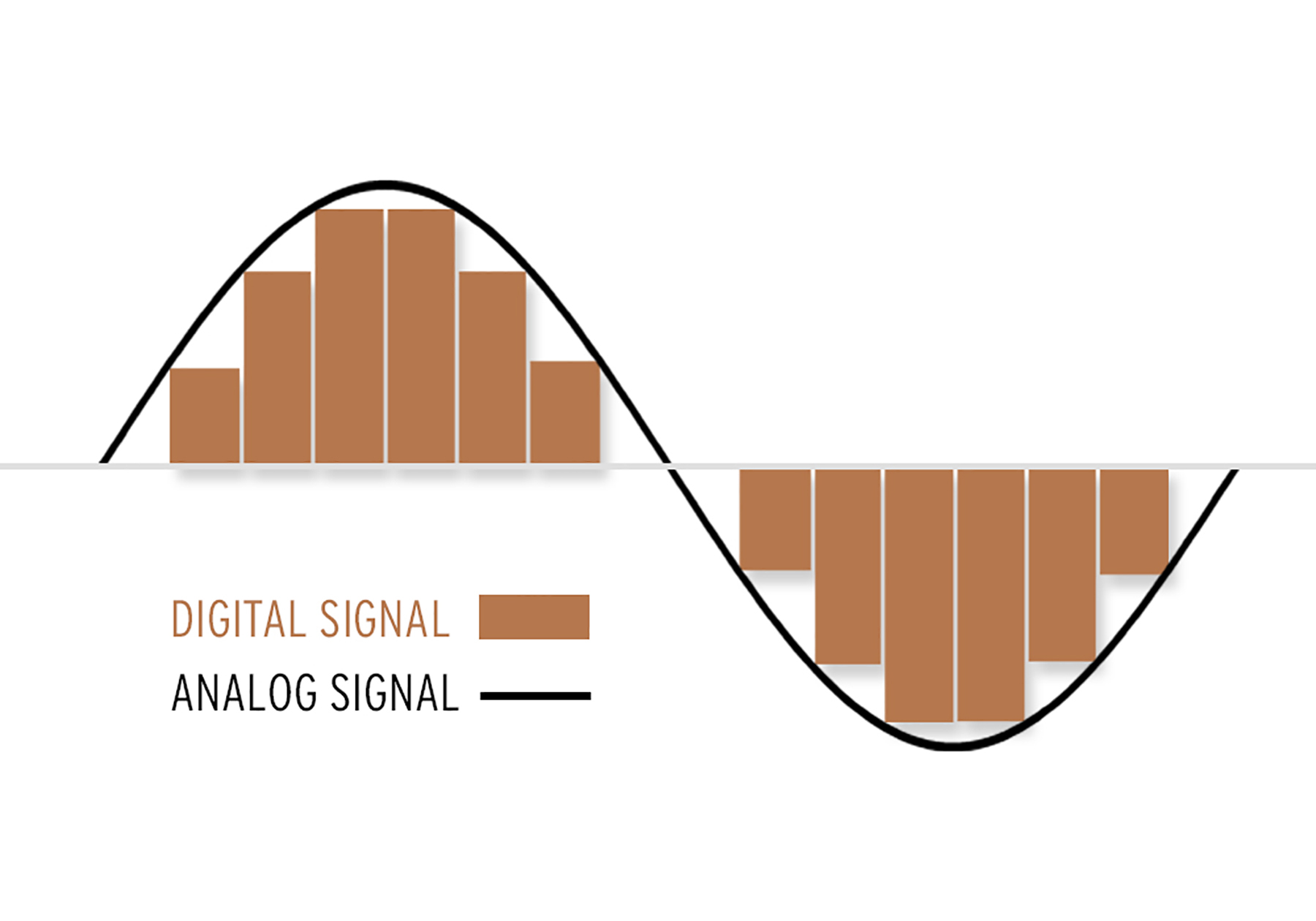
Divide the sound into segments.


Now let’s do this: We divide the second part into 4 parts and find the magnitude value for each part:


We measure the state of the quadratic wave in one second. This is called sampling.

We measured the magnitude of each of the four points and, in relative terms, we got four numbers: +30, -50, -50 and -60. In theory, if we were to pass current and apply these four voltages to the speaker, we would be able to reproduce the same sound. But there are several problems:

• Since we only measure in four places, all oscillation is lost.
• We ended up with a very distorted sound compared to the original.

Sampling at a rate of 4 is too little for the sound. To get at least intelligible speech, one second must be divided into 8,000 segments, and for music, 41,000 segments are usually sufficient.

Let’s increase the sample rate: cut the sound into smaller parts in the same unit of time:


Measurements are now more accurate and the resulting sound is more natural.

convert to number
After dividing the sound into small segments and measuring the amplitude value of each segment, we can record it in table form:

Time ⠀⠀⠀⠀⠀ Amplitude

0.01 seconds. ⠀⠀⠀⠀ 5

0.02 seconds. ⠀⠀⠀⠀ 7

0.03 seconds. ⠀⠀⠀⠀ 10

If we divide the whole sound into equal segments, then the time cannot be written, since we know how it changes, it is enough to write the amplitude value on a line:

5 7 10 … −21