What is digital audio?


Free Download Mp4Gain
picture

What is digital audio?
Digital Audio
Digital Audio

How does digital audio work?

Digital Audio
Digital Audio

What is the rate? Of course, I can’t directly explain to you that “rate is bitrate”. When you play sound files with some software, you should notice a small message. For example, “128Kbps”, “1411Kbps”… Some friends also know that under normal circumstances, the larger the number in front of “Kbps”, the better the sound effect, for example, CD is “1411Kbps”. So what exactly do these numbers represent? In a nutshell, how much data is converted into sound per second. The reason CDs sound better than MP3s is that CDs have more information per second than MP3s. For example, compared to a 1411 Kbps CD file, a 128 Kbps MP3 file can convert almost 12 times less data per second than a CD. For the same song, the CD is much more delicate to listen to (of course, there is a group of people in the crowd known as “mushrooms” who can feel that the effect is the same) MP3 expresses the same content with less data and, of course, its level of detail is not as good as that of a CD.


2. Sampling rate.


Sampling rate is also a very common term. The specific form is “XXHz”, where “XX” is a specific number. Such as “44100Hz (44.1KHz)”, “32000Hz (32KHz)” and so on. As mentioned above, digital audio files are made up of many “points”, so the sample rate is actually a standard “quantity” to collect these “points”. Obviously, the sampling rate of “44100 Hz” is higher than that of “32000 Hz”, so more points are collected per time unit (1 second). The more points per unit of time, the more complete the sound information and, of course, the closer to reality. So if the guaranteed rate is the same, the file “44100Hz” is better than “32000Hz” (of course, this is not absolute).


————————————————–


lossy compression


In fact, we are all familiar with lossy compressed audio sources. At present, popular lossy formats mainly include MP3, WMA, OGG, MP3pro, AAC, VQF, ASF, etc.


2.WMV format


The full name of WMA is WindowsMedia Audio, which is an audio format promoted by Microsoft. The WMA format achieves a higher compression ratio by reducing the data stream while maintaining sound quality. The compression ratio can usually reach 1:18, and the generated file size is only half of the corresponding MP3 file.


3.MP3 format


The full name of MP3 is MovingPicture Experts Group Audio Layer Ⅲ. In a nutshell, MP3 is an audio compression technology. Since the full name of this compression method is called MPEGAAudio Layer 3, people call it MP3 for short. It was born in 1993, and its “parents” are the German FaunhofeIIS and the French Thomson.


MP3 uses MPEGAudio Layer 3 technology to compress music into smaller files with a compression ratio of 1:10 or even 1:12. In other words, you can compress files to a smaller size with little loss of sound quality. And it keeps the original sound quality very well. It is precisely because of MP3’s small size and high sound quality that the MP3 format has become almost synonymous with online music. The MP3 format of music per minute is only 1 MB in size, so the size of each song is only 3-4 megabytes. Use an MP3 player to uncompress (decode) MP3 files in real time so that high-quality MP3 music can be played.


Free Download Mp4Gain
picture


Mp4Gain Main Window
picture


Mp4Gain Features
picture


Free Download Mp4Gain
picture

What is digital audio?

What is digital audio?

Digital Audio
Digital Audio

How does digital audio work?

Digital Audio
Digital Audio

In our daily lives, we listen to all kinds of music, and most of this music is transmitted in digital form, whether it is listened to or downloaded to a computer or played on an MP3 or CD player. Of course, you will often see various formats like MP3, WMV, APE, etc., but do you understand the meaning of these formats? Below I have compiled some of this content for you, I hope it helps you.


1. Introduction to digital music


Digital audio sources, that is, digital audio formats, first referred to CDs. After the CDs were compressed, a variety of formats suitable for playback on Walkmans were derived. These compressed formats can be divided into two categories: there is lossy and lossless compression. The compression mentioned here refers to converting the audio stream encoded in PCM or WAV format to other formats after special compression processing, so as to achieve the effect of reducing the file size. Lossy/Lossless refers to whether the sound signal retained in the new file is reduced compared to the original PCM/WAV format signal after compression.


PCM encoding is short for PulseCode Modulation, also known as Pulse Code Modulation, which is one of the digital communication encoding methods. The sampled value is rounded and quantized according to the hierarchical unit, and the sampled value is represented by a set of binary codes to represent the amplitude of the sampled pulse.

The final form of the digital audio signal is still made up of “0/1”. They can be any permutation and combination, such as “0001110101” or “11100001010”. Of course, different combinations have different effects. Seeing this, some friends should have noticed. If the sound is recorded in the form of “00101010”, then the final form is not a “dot”, that is, a simple “change” process. The sound is continuous, how can it be recorded with “dots”? Shouldn’t the sound we hear be segment by segment? The reason is not difficult to understand. Go home and turn on the fluorescent light, can you find the fluorescent light flickering? can not? In fact, fluorescent lights flicker constantly. Have you seen cartoons? They are all connected by a grid of still images. We can also simply understand the images one by one as “dots” one by one. Man against nature

There are limits to the sense of the world, both visual and auditory. The reason cartoons can produce coherent motion is that these “dots” are an illusion that people create when human vision doesn’t respond in time. With the exception of machines, people cannot distinguish these “dots”. So is the sound. If the frequency of the sound flicker is very fast, people cannot distinguish it. Also, when the sound performs a “digital conversion of analog signals” (D/A conversion), the decoder chip has already connected these “dots” coherently, so we hear a very coherent sound.

Benefits of “digital audio”

Benefits of “digital audio”

Digital Audio

The digitized audio signal has the following advantages:

DIGITAL AUDIO

-the possibility of infinitely long storage without loss of original quality,

-the ability to reproduce for a long time without losing the original quality,

-the possibility of infinite reproduction without loss of original quality,

-simplicity and wide possibilities of processing by modern means,

-Resistance to interference in signal transmission lines.

From CD to Super Audio CD and DVD Audio

CD (Compact Disk) is a type of removable plastic disk with optical reading of information.

In 1979, Sony and Philips proposed the Red Book standard for digital audio recording.

Analog sound is digitized and recorded as a spiral track of alternating zeros and ones (micron holes and a smooth surface) on a 12 cm polycarbonate disc, slightly thicker than a millimeter, covered with the thinner layer gold (later aluminum).

The player’s laser illuminates the disc and detects binary “zeros” and “ones”, which, after processing, are converted back to sound. It is almost impossible to mistake zero for one. Possible problems associated with read errors and scratches on the disc surface were compensated for using digital error correction.

As a result, not only did the physical dimensions of the record holder decrease compared to vinyl record, but also the musical capacity increased significantly: up to 74 minutes (the then owner of Sony wanted his favorite Beethoven Ninth Symphony to fit into a disk).

In 1982 in Langenhagen (Germany) the mass production of compact discs (CD) began with the “Alpine Symphony” by I. Strauss.

Real

High-quality audio is now recorded in Super Audio CD and DVD Audio formats, which:

use a DVD media,

use multichannel recording (up to 5.1),

sampling rate up to 192 kHz,

quantization level: up to 24 bits (each bit doubles the precision of sound transmission and, at such a depth of quantization, the dynamic range of the reproduced sounds can exceed 130 dB).

The new recording formats offer the highest quality, are expensive ($ 15 per disc), and are not popular because most listeners, sadly, don’t care too much about sound quality.

Digital audio options

The important parameters of the digital representation of sound are the sample rate of the audio signals and the quantization of bits.

Quantization rates indicate how many times per second a signal is sampled (measured in amplitude) for conversion to digital code.
For CD standard it is 44KHz (44 thousand times per second), for SACD 192KHz

The quantization bit characterizes the number of signal steps and is measured by the power of 2.

For the CD standard, 16-bit audio adapters are used, which have 65,536 quantization steps (2 to the 16 power), as in an audio CD. For standard and 24-bit SACD.

Digital audio storage

About digitizing sound has a set of signal amplitude values ​​taken at regular intervals and can be written to file sequence numbers (amplitude values).

Two methods are widely used to encode audio information:

PCM (pulse code modulation)

ADPCM (Adaptive Relative Pulse Code Modulation)

PCM (Pulse Code Modulation) is a method of digitally encoding a signal by recording the absolute values ​​of the amplitudes. This is how data is recorded on all audio CDs.

ADPCM (Adaptive Delta PCM) – Records signal values ​​in relative amplitude changes (increments), allowing you to simplify data to take up less memory.

Lossless encoding (for lossless data odirovanie) allows data recovery from fully compressed (20-50%) stream.

Popular L ossless encoding algorithms:

Windows Wave (WAV) is the primary audio file format for Windows.
The Audio Interchange File Format (AIFF) is the primary audio format for the Macintosh.

L ossy encoding (lossy data encoding) enables you to achieve sound similarity of the reconstructed signal to the original with the highest possible data compression (10-1 5 times).

The basis of lossy-encoders is the use of psychoacoustic models: certain portions of the signal, in certain frequency ranges that are inaudible to the human ear, nuances (masked or inaudible frequencies) and occurs to remove them from the original signal.

Digital audio

Digital audio

Digital Audio

what happens to sound within computer programs

Digital Audio

Digital audio is a representation of analog sound used by computers and various digital devices to record and reproduce audio information. Like the frames of a movie, a digital audio signal is created from a series of sound fragments that are played when we press the play button. There are many different digital audio formats, they differ from each other in the transmission quality of the audio information.

About Pulse Code Modulation – PCM

If we talk about an acoustic sound or an analog signal, we are always talking about the propagation of sound waves in space. Whereas digital audio is only a rough description of what happens to sound or should happen within computer programs or digital devices.

This article will discuss pulse code modulation (PCM), the most common digital audio decoding system. Besides PCM, there are also DTS and Dolby Digital systems, but these are mainly applicable in the field of film and video production. Today we will not talk about them.

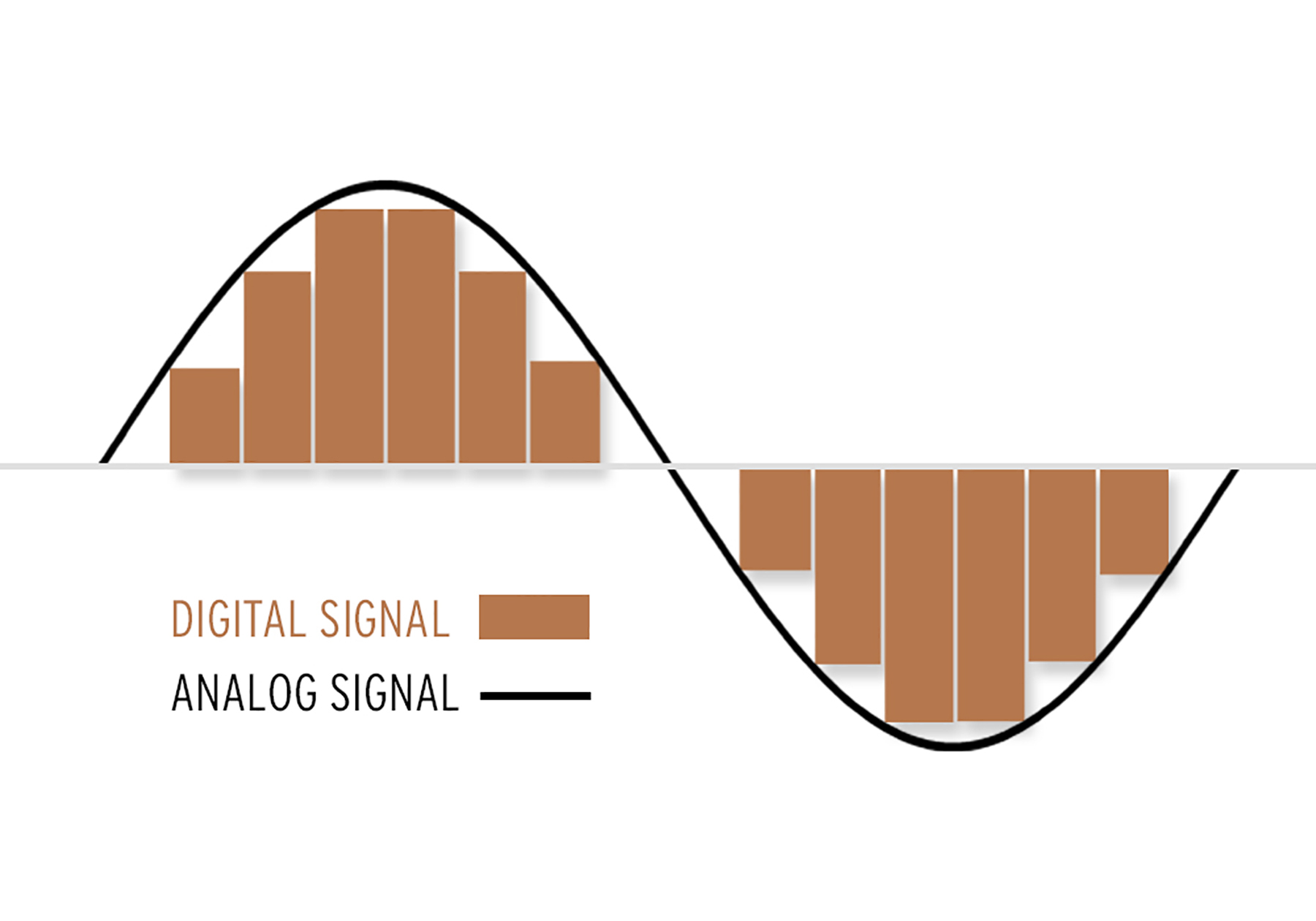
In pulse code modulation, a signal is read many times per second. At each reading moment the amplitude of the sound wave is recorded and reproduced. As mentioned above, a digital signal is just a rough copy of an analog signal, since an analog wave cannot be recreated with perfect precision. The values ​​of each fragment are rounded to the nearest most accurate, then all the fragments are played and we hear a copy of the original analog sound.

“What meanings are we talking about?” – you ask. Just as analog audio is defined by frequency and amplitude, digital audio is determined by two important values: the sample rate and the bit depth. The sample rate means how many times per second the fragments of the audio signal are read, and the bit depth is the value of the dynamic range of each fragment of the audio signal.

Sampling rate

The standard 44.1 kHz sample rate used for recording audio to CDs (remember those?) Might seem like a random number. But this is not the case at all. This value was chosen based on Kotelnikov’s theorem, which essentially states that the sampling frequency must be more than 2 times higher than the maximum value of the reading frequency. As you know, the upper limit of audibility of the human ear’s frequency range is 20 kHz. It turns out that the sampling frequency must be higher than 40 kHz. An additional 4.1 kHz is added to avoid distortion, the so-called aliasing effect. In theory, 44.1 kHz should be sufficient to accurately reproduce an audio signal, however there are higher values.

For example, 48 kHz is the dominant standard in film and video production. As in the case of cinema, sound is synchronized at a frame rate of 24 frames per second. We won’t go into the details of why exactly 24 frames per second was chosen, in other words, this is the minimum frequency at which we can see a smooth, eye-pleasing image. The sample rate must match this frame rate. Using a frequency of 44.1 kHz can cause a noticeable out of sync of the picture and sound. Again, based on Kotelnikov’s theorem.

Even higher sample rates are repelled by these two base frequencies of 44.1 or 48 kHz, multiplying them by multiples of 2. That is, 88.2, 96, 192 kHz are the standard sample rates for all audio equipment. modern audio.

Bit depth

The bitness or bitness of an audio file tells us about its dynamic resolution or, more simply, clarity. You can draw an analogy with digital photography: the higher the resolution of the photo, the clearer and better the image will be.

It is important to note here that we are not talking about the loudness of the signal, but about a more realistic, clean and clear sound. More accurate transmission of the audio signal.

Bit depth can be compared to text in the book. The lower the bit depth, the less meaningful the text will make. That is, lowering the bitness leads to the fact that some letters begin to disappear from words, punctuation marks from sentences. At the moment, we will still be able to grasp the meaning of the text, but if the bit depth continues to decrease, the information will become so distorted that we simply stop understanding what we are talking about. The same goes for sound: the lower the bit depth, the more distorted we hear the sound.