Analog Sound vs Digital Sound: Understanding the Differences


Free Download Mp4Gain
picture

Analog Sound vs Digital Sound: Understanding the Differences

Analog & Digital Sound

Have you ever wondered why some music sounds better than others? It might have to do with the way the sound was recorded. There are two main ways to record sound: analog and digital. Let’s explore the differences between these two methods and why they affect the sound of your music.
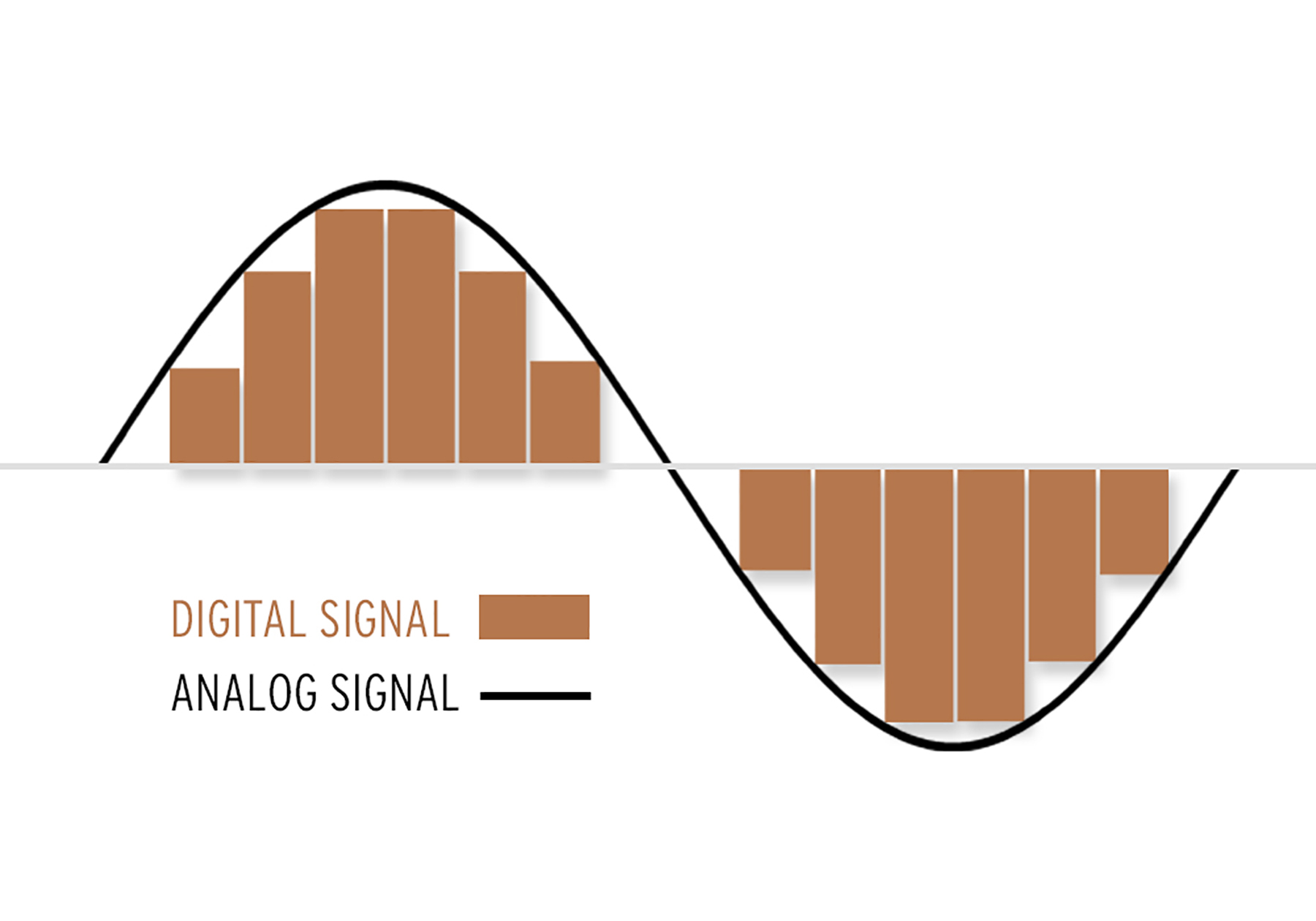
Digital vs Analog Sound

Analog Sound

Analog sound is a continuous wave that is recorded on a physical medium such as a vinyl record or cassette tape. When you listen to an analog recording, the needle or tape head reads the wave and converts it into sound that you can hear through your speakers or headphones.

One of the benefits of analog sound is that it captures the natural warmth and richness of live music. This is because analog recording is a more direct representation of the sound waves. However, analog recordings are also more prone to wear and tear and can degrade over time, causing hisses, pops, and crackles in the sound.

Digital Sound

Digital sound, on the other hand, is recorded by converting the sound waves into a series of numbers that represent the amplitude and frequency of the wave. This digital representation of sound can then be stored on a computer or other digital device and played back at a later time.

One of the benefits of digital sound is that it is much more reliable and consistent than analog sound. Digital recordings are not subject to wear and tear like analog recordings and the sound quality remains unchanged over time. Additionally, digital sound can be easily edited and manipulated, making it possible to remove any unwanted noise or to enhance certain aspects of the sound.

The Differences in Sound Quality

Despite the many benefits of digital sound, some people argue that it does not have the same warmth and richness as analog sound. This is because digital sound is limited by the resolution of the recording, meaning that it cannot capture the full range of sound that an analog recording can.

Additionally, digital sound is often compressed to make it easier to store and transfer, which can result in a loss of sound quality. This is why some people prefer the sound of analog recordings, which they perceive as being more natural and musical.

Conclusion

In conclusion, the choice between analog and digital sound depends on your personal preferences and the way you listen to music. If you are looking for a more natural, warm sound, analog recordings might be the way to go. However, if you value convenience and reliability, digital sound is the way to go.

To get the best sound quality from your digital music files, it is important to use a high-quality software like Mp4Gain.


Free Download Mp4Gain
picture


Mp4Gain Main Window
picture


Mp4Gain Features
picture


Free Download Mp4Gain
picture

Analog-Digital Processing

Analog-Digital Processing

Digital vs Analog

A digital signal is obtained from analog or is directly synthesized into digital (in electric musical instruments).

DIGITAL ANALOG AUDIO

Converting from analog to digital involves two basic operations: sampling and quantizing. Discretization is the replacement of a continuous signal with a series of samples of its instantaneous values ​​taken at regular intervals. According to the Kotelnikov-Chenon theorem, a discrete signal can be completely restored later, as long as the sampling frequency is at least twice the upper frequency of the signal spectrum. The samples are then quantized according to level: each of them is assigned a discrete value closer to the real one. The precision of quantization is determined by the bit width of the binary representation. The higher the bit depth, the more quantization levels (2N,

The audio CD format has a sampling frequency of 44.1 kHz and 16 bits. This gives 44 thousand samples per second, each of which can take one of 216 = 65536 levels (for each of the stereo channels).

In addition to the 44.1 kHz / 16-bit format, others are used in digital recording. Studio recording is generally done in 20-24 bit, then the data is converted to audio CD by recalculation. The extra bits are then discarded or (better) rounded, sometimes pseudo-random noise is added to reduce quantization noise (dither).

The most advanced custom audio formats are DVD Audio and Super Audio CD (SACD). DVD Audio adopts the MLP lossless data compression algorithm developed by Meridian. And SACD, unlike other formats, does not use pulse code modulation (PCM or PCM), but one-bit encoding of the DSD (Discrete Pulse Width Modulation) stream. SACDs come in single or double layer (hybrid) discs with a normal CD layer.

The most popular audio medium today is compact disc, despite certain limitations in sound quality seen by audiophiles. The reason for them is in the low sample rate: for an accurate reconstruction of signals near the upper limit of the audio range, a filter that is not physically workable is needed (its impulse response covers the negative time area). This is compensated to some extent by digital filtering with higher sampling and bit depth. The data on the disc is redundantly encoded (Reed-Solomon code) to ensure smooth playback in real time.

Broadband communication is required for digital audio transmission, especially for uncompressed high definition multichannel transmissions.

Figure: 1. Digitizing an analog signal and obtaining digital samples on CD Audio and SACD (right)

DIGITAL AUDIO TRANSMISSION

The communication lines for digital audio transmission can be cables, optical lines, and overhead radio.

For the transmission of PCM signals over wired lines, AES / EBU (balanced, coaxial), S / PDIF (unbalanced coaxial) interfaces have been developed, which provide transmission of various signals (clock frequency, digital word rate, channel data) over a cable. Inside the devices, these signals are transmitted separately, at the output of the transport mechanism they are encoded and at the input of a digital-to-analog converter (in two-block systems) they are separated again in a digital receiver.

Typically, a high-quality coaxial cable is used for digital audio transmission. There are also S / PDIF converters for fiber optic lines: AT&T ST and Toslink (the latter is standard in consumer equipment). And also, for the use of twisted pairs in Ethernet cable networks. The medium of distribution for compressed audio in the form of archived files is the Internet.

Like any digital signal, digitized audio is distributed and switched by special devices: distribution amplifiers, matrix switches, and conventional.

There is one factor that negatively affects digital signals, and often negates almost all of the advantages of digital audio over analog, including the ability to repeatedly copy, stream, and archive programs without any loss of quality: we are talking about jitter. Jitter is jitter, or the uncertainty of a transition from 0 to 1 and vice versa.