Why does even digital audio deteriorate? Part 2


Free Download Mp4Gain
picture

Why does even digital audio deteriorate? Part 2

Digital Audio

I am not an audiophile, and I am not the type that is very demanding to listen, which is why I am not aware of so-called pure audio.
So I didn’t know Mr. Kanai at all, but he seems to be famous for that source.

Digital Audio

The reason I met Mr. Kanai was because I saw the serialized article “What is the definitive SACD born in the” Kaimaru Room “” from the “Ken Fujimoto Weekly Digital Audio Lab” which I have long subscribed to ? , this article was really interesting.

This is an interview article about the production process of Emi Fujita’s (Le Couple) work “Manzanilla Best Audio”, but it is very easy to understand the difference in mindset between the production side and the actual listener. I think .

Anyway, the content on Mr. Kanai’s HP was scaled content for me.
It’s a good opportunity, so I’d like to change my mind a bit.

Especially around surround sound, you need to study.
I cannot understand it at all because I have not tried surround sound as a real experience.

I am also very interested in SACD, but I am very concerned about buying a PS3 because I do not have a playback environment.


Free Download Mp4Gain
picture


Mp4Gain Main Window
picture


Mp4Gain Features
picture


Free Download Mp4Gain
picture

Why does even digital audio deteriorate?

Why does even digital audio deteriorate?

Digital Audio

It is not limited to DTM and DAW, I think if you are a musician you may have noticed the deterioration in sound quality.

Digital Audio

For example, change the shield to a higher one or allow it to be bypassed entirely when the effector is not in use.
When it comes to old stories, record without ping-pong as much as possible.

I don’t think the deterioration in sound quality bothers me, but I’m obviously not afraid of losing sound, so I’m careful.
But, it is simply an analog of the story in, don’t use your mind as I don’t say anything about digital audio.

Why?
That’s because I couldn’t fully understand the concept of “digital data degradation”.

When it comes to guitars, it’s easy to see that upgrading the various effectors and protectors between the guitar and the amp, and the protector that goes to the amp’s audio I / O “improves the sound.”
It is an analog signal.
But I couldn’t quite understand the history of changing the Firewire cable connecting the audio I / O to the PC to improve the sound quality.

It does not matter if it is via the Internet or copying from a medium, but when you think about it normally and transfer data digitally, there is no deterioration.
To be precise, transmission loss always occurs, so the signal itself deteriorates, but when the data of the transfer result is considered as the center, the picture is that the transfer retries increase rather than deteriorate, and on the user side. From the point of view, I don’t think it can be said that the transfer time has increased and the data has deteriorated.

If the transmission loss is very large, the file itself may be corrupted, and in the case of data to be processed in real time, the transfer may not be on time and the processing may result in an error, but it is transfers normally. In that case, I thought it was digital data that the data should be the same before and after the transfer, no matter how much transmission loss occurred or how long it would take …
(This is just my own expectation. I don’t know if it fits).

Also, in terms of sound, there are two patterns: deterioration of the analog sound quality, which is literally “deterioration” that produces sloppy sound like “thinning sound”, and noise mixed in the transmission path. I think that in the case of a digital data error, it is not a level that says “the sound is bad”, but it becomes a choppy sound or a loud sound that can only be called noise.

Even in digital, analog affects sound quality

Even in digital, analog affects sound quality

analog digital


Audio network audio for PC

analog digital audio

Whether you listen to music or watch videos on television, it is becoming more and more common to use digital data as a sound source.

With the improvement of the quality of communications, such as optical lines on the Internet, the amount of information is increasing and the enjoyment and choices for users are increasing.

However, whether you listen to music on a smartphone or PC audio, the sound quality of subscriptions differs by high resolution, but analog is really important to fully bring out the high quality of the source of sound.

Analog opinions that are not anti-digital

Official benefits! The initial construction cost is virtually 0 yen! Up to 37,500 yen off! You can start au Hikari at an incredible price!

Analog opinions that are not anti-digital
At first glance, the difference in the amount of digital information appears to be the deciding factor.
CD player whose analog circuit influences the sound.

At first glance, the difference in the amount of digital information appears to be the deciding factor.

Digital sound sources (software) that started with CDs are now changing for downloads and stories.

Music data has an Internet environment and digital devices, such as PCs, network players, and transmitters, receive digital signals and a DA converter converts them to analog.

The analog signal converted from digital is amplified by the amplifier and sound is output from the speaker.

Recently, it seems that the digital sound source in the smartphone is popular for products that play music directly from the speaker via Wi-Fi or Bluetooth, but in fact, the Bluetooth speaker has a DA converter that converts digital to analog. ..

Analog to digital signal conversion Part 3

Analog to digital signal conversion Part 3

Analog to digital

Keywords can be streamed in parallel or serial.

Analog to digital

For parallel transmission, n communication lines must be used (n = 4). The codeword symbols are transmitted simultaneously over the lines within the sampling interval. For serial transmission, the sampling interval must be divided into n subintervals: cycles. In this case, the characters of the word are transmitted sequentially along a line and a clock cycle is assigned for the transmission of one character of the word. Each character of the word is transmitted by one or more discrete signals: pulses. Therefore, converting an analog signal into a sequence of code words is often called pulse code modulation. The way words are represented by certain signals is determined by the format of the code. You can, for example, set the signal level high within the clock cycle if a binary character 1 is transmitted in this clock cycle, and low – if a binary character 0 is transmitted (this representation method, shown in the Fig. 6, it is called BVN format – No return to zero).

In the example of Fig. 6 it uses 4-bit binary words (this allows 16 levels of quantization). In a parallel digital stream, 1 bit of a 4-bit word is transmitted on each line within the sampling interval. In a serial stream, the sampling interval is divided into 4 clocks, in which the bits of a 4-bit word are transmitted (starting with the most significant). 6 uses 4-bit binary words (this allows 16 levels of quantization). In a parallel digital stream, 1 bit of a 4-bit word is transmitted on each line within the sampling interval. In a serial stream, the sampling interval is divided into 4 clocks, in which the bits of a 4-bit word are transmitted (starting with the most significant). 6 uses 4-bit binary words (this allows 16 levels of quantization). In a parallel digital stream, 1 bit of a 4-bit word is transmitted on each line within the sampling interval. In a serial stream, the sampling interval is divided into 4 clocks, in which the bits of a 4-bit word are transmitted (starting with the most significant).

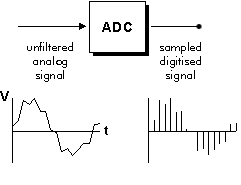
Operations related to converting an analog signal to digital form (sampling, quantizing, and encoding) are performed by one device: an analog-to-digital converter (ADC). Today, an ADC can simply be an integrated circuit. Reverse procedure, ie restoring an analog signal from a sequence of code words is performed in a digital-to-analog converter (DAC). Now there are technical possibilities for implementing all image and sound signal processing, including recording and transmission, in digital form. However, analog devices are still used as signal sensors (for example, a microphone, a TV transmission tube, or a charge-coupled device) and sound and image reproduction devices (for example, a speaker, a kinescope ).

Digital signals can be described using typical parameters of analog technology, such as bandwidth. But its applicability in digital technology is limited. An important indicator characterizing digital flow is the data transfer rate. If the length of the word is n and the sampling rate is FD, then the data rate, expressed in the number of binary symbols per unit time (bit / s), is calculated as the product of the length of the word by the sampling frequency: C = nFD.

Analog to digital signal conversion Part 2

Analog to digital signal conversion Part 2

Analog to digital

If you need no distortion of the TV signal during the sampling process with a cutoff frequency, for example 6 MHz, then the sampling frequency must be at least 12 MHz.

Image result for Analog to digital

However, the closer the sample rate is to twice the cutoff frequency of the signal, the more difficult it is to create a low-pass filter, which is used in the reconstruction and also in the pre-filtering of the original analog signal. This is due to the fact that as the sampling frequency approaches the doubling cutoff frequency of the sampled signal, increasingly stringent requirements are imposed on the shape of the frequency characteristics of the reconstruction filters: it must correspond more and more precisely to a rectangle. characteristic. It should be noted that a rectangular filter cannot be physically implemented. Such a filter, as theory shows, must introduce an infinitely large delay into the transmitted signal. Therefore, in practice, there is always a certain interval between the doubled cutoff frequency of the original signal and the sampling frequency.

Quantification
– represents the replacement of the count value of the signal with the closest value of a set of fixed values ​​- quantization levels. In other words, quantization is the rounding of the count value. Quantization levels divide the entire range of possible changes in signal values ​​into a finite number of intervals: quantization steps. The location of the quantization levels is determined by the quantization scale. Uniform and non-uniform scales are used. In Fig. 3 shows the original analog signal and its quantized version obtained by means of a uniform quantization scale, as well as the corresponding image signals.

Signal distortions that occur during the quantization process are called quantization noise. In instrumental noise estimation, the difference between the original signal and its quantized copy is calculated and, for example, the root mean square value of this difference is taken as objective noise indicators. The timing diagram and the image of the quantization noise are also shown in Fig. 3 (the image of the quantization noise is shown on a gray background). Unlike jitter noise, quantization noise is correlated with the signal, so quantization noise cannot be removed by post-filtering. The quantization noise decreases as the number of quantization levels increases.

With a relatively large number of levels, the quantization noise is similar to the usual jitter noise. The noise oscillation was reduced, so it was necessary to increase this oscillation 128 times when obtaining an image of quantization noise to make the noise noticeable. A few years ago, it seemed sufficient to use 256 levels to quantify a television video signal. It is now considered the norm to quantify a video signal at 1024 levels. The number of quantization levels in the formation of a digital audio signal is much greater – from tens of thousands to millions.

Digital encoding
A quantized signal, unlike the original analog signal, can only take on a finite number of values. This allows a number equal to the ordinal number of the quantization level to be represented within each sampling interval. In turn, this number can be expressed by a combination of some signs or symbols. The set of characters (symbols) and the system of rules by which data is represented as a set of characters is called a code. The final sequence of code symbols is called a code word. The quantized signal can be converted into a sequence of code words. This operation is called encoding. Each codeword is transmitted within a sampling interval. Binary code is widely used to encode audio and video signals. If the quantized signal can take N values, then the number of binary symbols in each codeword is n> = log2N. A bit, or character in a word represented in binary code, is called a bit. Generally, the number of quantization levels is equal to an integer power of 2, that is, N = 2n.

Analog to digital signal conversion

Analog to digital signal conversion

Analog to digital

To convert any analog signal (sound, image) into digital format, three basic operations must be performed: sampling, quantization and encoding.

Analog to digital

Sampling
– presentation of a continuous analog signal by means of a sequence of its values ​​(samples). These samples are taken at times separated from each other by an interval called the sampling interval. The reciprocal of the interval between samples is called the sample rate. In Fig. 1 shows the original analog signal and its sampled version. The images below the timing diagrams are obtained assuming that the signals are one line television video signals, the same for the entire television screen.

Analog to digital conversion. Sampling

It is clear that the shorter the sampling interval, and therefore the higher the sampling frequency, the smaller the difference between the original signal and its sampled copy. The stepped structure of the sampled signal can be smoothed with a low-pass filter. This is how the analog signal is restored from the sampled one. But the reconstruction will be accurate only if the sampling frequency is at least 2 times the bandwidth of the original analog signal (this condition is determined by the well-known Kotelnikov theorem). If this condition is not met, the sampling is accompanied by irreversible distortions. The fact is that, as a result of sampling, additional components appear in the frequency spectrum of the signal, which lie around the harmonics of the sampling frequency in the range, equal to twice the bandwidth of the original analog signal. . If the maximum frequency in the frequency spectrum of the analog signal exceeds half the sampling frequency, then the additional components fall within the frequency band of the original analog signal. In this case, it is no longer possible to restore the original signal without distortion. The theory of sampling is covered in many books.

Analog to digital conversion. Distortion sampling

An example of sampling distortions is shown in Fig. 2. An analog signal (again, suppose it is a TV line video signal) contains a wave, the frequency of which first increases from 0.5 MHz to 2.5 MHz and then decreases to 0.5 MHz. This signal is sampled at 3 MHz. In Fig. 2 the images are shown sequentially: the original analog signal, the sampled signal, the restored analog signal after sampling. The low-pass reconstruction filter has a 1.2 MHz bandwidth. As you can see, the low-frequency components (less than 1 MHz) are restored without distortion. The 1.5 MHz wave disappears and becomes a relatively flat field. The 2.5 MHz wave after recovery became a 0.5 MHz wave (this is the difference between the 3 MHz sampling frequency and the original 2.5 MHz frequency). These image diagrams illustrate the distortion associated with an insufficiently high spatial sample rate of the image. If the subject of the television recording is an object that is moving very fast or, for example, a rotating object, then sampling distortions in the time domain may occur. An example of distortion associated with an insufficiently high sample rate (and this is the frame rate of television decay) is an image of a fast moving car on stationary wheels or, for example, slowly turning in one direction or other, the spokes of the wheel (stroboscopic effect). There is no sampling distortion when the bandwidth of the original signal is limited from above and does not exceed half the sampling frequency. associated with insufficiently high spatial sampling rate of the image. If the subject of the television recording is an object that is moving very fast or, for example, a rotating object, then sampling distortions in the time domain may occur. An example of distortion associated with an insufficiently high sample rate (and this is the frame rate of television decay) is an image of a fast moving car on stationary wheels or, for example, slowly turning in one direction or other, the spokes of the wheel (stroboscopic effect). There is no sampling distortion when the bandwidth of the original signal is limited from above and does not exceed half the sampling frequency.

From analog to digital and vice versa

From analog to digital and vice versa

Analog-to-digital

Today, almost 99% of sound recording, sound reproduction studio equipment, and music synthesizers are digital devices.

Everyone knows that even a typical home CD player uses a digital-to-analog converter and that music on CDs is written in 16-bit numbers. However, both the original sound and musical material (voice, classical musical instruments, electric guitars, etc.) and the sound output of your music center are analog signals, not digital signals. Therefore, for today’s recording industry, the key is to convert analog signals to digital and convert digital data to analog audio signals. Let’s try to find out how these transformations take place. The analog signal represents is a continuous process in time and amplitude, and its digital representation is a sequence or series of numbers that consists of a finite number of bits. The conversion of an analog signal to digital consists of two stages: time sampling and amplitude quantization. Time sampling means that the signal is represented by a series of its samples taken at regular intervals. For example, when we say that the sample rate is 44.1 kHz, it means that the signal is measured 44100 times per second. The main problem in the first stage of converting an analog to digital signal (digitization) is choosing the sampling frequency of the analog process. The answer is given by the well-known Nyquist theorem, which states that for an analog signal (continuous in time) occupying the frequency range 0 Hz to F Hz to be reconstructed with absolute precision from its samples, the frequency of The sample rate must be at least twice the maximum audio frequency F. Therefore, if the actual analog signal that we are going to convert to digital format contains frequency components from 0 Hz to 20 kHz, then the sampling frequency of that signal it should not be less than 40 kHz. Let’s take a closer look at what happens to an analog signal and its spectrum when sampled.

During sampling, the frequency spectrum changes significantly. The original analog signal tends to have a spectrum mainly concentrated in the frequency band from 20 Hz to about 20 kHz, since the usual pickups and microphones from which it is taken have about this frequency response. In addition, the signal often contains interference with frequencies of up to several hundred kilohertz. These are various “vans” difficult to remove from computer equipment, industrial and electrical appliances, trams, trolleybuses, etc. After sampling, the signal is a sequential time series of very narrow pulses with different amplitudes and with a very wide spectrum of up to several megahertz (a mathematical fact: the narrower the pulse, the broader its spectrum). Therefore, in general, the spectrum of such a pulse sequence expands to the same several megahertz. Therefore, the spectrum of the sampled signal is much broader than the spectrum of the original analog signal. Let’s take a closer look at how this new broad spectrum is set up. There are two important processes. First, the “convolution” of the entire original spectrum of the analog signal extending from approximately 20 Hz to several hundred kilohertz within the frequency band from 0 Hz to half the sampling frequency.

Convolution means that all components of the original analog signal, with frequencies above half the sample rate (and this is mostly inaudible noise)) fall in the frequency range audible to the human ear from 20 Hz to ” Average sampling frequency “Hz, ie Inaudible interference becomes audible and therefore the signal-to-noise ratio may deteriorate. All of this seems very unusual, not to say that it even contradicts common sense! It turns out that there is a sampling of high-frequency signals with frequency components that are significantly higher than not just half the sample rate, but also the sample rate itself. At first glance, this even contradicts the Nyquist theorem mentioned above. But let’s look at Fig. 4. It shows the process of sampling a high-frequency sinusoidal signal at more than two times less than its sampling frequency.

Analog-Digital Processing

Analog-Digital Processing

Digital vs Analog

A digital signal is obtained from analog or is directly synthesized into digital (in electric musical instruments).

DIGITAL ANALOG AUDIO

Converting from analog to digital involves two basic operations: sampling and quantizing. Discretization is the replacement of a continuous signal with a series of samples of its instantaneous values ​​taken at regular intervals. According to the Kotelnikov-Chenon theorem, a discrete signal can be completely restored later, as long as the sampling frequency is at least twice the upper frequency of the signal spectrum. The samples are then quantized according to level: each of them is assigned a discrete value closer to the real one. The precision of quantization is determined by the bit width of the binary representation. The higher the bit depth, the more quantization levels (2N,

The audio CD format has a sampling frequency of 44.1 kHz and 16 bits. This gives 44 thousand samples per second, each of which can take one of 216 = 65536 levels (for each of the stereo channels).

In addition to the 44.1 kHz / 16-bit format, others are used in digital recording. Studio recording is generally done in 20-24 bit, then the data is converted to audio CD by recalculation. The extra bits are then discarded or (better) rounded, sometimes pseudo-random noise is added to reduce quantization noise (dither).

The most advanced custom audio formats are DVD Audio and Super Audio CD (SACD). DVD Audio adopts the MLP lossless data compression algorithm developed by Meridian. And SACD, unlike other formats, does not use pulse code modulation (PCM or PCM), but one-bit encoding of the DSD (Discrete Pulse Width Modulation) stream. SACDs come in single or double layer (hybrid) discs with a normal CD layer.

The most popular audio medium today is compact disc, despite certain limitations in sound quality seen by audiophiles. The reason for them is in the low sample rate: for an accurate reconstruction of signals near the upper limit of the audio range, a filter that is not physically workable is needed (its impulse response covers the negative time area). This is compensated to some extent by digital filtering with higher sampling and bit depth. The data on the disc is redundantly encoded (Reed-Solomon code) to ensure smooth playback in real time.

Broadband communication is required for digital audio transmission, especially for uncompressed high definition multichannel transmissions.

Figure: 1. Digitizing an analog signal and obtaining digital samples on CD Audio and SACD (right)

DIGITAL AUDIO TRANSMISSION

The communication lines for digital audio transmission can be cables, optical lines, and overhead radio.

For the transmission of PCM signals over wired lines, AES / EBU (balanced, coaxial), S / PDIF (unbalanced coaxial) interfaces have been developed, which provide transmission of various signals (clock frequency, digital word rate, channel data) over a cable. Inside the devices, these signals are transmitted separately, at the output of the transport mechanism they are encoded and at the input of a digital-to-analog converter (in two-block systems) they are separated again in a digital receiver.

Typically, a high-quality coaxial cable is used for digital audio transmission. There are also S / PDIF converters for fiber optic lines: AT&T ST and Toslink (the latter is standard in consumer equipment). And also, for the use of twisted pairs in Ethernet cable networks. The medium of distribution for compressed audio in the form of archived files is the Internet.

Like any digital signal, digitized audio is distributed and switched by special devices: distribution amplifiers, matrix switches, and conventional.

There is one factor that negatively affects digital signals, and often negates almost all of the advantages of digital audio over analog, including the ability to repeatedly copy, stream, and archive programs without any loss of quality: we are talking about jitter. Jitter is jitter, or the uncertainty of a transition from 0 to 1 and vice versa.