Analog to digital signal conversion Part 3

Keywords can be streamed in parallel or serial.
For parallel transmission, n communication lines must be used (n = 4). The codeword symbols are transmitted simultaneously over the lines within the sampling interval. For serial transmission, the sampling interval must be divided into n subintervals: cycles. In this case, the characters of the word are transmitted sequentially along a line and a clock cycle is assigned for the transmission of one character of the word. Each character of the word is transmitted by one or more discrete signals: pulses. Therefore, converting an analog signal into a sequence of code words is often called pulse code modulation. The way words are represented by certain signals is determined by the format of the code. You can, for example, set the signal level high within the clock cycle if a binary character 1 is transmitted in this clock cycle, and low – if a binary character 0 is transmitted (this representation method, shown in the Fig. 6, it is called BVN format – No return to zero).
In the example of Fig. 6 it uses 4-bit binary words (this allows 16 levels of quantization). In a parallel digital stream, 1 bit of a 4-bit word is transmitted on each line within the sampling interval. In a serial stream, the sampling interval is divided into 4 clocks, in which the bits of a 4-bit word are transmitted (starting with the most significant). 6 uses 4-bit binary words (this allows 16 levels of quantization). In a parallel digital stream, 1 bit of a 4-bit word is transmitted on each line within the sampling interval. In a serial stream, the sampling interval is divided into 4 clocks, in which the bits of a 4-bit word are transmitted (starting with the most significant). 6 uses 4-bit binary words (this allows 16 levels of quantization). In a parallel digital stream, 1 bit of a 4-bit word is transmitted on each line within the sampling interval. In a serial stream, the sampling interval is divided into 4 clocks, in which the bits of a 4-bit word are transmitted (starting with the most significant).
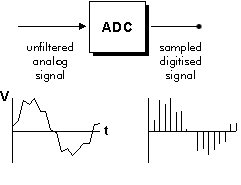
Operations related to converting an analog signal to digital form (sampling, quantizing, and encoding) are performed by one device: an analog-to-digital converter (ADC). Today, an ADC can simply be an integrated circuit. Reverse procedure, ie restoring an analog signal from a sequence of code words is performed in a digital-to-analog converter (DAC). Now there are technical possibilities for implementing all image and sound signal processing, including recording and transmission, in digital form. However, analog devices are still used as signal sensors (for example, a microphone, a TV transmission tube, or a charge-coupled device) and sound and image reproduction devices (for example, a speaker, a kinescope ).
Digital signals can be described using typical parameters of analog technology, such as bandwidth. But its applicability in digital technology is limited. An important indicator characterizing digital flow is the data transfer rate. If the length of the word is n and the sampling rate is FD, then the data rate, expressed in the number of binary symbols per unit time (bit / s), is calculated as the product of the length of the word by the sampling frequency: C = nFD.