From analog to digital and vice versa

Today, almost 99% of sound recording, sound reproduction studio equipment, and music synthesizers are digital devices.
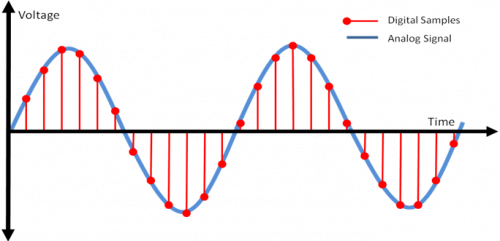
Everyone knows that even a typical home CD player uses a digital-to-analog converter and that music on CDs is written in 16-bit numbers. However, both the original sound and musical material (voice, classical musical instruments, electric guitars, etc.) and the sound output of your music center are analog signals, not digital signals. Therefore, for today’s recording industry, the key is to convert analog signals to digital and convert digital data to analog audio signals. Let’s try to find out how these transformations take place. The analog signal represents is a continuous process in time and amplitude, and its digital representation is a sequence or series of numbers that consists of a finite number of bits. The conversion of an analog signal to digital consists of two stages: time sampling and amplitude quantization. Time sampling means that the signal is represented by a series of its samples taken at regular intervals. For example, when we say that the sample rate is 44.1 kHz, it means that the signal is measured 44100 times per second. The main problem in the first stage of converting an analog to digital signal (digitization) is choosing the sampling frequency of the analog process. The answer is given by the well-known Nyquist theorem, which states that for an analog signal (continuous in time) occupying the frequency range 0 Hz to F Hz to be reconstructed with absolute precision from its samples, the frequency of The sample rate must be at least twice the maximum audio frequency F. Therefore, if the actual analog signal that we are going to convert to digital format contains frequency components from 0 Hz to 20 kHz, then the sampling frequency of that signal it should not be less than 40 kHz. Let’s take a closer look at what happens to an analog signal and its spectrum when sampled.
During sampling, the frequency spectrum changes significantly. The original analog signal tends to have a spectrum mainly concentrated in the frequency band from 20 Hz to about 20 kHz, since the usual pickups and microphones from which it is taken have about this frequency response. In addition, the signal often contains interference with frequencies of up to several hundred kilohertz. These are various “vans” difficult to remove from computer equipment, industrial and electrical appliances, trams, trolleybuses, etc. After sampling, the signal is a sequential time series of very narrow pulses with different amplitudes and with a very wide spectrum of up to several megahertz (a mathematical fact: the narrower the pulse, the broader its spectrum). Therefore, in general, the spectrum of such a pulse sequence expands to the same several megahertz. Therefore, the spectrum of the sampled signal is much broader than the spectrum of the original analog signal. Let’s take a closer look at how this new broad spectrum is set up. There are two important processes. First, the “convolution” of the entire original spectrum of the analog signal extending from approximately 20 Hz to several hundred kilohertz within the frequency band from 0 Hz to half the sampling frequency.
Convolution means that all components of the original analog signal, with frequencies above half the sample rate (and this is mostly inaudible noise)) fall in the frequency range audible to the human ear from 20 Hz to ” Average sampling frequency “Hz, ie Inaudible interference becomes audible and therefore the signal-to-noise ratio may deteriorate. All of this seems very unusual, not to say that it even contradicts common sense! It turns out that there is a sampling of high-frequency signals with frequency components that are significantly higher than not just half the sample rate, but also the sample rate itself. At first glance, this even contradicts the Nyquist theorem mentioned above. But let’s look at Fig. 4. It shows the process of sampling a high-frequency sinusoidal signal at more than two times less than its sampling frequency.