Why does even digital audio deteriorate? Part 2


Free Download Mp4Gain
picture

Why does even digital audio deteriorate? Part 2

Digital Audio

I am not an audiophile, and I am not the type that is very demanding to listen, which is why I am not aware of so-called pure audio.
So I didn’t know Mr. Kanai at all, but he seems to be famous for that source.

Digital Audio

The reason I met Mr. Kanai was because I saw the serialized article “What is the definitive SACD born in the” Kaimaru Room “” from the “Ken Fujimoto Weekly Digital Audio Lab” which I have long subscribed to ? , this article was really interesting.

This is an interview article about the production process of Emi Fujita’s (Le Couple) work “Manzanilla Best Audio”, but it is very easy to understand the difference in mindset between the production side and the actual listener. I think .

Anyway, the content on Mr. Kanai’s HP was scaled content for me.
It’s a good opportunity, so I’d like to change my mind a bit.

Especially around surround sound, you need to study.
I cannot understand it at all because I have not tried surround sound as a real experience.

I am also very interested in SACD, but I am very concerned about buying a PS3 because I do not have a playback environment.


Free Download Mp4Gain
picture


Mp4Gain Main Window
picture


Mp4Gain Features
picture


Free Download Mp4Gain
picture

Why does even digital audio deteriorate?

Why does even digital audio deteriorate?

Digital Audio

It is not limited to DTM and DAW, I think if you are a musician you may have noticed the deterioration in sound quality.

Digital Audio

For example, change the shield to a higher one or allow it to be bypassed entirely when the effector is not in use.
When it comes to old stories, record without ping-pong as much as possible.

I don’t think the deterioration in sound quality bothers me, but I’m obviously not afraid of losing sound, so I’m careful.
But, it is simply an analog of the story in, don’t use your mind as I don’t say anything about digital audio.

Why?
That’s because I couldn’t fully understand the concept of “digital data degradation”.

When it comes to guitars, it’s easy to see that upgrading the various effectors and protectors between the guitar and the amp, and the protector that goes to the amp’s audio I / O “improves the sound.”
It is an analog signal.
But I couldn’t quite understand the history of changing the Firewire cable connecting the audio I / O to the PC to improve the sound quality.

It does not matter if it is via the Internet or copying from a medium, but when you think about it normally and transfer data digitally, there is no deterioration.
To be precise, transmission loss always occurs, so the signal itself deteriorates, but when the data of the transfer result is considered as the center, the picture is that the transfer retries increase rather than deteriorate, and on the user side. From the point of view, I don’t think it can be said that the transfer time has increased and the data has deteriorated.

If the transmission loss is very large, the file itself may be corrupted, and in the case of data to be processed in real time, the transfer may not be on time and the processing may result in an error, but it is transfers normally. In that case, I thought it was digital data that the data should be the same before and after the transfer, no matter how much transmission loss occurred or how long it would take …
(This is just my own expectation. I don’t know if it fits).

Also, in terms of sound, there are two patterns: deterioration of the analog sound quality, which is literally “deterioration” that produces sloppy sound like “thinning sound”, and noise mixed in the transmission path. I think that in the case of a digital data error, it is not a level that says “the sound is bad”, but it becomes a choppy sound or a loud sound that can only be called noise.

Even in digital, analog affects sound quality

Even in digital, analog affects sound quality

analog digital


Audio network audio for PC

analog digital audio

Whether you listen to music or watch videos on television, it is becoming more and more common to use digital data as a sound source.

With the improvement of the quality of communications, such as optical lines on the Internet, the amount of information is increasing and the enjoyment and choices for users are increasing.

However, whether you listen to music on a smartphone or PC audio, the sound quality of subscriptions differs by high resolution, but analog is really important to fully bring out the high quality of the source of sound.

Analog opinions that are not anti-digital

Official benefits! The initial construction cost is virtually 0 yen! Up to 37,500 yen off! You can start au Hikari at an incredible price!

Analog opinions that are not anti-digital
At first glance, the difference in the amount of digital information appears to be the deciding factor.
CD player whose analog circuit influences the sound.

At first glance, the difference in the amount of digital information appears to be the deciding factor.

Digital sound sources (software) that started with CDs are now changing for downloads and stories.

Music data has an Internet environment and digital devices, such as PCs, network players, and transmitters, receive digital signals and a DA converter converts them to analog.

The analog signal converted from digital is amplified by the amplifier and sound is output from the speaker.

Recently, it seems that the digital sound source in the smartphone is popular for products that play music directly from the speaker via Wi-Fi or Bluetooth, but in fact, the Bluetooth speaker has a DA converter that converts digital to analog. ..

Conversion of analog sound to digital sound


Digital sounds and analog sound

With the advance of science and technology, both the transmission and recording of analog sounds and images have undergone major changes in recent years. The introduction of digital techniques allows you to do many more things, with greater advantages and more versatility than with analog technology.

Many of the devices that we know today as digital, first receive or capture the signals in analogue form and then convert them into digital signals. This is the case, for example, of CD and DVD players, the modem used by computers for the reception / transmission of data, digital cameras and video cameras, mobile or cell phones, etc.

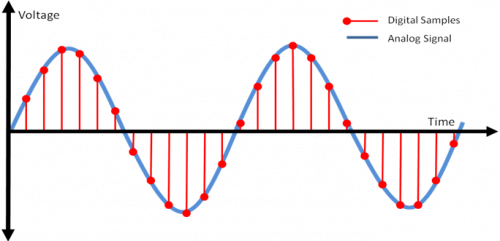
To perform the conversion, these devices use, as an intermediate element, a device called analog-digital converter or ADC (Analogic to Digital Converter), which first receives the electrical signals in the form of an analog sine wave (such as the one provided by the microphone) and It then converts them into digital signals, encoded in binary numerical values, that is, in “zeros” and “ones” (0 – 1).
1. Sound or acoustic wave (voice, music, effects, etc.). 2. Microphone 3. Analog sine wave that is <obtained after the microphone converts the sounds into audio-frequency electrical signals. 4. ADC (Analogic to Digital Converter – Digital Analog Converter). 5. Digital signal formed by zeros and <ones (0 – 1), obtained after the analog signal is processed by the ADC. 6. Output of the <digitized audio signal, ready to be recorded.

In digital cameras and video cameras, as well as in scanners, there is a sensor called CCD (Charge Coupled Device) or, failing that, a CMOS sensor (Complementary Metal Oxide Semiconductor – Semiconductor complementary metal oxide ), which are responsible for converting the images they receive into analog electrical signals.

In that case, as with the microphone, an ADC is responsible for converting those analog signals into digital image signals, so that they can be stored as such in a videotape, on the device’s memory card, or in any other Digital storage device, for later viewing.

The reverse conversion, from digital to analog, is strictly necessary, because the analog sound is the only audible, that is, the only one that recognizes our sense of hearing. Similarly, the analog electrical impulses are the only ones capable of moving the cone of a loudspeaker or loudspeaker to reproduce the original sounds again, which cannot be done by the electrical impulses of “1” and “0” of the binary or digital code. Therefore, to make the coding of the digital sounds audible by the loudspeaker (s), it is necessary to convert them back into analog electrical signals, with their corresponding variations in voltages or voltages.