Analog vs Digital Audio


Free Download Mp4Gain
picture

Analog vs Digital Audio: Understanding the Differences

Analog vs Digital Audio

Analog Audio: The Old School Sound

Analog audio refers to a sound signal that is continuous and unbroken. It is the old school way of recording sound, and it has been around for a long time. In the early days of audio recording, analog technology was the only option. Record players, cassette tapes, and reel-to-reel tapes were all analog formats that produced a unique sound.

One of the main advantages of analog audio is the warmth and depth of the sound. Analog recordings have a certain character that digital recordings simply can’t match. As author Salman Rushdie once said, “Analog is warm, digital is cold.”

However, analog audio is also subject to degradation and noise. Over time, the signal can deteriorate, resulting in a loss of quality. Analog recordings also tend to have more background noise and hiss than digital recordings.

Digital Audio: The Modern Sound

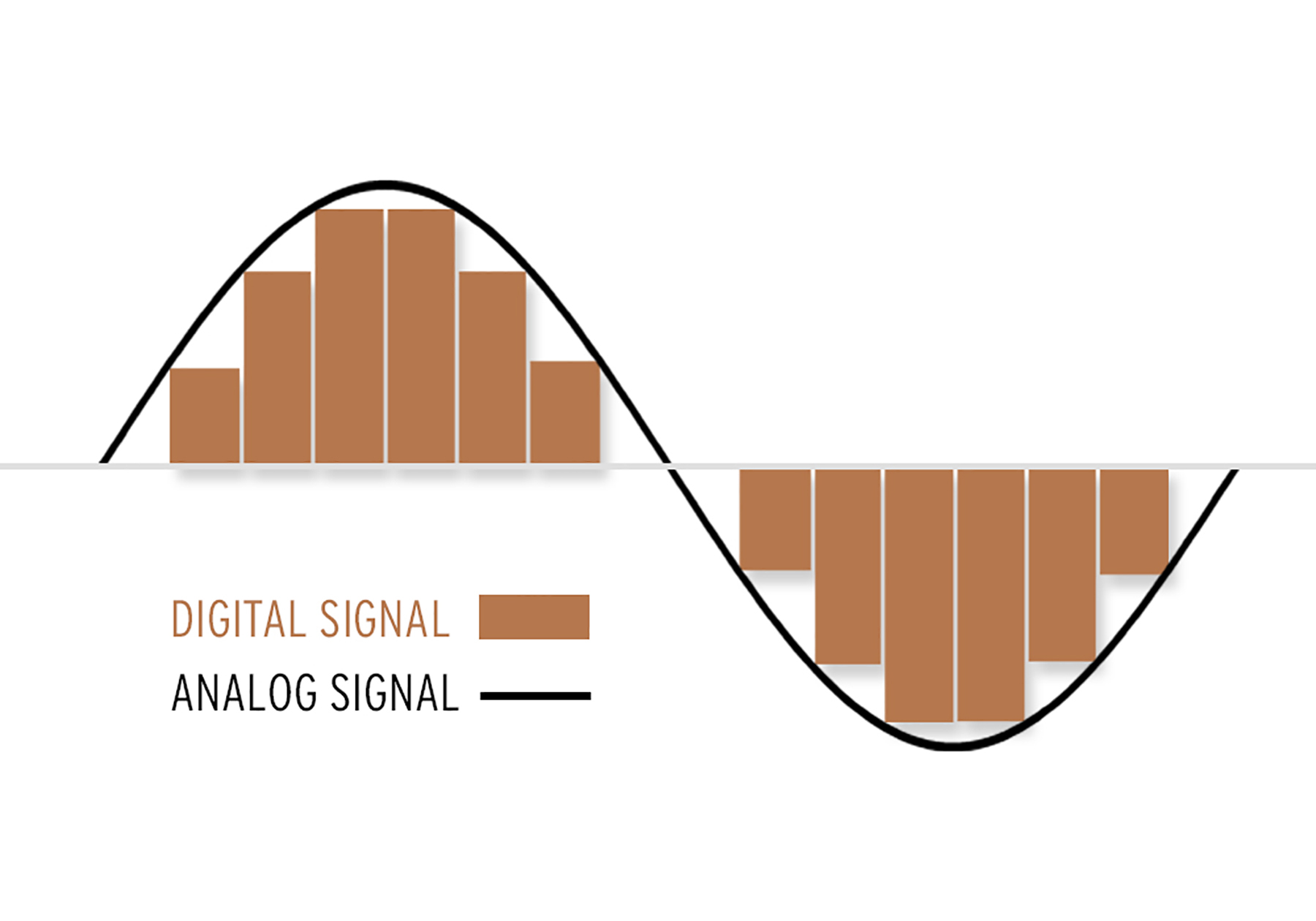
Digital audio, on the other hand, is a more modern method of recording sound. It involves converting sound waves into a series of numbers that can be stored and manipulated. The digital format has become increasingly popular in recent years, and it is now the standard for most audio recordings.

One of the main advantages of digital audio is its precision and clarity. Digital recordings are much more accurate and can reproduce sound with much greater fidelity than analog recordings. They are also immune to the degradation and noise that can affect analog recordings.

However, some people argue that digital recordings lack the warmth and character of analog recordings. As musician Jack White once said, “Digital sounds like it has a condom on it.”

Analog vs Digital: Which is Better?

So, which is better, analog or digital? The truth is, it depends on who you ask. Some people prefer the warmth and character of analog recordings, while others prefer the precision and clarity of digital recordings.

At the end of the day, the choice between analog and digital comes down to personal preference. Both formats have their advantages and disadvantages, and it ultimately comes down to what kind of sound you prefer.

Conclusion: The Best of Both Worlds

At mp4gain.com, we understand the importance of sound quality. That’s why we’ve developed a powerful audio normalization and conversion software that can work with both analog and digital formats. Our software can help you get the best of both worlds by optimizing your audio for clarity and warmth.

As technology continues to evolve, we can expect to see new and innovative ways of recording and manipulating sound. But no matter what the future holds, we will always be dedicated to providing our customers with the highest quality sound possible.

Final Words:

In the end, whether you prefer analog or digital audio comes down to personal preference. Both formats have their advantages and disadvantages, and it’s up to you to decide which one is best for you. But with the right tools and techniques, you can achieve great sound quality no matter what format you choose.


Free Download Mp4Gain
picture


Mp4Gain Main Window
picture


Mp4Gain Features
picture


Free Download Mp4Gain
picture

Analog Sound vs Digital Sound: Understanding the Differences

Analog Sound vs Digital Sound: Understanding the Differences

Analog & Digital Sound

Have you ever wondered why some music sounds better than others? It might have to do with the way the sound was recorded. There are two main ways to record sound: analog and digital. Let’s explore the differences between these two methods and why they affect the sound of your music.

Digital vs Analog Sound

Analog Sound

Analog sound is a continuous wave that is recorded on a physical medium such as a vinyl record or cassette tape. When you listen to an analog recording, the needle or tape head reads the wave and converts it into sound that you can hear through your speakers or headphones.

One of the benefits of analog sound is that it captures the natural warmth and richness of live music. This is because analog recording is a more direct representation of the sound waves. However, analog recordings are also more prone to wear and tear and can degrade over time, causing hisses, pops, and crackles in the sound.

Digital Sound

Digital sound, on the other hand, is recorded by converting the sound waves into a series of numbers that represent the amplitude and frequency of the wave. This digital representation of sound can then be stored on a computer or other digital device and played back at a later time.

One of the benefits of digital sound is that it is much more reliable and consistent than analog sound. Digital recordings are not subject to wear and tear like analog recordings and the sound quality remains unchanged over time. Additionally, digital sound can be easily edited and manipulated, making it possible to remove any unwanted noise or to enhance certain aspects of the sound.

The Differences in Sound Quality

Despite the many benefits of digital sound, some people argue that it does not have the same warmth and richness as analog sound. This is because digital sound is limited by the resolution of the recording, meaning that it cannot capture the full range of sound that an analog recording can.

Additionally, digital sound is often compressed to make it easier to store and transfer, which can result in a loss of sound quality. This is why some people prefer the sound of analog recordings, which they perceive as being more natural and musical.

Conclusion

In conclusion, the choice between analog and digital sound depends on your personal preferences and the way you listen to music. If you are looking for a more natural, warm sound, analog recordings might be the way to go. However, if you value convenience and reliability, digital sound is the way to go.

To get the best sound quality from your digital music files, it is important to use a high-quality software like Mp4Gain.

Analog Sound

Analogous means similar, that is, the electrical current that passes through a circuit, such as an audio amplifier or mixing console, varies similarly to the variations in air pressure that sound represents.

codecs

In the case of a vinyl record, the groove shape is similar to the sound waveform.

When the sound presses the membrane of a microphone it produces an alternating electric current (which permanently changes polarity or direction of movement through the conductor or cable). If we plot the sound pressure variations as a function of time it will give a curve similar to the one we get if we plot the alternating current variations. In turn, the speaker that reproduces the sound will move forward or backward following that graph.

In an analog audio system there are no calculations or more processes than simply converting a mechanical energy (sound waves) to electrical energy and vice versa.

In an analog mixing console, the sound undergoes simple processes by crossing circuits that attenuate or amplify it, at most according to each frequency (equalizers or filters), delay it, add it to other sounds, etc.

The old analog synthesizers were called in this way because the resulting sound followed the voltage variations of electronic oscillators or combinations thereof.

AC3 format

Digital sound

Digital systems convert the audio signal into data that can be processed by numerical calculations.

The numbers that are handled are not given in the commonly used decimal system but in the binary system in which a number can be represented as a succession of ones and zeros; a one means “there is voltage” (for example, more than 3 volts), while a zero means “there is no voltage” (or is less than, for example, 3 volts).

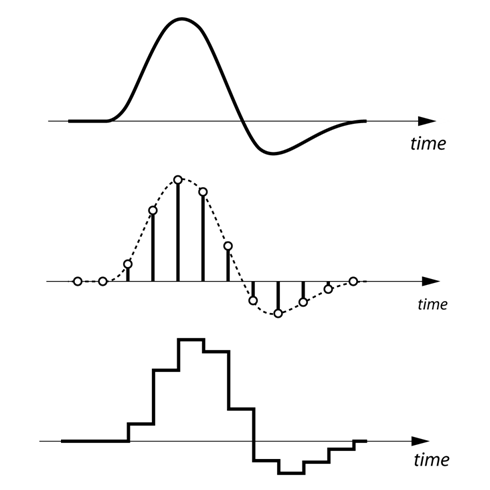
When an analog audio signal enters a digital device, the level or amplitude is measured at small intervals of time by assigning a binary number to each one.

This is called the Analog / Digital Converter (A / D).

If you want to recover the sound wave a circuit called Digital / Analog Converter will put in its output a voltage (voltage) that will correspond to the binary numbers that had been measured. This output signal is filtered to smooth out sudden changes in levels and get closer to the original waveform.

When we have the sound represented with binary numbers we can with these do calculation processes as do the DSP (Digital Signal Processor) effect processors to give the sound reverberance, echo, chorus, etc.

The advantage of working with digital equipment is that the noise does not affect the information because its level (voltage) is much lower than that of a binary digit. On the contrary, in an analog system the noise has a level very close to the softer sounds that are handled, for example, in a mixing console in which noises from different sound sources and circuits are added.

Resolution

It is the amount of bits (binary digits) that are used to obtain each binary number that corresponds to each point of the curve.

With 8 bits we can represent values ​​or levels from 0 to 255. With this you get a very precise and noisy digital wave, not at all true to the original sound.

With 24 bits, the most commonly used resolution in professional sound, we can represent the wave with values ​​between 0 and 16,777,215, which gives an extremely accurate sound wave. The 32-bit resolution is also commonly used.

Sample Rate

It is another parameter that determines the quality of digital audio and measures the number of samples (level measurement) that are taken per second. The higher the sampling rate, the higher the audio quality because less time elapses between one measurement and another allowing us greater accuracy.

It is measured in Kbits / sec (kilobits per second – kilo = 1000)

In CD quality 128 kbit / s are taken