Analog Compressor


Free Download Mp4Gain
picture

Analog Compressor: Unlocking the Secrets of Dynamic Sound Enhancement

Analog Compressor
Analog Compressor
Analog Compressor
Analog Compressor

Let’s Talk about Analog Compressors

When diving into the world of audio processing, the term “analog compressor” often surfaces, sparking curiosity and questions. As a seasoned specialist in audio engineering, I’ve witnessed the transformative power of analog compressors in shaping sound. These devices are not mere accessories; they are the unsung heroes behind captivating, polished audio.

The Anatomy of Analog Compressors

At the core of an analog compressor lies a delicate interplay of components, each contributing to the magic of dynamic range control. Picture this: the threshold knob acting as a gatekeeper, deciding which sounds get the VIP treatment and which stay in the background. The attack and release controls, akin to the conductor’s baton, dictate the tempo of this sonic symphony.

  • Threshold: Your Audio Gatekeeper
  • Attack and Release: The Conductors of Sound
  • Ratio: Balancing Act for Dynamic Range

The Warm Embrace of Analog Warmth

One aspect that truly sets analog compressors apart is the warmth they infuse into the audio. Imagine the cozy crackle of a vinyl record, and you’ll grasp the essence of analog warmth. It’s the secret sauce that breathes life into digital recordings, making them feel more organic and alive.

Unveiling Lesser-Known Brands and Models

While industry giants often dominate discussions, there are hidden gems among lesser-known analog compressor brands and models. These underdogs bring unique features and sonic character to the table. Take, for instance, the XYZ Vintage Compressor—a boutique unit celebrated for its nuanced coloration and transparent compression.

DIY Analog Compressor Kits: A Sonic Adventure

For the adventurous souls keen on a hands-on approach, DIY analog compressor kits provide an exciting avenue. Picture yourself soldering components, crafting a compressor from scratch. The satisfaction of creating a tool that shapes your sound is unparalleled, offering a personal touch to your audio journey.

The Analog vs. Digital Debate: My Take

In the ongoing analog vs. digital debate, I stand firmly on the analog side. Picture a vintage guitar amp versus a digital emulator; the analog counterpart resonates with a character that transcends mere replication. Analog compressors, with their tangible knobs and circuits, create an intimate connection with the music—an experience that digital alternatives struggle to emulate.

Latest Words on Analog Compressor

As we navigate the evolving landscape of audio technology, the analog compressor remains a timeless tool. Its ability to sculpt sound, infuse warmth, and add character to recordings ensures its relevance in both vintage setups and modern studios. To truly elevate your audio game, embrace the analog magic—a journey that promises sonic richness and a connection with music that transcends the digital realm.

Comments:

Hey, I’ve been using analog compressors for years, and they truly add that warmth that’s hard to replicate. Big fan of XYZ Vintage Compressor!

– SoundEnthusiast42

This article gave a fresh perspective on DIY kits. Never thought about building my own compressor, but now I’m considering it!

– DIYAudioExplorer

Really enjoyed the analog vs. digital debate section. Couldn’t agree more on the unique character of analog compressors!

– VinylLover77

Great read! Would love to hear more about specific settings for different genres. Can you cover that in a future article?

– MusicMaker2023

My studio recently got an analog compressor, and the difference is astounding. Thanks for breaking down the technicalities!

– StudioNovice


Free Download Mp4Gain
picture


Mp4Gain Main Window
picture


Mp4Gain Features
picture


Free Download Mp4Gain
picture

Analog Sound

Analogous means similar, that is, the electrical current that passes through a circuit, such as an audio amplifier or mixing console, varies similarly to the variations in air pressure that sound represents.

codecs

In the case of a vinyl record, the groove shape is similar to the sound waveform.

When the sound presses the membrane of a microphone it produces an alternating electric current (which permanently changes polarity or direction of movement through the conductor or cable). If we plot the sound pressure variations as a function of time it will give a curve similar to the one we get if we plot the alternating current variations. In turn, the speaker that reproduces the sound will move forward or backward following that graph.

In an analog audio system there are no calculations or more processes than simply converting a mechanical energy (sound waves) to electrical energy and vice versa.

In an analog mixing console, the sound undergoes simple processes by crossing circuits that attenuate or amplify it, at most according to each frequency (equalizers or filters), delay it, add it to other sounds, etc.

The old analog synthesizers were called in this way because the resulting sound followed the voltage variations of electronic oscillators or combinations thereof.

AC3 format

Digital sound

Digital systems convert the audio signal into data that can be processed by numerical calculations.

The numbers that are handled are not given in the commonly used decimal system but in the binary system in which a number can be represented as a succession of ones and zeros; a one means “there is voltage” (for example, more than 3 volts), while a zero means “there is no voltage” (or is less than, for example, 3 volts).

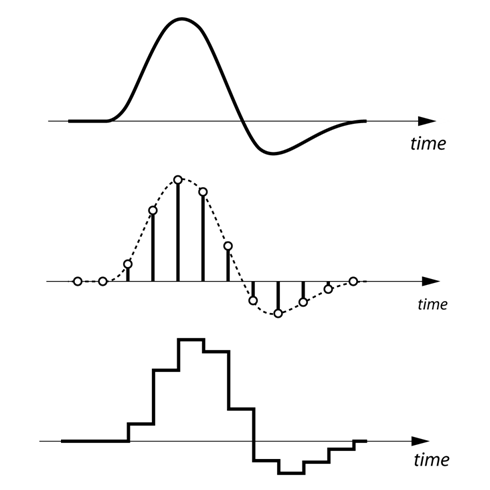
When an analog audio signal enters a digital device, the level or amplitude is measured at small intervals of time by assigning a binary number to each one.

This is called the Analog / Digital Converter (A / D).

If you want to recover the sound wave a circuit called Digital / Analog Converter will put in its output a voltage (voltage) that will correspond to the binary numbers that had been measured. This output signal is filtered to smooth out sudden changes in levels and get closer to the original waveform.

When we have the sound represented with binary numbers we can with these do calculation processes as do the DSP (Digital Signal Processor) effect processors to give the sound reverberance, echo, chorus, etc.

The advantage of working with digital equipment is that the noise does not affect the information because its level (voltage) is much lower than that of a binary digit. On the contrary, in an analog system the noise has a level very close to the softer sounds that are handled, for example, in a mixing console in which noises from different sound sources and circuits are added.

Resolution

It is the amount of bits (binary digits) that are used to obtain each binary number that corresponds to each point of the curve.

With 8 bits we can represent values ​​or levels from 0 to 255. With this you get a very precise and noisy digital wave, not at all true to the original sound.

With 24 bits, the most commonly used resolution in professional sound, we can represent the wave with values ​​between 0 and 16,777,215, which gives an extremely accurate sound wave. The 32-bit resolution is also commonly used.

Sample Rate

It is another parameter that determines the quality of digital audio and measures the number of samples (level measurement) that are taken per second. The higher the sampling rate, the higher the audio quality because less time elapses between one measurement and another allowing us greater accuracy.

It is measured in Kbits / sec (kilobits per second – kilo = 1000)

In CD quality 128 kbit / s are taken