Analog Sound vs Digital Sound: Understanding the Differences


Free Download Mp4Gain
picture

Analog Sound vs Digital Sound: Understanding the Differences

Analog & Digital Sound

Have you ever wondered why some music sounds better than others? It might have to do with the way the sound was recorded. There are two main ways to record sound: analog and digital. Let’s explore the differences between these two methods and why they affect the sound of your music.
Digital vs Analog Sound

Analog Sound

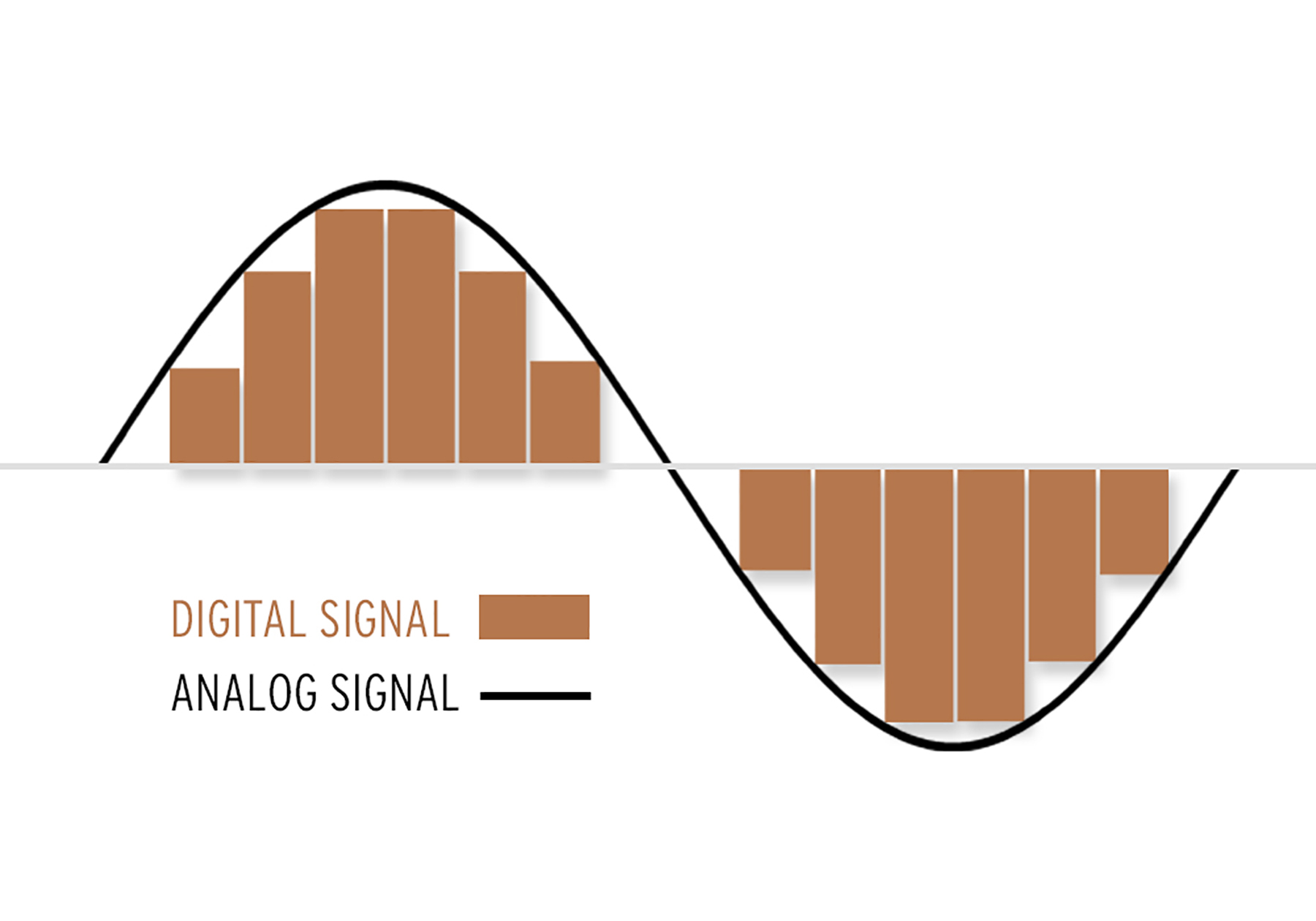
Analog sound is a continuous wave that is recorded on a physical medium such as a vinyl record or cassette tape. When you listen to an analog recording, the needle or tape head reads the wave and converts it into sound that you can hear through your speakers or headphones.

One of the benefits of analog sound is that it captures the natural warmth and richness of live music. This is because analog recording is a more direct representation of the sound waves. However, analog recordings are also more prone to wear and tear and can degrade over time, causing hisses, pops, and crackles in the sound.

Digital Sound

Digital sound, on the other hand, is recorded by converting the sound waves into a series of numbers that represent the amplitude and frequency of the wave. This digital representation of sound can then be stored on a computer or other digital device and played back at a later time.

One of the benefits of digital sound is that it is much more reliable and consistent than analog sound. Digital recordings are not subject to wear and tear like analog recordings and the sound quality remains unchanged over time. Additionally, digital sound can be easily edited and manipulated, making it possible to remove any unwanted noise or to enhance certain aspects of the sound.

The Differences in Sound Quality

Despite the many benefits of digital sound, some people argue that it does not have the same warmth and richness as analog sound. This is because digital sound is limited by the resolution of the recording, meaning that it cannot capture the full range of sound that an analog recording can.

Additionally, digital sound is often compressed to make it easier to store and transfer, which can result in a loss of sound quality. This is why some people prefer the sound of analog recordings, which they perceive as being more natural and musical.

Conclusion

In conclusion, the choice between analog and digital sound depends on your personal preferences and the way you listen to music. If you are looking for a more natural, warm sound, analog recordings might be the way to go. However, if you value convenience and reliability, digital sound is the way to go.

To get the best sound quality from your digital music files, it is important to use a high-quality software like Mp4Gain.


Free Download Mp4Gain
picture


Mp4Gain Main Window
picture


Mp4Gain Features
picture


Free Download Mp4Gain
picture

Analog Audio and Digital Audio

Analog Audio and Digital Audio

Analog vs Digital Audio

A sound wave is a kind of complex function, the dependence of the amplitude of a sound wave on time.

Analog Audio vs. Digital Audio

The information contained in the acoustic wave is not determined by the parameters of the medium in which the elastic wave propagates, and the oscillation parameters (amplitude and frequency, tone and harmonics).

Any form of recording (mechanical and Skye, magnetic, optical, laser) is based on the previous conversion of the sound wave into an alternating electrical current with the same parameters of the oscillations (via microphone).

Analog sound is represented on the device as a continuous electrical signal.

Sound quality depends on the fidelity of the waveform, which is very difficult to maintain.

Until 1982, the world was consuming “canned music” only from analog media: vinyl records and magnetic tapes.

Good vinyl records, played with good equipment, offered excellent sound quality, which unfortunately deteriorated a little with each listening due to mechanical wear as the stylus moved along the sound groove and into the dust that permeated everything.

Tape recorders required precision read heads and high tape feed speeds to reproduce smoothly. Over time, the tape demagnetized, the magnetic layer crumbled.

But the main disadvantage of analog audio recording is the inevitable loss of quality when copying.

The mystery of trigonometry

According to the theory of the mathematician Jean Baptiste Fourier, a sound wave can be represented as a spectrum of frequencies included in it.

The frequency components of the spectrum are sinusoidal oscillations (pure tones), each of which has its own amplitude and frequency.

According to Kotelnikov’s theorem, any vibration, even the most complex shape (for example, a human voice), can be recovered unambiguously and without loss from its discrete samples taken with a frequency equal to its doubled maximum frequency.

Vladimir Aleksandrovich Kotelnikov (1908-2005) – a prominent Soviet and Russian scientist in the field of radio engineering, radiocommunication and radio astronomy.

Observation . The finite duration signal has an infinitely wide spectrum. Therefore, when a signal with a finite duration is sampled, it is impossible to recover it from the samples without loss of quality.

Digitization of audio information

The digitization of sound is the recording of the amplitude of the signal at certain intervals and the recording of the amplitude values ​​obtained in the form of rounded digital values.
Any computer includes a motherboard, an audio adapter (sound card).

Sound cards include: ADC (analog to digital converter), synthesizer, mixer, DAC (digital to analog converter) amplifier s, MIDI interface port for gaming devices.

To record digital sound, the ADC produces:

temporal sampling of a continuous signal (determines the value of the amplitude of the signal with the frequency necessary to recreate its original shape = twice the maximum frequency of the sound wave);

quantization by the levels of the measured signal values ​​(determines the number of fixed values ​​(levels, gradations) of the amplitude of the signal);

signal coding (writing in a binary number system).

The reverse operation is performed by the DAC (digital to analog converter).

Bitrate

Bit rate (bit rate): literally bits of information of the transmission rate.

The bit rate is the effective information transmission rate through the channel (the transmission rate of “useful information”, in addition to the service information) expressed in kilobits per second (kilobits per second, kbps).

In lossy compression video and audio transmission formats, the bit rate parameter expresses the degree of compression of the stream and thus determines the size of the channel for which the data stream is compressed.

P-mode compression data stream:

with constant bit rate (constant bit rate, CBR) – The required bit rate is initially set, which does not change throughout the file. It makes it possible to predict the final file size quite accurately, but it does not provide an optimal size / quality ratio for musical works, the sound of which changes dynamically over time.

with variable bit rate (VBR): the codec changes the value of the bit rate based on the desired quality level according to the psychoacoustic model. It offers the best quality of the output file, but its size is unpredictable (it may differ several times).

with an average bit rate (ABR): a hybrid of constant and variable bit rates: the user sets the bit rate in kbit / s and the program varies it within certain limits.

Analog Sound

Analogous means similar, that is, the electrical current that passes through a circuit, such as an audio amplifier or mixing console, varies similarly to the variations in air pressure that sound represents.

codecs

In the case of a vinyl record, the groove shape is similar to the sound waveform.

When the sound presses the membrane of a microphone it produces an alternating electric current (which permanently changes polarity or direction of movement through the conductor or cable). If we plot the sound pressure variations as a function of time it will give a curve similar to the one we get if we plot the alternating current variations. In turn, the speaker that reproduces the sound will move forward or backward following that graph.

In an analog audio system there are no calculations or more processes than simply converting a mechanical energy (sound waves) to electrical energy and vice versa.

In an analog mixing console, the sound undergoes simple processes by crossing circuits that attenuate or amplify it, at most according to each frequency (equalizers or filters), delay it, add it to other sounds, etc.

The old analog synthesizers were called in this way because the resulting sound followed the voltage variations of electronic oscillators or combinations thereof.

AC3 format

Digital sound

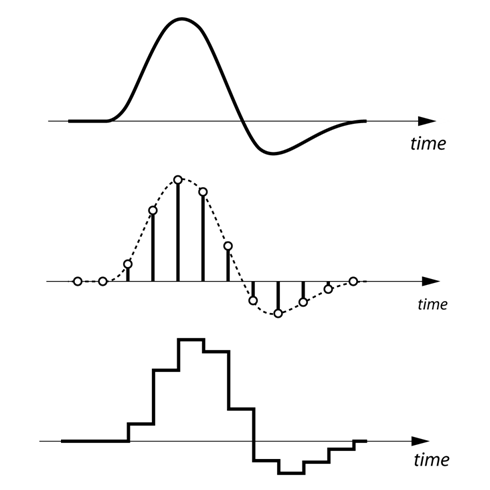
Digital systems convert the audio signal into data that can be processed by numerical calculations.

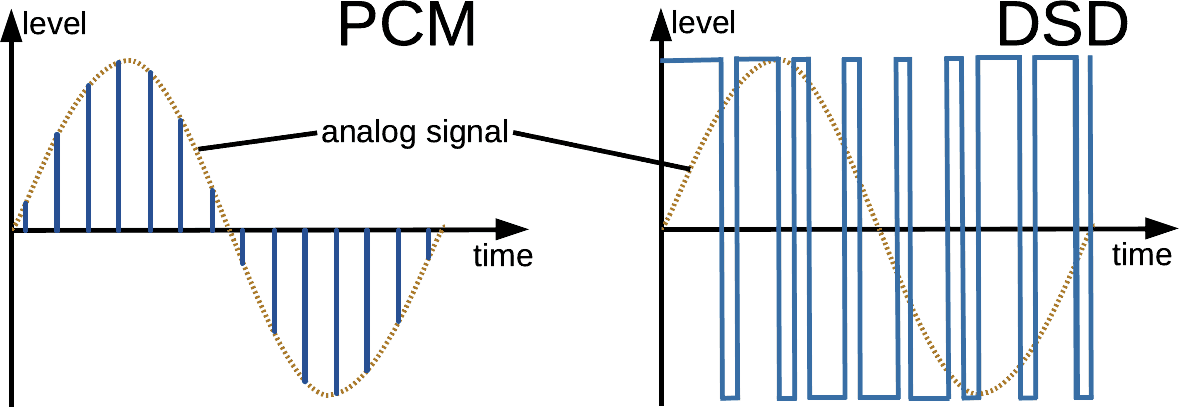
The numbers that are handled are not given in the commonly used decimal system but in the binary system in which a number can be represented as a succession of ones and zeros; a one means “there is voltage” (for example, more than 3 volts), while a zero means “there is no voltage” (or is less than, for example, 3 volts).

When an analog audio signal enters a digital device, the level or amplitude is measured at small intervals of time by assigning a binary number to each one.

This is called the Analog / Digital Converter (A / D).

If you want to recover the sound wave a circuit called Digital / Analog Converter will put in its output a voltage (voltage) that will correspond to the binary numbers that had been measured. This output signal is filtered to smooth out sudden changes in levels and get closer to the original waveform.

When we have the sound represented with binary numbers we can with these do calculation processes as do the DSP (Digital Signal Processor) effect processors to give the sound reverberance, echo, chorus, etc.

The advantage of working with digital equipment is that the noise does not affect the information because its level (voltage) is much lower than that of a binary digit. On the contrary, in an analog system the noise has a level very close to the softer sounds that are handled, for example, in a mixing console in which noises from different sound sources and circuits are added.

Resolution

It is the amount of bits (binary digits) that are used to obtain each binary number that corresponds to each point of the curve.

With 8 bits we can represent values ​​or levels from 0 to 255. With this you get a very precise and noisy digital wave, not at all true to the original sound.

With 24 bits, the most commonly used resolution in professional sound, we can represent the wave with values ​​between 0 and 16,777,215, which gives an extremely accurate sound wave. The 32-bit resolution is also commonly used.

Sample Rate

It is another parameter that determines the quality of digital audio and measures the number of samples (level measurement) that are taken per second. The higher the sampling rate, the higher the audio quality because less time elapses between one measurement and another allowing us greater accuracy.

It is measured in Kbits / sec (kilobits per second – kilo = 1000)

In CD quality 128 kbit / s are taken