Analog Sound vs Digital Sound: Understanding the Differences


Free Download Mp4Gain
picture

Analog Sound vs Digital Sound: Understanding the Differences

Analog & Digital Sound

Have you ever wondered why some music sounds better than others? It might have to do with the way the sound was recorded. There are two main ways to record sound: analog and digital. Let’s explore the differences between these two methods and why they affect the sound of your music.
Digital vs Analog Sound

Analog Sound

Analog sound is a continuous wave that is recorded on a physical medium such as a vinyl record or cassette tape. When you listen to an analog recording, the needle or tape head reads the wave and converts it into sound that you can hear through your speakers or headphones.

One of the benefits of analog sound is that it captures the natural warmth and richness of live music. This is because analog recording is a more direct representation of the sound waves. However, analog recordings are also more prone to wear and tear and can degrade over time, causing hisses, pops, and crackles in the sound.

Digital Sound

Digital sound, on the other hand, is recorded by converting the sound waves into a series of numbers that represent the amplitude and frequency of the wave. This digital representation of sound can then be stored on a computer or other digital device and played back at a later time.

One of the benefits of digital sound is that it is much more reliable and consistent than analog sound. Digital recordings are not subject to wear and tear like analog recordings and the sound quality remains unchanged over time. Additionally, digital sound can be easily edited and manipulated, making it possible to remove any unwanted noise or to enhance certain aspects of the sound.

The Differences in Sound Quality

Despite the many benefits of digital sound, some people argue that it does not have the same warmth and richness as analog sound. This is because digital sound is limited by the resolution of the recording, meaning that it cannot capture the full range of sound that an analog recording can.

Additionally, digital sound is often compressed to make it easier to store and transfer, which can result in a loss of sound quality. This is why some people prefer the sound of analog recordings, which they perceive as being more natural and musical.

Conclusion

In conclusion, the choice between analog and digital sound depends on your personal preferences and the way you listen to music. If you are looking for a more natural, warm sound, analog recordings might be the way to go. However, if you value convenience and reliability, digital sound is the way to go.

To get the best sound quality from your digital music files, it is important to use a high-quality software like Mp4Gain.


Free Download Mp4Gain
picture


Mp4Gain Main Window
picture


Mp4Gain Features
picture


Free Download Mp4Gain
picture

Analog vs Digital: a fight that never happened

Analog vs Digital: a fight that never happened

Analog vs Digital Audio

This article is not intended to foment a holy war between fans of analog and digital audio. The goal is to show the fundamental differences between the two technologies. The author of the article (that is, me) takes the side of digital technology as the most perfect and wants to explain his point of view to everyone, not only from the subjective side, but also from the scientific one. Knowledge of the principle of digital sound recording, together with an understanding of the scientific side of this matter, clearly excludes any doubt about the superiority of digital over analog technologies.

Analogue Vs. Digital

ANALOG AUDIO RECORDING.
In fact, sound (vibration of air particles) is analogous in nature. Sound propagates in airspace, it can be distorted depending on a variety of conditions: distance to the sound source, reflection from surrounding objects, speed of movement relative to the source, etc. The range of sound vibrations perceived by the human ear is considered to be the range of 20 Hz to 20 kHz. In fact, 20 kHz is a pretty optimistic figure, few can boast that they actually listen to that frequency. Most of the adults I met did not hear frequencies above 15-16 kHz, so I would say with a high degree of certainty that the average hearing threshold is 15 kHz. However, in terms of pitch, our ear perceives frequencies only up to 5 kHz; all that is higher are additional overtones, overtones, sounds, etc. However, correct reproduction of high components (cut-off frequency) is basically a measure of the quality of a sound recording, usually indicated in the technical specifications of any serious sound recording device.

In the world of analog sound recording, air vibration is first converted to electrical vibration through a microphone. The electrical vibration is then applied to a magnetic recording head (in the case of magnetic tape) or a mechanical cutter (in the case of vinyl). In the first case, the information is recorded on a magnetized tape, in the second – in the slot of the plate. To reproduce the sound, it is enough to stretch the magnetic tape along the magnetic head at the same speed at which the recording was made: the head converts the alternating magnetic field back into electrical oscillations, which are amplified and fed to the system of sound reproduction (speaker). The sound reproduction system vibrates the air and we hear sound. In the case of a plate, just drive the needle along the groove,

Purely from the point of view of common sense, it follows from all the above that vinyl is the worst option to record sound in principle, because in the recording / playback process there is an approximate mechanics (paradoxically, for some reason, conservatives they tend to advocate vinyl and not magnetic tapes, although the latter at the peak of their development had significantly higher quality characteristics). Among other things, almost all more or less normal vinyls were written from magnetic tapes. I simply had no where to record: mastering and mixing were done on tape, as on disk it is, in principle, impossible. That is, the sound of vinyl is the sound of a magnetic tape, only complemented by its own shortcomings of vinyl: creaks, hisses, and other outrages from “music lovers”,

In fact, analog audio recording is imperfect at almost every stage. For example, when recording on a magnetic tape, a lot depends on the quality of the magnetic head; its calibration with respect to the tape is paramount (eternal headache). Add to this detonation (inconsistency of belt speed due to inaccuracies in the belt transport mechanism), self-stretching of the belt, changes in the characteristics of the belt along its length, random bumps / foreign particles in she. Vinyl? Detonation, debris falling into the groove, disc warping, deterioration in sound quality after each playback due to “squashing” of the groove. But the main disadvantage of analog recording is the impossibility of creating an exact copy: any copy of the original will be of inferior quality. Also, any analog media, even if not in use,

DIGITAL SOUND RECORDING.
Digital sound recording has been made possible by the enormous technological advances of the last decades. In fact, digital sound recording is based on a fairly old theory – it just became possible to turn theory into practice.

Differences between analog and digital audio

Differences between analog and digital audio

Analog and Digita

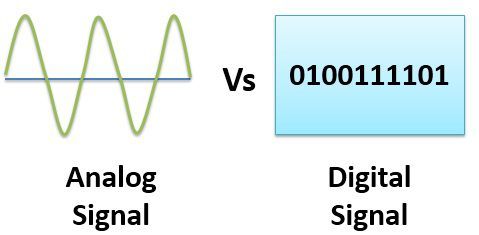
Very often we hear definitions such as “digital” or “discrete” signal, how is it different from “analog”?

Actual] Difference between Analog and Digital Signal with Examples -  ETechnoG

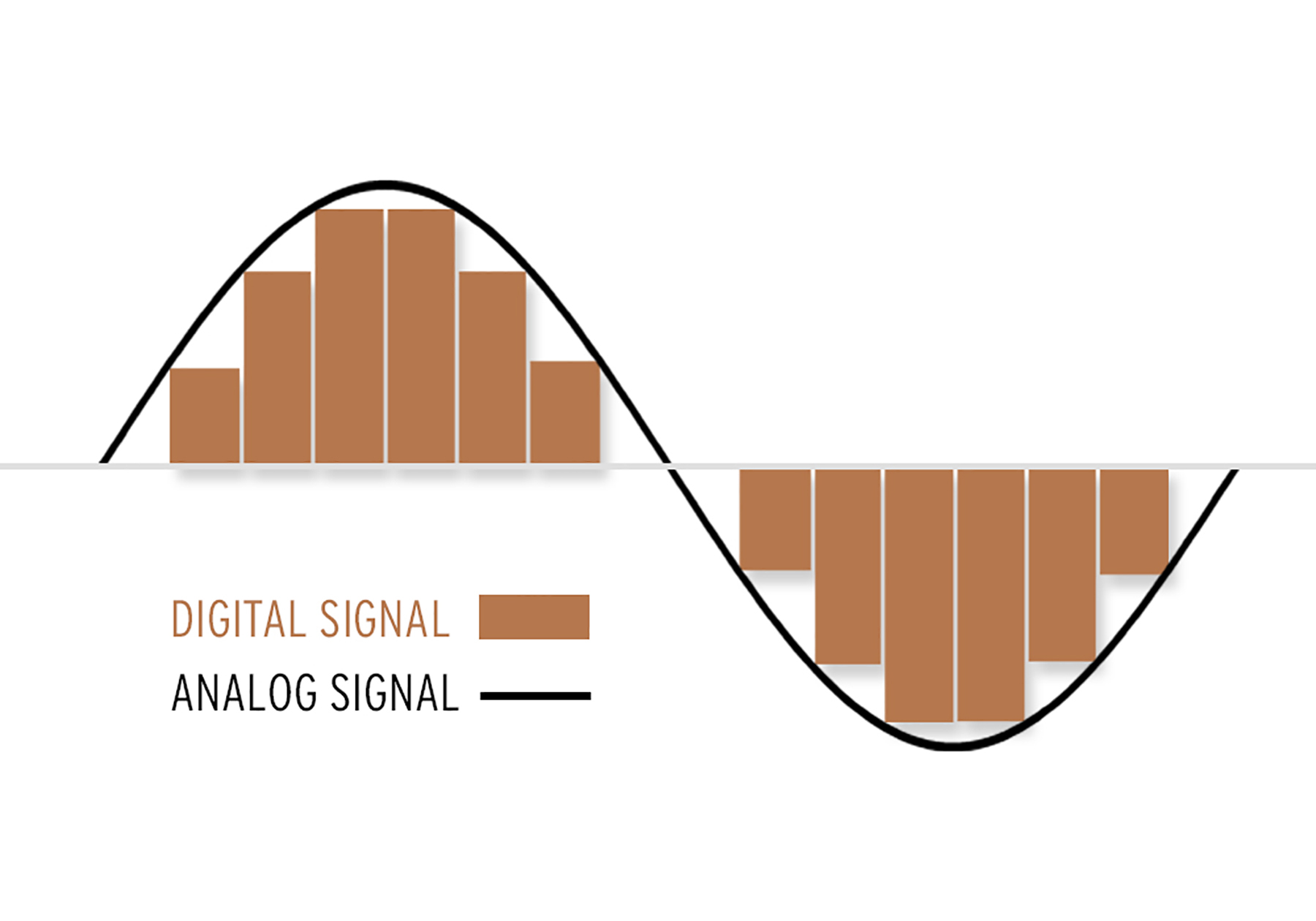
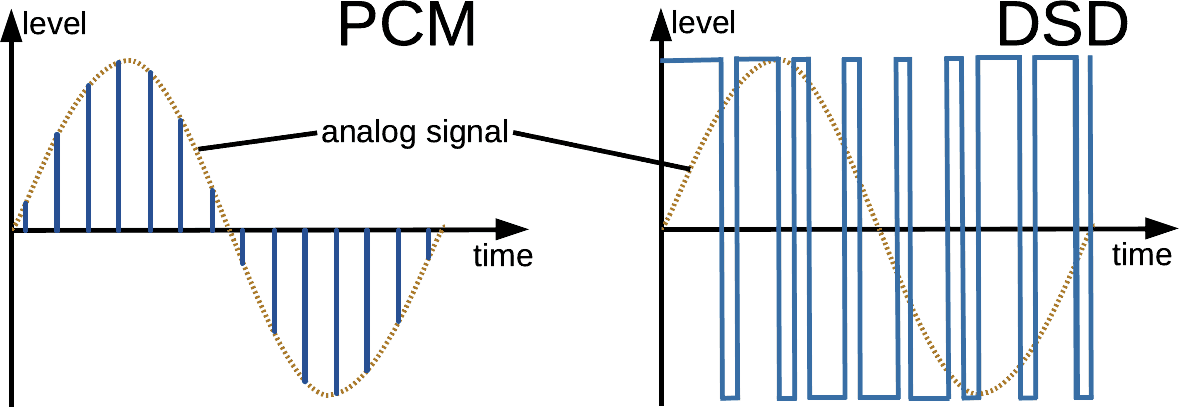
The difference is that the analog signal is continuous in time (blue line), while the digital signal consists of a limited set of coordinates (red dots). If everything is reduced to coordinates, then any segment of an analog signal consists of an infinite number of coordinates.

For a digital signal, the coordinates along the horizontal axis are located at regular intervals, according to the sampling frequency. In the popular audio CD format, this is 44,100 points per second. Vertically, the precision of the coordinate height corresponds to the digit capacity of the digital signal, for 8 bits it is 256 levels, for 16 bits = 65536 and for 24 bits = 16777216 levels. The greater the bit depth (the number of levels), the closer the vertical coordinates will be to the original wave.

Analog sources are cassette tapes and vinyl. Digital sources are: CD-Audio, DVD-Audio, SA-CD (DSD) and files in WAVE and DSD formats (including those derived from APE, Flac, Mp3, Ogg, etc.).

Advantages and disadvantages of the analog signal

The advantage of the analog signal is that it is in the analog form that we perceive sound with our ears. And although our auditory system converts the perceived sound stream into digital form and transmits it to the brain in this way, science and technology have not yet reached the possibility of connecting players and other sound sources directly in this way. Currently, this research is being actively carried out for people with disabilities, and we exclusively enjoy analog sound.

The downside to an analog signal is the ability to store, transmit, and replicate the signal. When recording on tape or vinyl, the quality of the signal will depend on the properties of the tape or vinyl. Over time, the tape will degauss and the quality of the recorded signal will deteriorate. Each read gradually destroys the medium and rewriting introduces additional distortion, where additional deviations are added by the next medium (tape or vinyl), devices for reading, recording and transmitting a signal.

Making a copy of an analog signal is like taking another photograph to copy a photograph.

Advantages and disadvantages of a digital signal

The advantages of a digital signal include precision when copying and transmitting an audio stream, where the original is no different from the copy.

The main disadvantage can be considered that the digital signal is an intermediate stage and the precision of the final analog signal will depend on how detailed and precise the coordinates of the sound wave are. It is quite logical that the more points there are and the more precise the coordinates, the more precise the wave will be. But there is still no consensus on how many coordinates and data precision is sufficient to say that the digital representation of the signal is sufficient to accurately reconstruct the analog signal, indistinguishable from the original by our ears.

In terms of data volume, the capacity of a conventional analog audio cassette is only 700-1.1 MB, while a normal CD is 700 MB. This gives an indication of the need for high capacity media. And this results in a separate war of compromises with different requirements for the number of descriptive points and for the precision of the coordinates.

Today, it is considered sufficient to represent a sound wave with a sampling frequency of 44.1 kHz and a bit depth of 16 bits. With a sampling frequency of 44.1 kHz, you can recall up to 22 kHz. As psychoacoustic studies show, a further increase in sample rate is unremarkable, but an increase in bit depth provides a subjective improvement.

How DACs Build the Wave

A DAC is a digital-to-analog converter, an item that converts digital sound to analog. We’ll take a quick look at the basics. If the comments show interest in considering various points in more detail, a separate material will be published.

Multibit DAC

Most often, the wave is presented in the form of steps, which is due to the architecture of the first generation of R-2R multi-bit DACs, which function similar to a relay switch.