
Analog vs Digital: a fight that never happened
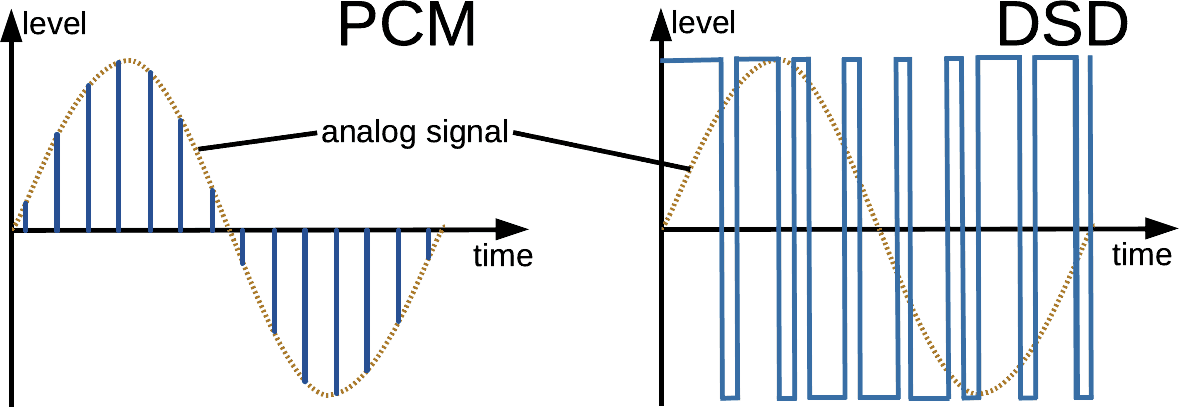
This article is not intended to foment a holy war between fans of analog and digital audio. The goal is to show the fundamental differences between the two technologies. The author of the article (that is, me) takes the side of digital technology as the most perfect and wants to explain his point of view to everyone, not only from the subjective side, but also from the scientific one. Knowledge of the principle of digital sound recording, together with an understanding of the scientific side of this matter, clearly excludes any doubt about the superiority of digital over analog technologies.

ANALOG AUDIO RECORDING.
In fact, sound (vibration of air particles) is analogous in nature. Sound propagates in airspace, it can be distorted depending on a variety of conditions: distance to the sound source, reflection from surrounding objects, speed of movement relative to the source, etc. The range of sound vibrations perceived by the human ear is considered to be the range of 20 Hz to 20 kHz. In fact, 20 kHz is a pretty optimistic figure, few can boast that they actually listen to that frequency. Most of the adults I met did not hear frequencies above 15-16 kHz, so I would say with a high degree of certainty that the average hearing threshold is 15 kHz. However, in terms of pitch, our ear perceives frequencies only up to 5 kHz; all that is higher are additional overtones, overtones, sounds, etc. However, correct reproduction of high components (cut-off frequency) is basically a measure of the quality of a sound recording, usually indicated in the technical specifications of any serious sound recording device.
In the world of analog sound recording, air vibration is first converted to electrical vibration through a microphone. The electrical vibration is then applied to a magnetic recording head (in the case of magnetic tape) or a mechanical cutter (in the case of vinyl). In the first case, the information is recorded on a magnetized tape, in the second – in the slot of the plate. To reproduce the sound, it is enough to stretch the magnetic tape along the magnetic head at the same speed at which the recording was made: the head converts the alternating magnetic field back into electrical oscillations, which are amplified and fed to the system of sound reproduction (speaker). The sound reproduction system vibrates the air and we hear sound. In the case of a plate, just drive the needle along the groove,
Purely from the point of view of common sense, it follows from all the above that vinyl is the worst option to record sound in principle, because in the recording / playback process there is an approximate mechanics (paradoxically, for some reason, conservatives they tend to advocate vinyl and not magnetic tapes, although the latter at the peak of their development had significantly higher quality characteristics). Among other things, almost all more or less normal vinyls were written from magnetic tapes. I simply had no where to record: mastering and mixing were done on tape, as on disk it is, in principle, impossible. That is, the sound of vinyl is the sound of a magnetic tape, only complemented by its own shortcomings of vinyl: creaks, hisses, and other outrages from “music lovers”,
In fact, analog audio recording is imperfect at almost every stage. For example, when recording on a magnetic tape, a lot depends on the quality of the magnetic head; its calibration with respect to the tape is paramount (eternal headache). Add to this detonation (inconsistency of belt speed due to inaccuracies in the belt transport mechanism), self-stretching of the belt, changes in the characteristics of the belt along its length, random bumps / foreign particles in she. Vinyl? Detonation, debris falling into the groove, disc warping, deterioration in sound quality after each playback due to “squashing” of the groove. But the main disadvantage of analog recording is the impossibility of creating an exact copy: any copy of the original will be of inferior quality. Also, any analog media, even if not in use,
DIGITAL SOUND RECORDING.
Digital sound recording has been made possible by the enormous technological advances of the last decades. In fact, digital sound recording is based on a fairly old theory – it just became possible to turn theory into practice.

