Analog vs Digital: a fight that never happened


Free Download Mp4Gain
picture

Analog vs Digital: a fight that never happened
Analog vs Digital Audio

This article is not intended to foment a holy war between fans of analog and digital audio. The goal is to show the fundamental differences between the two technologies. The author of the article (that is, me) takes the side of digital technology as the most perfect and wants to explain his point of view to everyone, not only from the subjective side, but also from the scientific one. Knowledge of the principle of digital sound recording, together with an understanding of the scientific side of this matter, clearly excludes any doubt about the superiority of digital over analog technologies.

Analogue Vs. Digital

ANALOG AUDIO RECORDING.
In fact, sound (vibration of air particles) is analogous in nature. Sound propagates in airspace, it can be distorted depending on a variety of conditions: distance to the sound source, reflection from surrounding objects, speed of movement relative to the source, etc. The range of sound vibrations perceived by the human ear is considered to be the range of 20 Hz to 20 kHz. In fact, 20 kHz is a pretty optimistic figure, few can boast that they actually listen to that frequency. Most of the adults I met did not hear frequencies above 15-16 kHz, so I would say with a high degree of certainty that the average hearing threshold is 15 kHz. However, in terms of pitch, our ear perceives frequencies only up to 5 kHz; all that is higher are additional overtones, overtones, sounds, etc. However, correct reproduction of high components (cut-off frequency) is basically a measure of the quality of a sound recording, usually indicated in the technical specifications of any serious sound recording device.

In the world of analog sound recording, air vibration is first converted to electrical vibration through a microphone. The electrical vibration is then applied to a magnetic recording head (in the case of magnetic tape) or a mechanical cutter (in the case of vinyl). In the first case, the information is recorded on a magnetized tape, in the second – in the slot of the plate. To reproduce the sound, it is enough to stretch the magnetic tape along the magnetic head at the same speed at which the recording was made: the head converts the alternating magnetic field back into electrical oscillations, which are amplified and fed to the system of sound reproduction (speaker). The sound reproduction system vibrates the air and we hear sound. In the case of a plate, just drive the needle along the groove,

Purely from the point of view of common sense, it follows from all the above that vinyl is the worst option to record sound in principle, because in the recording / playback process there is an approximate mechanics (paradoxically, for some reason, conservatives they tend to advocate vinyl and not magnetic tapes, although the latter at the peak of their development had significantly higher quality characteristics). Among other things, almost all more or less normal vinyls were written from magnetic tapes. I simply had no where to record: mastering and mixing were done on tape, as on disk it is, in principle, impossible. That is, the sound of vinyl is the sound of a magnetic tape, only complemented by its own shortcomings of vinyl: creaks, hisses, and other outrages from “music lovers”,

In fact, analog audio recording is imperfect at almost every stage. For example, when recording on a magnetic tape, a lot depends on the quality of the magnetic head; its calibration with respect to the tape is paramount (eternal headache). Add to this detonation (inconsistency of belt speed due to inaccuracies in the belt transport mechanism), self-stretching of the belt, changes in the characteristics of the belt along its length, random bumps / foreign particles in she. Vinyl? Detonation, debris falling into the groove, disc warping, deterioration in sound quality after each playback due to “squashing” of the groove. But the main disadvantage of analog recording is the impossibility of creating an exact copy: any copy of the original will be of inferior quality. Also, any analog media, even if not in use,

DIGITAL SOUND RECORDING.
Digital sound recording has been made possible by the enormous technological advances of the last decades. In fact, digital sound recording is based on a fairly old theory – it just became possible to turn theory into practice.


Free Download Mp4Gain
picture


Mp4Gain Main Window
picture


Mp4Gain Features
picture


Free Download Mp4Gain
picture

Working with sound

Working with sound

Analog and Digital

Analog and digital audio

 Analog and Digital

Analog sound recording is based on the conversion of acoustic waves into electrical waves using a microphone. A microphone consists of a small membrane that can vibrate and a mechanism to convert the vibrations of the membrane into an electrical signal. (The exact electrical mechanism differs depending on the type of microphone.) Generally, a higher pressure corresponds to a higher voltage and vice versa.

The recorder transmits the waveform one more time, this time from an electrical signal through a wire to a magnetic signal on tape. When the recording is played back, the opposite process occurs: the magnetic signal is converted into an electronic signal, which makes the speaker vibrate (usually electromagnetic).

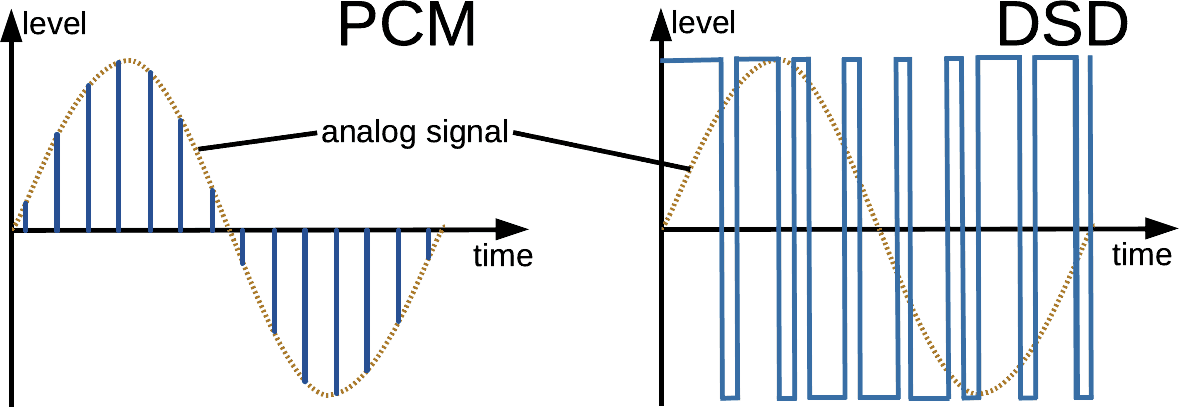
The main device for digital recording is an analog-to-digital converter (ADC, analog-to-digital converter, ADC). The ADC captures a chunk of electrical voltage on the audio path and presents it as a number, which is then transmitted to the computer. By capturing the voltage several thousand times per second, you can get a signal quite close to the original. The unit of capture is called a sample (each number in a sound file represents corresponds to a sample in a waveform).

There are two factors that determine the quality of a digital recording:

Sampling rate
The frequency at which samples are captured or played, measured in Hertz (Hz) or samples per second. A typical audio CD is recorded at a sample rate of 44100 Hz, more commonly known as 44 kHz for short. This is the same default sample rate used for most digitals.

Sample format (size)
The number of digits in the digital representation of each sample. Imagine that the sample rate is plotted horizontally and the sample size is plotted vertically. Audio CD is 16 bits wide, which corresponds to approximately 5 decimal places.

Higher sample rates for digital recording provide accurate recording at higher frequencies. The sample rate must be at least twice the highest desired sample rate. The average human ear is believed to be unable to distinguish frequencies above 20,000 Hz, so 44,100 Hz was chosen as the standard for audio CDs. Now the transition to the frequencies of 96 and 192 kHz is taking place gradually, in particular within the DVD-Audio format. However, many people just don’t hear the difference between 44.1 kHz and 192 kHz audio.

Larger sample sizes provide a greater dynamic range, that is, the ability to present louder and quieter sounds. If you are familiar with the decibel (dB) scale, you can give an example from ordinary audio CDs – its dynamic range is theoretically 90 dB, but it actually sounds lower than -24 dB. Audacity supports two more sample sizes: 24-bit, which is most often used in digital studio recording, and 32-bit floating point, whose dynamic range covers all imaginable needs, despite the fact that the data with these parameters occupies just twice the disk space compared to 16-bit audio.

When playing digital sound, a digital-to-analog converter (DAC) is used. In this case, to recreate the original signal and then digitized with the ADC, a sample is taken, from which a certain voltage is established at the analog outputs. The first CD players did just that, so the sound quality was not very good. Modern players also smooth out the audio signal by sampling within a range of the sampling frequency. The quality of the filters on the DAC also affects the sound signal that is recreated. The filter is one of the signal adaptation stages in the DAC.

The inevitable loss in the transition from analog to digital audio can be offset by a number of advantages of digital recording. Digital data can be copied as much as you like and there is no loss of quality. This data can be burned to a music CD or posted on the Internet as compressed files. Also, digital recordings are much easier to edit than analog tapes.

A personal computer has all the necessary devices to convert audio data from analog to digital and vice versa. First of all, it’s a sound card, an additionally installed separate device like Creative SBLive !, and maybe a sound chip built into the motherboard. In both cases, the audio device contains an analog-to-digital converter (ADC) to record sound and a digital-to-analog converter (DAC) to play it back. The operating system you are using interacts with the sound card,

Differences between analog and digital audio

Differences between analog and digital audio

Analog and Digita

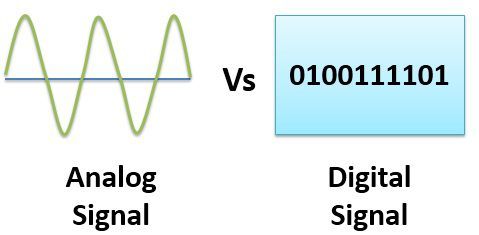
Very often we hear definitions such as “digital” or “discrete” signal, how is it different from “analog”?

Actual] Difference between Analog and Digital Signal with Examples -  ETechnoG

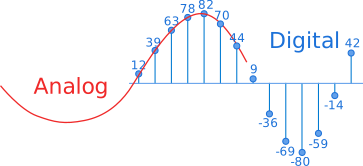
The difference is that the analog signal is continuous in time (blue line), while the digital signal consists of a limited set of coordinates (red dots). If everything is reduced to coordinates, then any segment of an analog signal consists of an infinite number of coordinates.

For a digital signal, the coordinates along the horizontal axis are located at regular intervals, according to the sampling frequency. In the popular audio CD format, this is 44,100 points per second. Vertically, the precision of the coordinate height corresponds to the digit capacity of the digital signal, for 8 bits it is 256 levels, for 16 bits = 65536 and for 24 bits = 16777216 levels. The greater the bit depth (the number of levels), the closer the vertical coordinates will be to the original wave.

Analog sources are cassette tapes and vinyl. Digital sources are: CD-Audio, DVD-Audio, SA-CD (DSD) and files in WAVE and DSD formats (including those derived from APE, Flac, Mp3, Ogg, etc.).

Advantages and disadvantages of the analog signal

The advantage of the analog signal is that it is in the analog form that we perceive sound with our ears. And although our auditory system converts the perceived sound stream into digital form and transmits it to the brain in this way, science and technology have not yet reached the possibility of connecting players and other sound sources directly in this way. Currently, this research is being actively carried out for people with disabilities, and we exclusively enjoy analog sound.

The downside to an analog signal is the ability to store, transmit, and replicate the signal. When recording on tape or vinyl, the quality of the signal will depend on the properties of the tape or vinyl. Over time, the tape will degauss and the quality of the recorded signal will deteriorate. Each read gradually destroys the medium and rewriting introduces additional distortion, where additional deviations are added by the next medium (tape or vinyl), devices for reading, recording and transmitting a signal.

Making a copy of an analog signal is like taking another photograph to copy a photograph.

Advantages and disadvantages of a digital signal

The advantages of a digital signal include precision when copying and transmitting an audio stream, where the original is no different from the copy.

The main disadvantage can be considered that the digital signal is an intermediate stage and the precision of the final analog signal will depend on how detailed and precise the coordinates of the sound wave are. It is quite logical that the more points there are and the more precise the coordinates, the more precise the wave will be. But there is still no consensus on how many coordinates and data precision is sufficient to say that the digital representation of the signal is sufficient to accurately reconstruct the analog signal, indistinguishable from the original by our ears.

In terms of data volume, the capacity of a conventional analog audio cassette is only 700-1.1 MB, while a normal CD is 700 MB. This gives an indication of the need for high capacity media. And this results in a separate war of compromises with different requirements for the number of descriptive points and for the precision of the coordinates.

Today, it is considered sufficient to represent a sound wave with a sampling frequency of 44.1 kHz and a bit depth of 16 bits. With a sampling frequency of 44.1 kHz, you can recall up to 22 kHz. As psychoacoustic studies show, a further increase in sample rate is unremarkable, but an increase in bit depth provides a subjective improvement.

How DACs Build the Wave

A DAC is a digital-to-analog converter, an item that converts digital sound to analog. We’ll take a quick look at the basics. If the comments show interest in considering various points in more detail, a separate material will be published.

Multibit DAC

Most often, the wave is presented in the form of steps, which is due to the architecture of the first generation of R-2R multi-bit DACs, which function similar to a relay switch.

Analog and digital sound sources

Analog and digital sound sources

analog and digital audio

Digital music comes from two main sources: analog and digital.

Analog and Digital

Analogous sources
An analog music source must use an analog-to-digital converter, such as a sound card, to convert the physical changes of the analog medium into a digital file that can be read by a computer. An analog medium is an object that stores music in itself through physical changes.

For example:

A cassette recorder changes the degree of magnetization of a cassette tape to record sound. Connecting a cassette deck to a recording device allows you to make a digital copy of an analog cassette.
The recorder cuts grooves in the vinyl record to create a physical representation of the sound. Ripping vinyl with a preamp and sound card allows you to make a digital copy of an analog record.
Analog recordings can be converted to digital music files in various formats, such as FLAC and MP3. Vinyl recordings can always be posted to the site, but posting tape recordings and other analog sources requires approval from the moderator.

Digital music sources
Music from digital sources is already encoded in a computer-compatible format, so no additional conversion is required. A digital medium is an object that stores music digitally (as a sequence of binary numbers).

For example:

CD
DVD
Super Audio CD (SACD)
Content from online stores (iTunes, Amazon, etc.)
Music from digital sources can be uploaded to RED after analyzing the spectrograms of the files to verify lossy transcoding.

Comparison of analog to digital music sources
Controversy still exists as to whether music sounds differently from analog and digital sources. Some people prefer the feel of vinyl and find that music on vinyl sounds “warmer” and “brighter.” On the other hand, some believe that digital sources provide true, pure and authentic sound. Both are represented in RED, so you can compare and make your own choice!

Analog and digital

First of all, a fundamental distinction is necessary: ​​what is meant by an analog signal and what is meant by a digital signal. Sampling is in fact an analog-to-digital conversion, and to understand how this is accomplished, it is necessary to understand what the subjects of this transformation are.

The classic definition of “analog” and “digital” is as follows.
The analog signal is one in which the variation is continuous in time.
The digital signal is one in which the variation in time occurs in a discrete way.
Pay attention to this definition because it expresses a very simple concept but at the same time misunderstood.

Let’s use some examples to get the concept down.
As a first example, let’s think of a watch with hands (suppose it is of the type in which the second hand moves continuously and not broken).

This clock not only marks the hours, minutes and seconds, but also any other type of fraction that we want to imagine: half seconds, tenths, hundredths, etc. As difficult as it is for the eye to distinguish the different moments, we know that the clock continuously passes through every instant of time that we can imagine.

Let’s think instead of a digital clock, those that indicate the time with numbers on a screen. This clock will mark the hours, minutes and seconds, activating the latter one by one; We do not see half seconds, tenths and so on: from 10:10:01 to 10:10:02 (for example) the clock will always read 10:10:01.

The watch with hands can be defined as an analog device, while the other watch, which provides only discrete, but not continuous measurements, is called digital.

A second example: let’s think about two different ways to monitor the level of a signal: the first, the classic needle VU-meter, typical of old mixers; the second, the column of bright LEDs, typical for example of equalizers.

The VU-meter, for reasons exactly analogous to those of the hand watch, is an analog device; The LED column, which only provides discrete data, is a digital device.

So what does it mean to sample a signal?

It means finding a discrete representation for something that originally has continuous variation.
The purpose is obvious: where, for example, to modify the analog recording of a voice, we must first convert the sound energy into electrical energy (through a microphone), then transform the electrical energy into the magnetic property of a tape ( through a tape recorder) and finally intervene with mechanical modifications to the tape itself (editing operations with manual cutting and pasting of the tape), with a digital recording, in which the electrical energy supplied by the microphone is converted directly In digital samples, that is, in discrete number data, it will be possible to modify the register through an electronic calculator capable of analyzing and modifying the data.

Sampling and time (frequency and Nyquist theorem)

The first practical problem that sampling is faced with is establishing how many times in a given period of time the signal must be measured for the sampling to be accurate, and the resulting digital signal can be converted back into an analog signal without losing or changing certain characteristics of the original signal.

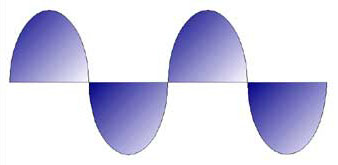
Take as an example the classic elementary sinusoid, like the one in the figure.

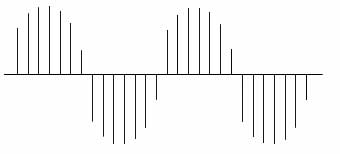
Let’s say we have a device that takes, over a certain period of time, a certain number of samples of the signal: for example, 14 samples per period of the sinusoid.
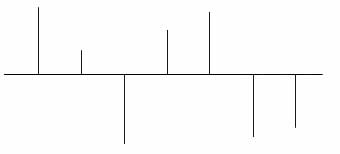
We will obtain a series of samples like the one in the figure:

We see that the original sinusoid is still intuitive, so it is possible to reconstruct it and reverse the procedure.
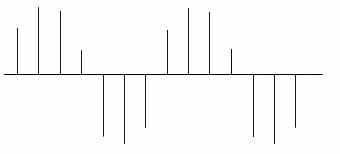
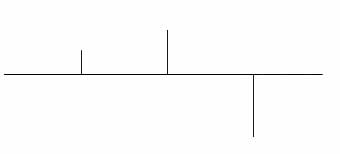
But imagine halving the sample rate, that is, doubling the time between one measurement and another.
We will obtain a different series of samples, less dense than the previous one:

The sine wave can still be guessed, but it is clear that we have lost some of the original information.
Halving again, the situation becomes almost critical:

Here it is already very difficult to trace the original signal.
By reducing more by half, all traces of the sine wave are lost:

Therefore, we understood that there is a critical point, below which the sampling frequency cannot fall, under penalty of total loss of information.