
First of all, a fundamental distinction is necessary: what is meant by an analog signal and what is meant by a digital signal. Sampling is in fact an analog-to-digital conversion, and to understand how this is accomplished, it is necessary to understand what the subjects of this transformation are.
The classic definition of “analog” and “digital” is as follows.
The analog signal is one in which the variation is continuous in time.
The digital signal is one in which the variation in time occurs in a discrete way.
Pay attention to this definition because it expresses a very simple concept but at the same time misunderstood.
Let’s use some examples to get the concept down.
As a first example, let’s think of a watch with hands (suppose it is of the type in which the second hand moves continuously and not broken).
This clock not only marks the hours, minutes and seconds, but also any other type of fraction that we want to imagine: half seconds, tenths, hundredths, etc. As difficult as it is for the eye to distinguish the different moments, we know that the clock continuously passes through every instant of time that we can imagine.
Let’s think instead of a digital clock, those that indicate the time with numbers on a screen. This clock will mark the hours, minutes and seconds, activating the latter one by one; We do not see half seconds, tenths and so on: from 10:10:01 to 10:10:02 (for example) the clock will always read 10:10:01.
The watch with hands can be defined as an analog device, while the other watch, which provides only discrete, but not continuous measurements, is called digital.
A second example: let’s think about two different ways to monitor the level of a signal: the first, the classic needle VU-meter, typical of old mixers; the second, the column of bright LEDs, typical for example of equalizers.
The VU-meter, for reasons exactly analogous to those of the hand watch, is an analog device; The LED column, which only provides discrete data, is a digital device.
So what does it mean to sample a signal?
It means finding a discrete representation for something that originally has continuous variation.
The purpose is obvious: where, for example, to modify the analog recording of a voice, we must first convert the sound energy into electrical energy (through a microphone), then transform the electrical energy into the magnetic property of a tape ( through a tape recorder) and finally intervene with mechanical modifications to the tape itself (editing operations with manual cutting and pasting of the tape), with a digital recording, in which the electrical energy supplied by the microphone is converted directly In digital samples, that is, in discrete number data, it will be possible to modify the register through an electronic calculator capable of analyzing and modifying the data.
Sampling and time (frequency and Nyquist theorem)
The first practical problem that sampling is faced with is establishing how many times in a given period of time the signal must be measured for the sampling to be accurate, and the resulting digital signal can be converted back into an analog signal without losing or changing certain characteristics of the original signal.
Take as an example the classic elementary sinusoid, like the one in the figure.
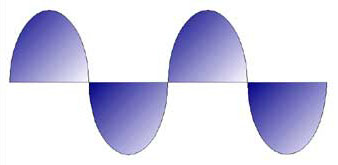
Let’s say we have a device that takes, over a certain period of time, a certain number of samples of the signal: for example, 14 samples per period of the sinusoid.
We will obtain a series of samples like the one in the figure:
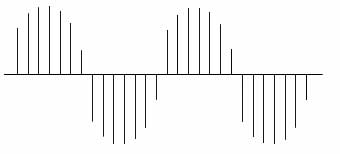
We see that the original sinusoid is still intuitive, so it is possible to reconstruct it and reverse the procedure.
But imagine halving the sample rate, that is, doubling the time between one measurement and another.
We will obtain a different series of samples, less dense than the previous one:
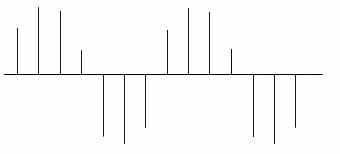
The sine wave can still be guessed, but it is clear that we have lost some of the original information.
Halving again, the situation becomes almost critical:
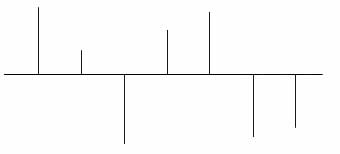
Here it is already very difficult to trace the original signal.
By reducing more by half, all traces of the sine wave are lost:
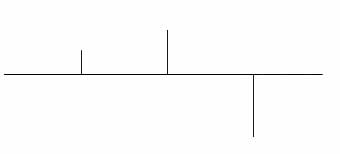
Therefore, we understood that there is a critical point, below which the sampling frequency cannot fall, under penalty of total loss of information.

