
Differences between analog and digital audio
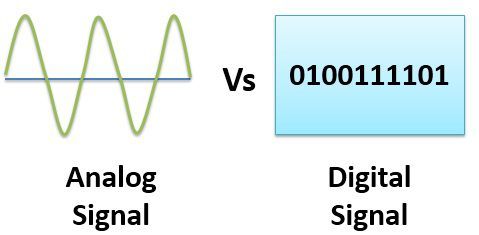
Very often we hear definitions such as “digital” or “discrete” signal, how is it different from “analog”?
![Actual] Difference between Analog and Digital Signal with Examples - ETechnoG](https://1.bp.blogspot.com/-BOJ9ZDChtnQ/Xcw3rI-uRII/AAAAAAAACUM/lNFGx00PNucfiRQewbFUqjhz8g_cY2ingCLcBGAsYHQ/s1600/Difference%2Bbetween%2BAnalog%2Band%2BDigital%2BSignal.png)
The difference is that the analog signal is continuous in time (blue line), while the digital signal consists of a limited set of coordinates (red dots). If everything is reduced to coordinates, then any segment of an analog signal consists of an infinite number of coordinates.
For a digital signal, the coordinates along the horizontal axis are located at regular intervals, according to the sampling frequency. In the popular audio CD format, this is 44,100 points per second. Vertically, the precision of the coordinate height corresponds to the digit capacity of the digital signal, for 8 bits it is 256 levels, for 16 bits = 65536 and for 24 bits = 16777216 levels. The greater the bit depth (the number of levels), the closer the vertical coordinates will be to the original wave.
Analog sources are cassette tapes and vinyl. Digital sources are: CD-Audio, DVD-Audio, SA-CD (DSD) and files in WAVE and DSD formats (including those derived from APE, Flac, Mp3, Ogg, etc.).
Advantages and disadvantages of the analog signal
The advantage of the analog signal is that it is in the analog form that we perceive sound with our ears. And although our auditory system converts the perceived sound stream into digital form and transmits it to the brain in this way, science and technology have not yet reached the possibility of connecting players and other sound sources directly in this way. Currently, this research is being actively carried out for people with disabilities, and we exclusively enjoy analog sound.
The downside to an analog signal is the ability to store, transmit, and replicate the signal. When recording on tape or vinyl, the quality of the signal will depend on the properties of the tape or vinyl. Over time, the tape will degauss and the quality of the recorded signal will deteriorate. Each read gradually destroys the medium and rewriting introduces additional distortion, where additional deviations are added by the next medium (tape or vinyl), devices for reading, recording and transmitting a signal.
Making a copy of an analog signal is like taking another photograph to copy a photograph.
Advantages and disadvantages of a digital signal
The advantages of a digital signal include precision when copying and transmitting an audio stream, where the original is no different from the copy.
The main disadvantage can be considered that the digital signal is an intermediate stage and the precision of the final analog signal will depend on how detailed and precise the coordinates of the sound wave are. It is quite logical that the more points there are and the more precise the coordinates, the more precise the wave will be. But there is still no consensus on how many coordinates and data precision is sufficient to say that the digital representation of the signal is sufficient to accurately reconstruct the analog signal, indistinguishable from the original by our ears.
In terms of data volume, the capacity of a conventional analog audio cassette is only 700-1.1 MB, while a normal CD is 700 MB. This gives an indication of the need for high capacity media. And this results in a separate war of compromises with different requirements for the number of descriptive points and for the precision of the coordinates.
Today, it is considered sufficient to represent a sound wave with a sampling frequency of 44.1 kHz and a bit depth of 16 bits. With a sampling frequency of 44.1 kHz, you can recall up to 22 kHz. As psychoacoustic studies show, a further increase in sample rate is unremarkable, but an increase in bit depth provides a subjective improvement.
How DACs Build the Wave
A DAC is a digital-to-analog converter, an item that converts digital sound to analog. We’ll take a quick look at the basics. If the comments show interest in considering various points in more detail, a separate material will be published.
Multibit DAC
Most often, the wave is presented in the form of steps, which is due to the architecture of the first generation of R-2R multi-bit DACs, which function similar to a relay switch.

