Analog vs Digital Audio


Free Download Mp4Gain
picture

Analog vs Digital Audio: Understanding the Differences

Analog vs Digital Audio

Analog Audio: The Old School Sound

Analog audio refers to a sound signal that is continuous and unbroken. It is the old school way of recording sound, and it has been around for a long time. In the early days of audio recording, analog technology was the only option. Record players, cassette tapes, and reel-to-reel tapes were all analog formats that produced a unique sound.

One of the main advantages of analog audio is the warmth and depth of the sound. Analog recordings have a certain character that digital recordings simply can’t match. As author Salman Rushdie once said, “Analog is warm, digital is cold.”

However, analog audio is also subject to degradation and noise. Over time, the signal can deteriorate, resulting in a loss of quality. Analog recordings also tend to have more background noise and hiss than digital recordings.

Digital Audio: The Modern Sound

Digital audio, on the other hand, is a more modern method of recording sound. It involves converting sound waves into a series of numbers that can be stored and manipulated. The digital format has become increasingly popular in recent years, and it is now the standard for most audio recordings.

One of the main advantages of digital audio is its precision and clarity. Digital recordings are much more accurate and can reproduce sound with much greater fidelity than analog recordings. They are also immune to the degradation and noise that can affect analog recordings.

However, some people argue that digital recordings lack the warmth and character of analog recordings. As musician Jack White once said, “Digital sounds like it has a condom on it.”

Analog vs Digital: Which is Better?

So, which is better, analog or digital? The truth is, it depends on who you ask. Some people prefer the warmth and character of analog recordings, while others prefer the precision and clarity of digital recordings.

At the end of the day, the choice between analog and digital comes down to personal preference. Both formats have their advantages and disadvantages, and it ultimately comes down to what kind of sound you prefer.

Conclusion: The Best of Both Worlds

At mp4gain.com, we understand the importance of sound quality. That’s why we’ve developed a powerful audio normalization and conversion software that can work with both analog and digital formats. Our software can help you get the best of both worlds by optimizing your audio for clarity and warmth.

As technology continues to evolve, we can expect to see new and innovative ways of recording and manipulating sound. But no matter what the future holds, we will always be dedicated to providing our customers with the highest quality sound possible.

Final Words:

In the end, whether you prefer analog or digital audio comes down to personal preference. Both formats have their advantages and disadvantages, and it’s up to you to decide which one is best for you. But with the right tools and techniques, you can achieve great sound quality no matter what format you choose.


Free Download Mp4Gain
picture


Mp4Gain Main Window
picture


Mp4Gain Features
picture


Free Download Mp4Gain
picture

Is analog recording better than digital?

During my training as a sound engineer, I read several times that in analog systems the sound wave, in the form of alternating current, is continuously recorded on the tape, something that does not happen in the digital environment where the sound wave is found. photographed thousands of times per second and reconstructed to some degree of approximation.

analog

“Tape recording is better from this point of view than digital recording”

Obviously I was not the only one to have taken this statement as true, since among technicians and musicians I hear it repeated often, but are we really sure that it is so? Could such outdated technology be better than the current one? Obviously not.

digital audio

From a technical point of view, analog recording suffers from a number of problems that introduce distortions and artifacts, so comparing the recorded sound with the source, the result is anything but faithful. Don’t you think so? Here are some issues that you may not have been told about analog recording.

–The flutter and the wow are oscillations that are generated during the route of the tape that, stretching between the heads, begins to vibrate like a guitar string, introducing micro-phasing and effects similar to tremolo;
–hysteresis. The metallic particles that cover the surface of the tape are quite slow and do not move from their rest state unless the magnetic field of the recording head is strong enough to polarize them. Therefore, sounds of weaker intensity are not correctly recorded, as well as high frequencies;
–maximum distortion. Transients are very fast, dynamic, and rich in high frequencies, qualities that tape cannot fully satisfy;
Background noise is an intrinsic feature of tape, to which we have tried to bypass filters with pre-emphasis and noise reduction circuitry, which in turn add more distortion;
deterioration of the material that occurs in each step and risk of self-cancellation of the material.

These aspects of analog recording, and they are just a few, are enough to make us understand that, even if we record continuously, our signal suffers many alterations.

Digital technology represents a clear improvement on many fronts, thanks to the low prices and the reliability of the instruments, capable of always guaranteeing the same performance without the need for constant maintenance.

With ever higher sample rates, 144 dB of dynamics (for 24-bit formats), and no background noise, digital audio recording allows you to truly capture sound in all its dynamic and tonal components.

–Yes, but digital is cold, analog is hot!

Seriously, the adjectives hot and cold are not appropriate terms to describe the characteristics of sound and are used incorrectly to express personal preferences and tastes.

What is generally understood by “warm sound” is the sensation of tonal enrichment that analog machines give to the audio signal in which there is less presence of high frequencies, while the adjective “cold” refers to a bare sound , raw, essential and seemingly unbalanced in favor of high frequencies.

If you want to improve the tone, it is better to use more appropriate terms, referring to digital as true copy and analog as artificial.

Analog vs. Digital

Analog and digital signals are used to transmit information, generally through electrical signals. In these two technologies, information, such as audio or video, is transformed into electrical signals. The difference between analog and digital technologies is that in analog technology, information is translated into electrical pulses of varying amplitude. In digital technology, the translation of information is in binary format (zero or one), each bit represents two different amplitudes.

Analog vs Digital

Analog and digital signal definitions.

An analog signal is a continuous signal for which the variable characteristic of the signal (variable) is a representation of another quantity that varies in time, that is, analogous to another signal that varies in time. It differs from a digital signal in terms of small signal fluctuations that are significant.

A digital signal uses discrete (discontinuous) values. In contrast, non-digital (or analog) systems use a continuous range of values ​​to represent information. Although digital representations are discrete, the information represented can be discrete, such as numbers or letters, or continuous, such as sounds, images, and other measures of continuous systems.

Properties of digital and analog signals.

Digital information has certain properties that distinguish it from analog communication methods. These included

Synchronization: Digital communication uses specific synchronization sequences to determine synchronization.
Language: Digital communications require a language that must be the property of the sender and receiver and must specify the meaning of the symbol sequences.
Errors: disturbances in analog communication cause errors in actual planned communication, but disturbances in digital communication do not cause errors that allow error-free communication. Errors must be able to replace, insert or delete symbols to be expressed.
Copy: Analog communication copies are inferior to their originals, but due to error-free digital communication, copies can be made indefinitely.
Granularity: For a continuously variable analog value to be represented digitally, there is a quantization error that is the difference between the actual analog value and the digital representation, and this property of digital communication is called granularity.

Differences in use in equipment.

Many devices have built-in translation features ranging from analog to digital. Microphones and speakers are perfect examples of analog devices. Analog technology is cheaper, but the size of the data that can be transmitted at any given time is limited.

Digital technology has revolutionized the operation of most equipment. The data is converted into binary code and then reassembled in its original form at the point of reception. As they are easy to handle, they offer a wider range of options. Digital equipment is more expensive than analog equipment.

Analog and digital quality comparison.

Digital devices translate and reassemble data and are more likely to lose quality than analog devices. The advancement of the computer has allowed the use of error detection and correction techniques to eliminate artificial disturbances in digital signals and improve quality.

Differences in applications

Digital technology has been more effective in the cell phone industry. Analog phones became redundant despite good clarity and sound quality.

Analog technology includes natural signals like human speech. With digital technology, this human speech can be recorded and stored on a computer. Therefore, digital technology opens the way to infinite possible uses.

ANALOGUE VS DIGITAL SOUND: WHAT A DIFFERENCE?

The difference between digital and analog audio depends mainly on how the audio was recorded and stored.

Analog and Digital Audio

The analogue:

In keeping with a traditional recording technology, the analog sound experienced its golden age in the 1970s and was then attached to a magnetic tape or vinyl record. The audio signal is reproduced as faithfully as possible by copying the original audio waveform identically and continuously. As production costs are substantial, this recording model has gradually been abandoned in favor of digital.

Analogue Vs. Digital

digital:

The digital audio signal is in the form of a series of binary coded digital data, the basic language of modern computing: 0 and 1. As soon as a computer enters the audio production chain during recording or playback, the audio is digital. Sound is no longer obtained by copying the sound wave, but digitizing the sound, a process that allows the computer to decipher the sound in binary format. However, 0 and 1 do not allow you to reproduce the entire analog audio wave. To reproduce the sound, it will divide the sound wave into a series of small sound samples, each of sufficient quality separately, to artificially reproduce the sound wave.

The differences between analog and digital audio

Traditionally, we distinguish analog audio from digital audio. Before we get to the heart of the matter, it must be understood that the phenomena that surround us and which our ears perceive are all analogous.

Analog vs Digital

In a concert, for example, the sound produced by the artist’s instrument, the audience’s applause, or the spectator’s whisper is all analogous: they are continuous, that is, they give value to another without interruption and this continuously.

As soon as we want to reproduce these sounds using a recording, we have two solutions: either the signal is recorded continuously and analogously to the source, or we only record certain signal information in the Conversion of a list of predefined values. The first is said to be analog, the second is digital.

The dancer, the light and the strobe.

A good image that is often used to differentiate analog from digital audio is that of the dancer, the light and the strobe.

Imagine one dancer performing their choreography under a “normal” diffused light, and another performing the same dance but under a strobe light.

The first dance will no doubt be considered fluid and continuous, while the second is seen as uneven.

And the more you increase the speed of the strobe, the more you’ll be able to perceive the choreography fine. This is exactly what happens to digital audio: the higher the sample rate and resolution, the more faithful the audio reproduction will be.

SIGNAL PROCESSING

The analog signal varies continuously with time. Therefore, it consists of continuous variations in air pressure, and our ear, more precisely the eardrum, perceives these variations, which our brain in turn interprets as sound. How good is nature!

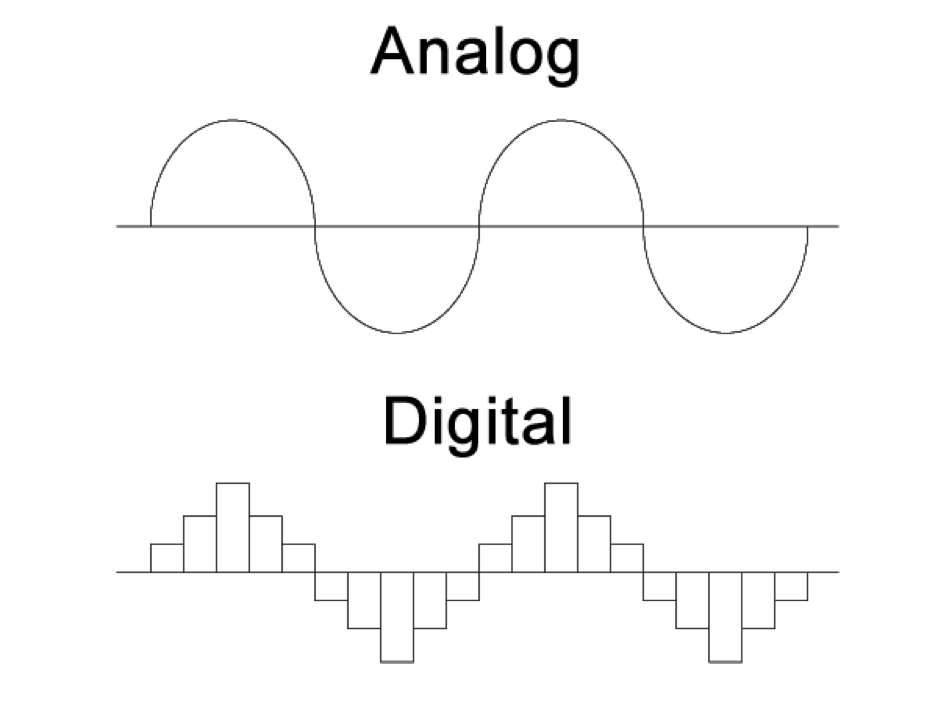
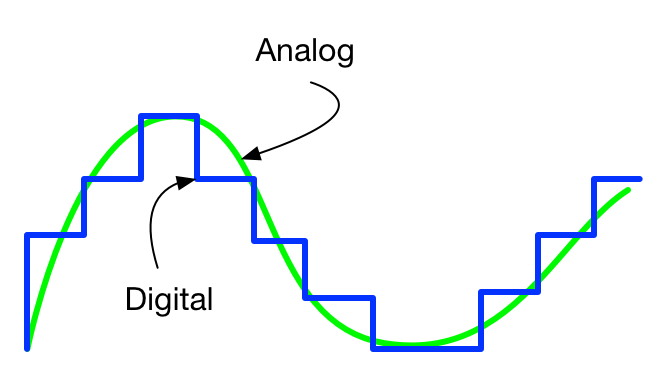
The analog signal which can take an infinite number of values ​​is traditionally represented as a continuous and sinusoidal curve.

In contrast, the digital signal is discontinuous and limited to a number of predefined values ​​at precise times. Therefore, it is represented schematically in the form of a histogram.

TRANSFER FROM ANALOGUE TO DIGITAL: DIGITIZATION

The transformation of the analog signal into a digital signal is called digitization.

It is actually a transformation of the vibration (analog signal) into a series of figures (digital signal), made thanks to an analog-digital converter (ADC: Analog Digital Converter).
Sampling and quantification.
ADC measures the analog signal strength at regular intervals and over an equal period of time – this is called sampling. Sampling frequency, expressed in kHz, represents the number of samples taken per day. Second.

These samples are stored in the memory of a computer and constitute an audio file which, in order to be heard by the human ear, must be converted to an analog signal: it is the role of DAC (analog digital converter).

Quantification or resolution is for each sample to measure an amplitude value.

This amplitude value is expressed in bits.

The act of converting the digital value of the amplitude into a binary value is called encoding.