
The difference between digital and analog audio depends mainly on how the audio was recorded and stored.

The analogue:
In keeping with a traditional recording technology, the analog sound experienced its golden age in the 1970s and was then attached to a magnetic tape or vinyl record. The audio signal is reproduced as faithfully as possible by copying the original audio waveform identically and continuously. As production costs are substantial, this recording model has gradually been abandoned in favor of digital.

digital:
The digital audio signal is in the form of a series of binary coded digital data, the basic language of modern computing: 0 and 1. As soon as a computer enters the audio production chain during recording or playback, the audio is digital. Sound is no longer obtained by copying the sound wave, but digitizing the sound, a process that allows the computer to decipher the sound in binary format. However, 0 and 1 do not allow you to reproduce the entire analog audio wave. To reproduce the sound, it will divide the sound wave into a series of small sound samples, each of sufficient quality separately, to artificially reproduce the sound wave.
The differences between analog and digital audio
Traditionally, we distinguish analog audio from digital audio. Before we get to the heart of the matter, it must be understood that the phenomena that surround us and which our ears perceive are all analogous.
In a concert, for example, the sound produced by the artist’s instrument, the audience’s applause, or the spectator’s whisper is all analogous: they are continuous, that is, they give value to another without interruption and this continuously.
As soon as we want to reproduce these sounds using a recording, we have two solutions: either the signal is recorded continuously and analogously to the source, or we only record certain signal information in the Conversion of a list of predefined values. The first is said to be analog, the second is digital.
The dancer, the light and the strobe.
A good image that is often used to differentiate analog from digital audio is that of the dancer, the light and the strobe.
Imagine one dancer performing their choreography under a “normal” diffused light, and another performing the same dance but under a strobe light.
The first dance will no doubt be considered fluid and continuous, while the second is seen as uneven.
And the more you increase the speed of the strobe, the more you’ll be able to perceive the choreography fine. This is exactly what happens to digital audio: the higher the sample rate and resolution, the more faithful the audio reproduction will be.
SIGNAL PROCESSING
The analog signal varies continuously with time. Therefore, it consists of continuous variations in air pressure, and our ear, more precisely the eardrum, perceives these variations, which our brain in turn interprets as sound. How good is nature!
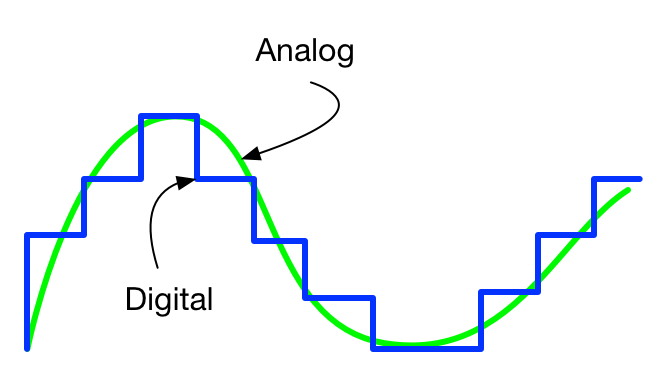
The analog signal which can take an infinite number of values is traditionally represented as a continuous and sinusoidal curve.
In contrast, the digital signal is discontinuous and limited to a number of predefined values at precise times. Therefore, it is represented schematically in the form of a histogram.
TRANSFER FROM ANALOGUE TO DIGITAL: DIGITIZATION
The transformation of the analog signal into a digital signal is called digitization.
It is actually a transformation of the vibration (analog signal) into a series of figures (digital signal), made thanks to an analog-digital converter (ADC: Analog Digital Converter).
Sampling and quantification.
ADC measures the analog signal strength at regular intervals and over an equal period of time – this is called sampling. Sampling frequency, expressed in kHz, represents the number of samples taken per day. Second.
These samples are stored in the memory of a computer and constitute an audio file which, in order to be heard by the human ear, must be converted to an analog signal: it is the role of DAC (analog digital converter).
Quantification or resolution is for each sample to measure an amplitude value.
This amplitude value is expressed in bits.
The act of converting the digital value of the amplitude into a binary value is called encoding.


