TRUTHS ABOUT ANALOGUE VS. DIGITAL: VINYL VS. CD


Free Download Mp4Gain
picture

Experts report on the topic of analog vs. Digital
Analog vs Digital

Which is better: the vinyl record or the CD, analog or digital? Generations of music lovers argue on this topic, but so do self-proclaimed experts. At this point, I’d like to let some real experts in your field speak up: sound engineers or sound engineers, people who deal with the subject on a daily basis. Here are some truths about record technology and how it really came about.

Analog vs digital audio

ABOUT DISCS, CDS AND RECORDINGS
First of all, a short note that the question asked at the beginning cannot be answered in this way. On the one hand, it has to be structured from a technical point of view, and on the other hand, it makes no sense to seriously compare two fundamentally different systems. However, there are approaches by many music lovers to compare the end results as a sound carrier.
In the end, I would like to return to the fact that there are many obstacles, most of which you have no idea. First, however, I will let the experts express their opinion, who know much more about the subject than the consumers. And in doing so, amazing aspects come to light that mainly illuminate the development of a vinyl recording, right from the beginning!

“The analog vs. digital discussion has been with me for many years, to be precise since 1982. That was when the CD was introduced. There was probably no sound engineer at the time who was not relieved that the CD arrived. Because in almost all technical respects, digital recording, assuming reasonable sampling accuracy, is clearly better.

Let’s take the signal-to-noise ratio: with the LP, you can consider yourself lucky to achieve 50 dB, with the CD – 80 dB. Or the wow and flutter: with the LP, it’s enough that the center hole is a bit too large (but still within the norm!), And a clear egg can be heard. With CD: neither measurable nor audible. Or take the channel separation: with the LP maybe 30 dB, with the CD 80 dB. And so. The exception may be the frequency response, the CD cuts hard at 20 kHz, the LP comes out “soft” and transmits perhaps up to 30 or 40 kHz, but much quieter.

The fact that many listeners and, meanwhile, many sound professionals, from musicians to sound engineers / technicians / teachers, turn to the LP again, has aesthetic and fundamental reasons, also philosophical. And there are many good ones. Digital is, for example, B. much more manipulable. Up to 100 cuts were found on an analog recording, mostly less, rarely more. 500 cuts are not uncommon on CD. Pitch correction, velocity change, sound manipulation, post-processing of individual tracks, synthetic spaces or even natural spaces, but artificially added, etc. etc.

It is also digitally interchangeable. An LP is unique, due to supposedly damaging technical weaknesses like creak, eggs, and noise. But what does technical weakness really mean in something like art? Isn’t it rather an advantage that not everything is so smooth and reproducible and that you have to fight hard to get a good result? The “clinical, sterile” sound of the CD is often criticized, it is not the weakness of the CD, but that of the LP, only that this incorruptibility also means lack of life.

Digital also means zack – track 17 and zack – track 9, while LP first means holding record in hand (haptic!), Admiring the cover / maybe running fingers over it, carefully removing record ( music is vulnerable and precious!), the hanging ceremony, taking your time and listening. In contrast, digital: next door, in the car, without emotions and without love.

Still, I find it difficult to say that one is better than the other. Like many others, I feel at home in both worlds. Digital can be intoxicating and addictive (if done right), analog too, just completely different. When it comes to my TACET label, we are pursuing a twofold approach: Producing with fervor and devotion to satisfy LP listeners. And equally fascinated and enthusiastic, working in a completely different way, suitable for digital sound carriers. “


Free Download Mp4Gain
picture


Mp4Gain Main Window
picture


Mp4Gain Features
picture


Free Download Mp4Gain
picture

Is analog recording better than digital?

During my training as a sound engineer, I read several times that in analog systems the sound wave, in the form of alternating current, is continuously recorded on the tape, something that does not happen in the digital environment where the sound wave is found. photographed thousands of times per second and reconstructed to some degree of approximation.

analog

“Tape recording is better from this point of view than digital recording”

Obviously I was not the only one to have taken this statement as true, since among technicians and musicians I hear it repeated often, but are we really sure that it is so? Could such outdated technology be better than the current one? Obviously not.

digital audio

From a technical point of view, analog recording suffers from a number of problems that introduce distortions and artifacts, so comparing the recorded sound with the source, the result is anything but faithful. Don’t you think so? Here are some issues that you may not have been told about analog recording.

–The flutter and the wow are oscillations that are generated during the route of the tape that, stretching between the heads, begins to vibrate like a guitar string, introducing micro-phasing and effects similar to tremolo;
–hysteresis. The metallic particles that cover the surface of the tape are quite slow and do not move from their rest state unless the magnetic field of the recording head is strong enough to polarize them. Therefore, sounds of weaker intensity are not correctly recorded, as well as high frequencies;
–maximum distortion. Transients are very fast, dynamic, and rich in high frequencies, qualities that tape cannot fully satisfy;
Background noise is an intrinsic feature of tape, to which we have tried to bypass filters with pre-emphasis and noise reduction circuitry, which in turn add more distortion;
deterioration of the material that occurs in each step and risk of self-cancellation of the material.

These aspects of analog recording, and they are just a few, are enough to make us understand that, even if we record continuously, our signal suffers many alterations.

Digital technology represents a clear improvement on many fronts, thanks to the low prices and the reliability of the instruments, capable of always guaranteeing the same performance without the need for constant maintenance.

With ever higher sample rates, 144 dB of dynamics (for 24-bit formats), and no background noise, digital audio recording allows you to truly capture sound in all its dynamic and tonal components.

–Yes, but digital is cold, analog is hot!

Seriously, the adjectives hot and cold are not appropriate terms to describe the characteristics of sound and are used incorrectly to express personal preferences and tastes.

What is generally understood by “warm sound” is the sensation of tonal enrichment that analog machines give to the audio signal in which there is less presence of high frequencies, while the adjective “cold” refers to a bare sound , raw, essential and seemingly unbalanced in favor of high frequencies.

If you want to improve the tone, it is better to use more appropriate terms, referring to digital as true copy and analog as artificial.

ANALOGUE VS DIGITAL SOUND: WHAT A DIFFERENCE?

The difference between digital and analog audio depends mainly on how the audio was recorded and stored.

Analog and Digital Audio

The analogue:

In keeping with a traditional recording technology, the analog sound experienced its golden age in the 1970s and was then attached to a magnetic tape or vinyl record. The audio signal is reproduced as faithfully as possible by copying the original audio waveform identically and continuously. As production costs are substantial, this recording model has gradually been abandoned in favor of digital.

Analogue Vs. Digital

digital:

The digital audio signal is in the form of a series of binary coded digital data, the basic language of modern computing: 0 and 1. As soon as a computer enters the audio production chain during recording or playback, the audio is digital. Sound is no longer obtained by copying the sound wave, but digitizing the sound, a process that allows the computer to decipher the sound in binary format. However, 0 and 1 do not allow you to reproduce the entire analog audio wave. To reproduce the sound, it will divide the sound wave into a series of small sound samples, each of sufficient quality separately, to artificially reproduce the sound wave.

The differences between analog and digital audio

Traditionally, we distinguish analog audio from digital audio. Before we get to the heart of the matter, it must be understood that the phenomena that surround us and which our ears perceive are all analogous.

Analog vs Digital

In a concert, for example, the sound produced by the artist’s instrument, the audience’s applause, or the spectator’s whisper is all analogous: they are continuous, that is, they give value to another without interruption and this continuously.

As soon as we want to reproduce these sounds using a recording, we have two solutions: either the signal is recorded continuously and analogously to the source, or we only record certain signal information in the Conversion of a list of predefined values. The first is said to be analog, the second is digital.

The dancer, the light and the strobe.

A good image that is often used to differentiate analog from digital audio is that of the dancer, the light and the strobe.

Imagine one dancer performing their choreography under a “normal” diffused light, and another performing the same dance but under a strobe light.

The first dance will no doubt be considered fluid and continuous, while the second is seen as uneven.

And the more you increase the speed of the strobe, the more you’ll be able to perceive the choreography fine. This is exactly what happens to digital audio: the higher the sample rate and resolution, the more faithful the audio reproduction will be.

SIGNAL PROCESSING

The analog signal varies continuously with time. Therefore, it consists of continuous variations in air pressure, and our ear, more precisely the eardrum, perceives these variations, which our brain in turn interprets as sound. How good is nature!

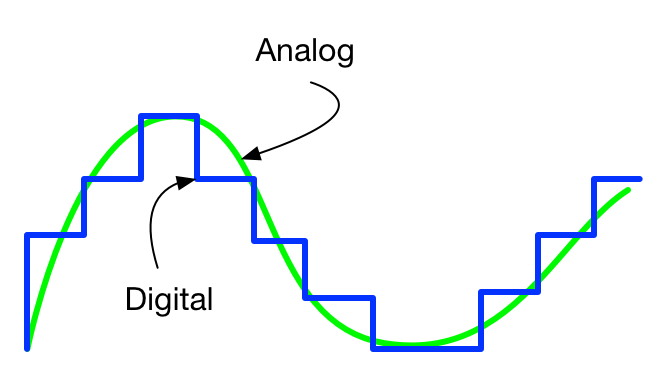
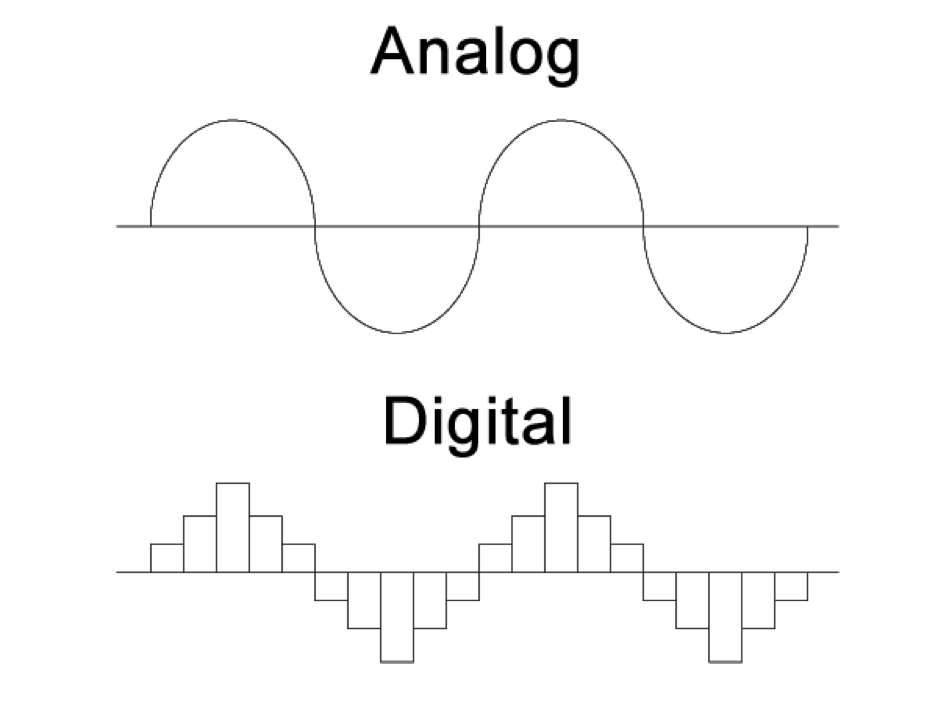
The analog signal which can take an infinite number of values ​​is traditionally represented as a continuous and sinusoidal curve.

In contrast, the digital signal is discontinuous and limited to a number of predefined values ​​at precise times. Therefore, it is represented schematically in the form of a histogram.

TRANSFER FROM ANALOGUE TO DIGITAL: DIGITIZATION

The transformation of the analog signal into a digital signal is called digitization.

It is actually a transformation of the vibration (analog signal) into a series of figures (digital signal), made thanks to an analog-digital converter (ADC: Analog Digital Converter).
Sampling and quantification.
ADC measures the analog signal strength at regular intervals and over an equal period of time – this is called sampling. Sampling frequency, expressed in kHz, represents the number of samples taken per day. Second.

These samples are stored in the memory of a computer and constitute an audio file which, in order to be heard by the human ear, must be converted to an analog signal: it is the role of DAC (analog digital converter).

Quantification or resolution is for each sample to measure an amplitude value.

This amplitude value is expressed in bits.

The act of converting the digital value of the amplitude into a binary value is called encoding.