
The essential
Analog and digital are two methods of transporting and storing data. (audio, photo, video …). Analog was born with the onset of electricity, while digital appeared more recently in the computer age.

The analogical principle is to reproduce the signal to be recorded (audio, video …) in a similar way in a medium (magnetic in general). For example, when recording an audio signal in an analog system, the signal present on the tape will follow the same amplitudes (“the same curve”) as the sound wave (with more or less fidelity): the characteristic pressure variations of a sound wave will result in variations of an electrical signal. Therefore, the electrical amplitude of the analog signal will be the more or less faithful image of the signal to be recorded (audio, video, etc.)
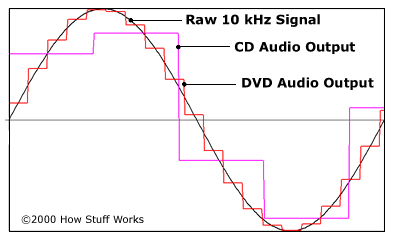
In digital, the analog signal to record becomes digital thanks to an analog> digital converter. After this conversion, the signal is just a sequence of “0” and “1”, that is, a signal with two amplitudes instead of infinity in analog.
Once in this form, the signal can be copied and transmitted losslessly because instead of transporting a signal whose amplitude should faithfully vary from the original, it carries a signal consisting of only two amplitudes (for example, 0 = 0 volts and 1 = 5 volts). So when a parasite disturbs an analog signal, digitally this parasite will have no effect: for example, a parasite that adds 0.2v disturbance will deteriorate an analog signal, while this same parasite on a digital signal will have no effect because 0v + / – 0.2v will always be considered = “0”.
Therefore, the digital signal is an analog signal made up of two possible levels (for example, “0” = 0v and “1” = 5v) and when the analog signal moves away from these two voltages, it does not matter because all the signals close of 0v will be considered = “0” and any signal close to 5v will be = “1” with a voltage threshold between the two resulting in exceptional immunity against parasites and exemplary ease of making perfect copies (clones) of this signal type.
After digital transport and storage, any signal (video or audio) must return to its original analog form. For example, an audio signal will be converted from digital to analog and then amplified; in fact, our ears cannot hear digitally! ! !
It should be noted that digital is only used (in the case of an audio or video signal) for the transport and storage of data.
2 / Analog VS Digital and data compression.
So we have just seen that digital is not a commercial device, it is the support of all new technologies, but should we consider that digital is definitely better than analog?
I would try to answer yes, but it is necessary to moderate this judgment and that for two reasons: compression and sampling.
* / Digital compression:
Converting a signal to digital is not without problems: the bandwidth occupied by a signal once digitized is greater than its analog equivalent. When dealing with very bulky data, such as video, the processing is very cumbersome; Therefore, it is necessary to use a compression algorithm intended to reduce the amount of information by reducing the quality of the signal. All of the compressions used for video or audio rely on human perception to make this drop in quality little or not noticeable to humans. But the problem is that we often tend to want to compress the signal too much and the degradation becomes noticeable (case of GSM phones, MP3 <128kbit / s, mpeg-1 videos …)
For example, a high-quality audio signal recorded on a high-end cassette deck (analog) will be of better quality than a 112kbit / s mp3, because a large amount of information has been suppressed at 112kbit / s to satisfy the 112kbit / s imposed bit rate.
On the other hand, in an analogous way, the concept of copy generation intervenes: one copy will be less good than the original, one copy of the copy will lose a little more … After 10 or 20 copies of copies, the signal is totally deteriorated and cannot be used. In digital, a copy is often a clone of the original, so in theory you can make countless copies that are strictly the same quality as the original. I am talking about theory because errors can occur during a digital copy, often due to the state of the media. This is the case when copying an audio CD digitally (from your CD-ROM drive to your hard drive, for example): when a scratch or failure occurs, the information will not be copied and will be replaced by the correction system errors due to “extrapolated” data make this defect go unnoticed; In this case, the digital copy will no longer be identical to the original.


