Music stored on vinyl is making a big comeback. The question of whether CDs, files, or music saved on vinyl sound “better” divides music fans. Sometimes the feeling arises that the toughest commentary battles on the web take place not between political camps, but between listeners of analog and digital music.
It’s a shame, because almost everyone involved in these battles, which were fought with incredible vehemence, are united by their love of music. They belong to the minority of those who spend a lot of money on music, regardless of the medium they prefer. This battle is completely unnecessary and is mainly based on a misunderstanding or two different interpretations of what “good sound” means.
“Good sound”: one expression, two meanings
Some say that something “sounds good” when the sound suits them. That is the musician’s point of view. A good example of this is the sound of a distorted electric guitar, a constituent element of rock music. It originated from the fact that a guitar amp was so loud that the actual sound of the guitar was destroyed beyond recognition by the overdriven amp. The result no longer sounds like a guitar, but the sound has been and continues to be liked by millions of people because it just “sounds good.”
Distorted but pleasing to the ears: the sound of a classic rock guitar.
Others use the term “good sound” as a synonym for “high fidelity,” meaning the most realistic reproduction of what the sound engineer heard when mixing a recording in the studio. This is what we call “high fidelity”.
By this definition, “good sound” means, at best, that the playback chain does not sound at all and that the sound changes as little as possible on its way from recording to playback. It’s called “High Fidelity”, not “Perfect Fidelity” because there can only be an approximation of the original sound.
And it is precisely this point that is the axis of the whole discussion. Logs were never a particularly good medium for hi-fi, but for decades they were the best medium that end users had access to. Until the CD arrived.
In terms of measurement technology, the record falls short
If one compares the CD and the disc under the criteria of “high fidelity”, the disc not only drops the straw, but is completely outperformed by the CD in terms of all the relevant criteria. Here are some examples.
Dynamic is the difference between the softest and loudest sound of a piece of music. While all digital media, including MP3, easily go up to 90 dB and can therefore even map the dynamic range of a large symphony orchestra, in practice the record barely achieves more than 40 dB. Enough for pop music, but even a well-received little jazz band like the one in our sound sample becomes a problem for the record. In quiet places, typical vinyl noise would be clearly audible.
Speaking of background noise: Typical vinyl noise, low-frequency rumble, and creaking caused by dust grains in the groove are also noticeable because they occur unevenly. The noise from a compact cassette is more constant, so the brain can filter it better. Digital recordings are virtually noise-free.
To present the purest music possible, all frequencies in the audible spectrum between 20 Hz and 20 kilohertz should be played at the same volume. With digital media, the frequency responses appear to have been drawn with a ruler. As a general rule of thumb, registers can linearly reproduce frequencies up to a maximum of 12 kilohertz and this only applies to the outermost slots at the beginning of a page. Due to the slowing down of the path speed towards the end of the groove, the highest transmission frequency drops more and more during the playing time of a disc, which, by the way, can be heard clearly. For the lower end of the spectrum, the deeper and louder the bass, the more space it needs in the groove, shortening the possible playing time. With LPs, you always have to find a compromise between bass level and playing time.
An important measure of the fidelity of a reproduction medium to sound is the distortion that is added to actual music. Especially in the low range, the register reaches values that significantly change the original signal.
In principle, a pick-up system works like a microphone. Converts mechanical energy into electrical energy. This mechanical energy comes not only from the grooves of the record, but also from the sound of the speakers. The louder you listen to the music from the turntable, the more feedback you will hear. And feedback blurs impulses in music, like the sound of drums. At home with moderate volume it is more likely to be neglected, at a club not.
Thanks to these (and a few other) technical shortcomings, the record doesn’t even meet the requirements of the traditional DIN No. 45500 standard on all points, which has defined the official hi-fi standard since the 1960s.
Don’t die: rumors about digital technology
On the contrary, rumors and false statements about digital technology are still circulating, for which the problems of the beginnings of the compact disc and the blatant misunderstandings about how digitization works are responsible.
Over and over again you can read that digital technology covers a smaller frequency range than analog. That’s actually true in theory, because CDs, for example, are limited to the range between 20 Hertz and 20 Kilohertz with filters.
However, on the one hand this is exactly the range that our hearing can cover in principle, and on the other hand it is pure theory that analog technology can represent a higher frequency range. In practice, for example, the cutting tools with which music is scraped into the matrices that vinyl is made of, heat up very quickly to high frequencies with a high level and thus limit the frequency response upward.
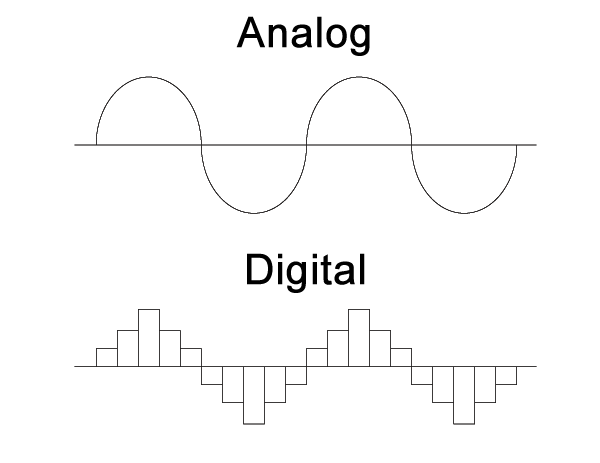
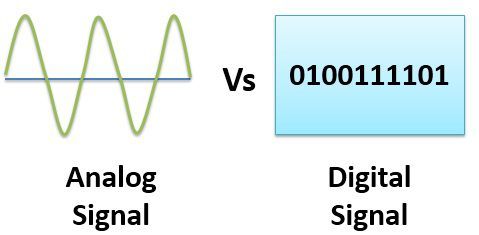
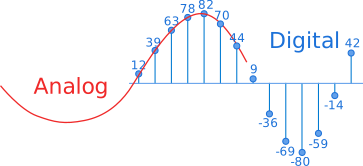
Friends of analog music storage like to deny digital technology the ability to display music correctly and that’s because of the discrete sampling. The waves that make up sounds are continuous events, whereas computers know only discrete states. The popular misunderstanding is that you can never fully capture the airwaves. After digitization, the waveforms would no longer be round, but staggered. But that is not right. The Niyquist-Shannon sampling theorem clearly states that the original signal can be restored exactly and not just roughly.
If all these facts are true and the record is so hopelessly inferior to the CD, why do so many people claim that the record “sounds better”?