
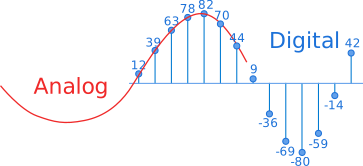
When we talk about the Internet and the current technological “machines” (mobile phone, camera, tablet, computer) we always speak of “digital” and, sometimes, we contrast this term with “analog”. But what exactly these words mean and what they refer to, many times we ignore, perhaps also because it is not relevant for us and is based on being able to use “digital” for what we need without investigating it so much.
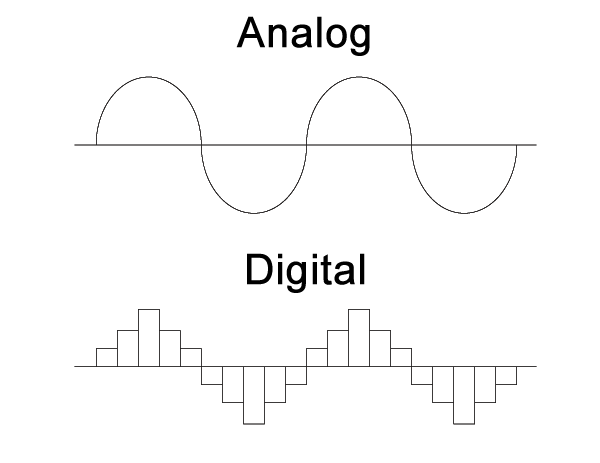
“Analog” and “digital” are terms that are constantly encountered when talking about technologies (old and new). In common sense, “analog” is associated with a meaning of “old” or “past” or “low quality”; “Digital”, on the other hand, is synonymous with “new” or “innovative” or “quality”. This common sense distinction is not true.
One thing to keep in mind when addressing these issues is that the definitions of the two terms are one thing (what do they mean, where do they come from, …) and the operational implications they have (because we use one and not the other, as the consequences, implications, results …). As if to say, one thing is the universal law of gravity (with which the sun also has to do) and another is to stay in the sun to warm up and tan.
Another thing to keep in mind is that everything that is under the Digital / Analog issue is not something of our days, its essence was not born with the advent of “new” technologies; here it is one of the oldest problems in human thought and refers to philosophical disquisitions and to the issue of “continuous” and “discrete” variables. But we won’t dwell on these.
As for the definitions. ..
First of all, we must bear in mind that when we talk about Analogue and Digital we refer to ways of representing the measure of a quantity (they are “attributes of a quantity”), to ways in which the quantities we are considering vary (such as a audio signal, a video signal, color,….).
Analogous thing is a continuously varying quantity: an analog variable can take an infinite number of values (for example, the distance between two points in space can take an infinite number of values).
Digital is a quantity that varies “step by step”: a digital variable can take only a finite number of values (the duration of a day; for example, it can take only one of the 85,000 values if we use the “second” unit, a of the 850 thousand values if we use tenths of a second or one of the 8 million and 500 thousand if we use hundredths of a second; many possibilities but still finite, determined).
We can deduce that the concept of analog can be associated with a condition of continuity, that is, in a probable path something moves by changing its location through infinite positions and defining them as infinite we exclude the possibility of being able to number them.
With digital instead, the same path would be divided into stages (steps) and even if it is very small and numerous, it would always be possible to determine the amount.
Practice
Let us now turn to the practical implications of these two ways of representing physical quantities.
Until recently, all the data with which they organized audio or video recordings, static images, data transmissions such as radio, television, telephone were organized in the form of analog signals because the instruments that detected them “. The surfaces” on which they were recorded and the channels through which they were transported were mechanical and made specifically for that type of signal, in fact, they were the same as that signal.
Let’s think about color: the colors we see in a landscape are nothing more than a well-organized set of blue, red and green lights in their infinite shades; its representation through a photograph is based on the combination of blue, red and green pigments (therefore physical objects). We can say that the representation of a landscape through a photographic print is an analog representation of reality.
With the arrival of electronics (which has to do with physical quantities transformed and processed into electrical signals), physical quantities begin to be represented through electrical signals. Initially, these electrical signals were of the analog type (electronics that use continuous signals, signals that can assume an infinite range of possible values, that is, analog signals); later and a special type of signal has been used that can assume only some values among the infinitely possible, in fact it can only assume two values: the presence or absence of the signal. If we look at the basic level of any computer application we will realize that we have a very long series of numbers “one” and “zero” where “one” is the presence of the signal and “zero” its absence.
This is “digital” electronics; digital because it uses signals that are not continuous but “in jumps”.

