Digital Audio Processing


Free Download Mp4Gain
picture

Digital Audio Processing
Digital Audio Processing

Digital Audio Processing

Digital Audio Processing

In the world of audio technology, Digital Audio Processing stands as a fundamental pillar, shaping the way we interact with sound. From music production to telecommunications, this versatile field plays a crucial role in delivering high-quality audio experiences to users worldwide. In this article, we delve into the depths of Digital Audio Processing, exploring its principles, applications, and the innovative technologies driving its evolution.

The Fundamentals of Digital Audio Processing

Digital Audio Processing, in its essence, revolves around transforming analog audio signals into digital data, enabling efficient storage, manipulation, and transmission. It involves the use of mathematical algorithms to convert continuous audio waveforms into discrete digital samples. These samples can then be processed and restored back to analog signals at the receiving end, providing a seamless auditory experience.

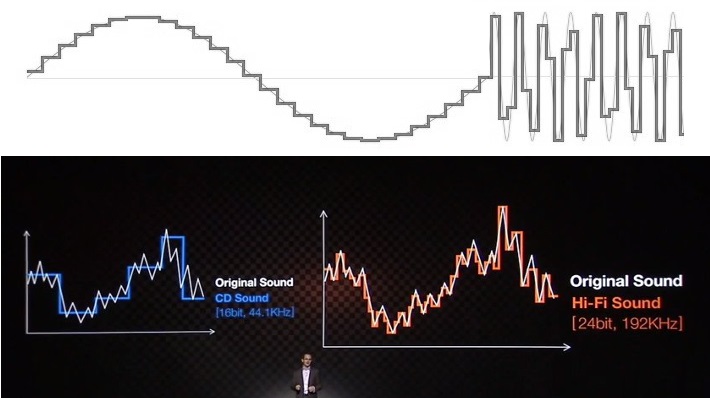
One of the essential concepts in Digital Audio Processing is the sampling rate, which determines the number of samples taken per second to represent the analog signal accurately. A higher sampling rate results in more precise audio reproduction but demands increased data storage and processing capabilities. Conversely, lower sampling rates may lead to a loss of audio fidelity.

“The science of Digital Audio Processing brings music to life, capturing its essence in a string of zeros and ones.” – Sound Engineering: A Journey into the World of Sound

Applications in Music Production

When it comes to the creation and production of music, Digital Audio Processing has revolutionized the entire landscape. In modern recording studios, analog audio equipment has largely been replaced by digital audio workstations (DAWs), allowing musicians and producers to manipulate sound with unprecedented flexibility.

Through the use of Digital Signal Processing (DSP) algorithms, artists can apply various effects, such as reverb, delay, and equalization, to their recordings. Additionally, pitch correction and time-stretching tools have become commonplace, helping achieve flawless performances. This digital revolution has democratized music production, empowering artists to bring their creative visions to life without the need for extravagant studio setups.

“In the digital realm, the possibilities are endless. Every musician now has the power to be a producer, engineer, and composer rolled into one.” – The Digital Audio Handbook

Enhancing Communication with Digital Audio Processing

Beyond music, Digital Audio Processing plays a critical role in enhancing communication across various industries. Telecommunications heavily rely on efficient audio processing techniques to ensure clear voice calls and seamless video conferences. Noise reduction algorithms help eliminate background disturbances, while echo cancellation ensures smooth and echo-free conversations.

Moreover, voice recognition systems, powered by advanced Digital Audio Processing, have become integral to virtual assistants and smart devices. These systems employ techniques like speech-to-text conversion and natural language processing to interpret and respond to user commands accurately. As a result, the way we interact with technology has evolved, making it more intuitive and user-friendly.

“The future of communication lies in harnessing the power of Digital Audio Processing, enabling crystal-clear connections across the globe.” – The Communication Revolution

Advancements and Future Prospects

As technology continues to advance, Digital Audio Processing is poised for further breakthroughs. With the rise of artificial intelligence and machine learning, audio processing algorithms can now adapt and learn from data, leading to even more precise and personalized audio experiences. The integration of 5G networks will enable real-time audio processing, opening up new possibilities for interactive applications.

Moreover, the evolution of virtual reality and augmented reality technologies demands sophisticated audio processing techniques to create immersive soundscapes that complement the visual experience. As we venture deeper into the digital age, Digital Audio Processing will undoubtedly remain at the forefront, shaping the way we perceive and interact with sound in our daily lives.

“Innovation knows no bounds, and the future of Digital Audio Processing promises to unlock a world of sonic wonders yet to be explored.” – The Audio Frontier

Final Words

From the early days of audio digitization to the cutting-edge technologies of today, Digital Audio Processing has consistently pushed the boundaries of what is possible in the world of sound. Its impact spans from music production to telecommunications, revolutionizing the way we experience audio. As we embark on a journey of continued innovation, the future of Digital Audio Processing holds exciting prospects for audio enthusiasts and technology aficionados alike.


Free Download Mp4Gain
picture


Mp4Gain Main Window
picture


Mp4Gain Features
picture


Free Download Mp4Gain
picture

Formats: what is digital sound Part 3

Formats: what is digital sound Part 3

digital sound

JointStereo, which is one of the features of MP3, means that instead of encoding stereo as two independent channels, it encodes calls. center channel and the difference from the original stereo channels.

DIGITAL SOUND

Many audio components on stereo channels are the same, and encoding them on the common channel allows you to free up additional bandwidth for more detailed encoding of the difference, leading to improved quality.

Be sure to mention the variable bit rate or VBR. This means that the encoder changes the compression ratio on the fly, depending on the nature of the sound. This approach results in a smaller total file size or, if quality requirements increase, the same file size may produce better sound.

MP3 Pro

Introduced in 2001, the MP3 Pro codec was developed by Coding Technologies in association with Thomson Multimedia. It is MP3-based and as a result turned out to be fully MP3 backward compatible and only partially forward compatible. It uses SBR (Spectral Band Replication) technology, so the codec provides good quality at low bit rates. However, the encoding quality at medium to high bit rates is inferior to almost all other codecs. As a result, MP3 Pro is used more for streaming on the Internet and demonstrating snippets of new musical compositions.

WMA

The WMA codec, or Microsoft Windows Media Audio, is a serious alternative to MP3. Files in this format have the extensions .WMA and .ASF, have a clear advantage over MP3 at low data rates (bitrates) and lose it when the data feed rate to the codec is increased.

Based on WMA, the WMA DRM standard has been developed to provide copy protection so appreciated by record companies. Files based on this format can be recorded on playback devices such as MP3 flash players, but cannot be copied from there.

ATTRAC

ATRAC (Adaptive TRansform Acoustic Coding) is based on a stereo audio format with 16-bit quantization and a sample rate of 44.1 kHz. When compressed, each frame is divided into 52 frequency bands, resulting in a transmission rate of 292 kbps (1: 5 compression). Used in MiniDisk system.

Ogg Vorbis

The Ogg Vorbis format is a relatively new universal lossy audio recording format. It belongs to the same type of audio compression formats as MP3 and WMA, and the psychoacoustic model that describes the characteristics of the human ear, according to which compression is performed, is similar in principle to MP3. The radical difference of this format was the mathematical processing and the practical implementation of this model. In this format, the maximum threshold sample rate is not 44 kHz as in MP3, but 48, which theoretically improves the sound quality. It should also be noted that the theoretical number of channels is not limited to two, as usual, but reaches 255. Files encoded in this format are smaller than the same MP3 files. The spread of the format was slowed by insufficient support from hardware manufacturers.

Formats: what is digital sound Part 2

Formats: what is digital sound Part 2

Digital Sound

Historically, digital sound was undoubtedly the initiative of company engineers who adopted Philips-developed Audio-CDs, also called CDDA – Compact Disk Digital Audio.

DIGITAL SOUND

As a result, digital audio media led to a massive transition in recording studios to digital DAT tape recorders and digital editing equipment with S / PDIF and other interfaces. And then digital sound began to penetrate deeper into our lives from CD players, and as it was transmitted via S / PDIF, it became digital switches, equalizers, and noise reduction systems. Today this series ends with Dolby Digital surround sound processors.

Who needs it

CDDA’s sound quality is satisfactory for most end users, ie listeners, but the amount of data required to present sound in this way is critical. As a result, several compressed digital audio formats appear, one of which is the old MS ADPCM, and among which are quite acceptable Sony ATRAC, PASC or Fraunhoffer MP3. Each of the encoding methods has an important characteristic – the bit rate, with which the compressed information enters the decoder when the audio signal is restored.

For example, when you talk on a cell phone, the sound of your voices is digitally converted and compressed, degrading its performance. Various algorithms compress speech hundreds of times, preserving the basic characteristics.

Let’s move on to specific audio file formats and audio compression formats. The most common format today is, of course, MP3. However, historically, to understand the evolution of sound formats, it is necessary to start with a different type of file, with the extension .WAV.

Variety of formats

Wav

It is the primary format for many, many digital audio playback systems and is used as a standard audio file format on personal computers. In addition, it has a strong set of specifications, which has grown considerably lately. Its full name is Microsoft RIFF / WAVE – Resource Interchange File Format / Wave – Resource Interchange File Format / Waveform, and it was created by Microsoft and Intel engineers. In turn, WAV is short for Waveform Audio File Format.

Apple AIFF

This type of file is standard for Apple Macintosh systems and sound processing systems based on it. Apple AIFF stands for Audio Interchange File Format: an audio interchange file format, it is somewhat similar to WAV. Its peculiarity is that it allows additional information to be placed next to the sound wave, in particular WaveTable samples (examples of the instrument sound together with synthesizer parameters), which improves the quality of the final result. Although today Apple computers are capable of playing files in almost any format, including MP3.

RAW

Yes, this is not just the image format in which some digital cameras take pictures. In fact, RAW is the call. “Pure Digitization”, which does not contain a title and only contains a sequence of samples of a sound wave. Typically, the scan is stored in 16-bit format.

MP3

The most popular compression format today is MP3. The MP3 (MPEG Layer 3) format was developed, after several intermediate formats, by the Fraunhofer Institute in Germany. Actually, the .MP3 format is based on fooling the human ear. After some research, it turned out that human hearing tends to adapt to the appearance of new sounds, which is expressed in an increase in the hearing threshold. Therefore, some sounds are capable of masking (that is, making them subjectively inaudible) others. So in this format, some of the sounds that, according to the corresponding theory, are made inaudible, are simply removed from the general sound. The resulting “semi-finished product” is then encoded using the Hoffman method. Be sure to note that in MP3 format, programs that compress the sound of the original are not standardized, that is, each competent programmer can implement their own compression scheme. And only decoders meet the standards, which leads to the fact that the quality of MP3 playback does not always depend on the player that plays this file. Due to the different skills and predilections of implementers of various encoders, some of them are better at handling symphonic music, some with rock and metal, some with rap and rave, etc.

Formats: what is digital sound

Formats: what is digital sound

Digital Sound

Sound plays an increasingly important role in the modern world, having long since separated itself from the close link with the image that emerged during the heyday of television and cinema.

digital sound

Modern multimedia equipment has the widest possibilities not only for playback, but even for changing the sound. It is no longer a dead record, a static reproduction of events from the past, firmly imprinted on its medium. The most important role in transforming our ideas about sound was played by the development of a digital method of recording sound, turning it into a data stream that can be easily and naturally operated with modern devices.

The basics of “numbers”

Each of the multimedia devices on sale today, be it a CD player, a voice recorder or a flash memory player, uses many different types of presentation of data streams, which are then converted into sound. And even more sound formats used for professional purposes have been invented. An inexperienced buyer is forced to gather information about designations on boxes and devices from a variety of sources, often receiving incorrect information or even more confusion.

Almost all devices in the “Portable Audio” section of the ZOOM.CNews.ru catalog support multiple sound formats at the same time, and many devices that do not belong in this category are also tagged with support for playing sound files. To help our reader, we decided to create a short glossary of abbreviations and talk about the most common formats. We plan to leave it open for updates and modifications, adding new formats and describing in more detail the advantages and disadvantages of the already common or forgotten ones.

A little theory

To begin with, remember that digital sound is nothing more than a collection of numbers. The determining factor is the system by which sound as air pressure is converted into data streams and encoded for further processing and reproduction. Consequently, digital sound is usually included in computer files with various extensions, which more often (but not always) can determine their format. And the same concept of format can have, paradoxically, two meanings. First, the format may exist as a general characteristic that includes both the type and the physical characteristics of the medium (disk or cassette), the method of recording, the principles of encoding, and protection against errors. Second, the format can only be understood as the method of audio encoding and compression, as standard means are used for transfer, for example,

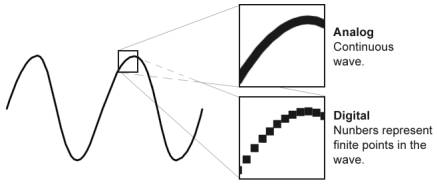
Analog sound, unlike digital, is reproduced on analog devices and has a number of significant differences. While not a data stream, analog audio is represented as a continuous electrical signal that represents a change in the sound wave. To translate it into digital format, the sound is “digitized”, that is, it is divided into certain segments, in which the numerical value of the amplitude is fixed at that moment. We will not delve into the principles of digital sound creation, but it is absolutely necessary to note that the more often a sound segment is divided and its characteristics described, the clearer and more complete the sound image itself is created.

This process generates a large amount of data that describes the sound, and it is clear that each digital audio format is nothing more than a compromise between the need to present the sound as loudly as possible and the memory limitations of a computer or device. Of reproduction.

A little more theory. In most cases, the human ear perceives sound with a frequency no higher than 22,000 Hz and, to describe it fully in digital form, a sampling frequency of at least 44.1 kHz is required. Since it is absolutely impossible to determine the value of the signal at any given moment, during digitization quantization occurs, that is, the replacement of the actual values ​​of the signal by approximate values. The more levels of audio quantization, the more accurately the signal level is described. As a result, each standard CD carries an audio signal with a sampling frequency of the same 44.1 kHz and a 16-bit quantization level, and in some devices, sampling is done at 48 kHz.

The benefits of digital audio

And now, briefly on why this algorithm was developed. Digital sound has enormous advantages over analog, although we must not forget its certain disadvantages. The main value of digital sound is the possibility of infinitely long storage and playback

Digital sound

Digital sound

Digital Sound

Unlike the analog signal, the digital signal does not simulate acoustic sound.


Digital Sound

Digital sound assigns digital values ​​to individual points in time that reflect the height of the amplitude at a given point. The second difference between digital and analog audio is that digital audio is discrete.

As you know, digital information is stored in bytes, each of which consists of 8 bits. A bit is the smallest unit of digital information that can take only two values: zero or one.

So how do you convert a continuous analog signal into a sequence of zeros and ones, and even link this information correctly to the timeline? Converting audio to digital format is divided into two operations: sampling and quantizing. Sampling – sampling and quantization time – amplitude. It is these operations that your audio interface performs.

Any audio interface has an ADC (analog-to-digital converter) and a DAC (digital-to-analog converter). Let’s consider how audio recording works when used to record a microphone and a computer with an audio interface attached.

When you speak, your voice creates fluctuations in air pressure, which the microphone picks up and translates into an alternating voltage electrical signal. The received electrical signal is very weak, so it is amplified and then sent to the audio interface for digital conversion. Based on its internal clock, the ADC divides time into many different points. Time sampling occurs according to the set frequency, which indicates how many dots will be divided by 1 second of sound. At each received time point, the ADC measures the voltage of the input signal and assigns the corresponding digit to the amplitude value. The data obtained as a result of this conversion can be saved on a computer.

Digital sound

When you start playing the audio file, the reverse process will start. The digital information will be sent from the computer to your audio interface. Your DAC will provide a reverse conversion of the received information into a continuous electrical signal with alternating voltage. The signal will then be amplified and reproduced through your speaker system.

So what is the sample rate to get digital sound that can then be converted back to analog? According to Kotelnikov’s theorem, each band-limited signal can be sampled and then recovered in digital form, as long as the sample rate is at least twice the highest frequency of the original signal.

This means that our signal must have a maximum frequency that will never be exceeded. When we set the highest frequency, all that remains is to multiply it by two and get the desired sample rate. Also, according to the theorem, all frequencies above half the sample rate must be removed from the input signal.

Since a person hears sounds from 20 Hz to 20 kHz, a sample rate of 40 kHz should be adequate to encode any sound audible to a person. With a small margin for the filter, which is calculated before converting to digital format, in the CD audio standard, sounds above 22,050 Hz are cut off and the sample rate is 44,100 Hz.

Now let’s see exactly what numbers the ADC assigns to the amplitude values ​​when converting an analog signal.

The computer can assign a finite number of values ​​to the amplitude. As mentioned above, any information in a computer is a sequence of bits, each of which takes on values ​​of zero or one.

A numeric expression of n bits assumes 2 n different variants of values, that is, 2 n different variants of sequences of zeros and ones. The table shows the sequence options for n = 2,3,4.

About digital sound. Digital sound

About digital sound. Digital sound

digital sound

Recently, the capabilities of multimedia equipment have grown significantly, but for some reason this area has not received enough attention.

Digital sound

The average user suffers from a lack of information and is forced to learn only from his own experience and mistakes. With this article we will try to eliminate this annoying misunderstanding. This article is aimed at a common user and aims to help you understand the theoretical and practical foundations of digital sound, to identify the basic possibilities and techniques of its use.

What exactly do we know about the sound capabilities of a computer, other than the fact that our home computer has a sound card and two speakers? Unfortunately, probably due to insufficient literature or for some other reason, but the user, in most cases, is unfamiliar with anything other than the built-in Windows audio input / output mixer and recorder. The only use of a sound card that a common user finds is to play sound in games and listen to a collection of audio. And after all, even the simplest sound card installed in almost every computer can do much more: it opens up wide opportunities for everyone who loves and is interested in music and sound, and for those who want to create your own music, a sound card. it can become an omnipotent tool. To find out what the computer can do in the field of sound, you just need to take an interest, and you will be presented with opportunities that, perhaps, you did not even know about. And all this is not as difficult as it might seem at first glance.

Some facts and concepts that are difficult to do without:

According to the theory of the Fourier mathematician, a sound wave can be represented as a spectrum of frequencies included in it.

About digital audio (digital audio)

The frequency components of the spectrum are sinusoidal oscillations (so-called pure tones), each of which has its own amplitude and frequency. Therefore, any vibration, even the most complex shape (for example, a human voice), can be represented as the sum of the simplest sinusoidal vibrations of certain frequencies and amplitudes. And vice versa, generating different vibrations and superimposing them on each other (mixing, mixing), you can get different sounds.

Note: The hearing aid / human brain is capable of distinguishing between frequency components of 20 Hz and ~ 20 kHz (upper limit may vary based on age and other factors). Also, the lower limit fluctuates a lot depending on the intensity of the sound.

Digitization of sound and its storage on a digital carrier

“Normal” analog sound is represented on analog equipment by a continuous electrical signal. The computer operates with data in digital form. This means that the sound on the computer is also represented in digital form. How does the analog to digital conversion work?

Digital sound is a way of representing an electrical signal using discrete numerical values ​​of its amplitude. Let’s say we have a good quality analog audio track (by saying “good quality” we will assume a silent recording that contains spectral components from the entire audible frequency range, roughly 20 Hz to 20 KHz) and we want to “feed” it into a computer. (that is, digitize) without loss of quality. How to achieve it and how does digitization occur? A sound wave is a kind of complex function, the dependence of the amplitude of a sound wave on time. It would seem that since it is a function, you can write it to a computer “as is,” that is, describe the mathematical form of the function and store it in the computer’s memory. However, this is practically impossible, since sound vibrations cannot be represented by an analytical formula (like y = x2, for example). There is only one way left: to describe the function by storing its discrete values ​​at certain points. In other words, at each moment you can measure the value of the amplitude of the signal and write it down as numbers. However, this method also has its drawbacks, as we cannot record the amplitude values ​​of the signal with infinite precision and we have to round them.

ADVANTAGES AND DISADVANTAGES OF DIGITAL SOUND

ADVANTAGES AND DISADVANTAGES OF DIGITAL SOUND

DIGITAL SOUND

Digital sound opens up truly endless possibilities. If the previous radio and sound studios were located on several tens of square meters, they can now be replaced by a good computer, which, in terms of capabilities, exceeds ten of those studios combined, and at a cost many times cheaper than one.

Digital sound

This removes many financial barriers and makes sound recording more accessible to both the professional and the amateur. Modern software lets you do what you want with sound. Previously, various sound effects were achieved with the help of ingenious devices that did not always live up to technical thinking or were simply handcrafted devices. Today, the most complex and hitherto unimaginable effects are achieved by pressing a couple of buttons. Of course,

From the point of view of an ordinary user, there are many benefits: the compactness of modern storage media allows you to transfer all disks and records to a digital representation and store them for many years on a small three-inch hard disk or a dozen or two CDs; you can use special software and thoroughly “clean” old records from reels and discs, removing noise and crackle from their sound; You can also not only correct the sound, but also beautify it, add richness, volume, restore frequencies. The Internet also comes to the rescue of the audio hobbyist: the network allows people to share music, listen to hundreds of thousands of different Internet radio stations and show their sonic creativity to the public, all that is needed is a computer and the Internet.

Of course, digital technology also has its drawbacks. Many people noticed that the analog sound was heard with more life. And this is not just a tribute to the past: the digitization process introduces a certain error in the sound, in addition, various digital amplifiers introduce the so-called “transistor noise” and other specific distortions. There is no precise definition of the term “transistor noise”, but we can say that they are chaotic oscillations in the high frequency region. Although the human hearing aid is capable of perceiving frequencies up to 20 kHz, it appears that the human brain picks up higher frequencies. And it is on a subconscious level that a person still feels analog sound cleaner than digital.

“Normal” analog sound is represented on analog equipment as a continuous electrical signal. The computer operates with data in digital form. This means that the sound on the computer is also represented in digital form.

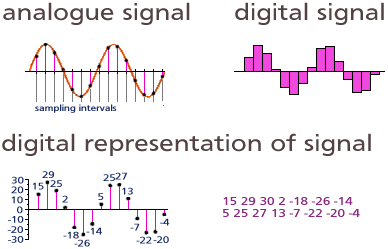
Digital sound is a way of representing an electrical signal by means of discrete numerical values ​​of its amplitude; Signal digitization involves two processes: a sampling process (sampling) and a quantization process. The sampling process is the process of obtaining the values ​​of the converted signal values ​​at specific intervals. Digitization is fixing the amplitude of the signal at regular intervals and recording the amplitude values ​​obtained in the form of rounded digital values ​​(since the amplitude values ​​are continuous, it is not possible to record the exact value of the amplitude of the signal to a finite number, so we resort to rounding). The recorded signal amplitude values ​​are called samples. Obviously, the more often we take amplitude measurements (the higher the sampling frequency) and the less we round the obtained values ​​(more quantization levels), the more accurate the digital representation of the signal that we will obtain will be. The digitized signal can be saved as a set of successive amplitude values.

Quantization is the process of replacing the actual values ​​of the signal with approximate values ​​with some precision.

Sound processing should be understood as various transformations of sound information to change some characteristics of sound. Sound processing includes methods for creating various sound effects, filtering, as well as methods for cleaning the sound of unwanted noise, changing the timbre, etc. This whole huge set of transformations ultimately boils down to the following basic types:

1. Amplitude transformations. They are carried out on the amplitude of the signal and lead to its amplification / attenuation or change according to some law in certain parts of the signal;

2. Frequency conversions. They are performed on the frequency components of sound: the signal is presented in the form of a frequency spectrum at regular intervals, the necessary frequency components are processed, for example, filtering and inverse “folding” of the signal from the spectrum to the wave;

Digital sound encoding

Digital sound encoding

Digital audio

The development of methods for encoding audio information as well as moving images (animation and video recordings) occurred with a delay relative to the types of information discussed above.

Digital Audio

A computer is a digital device, that is, an electronic device in which a discrete signal is the operating signal. Today’s computers operate on discrete signals that carry binary values, conventionally designated as “yes” and “no” (at the electrical level: 0 volts and V volts, for some non-zero value of V). With a one-step binary signal, you can transfer information about one of two positions: 0 (“yes”) or 1 (“no”). Using N binary signals in one step, you can transfer information about one of 2 N positions (2 N is the number of combinations of zeros and ones for N signals). The interaction of all the blocks that make up a computer occurs through the exchange and processing of one or more binary signals simultaneously. They are all control codes as well as the information that is processed itself, everything is represented on the computer in the form of numbers. For this reason, audio signals in digital equipment are also represented as numbers.

So how can you describe an analog audio signal in digital form? A real audio signal is a complex waveform, a certain complex dependence of the amplitude of a sound wave in time. In Fig. 2 shows a graph of a real sound wave.

For computer processing, an analog signal must somehow be converted to a sequence of binary numbers. Let’s proceed as follows. We will measure the voltage at regular intervals and write the obtained values ​​into the computer memory. This process is called sampling (or digitization).

Converting an analog audio signal to digital is called analog-to-digital conversion or digitizing. The process of this transformation consists of:

carry out measurements of the amplitude of an analog signal with a certain time interval: sampling,

subsequent recording of the amplitude values ​​obtained in numerical form – quantification.

The time sampling process is the process of obtaining the instantaneous values ​​of an analog signal converted into a specific time step, called a sampling step.

The higher the sample rate (that is, the number of samples per second) and the more digits assigned to each sample, the more accurately the sound will be represented. But this also increases the size of the sound file. Therefore, depending on the nature of the sound, the requirements for its quality and the amount of memory occupied, some compromise values ​​are chosen.

The number of signal measurements taken in one second is called the sample rate or sample rate, or sample rate (from English “sampling”). Obviously, the smaller the sampling step, the higher the sampling frequency (that is, more often amplitude values) and therefore the more accurate representation of the signal we get.

The human ear does not notice the gradation of the received signal. Here the following analogy can be drawn. Each person watched movies in the cinema and before their eyes on the screen there was a continuous and fluid action: but, in fact, a filmstrip is a series of still and discrete images that move at a high speed of 24 frames per second . Since human eyes are characterized by a certain inertia, they are easy to fool, which the filmmakers use extremely cleverly. Our ears are also somewhat imperfect and can be tricked in this way, representing a continuous analog signal as a sequence of rapidly changing instantaneous voltage values. But unlike a film strip, changing the “sound frame” happens thousands of times faster.

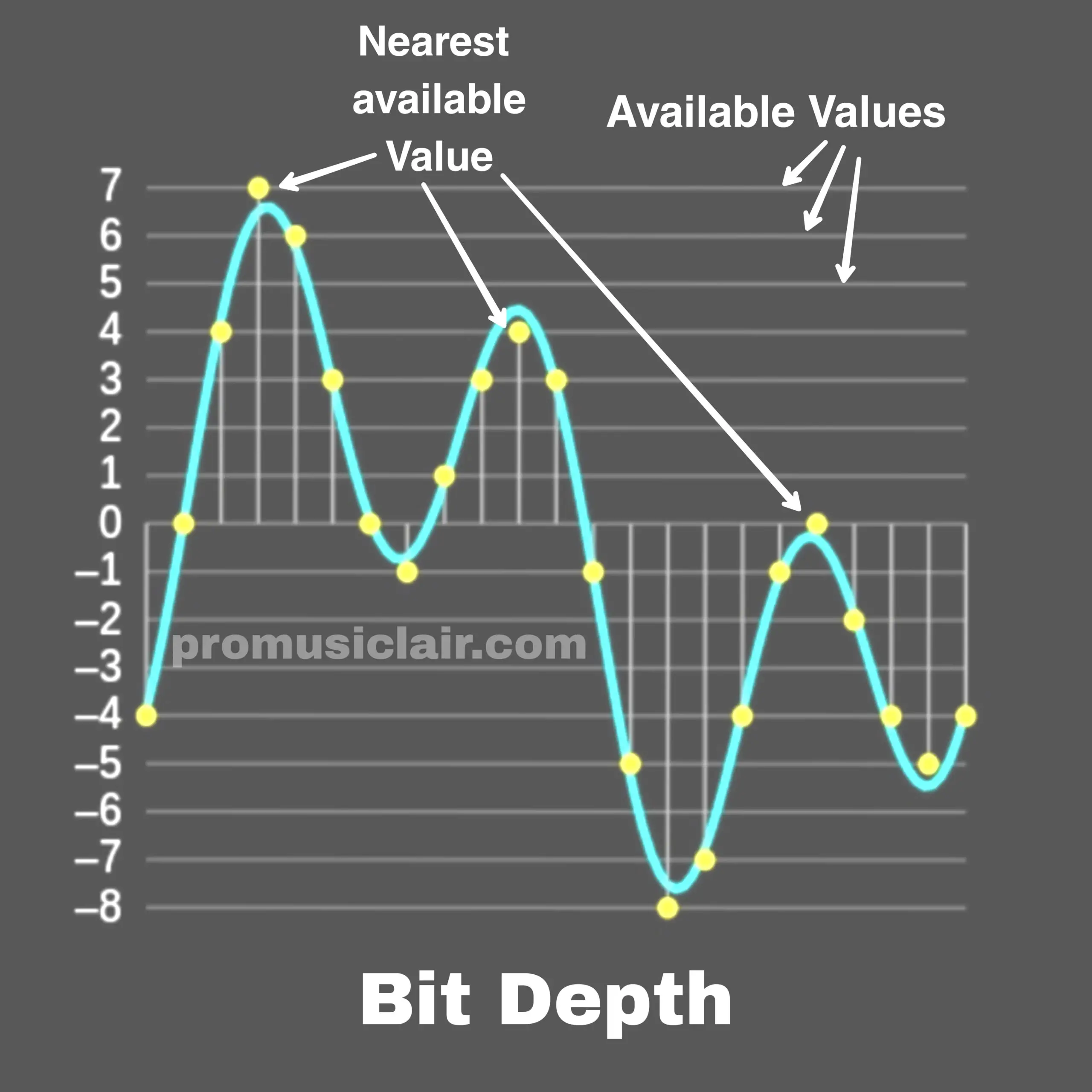
Now, to record each individual amplitude value, it must be rounded to the nearest quantization level. This process is called amplitude quantization. In more formal terms, amplitude quantization is the process of replacing the actual (measured) values ​​of the signal’s amplitude with values ​​that approximate with some precision. Each of the 2 N possible levels is called the quantization level, and the distance between the two closest quantization levels is called the quantization step. Quantization of signal values ​​introduces additional interference into the signal spectrum, called quantization noise or division noise … Quantization noise (error) refers to the signal that makes the difference between the signals reconstructed original and digital audio tracks. This difference results from the rounding of the measured signal values.

The quality of digital sound reproduction.

The quality of digital sound reproduction.

Digital Sound Quality

Audio coding. Before converting music to another format, you must “unzip” it to WAV.

SOUND QUALITY

Sound information. Sound is a wave that travels through air, water, or other medium with a continuously changing intensity and frequency.

A person perceives sound waves (air vibrations) with the help of hearing in the form of sound of varying volume and pitch. The greater the intensity of the sound wave, the louder the sound, the higher the frequency of the wave, the higher the pitch of the sound (Fig. 1.1).

Dependence of the volume and pitch of the sound on the intensity and frequency of the sound wave.

The human ear perceives sound at a frequency of 20 vibrations per second (low sound) to 20,000 vibrations per second (high sound).

A person can perceive sound in a wide range of intensities, in which the maximum intensity is 1014 times greater than the minimum (one hundred thousand billion times). To measure the volume of sound, a special unit “decibel” (dbl) is used (Table 5.1). Decreasing or increasing the sound volume by 10 dB corresponds to a decrease or increase in sound intensity by 10 times.

The sound volume the volume of the
sound in decibels
lower limit of human ear sensitivity 0
leaf whisper 10
Conversation 60
Gudok Vehicle 90
Jet engine 120
Pain threshold 140

Provisional discretization sound. In order for a computer to process sound, a continuous audio signal must be converted to a discrete digital form using time sampling. A continuous sound wave is divided into separate small time sections, for each section a certain value of sound intensity is set.

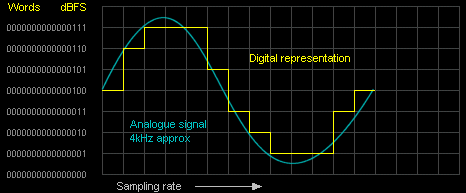
Therefore, the continuous dependence of the loudness of the sound at time A (t) is replaced by a discrete sequence of loudness levels. On the graph, this appears to replace a smooth curve with a sequence of “steps” (Fig. 1.2).

Sync Audio Sampling

Sampling frequency. A microphone connected to the sound card is used to record analog sound and convert it to digital format. The quality of the digital sound obtained depends on the number of measurements of the sound volume level per unit of time, that is, the sampling frequency. The more measurements that are made in 1 second (the higher the sampling frequency), the more accurately the “ladder” of the digital audio signal repeats the curve of the dialogue signal.

The audio sample rate is the number of sound volume measurements in one second.

The audio sample rate can vary between 8000 and 48000 sound volume measurements per second.

Audio encoding depth. Each “step” is assigned a specific value for the sound volume level. Loudness levels of sound can be viewed as a set of possible states N, for which a certain amount of information I is required, which is called audio coding depth.

Audio encoding depth is the amount of information required to encode the discrete volume levels of digital audio.

If the encoding depth is known, then the number of digital audio loudness levels can be calculated using the formula N = 2I. Let the audio encoding depth be 16 bit, then the number of sound volume levels is:

N = 2I = 216 = 65536.

During the encoding process, each sound volume level is assigned its own 16-bit binary code, the lowest sound level will correspond to the code 0000000000000000 and the highest – 1111111111111111.

How is sound represented digitally?

How is sound represented digitally?

Digital Representation of Sound

The original shape of an audio signal (a continuous change in amplitude over time) is represented digitally by “cross-sampling”, in time and level.

Representing Sound Digitally

According to Kotelnikov’s theorem, any continuous process with a limited spectrum can be completely described by a discrete sequence of its instantaneous values, following with a frequency at least twice the frequency of the highest harmonic of the process; the sampling frequency Fd of instantaneous values ​​(samples) is called the sampling frequency.

It follows from the theorem that a signal with a frequency Fa can be successfully sampled in time at a frequency 2Fa only if it is a pure sinusoid, because any deviation from the sinusoidal shape leads the spectrum to go beyond the frequency Fa. Therefore, for temporal sampling of an arbitrary audio signal (which normally has, as is known, a spectrum that falls smoothly), it is necessary to select a sampling frequency with a margin or to forcefully limit the spectrum of the input signal below half the sample rate.

Simultaneously with time sampling, amplitude sampling is performed: measurement of instantaneous amplitude values ​​and their representation in the form of numerical values ​​with some precision. The precision of the measurement (binary width N of the obtained discrete value) determines the signal-to-noise ratio and the dynamic range of the signal (theoretically these are reciprocal values, but any real path also has its own level of noise and interference).

The resulting stream of numbers (a series of binary digits) that describe an audio signal is called Pulse Code Modulation (PCM), since each pulse of a time-sampled signal is represented by its own digital code.

Linear quantization is most often used when the numerical value of the sample is proportional to the amplitude of the signal. Due to the logarithmic nature of hearing, logarithmic quantization, when the numerical value is proportional to the magnitude of the signal in decibels, would be more appropriate, but this is fraught with difficulties of a purely technical nature.

Time sampling and amplitude quantization of the signal inevitably introduce noise distortions in the signal, the level of which is generally estimated using the formula 6N + 10lg (Fdiscr / 2Fmax) + C (dB), where the constant C varies for different types of signals: for a pure sinusoid it is 1.7 dB, for sound signals – from -15 to 2 dB. Thus, it can be seen that a decrease in noise in the operating frequency band 0..Fmax leads not only to an increase in the bit depth of the sample, but also to an increase in the sample rate relative to 2Fmax, as the quantization noise is “smeared” across the band up to the sample rate, and the audio information occupies only the smallest part of this strip.

Most modern digital audio systems use the standard 44.1 and 48 kHz sample rates, but the frequency range of the signal is usually limited to about 20 kHz to keep it clear of the theoretical limit. Also the most common is 16-bit level quantization, which provides a limit signal-to-noise ratio of approximately 98 dB. The studio equipment uses higher resolutions: 18, 20, and 24-bit quantization at 56, 96, and 192 kHz sample rates. This is done to preserve the higher harmonics of the sound signal, which are not directly perceived by the ear, but affect the formation of the overall sound image.

To digitize lower-quality, narrow-band signals, you can lower the sample rate and bit depth; for example, telephone lines use 7 or 8 bit digitization with frequencies 8..12 kHz.

The representation of an analog signal in digital form is also called Pulse Code Modulation (PCM), since the signal is represented as a series of pulses of constant frequency (time sampling), the amplitude of which is transmitted digitally (amplitude sampling ). A PCM stream can be parallel, when all the bits in each sample are transmitted simultaneously over several lines with one sampling frequency, or sequential, when the bits are transmitted one after another at a higher frequency on a line.

Digital sound itself and related elements are often denoted by the general term Digital Audio; The analog and digital portions of a sound system are called the Analog Domain and Digital Domain.