Vinyl vs Digital: The Battle of Lo-Fi vs. High Tech Part 2


Free Download Mp4Gain
picture

Vinyl vs Digital: The Battle of Lo-Fi vs. High Tech Part 2

Vinyl Vs. Digital

What is analog recording technology? In short, it is the musician’s work recorded in the studio on 8 or 16 track tape.

Vinyl vs Digital

The recording of a song is continuous and the sound is continuous without interruption. In contrast, CDs, which are sound samples from analog or digital recordings, can theoretically capture an extremely high amount of information beyond what the human ear can distinguish.

Interestingly, at least for me, the first band I met to switch to a new digital format was Steely Dan, who had very good recording quality and were said to be the best example of marketing at the time. They recommend and sell this new format to potential buyers, telling them that CDs won’t suffer from the popping, galvanic, or other noises that vinyl normally has, and claiming that CDs are less likely to wear out after multiple plays than vinyl. o The CD is nearly indestructible, and neither scratches nor fast-forwarding will damage it. Well, we all know that’s a lie, and I’ve already re-polished a lot of damaged CDs.

But problems and controversies immediately arose, and the CDs had distinct, audible voices. Some say the sound is cooler, as if it floats aimlessly in midair. I don’t remember what my first CD was, but the difference in sound is fresh in my memory. They all sounded too light and lacked the warmth of analog records.

Now you must remember that stereo technology came into use in music performance and recording at that time, and its several important components included amplifiers/loudspeakers (speakers), and if you ask me what the quality of the speakers is, give it Not the The most important thing is that the speakers provide enough power to turn up the volume, we want more than just volume, to be an accurate and faithful representation of the high and low frequencies, as well as the all-important midrange.

Mono or binaural?

Stereo technology itself was a controversial topic in the mid-1960s. Many people don’t know that The Beatles are recorded in mono, layer after layer on the same track. Believe it or not, Sgt, Pepper was the first song recorded in mono, but since then everyone has stereo speakers and everyone expects the sound of two-track recordings.

Their producer George Martin and talented recording engineer Geoff Emerick (who was 15 when they worked with The Beatles in 1962) were extremely reluctant to meet the label’s stereo requirements, so they simply put the vocals and rhythm guitar on a single channel. and the bass, drums, and lead guitar are placed on the other channel. You can clearly hear these changes in your headphones or earphones. Even today, it’s a bit of a shock to hear John and Paul singing in the right channel with George’s lead guitar buzzing in the left channel.

Most of today’s stereo sound systems are built in TV 6.1 surround sound system, and most people do not use speakers to listen to songs, but use computers to download songs from online music libraries, and phones mobiles have also become the option. of many people. . But the song is not yet recorded for a cinematic surround sound system, it is still based on stereo, so once again the “sound” is broken.

As far as I am right now, there is nothing better than listening to a BOSE ceiling or bookshelf box under a high-end CD player connected to a high-power amplifier.


Free Download Mp4Gain
picture


Mp4Gain Main Window
picture


Mp4Gain Features
picture


Free Download Mp4Gain
picture

Vinyl vs Digital: The Battle of Lo-Fi vs. high-tech

Vinyl vs Digital: The Battle of Lo-Fi vs. high-tech

Vinyl vs Digital

“What I’m doing is trying to save the art that I’ve been in for the last 50 years,” Neil Young told Wired magazine. “We live in the digital age, but unfortunately, instead of progressing, music has gone backwards in this age.”

Vinyl vs Digital

Jobs, the giant who revolutionized MP3 products with his iPod line, was also an audiophile and used to listen to his vinyl records at home. MP3 used to be considered a compromise between loading smaller files and listening quality.

Ironically, we used to grow up listening to music and the way we listened to music was much better than the way we listen now – the sound quality we heard back then was much better than the way it’s now common, whether ripped from CD . MP3s are also bought. from iTunes or Amazon. As digital technology became more widespread and replaced analog recording technology and the number of physical discs consumed, the quality of music slowly declined. For example, an MP3, regardless of whether it is ripped from a CD or downloaded, or downsampled at 192 kbps, only retains 5 of the recorded vinyl records from a master recording studio tape.

You may not notice this difference when listening to songs on the go with normal sound quality headphones, but listening to the same song, your MP3 may not be very good compared to a CD.

The vast majority of modern music turns up the low-frequency volume, with “heavy bass” and “subwoofer” as a trend or selling point, but gets a muffled midrange. It also loses a lot of the dynamics of the high quality format, especially the analog texture that is nowhere to be found.

Heading into the damped midrange

I had a huge vinyl collection a few years ago, but for some reason I’ve been trying to replace them with CDs and digital downloads over the years. I used to be able to hear the vocals before the chorus of a Judybats song, but now that’s gone and the mids are muddy. The 320 kbps sound quality of the song, which was ripped from a CD, lost its inherent dynamics and was attenuated by compression.

And a song with a sample rate of 320 kbps should have no difference to the human ear with a CD. At least that’s how it should be for most people, including me, but with today’s technological advances, photos and videos have reached “diamond” level, but music quality has gone downhill, especially when beginning of the evolution of analog recording. to the birth of the digital format.

Formats: what is digital sound Part 3

Formats: what is digital sound Part 3

digital sound

JointStereo, which is one of the features of MP3, means that instead of encoding stereo as two independent channels, it encodes calls. center channel and the difference from the original stereo channels.

DIGITAL SOUND

Many audio components on stereo channels are the same, and encoding them on the common channel allows you to free up additional bandwidth for more detailed encoding of the difference, leading to improved quality.

Be sure to mention the variable bit rate or VBR. This means that the encoder changes the compression ratio on the fly, depending on the nature of the sound. This approach results in a smaller total file size or, if quality requirements increase, the same file size may produce better sound.

MP3 Pro

Introduced in 2001, the MP3 Pro codec was developed by Coding Technologies in association with Thomson Multimedia. It is MP3-based and as a result turned out to be fully MP3 backward compatible and only partially forward compatible. It uses SBR (Spectral Band Replication) technology, so the codec provides good quality at low bit rates. However, the encoding quality at medium to high bit rates is inferior to almost all other codecs. As a result, MP3 Pro is used more for streaming on the Internet and demonstrating snippets of new musical compositions.

WMA

The WMA codec, or Microsoft Windows Media Audio, is a serious alternative to MP3. Files in this format have the extensions .WMA and .ASF, have a clear advantage over MP3 at low data rates (bitrates) and lose it when the data feed rate to the codec is increased.

Based on WMA, the WMA DRM standard has been developed to provide copy protection so appreciated by record companies. Files based on this format can be recorded on playback devices such as MP3 flash players, but cannot be copied from there.

ATTRAC

ATRAC (Adaptive TRansform Acoustic Coding) is based on a stereo audio format with 16-bit quantization and a sample rate of 44.1 kHz. When compressed, each frame is divided into 52 frequency bands, resulting in a transmission rate of 292 kbps (1: 5 compression). Used in MiniDisk system.

Ogg Vorbis

The Ogg Vorbis format is a relatively new universal lossy audio recording format. It belongs to the same type of audio compression formats as MP3 and WMA, and the psychoacoustic model that describes the characteristics of the human ear, according to which compression is performed, is similar in principle to MP3. The radical difference of this format was the mathematical processing and the practical implementation of this model. In this format, the maximum threshold sample rate is not 44 kHz as in MP3, but 48, which theoretically improves the sound quality. It should also be noted that the theoretical number of channels is not limited to two, as usual, but reaches 255. Files encoded in this format are smaller than the same MP3 files. The spread of the format was slowed by insufficient support from hardware manufacturers.

Formats: what is digital sound Part 2

Formats: what is digital sound Part 2

Digital Sound

Historically, digital sound was undoubtedly the initiative of company engineers who adopted Philips-developed Audio-CDs, also called CDDA – Compact Disk Digital Audio.

DIGITAL SOUND

As a result, digital audio media led to a massive transition in recording studios to digital DAT tape recorders and digital editing equipment with S / PDIF and other interfaces. And then digital sound began to penetrate deeper into our lives from CD players, and as it was transmitted via S / PDIF, it became digital switches, equalizers, and noise reduction systems. Today this series ends with Dolby Digital surround sound processors.

Who needs it

CDDA’s sound quality is satisfactory for most end users, ie listeners, but the amount of data required to present sound in this way is critical. As a result, several compressed digital audio formats appear, one of which is the old MS ADPCM, and among which are quite acceptable Sony ATRAC, PASC or Fraunhoffer MP3. Each of the encoding methods has an important characteristic – the bit rate, with which the compressed information enters the decoder when the audio signal is restored.

For example, when you talk on a cell phone, the sound of your voices is digitally converted and compressed, degrading its performance. Various algorithms compress speech hundreds of times, preserving the basic characteristics.

Let’s move on to specific audio file formats and audio compression formats. The most common format today is, of course, MP3. However, historically, to understand the evolution of sound formats, it is necessary to start with a different type of file, with the extension .WAV.

Variety of formats

Wav

It is the primary format for many, many digital audio playback systems and is used as a standard audio file format on personal computers. In addition, it has a strong set of specifications, which has grown considerably lately. Its full name is Microsoft RIFF / WAVE – Resource Interchange File Format / Wave – Resource Interchange File Format / Waveform, and it was created by Microsoft and Intel engineers. In turn, WAV is short for Waveform Audio File Format.

Apple AIFF

This type of file is standard for Apple Macintosh systems and sound processing systems based on it. Apple AIFF stands for Audio Interchange File Format: an audio interchange file format, it is somewhat similar to WAV. Its peculiarity is that it allows additional information to be placed next to the sound wave, in particular WaveTable samples (examples of the instrument sound together with synthesizer parameters), which improves the quality of the final result. Although today Apple computers are capable of playing files in almost any format, including MP3.

RAW

Yes, this is not just the image format in which some digital cameras take pictures. In fact, RAW is the call. “Pure Digitization”, which does not contain a title and only contains a sequence of samples of a sound wave. Typically, the scan is stored in 16-bit format.

MP3

The most popular compression format today is MP3. The MP3 (MPEG Layer 3) format was developed, after several intermediate formats, by the Fraunhofer Institute in Germany. Actually, the .MP3 format is based on fooling the human ear. After some research, it turned out that human hearing tends to adapt to the appearance of new sounds, which is expressed in an increase in the hearing threshold. Therefore, some sounds are capable of masking (that is, making them subjectively inaudible) others. So in this format, some of the sounds that, according to the corresponding theory, are made inaudible, are simply removed from the general sound. The resulting “semi-finished product” is then encoded using the Hoffman method. Be sure to note that in MP3 format, programs that compress the sound of the original are not standardized, that is, each competent programmer can implement their own compression scheme. And only decoders meet the standards, which leads to the fact that the quality of MP3 playback does not always depend on the player that plays this file. Due to the different skills and predilections of implementers of various encoders, some of them are better at handling symphonic music, some with rock and metal, some with rap and rave, etc.

Formats: what is digital sound

Formats: what is digital sound

Digital Sound

Sound plays an increasingly important role in the modern world, having long since separated itself from the close link with the image that emerged during the heyday of television and cinema.

digital sound

Modern multimedia equipment has the widest possibilities not only for playback, but even for changing the sound. It is no longer a dead record, a static reproduction of events from the past, firmly imprinted on its medium. The most important role in transforming our ideas about sound was played by the development of a digital method of recording sound, turning it into a data stream that can be easily and naturally operated with modern devices.

The basics of “numbers”

Each of the multimedia devices on sale today, be it a CD player, a voice recorder or a flash memory player, uses many different types of presentation of data streams, which are then converted into sound. And even more sound formats used for professional purposes have been invented. An inexperienced buyer is forced to gather information about designations on boxes and devices from a variety of sources, often receiving incorrect information or even more confusion.

Almost all devices in the “Portable Audio” section of the ZOOM.CNews.ru catalog support multiple sound formats at the same time, and many devices that do not belong in this category are also tagged with support for playing sound files. To help our reader, we decided to create a short glossary of abbreviations and talk about the most common formats. We plan to leave it open for updates and modifications, adding new formats and describing in more detail the advantages and disadvantages of the already common or forgotten ones.

A little theory

To begin with, remember that digital sound is nothing more than a collection of numbers. The determining factor is the system by which sound as air pressure is converted into data streams and encoded for further processing and reproduction. Consequently, digital sound is usually included in computer files with various extensions, which more often (but not always) can determine their format. And the same concept of format can have, paradoxically, two meanings. First, the format may exist as a general characteristic that includes both the type and the physical characteristics of the medium (disk or cassette), the method of recording, the principles of encoding, and protection against errors. Second, the format can only be understood as the method of audio encoding and compression, as standard means are used for transfer, for example,

Analog sound, unlike digital, is reproduced on analog devices and has a number of significant differences. While not a data stream, analog audio is represented as a continuous electrical signal that represents a change in the sound wave. To translate it into digital format, the sound is “digitized”, that is, it is divided into certain segments, in which the numerical value of the amplitude is fixed at that moment. We will not delve into the principles of digital sound creation, but it is absolutely necessary to note that the more often a sound segment is divided and its characteristics described, the clearer and more complete the sound image itself is created.

This process generates a large amount of data that describes the sound, and it is clear that each digital audio format is nothing more than a compromise between the need to present the sound as loudly as possible and the memory limitations of a computer or device. Of reproduction.

A little more theory. In most cases, the human ear perceives sound with a frequency no higher than 22,000 Hz and, to describe it fully in digital form, a sampling frequency of at least 44.1 kHz is required. Since it is absolutely impossible to determine the value of the signal at any given moment, during digitization quantization occurs, that is, the replacement of the actual values ​​of the signal by approximate values. The more levels of audio quantization, the more accurately the signal level is described. As a result, each standard CD carries an audio signal with a sampling frequency of the same 44.1 kHz and a 16-bit quantization level, and in some devices, sampling is done at 48 kHz.

The benefits of digital audio

And now, briefly on why this algorithm was developed. Digital sound has enormous advantages over analog, although we must not forget its certain disadvantages. The main value of digital sound is the possibility of infinitely long storage and playback

Basic concepts of digital sound theory

Basic concepts of digital sound theory

Digital Sound

Sound is, in general, the vibrations of an elastic medium. The sound is caused by mechanical vibrations of some object (this can be a string, vocal cords, etc.) in contact with the environment. The frequency of vibration (measured in Hertz) determines the pitch. The higher the frequency, the louder the sound. The human ear can perceive sound vibrations from the air with a frequency of 20 Hz to 20 kHz. The ear perceives the amplitude of the vibration as volume. The higher the amplitude, the louder the sound.

Digital Sound

Electromagnetic waves are a direct analog of sound waves. The latter are less susceptible to dispersal by the environment, the information they carry is easier to store and process. Electromagnetic waves are the most important secondary carrier of sound. The transformation of acoustic waves into electromagnetic waves (as well as the reverse operation) is carried out due to the usual induction effect, which consists in the appearance of a current in a conductor when it is placed in an alternating magnetic field.

Simply put, the oscillation of the loudspeaker membrane magnet near the coil induces an alternating current in it. If this current is applied to another speaker, then the magnet on its membrane will move, creating a corresponding sound.

This is how the telephone and the radio work.

Sound converted to electromagnetic waveform can be easily stored. For this, some parameter of the carrier must be compared (the depth of the plate track or the degree of magnetization of the film) with the amplitude of the oscillations (that is, the strength of the induced current in the speaker coil) . Sound converted directly to electromagnetic waves is called analog sound. Its main characteristic is the direct correspondence of the electromagnetic waves transmitted or recorded with the acoustic ones.

Digital sound is relatively new. Its main difference from analog is discretion. When digitizing, a special device, an analog-to-digital converter (ADC), measures at regular intervals (approximately 0.001-0.0001 seconds) the magnitude of the amplitude of an electromagnetic wave corresponding to an analog sound form and writes its value to a file with a specified precision. This value is generally called sample, or in jargon, sample (of the sample in English, sample). The same digitization is often called sampling or sampling.

By converting sound from digital to analog (this is done by a device called a digital-to-analog converter (DAC)).

The interpolation (approximation) of the intermediate values ​​of the amplitude is carried out according to the known ones. Since the sampling frequency is usually high, this operation allows you to fairly accurately reconstruct the original analog signal.

The digital form of sound is characterized by five parameters.

1. The sampling rate;
2. Bit size of the samples.
3. The number of channels or tracks.
4. Compression / decompression algorithm (codec).
5. Storage format.

Since each of these parameters is quite specific, we will consider them separately.

Sampling rate
The sample rate determines how many samples per second will be taken when digitizing. If we compare digital sound with digital images, then the sample rate will correspond to the resolution (a more “realistic” analogy is the frame rate in cinema). The higher the sampling frequency, the better it is possible to reconstruct the analog signal based on the digital form of the sound (more precisely, the higher the sampling frequency, the broader the spectrum of frequencies that can be recorded during digitization).
The famous Nyquist-Kotelnikov theorem states that for the correct reconstruction of an analog signal from its digital recording, it is necessary that the sampling frequency be at least twice the maximum sound frequency.

Since the upper listening limit is 20 kHz, ideally the sample rate should be at least 40 kHz. This is why the standard sampling frequency used for recording CDs is 44.1 kHz (so-called CD quality). However, the sample rate can be higher, but this sound quality is only used by recording studios and especially demanding music lovers.

A sample rate of 44.1 kHz is not always ideal. When transmitting data over a low bandwidth network, sound quality must be sacrificed in favor of size, in practice sampling frequencies two, four and eight times lower than 44.1 kHz are often used.

Sound information on the computer

Sound information on the computer

Digital Audio

Sound is a continuous signal, a sound wave with variable amplitude and frequency.

digital wave sound

The greater the amplitude of the signal, the stronger it will be for a person.

The higher the frequency of the signal, the higher the pitch.

The frequency of a sound wave is expressed as a number of vibrations per second and is measured in Hertz (Hz, Hz).

The human ear can perceive sounds in the range of Hz to 20 kHz, which is called sound .2020
The number of bits per audio signal is called the audio coding depth.
Modern sound cards provide 16-, 32-, or 64-bit audio encoding depth. 163264

When encoding audio information, a continuous signal is replaced by a discrete one, that is, it is converted into a sequence of electrical impulses (binary zeros and ones).
The process of converting audio signals from a continuous representation form to a discrete digital form is called digitization.
An important characteristic when encoding audio is the sample rate, the number of signal level measurements in second: 1
– (one) measurement per second corresponds to a frequency of Hz; 11
– measurements per second correspond to a frequency of kHz. 10001
Audio sample rate is the number of audio volume measurements in one second.
The number of measurements can be in the range of kHz to kHz (from the radio transmission frequency to the frequency corresponding to the sound quality of musical media) .848

The higher the sampling frequency and depth of the sound, the better the sound of the digitized sound. The lowest quality of digitized sound, corresponding to the quality of telephone communication, is obtained at a sampling rate of times per second, a sampling rate of bits, and by recording an audio track (“mono” mode). The highest quality digitized audio, corresponding to the quality of an audio CD, is achieved with a sampling rate of times per second, a sampling rate of bits, and the recording of two audio tracks (stereo mode) .8000 848 000 16
It should be remembered that the higher the quality of the digital sound, the greater the volume of information in the audio file.
The volume of information in a mono audio file () can be estimated as follows: VV = Nâ‹… fâ‹… k, where is the total duration of the sound (seconds), is the sampling frequency (Hz), is the encoding depth (bit) .norteFk

For example, with a sound duration of one minute and a medium sound quality (bits, kHz): 11624
V = 60 â‹… 24000 â‹… 16 bits = 23040000 bits = 2,880,000 bytes = 2812.5 kB = 2.75 MB.

When encoding stereo sound, the sampling process is performed separately and independently for the left and right channels, consequently doubling the size of the audio file compared to mono sound.

For example, let’s estimate the information volume of a digital stereo sound file with a duration of one second with an average sound quality (bits, measurements per second). For this encoding, the depth must be multiplied by the number of measurements per second and multiplied by (stereo): 11624 00012
V = 16 bits â‹… 24000â‹…2 = 768000 bits = 96000 bytes = 93.75 KB.

There are several methods for encoding audio information with binary code, among which two main areas can be distinguished: the FM method and the Wave-Table method.

The FM (Frequency Modulation) method is based on the fact that, theoretically, any complex sound can be decomposed into a sequence of the simplest harmonic signals of different frequencies, each of which is a regular sinusoid and therefore It can be described by a code. The decomposition of audio signals into harmonic series and representation in the form of discrete digital signals is done by special devices – analog-to-digital converters (ADC).

Conversion of an audio signal into a discrete signal: to – audio signal at the ADC input; b – discrete signal at the ADC output.

Digital-to-analog converters (DACs) perform reverse conversion to reproduce sound encoded with a numeric code. The sound conversion process is shown in Fig. Below. This encoding method does not provide good sound quality, but it does provide compact code.

Conversion of a discrete signal into an audio signal: to – discrete signal at the DAC input; b – audio signal at the DAC output.

The table wave method (the Wave, the Table) is based on the fact that the previously prepared tables store sound samples from the world, musical instruments, etc.

Is Vinyl Sound Better Than Digital Audio Formats?

Is Vinyl Sound Better Than Digital Audio Formats?

Vinyl vs Digital

True music fans want the best sound quality for their favorite albums and recordings, and with the return of vinyl, the debate over which is better (CD versus vinyl, digital versus analog) has only sharpened. Many people value vinyl not only for its clean playability and lack of digital sound processing during playback, but also for the very process of installing the record on the turntable and the ability to hold the record in your hands.

Vinyl Vs. Digital

Nowadays, it is possible to play tracks as often as musicians record them. They record music at frequencies above the standard 44.1 kHz (96 kHz or 192 kHz) CD recording rate for better sound quality. Many people in the audio industry say that they can see a noticeable improvement in quality with higher sample rates than CDs, which is why they prefer listening to high-resolution music.

When turntables take priority over other formats

There’s a reason the vinyl revival has taken place. Yes, there is a certain appeal when you can hold a recording in your hands, which is different than choosing digital tracks on the screen. But there is also the argument that vinyl sounds better than digital recordings, exactly as the musician intended. The main difference between a vinyl record and a CD and MP3 is that the record on the record is analog. It is a physical recording, represented by a continuous electrical signal that reflects a change in the sound wave that is fully consistent with the original sound.

Unlike vinyl, most digital formats are compressed during recording and playback to minimize file size, making it ideal for various devices and can easily be streamed over the Internet. Most streaming services simply won’t be viable without audio compression technology.

When compressed, audio files lose not only size but also sound quality. This means that the listener loses the smallest sound details that the musician wanted to convey when he recorded this track. For the average listener this may not matter, but for music lovers, losing this depth of sound is completely unacceptable.

However, in both cases, analog or digital, good sound always begins with a good recording and how the sound engineer created it. If mistakes were made from the beginning, this cannot be corrected during playback.

Vinyl provides a warmer, livelier sound

Vinyl fans always talk about the “warmth” they get from classic recordings. This is not nostalgia, but a very real sonic phenomenon. According to sound engineer Adam Gonsalves, vinyl provides a more pleasant and warmer sound to your ears. This is especially noticeable when listening to classic rock artists like the Beatles, Led Zeppelin or Pink Floyd.

In the 1990s, record labels struggled to make their records stand out from the rest. To do this, the sound was processed and compressed with special programs for greater saturation. But this digital sound processing not only increased the volume, it also noticeably spoiled the sound quality. Compared to those processed tracks, vinyl is just so much cleaner and better.

When digital formats win

There is an important caveat that vinyl sounds better in certain but not all circumstances, especially when modern music is digitally recorded in the studio. In this case, albums released on vinyl and digital have little or no difference in sound quality between them. In addition, there are high definition digital audio formats and SACD (Super Audio CD) formats that surpass vinyl in sound quality.

In terms of convenience, digital formats outperform vinyl. Streaming music from your smartphone or mobile device is infinitely easier and more convenient than putting on a disc and flipping the disc every three to four songs.

Ultimately, it is up to each listener to decide what is most important to listen to: the high sound quality of vinyl records or the convenience of digital formats.

If you want to hear your favorite classical composers in exactly the way the musicians and sound engineer wanted to convey it, vinyl is made for you. Be sure to check out today’s Denon turntables, amplifiers, and other hi-fi components to begin your journey to real sound.

Audio quality

MP3 generation: today they are young. The most famous digital music format of all time is in people’s mouths and ears, targeted by piracy, and on portable players around the world.

Bitrate

Meanwhile, vinyls have become relics in used bookstores and K7 tapes are left behind in the closet. In fact, it’s not surprising that many of today’s youngsters have never had the pleasure of listening to a good vinyl record on an old record player.

Digital music formats are everywhere and make the soundtrack of every user’s life. But then, do you know how to take advantage of available audio technologies or any MP3 file, regardless of quality, is a good size for your ear?

Bitrate

No matter your musical style, the audio quality in digital music is of great importance. Each format, each size, each file has a different quality and this directly influences how a song is heard.

Find any music CD in your drawer and put it to play on your radio. Now choose an MP3 and listen to it on your computer speakers. Did you notice the difference in noise and compression?

Quality, format and compression.

To transfer songs from an audio CD to your computer, there may be no loss of quality to your music? Quality if you use the WAV (Windows standard) or AIFF (Mac standard) format. The quality is perfect, but the size can give you a big headache: for every minute of music in WAV format, an average of 10 MB is taken up on the hard drive.

So to take up less space, use an audio file compressor like Free MP3 Converter and end up with a low quality, compressed size audio file. How does MP3 get so much smaller? The format basically removes all audio tracks that, in theory, are not perceived by the human ear, compressing instruments and layers of music.

It is as if a steamroller passes over an orchestra: the music sounds like a block of noise, which can cause hearing fatigue. The big problem is that people are so used to this mass of instruments and voice that music is at serious risk of degradation.

Bit rate (bit rate)

An encoded or decoded file is never exactly the same as the original file, as much of the information deemed superfluous is removed. In general, the lower the compression ratio, the better the quality of the file.

The term used to speak of compression is Bitrate, it consists of the average number of bits that in one second of the data will be compressed. The unit used is KBPS or 1000 BITS per second. Check the audio quality below based on the bit rate used.

Vinyl, CD or files: Who wins this historic clash?

We analyzed the difference and the peculiarities of both CDs and vinyl, reaching a controversial conclusion: vinyl is great, but it is not better than CD.

vinyl vs digital

The return of vinyl has been celebrated around the world, it is a large format, nostalgic, but when it comes to sound quality, there are many steps behind the CD. There is no way to compare something analog with something digital. What can be discussed is the quality of the artists of today, in relation to the artists of the past.

If Led Zeppelin recorded his self-titled album today, digitally, it would be even better when it comes to sound quality. Just as if Justin Bieber recorded “Believe” in the past, similarly, it would be even worse.

In addition to vinyl and CDs, other music distribution formats are also in vogue, such as MP3.

Advantages and disadvantages of vinyl:

vinyl

On vinyl, sound waves are analog, as is vinyl recording. This means that there is not much loss between recording and playback. Many claim that vinyl sound has more body and shows more detail. Since it is an analog process, the EQ naturally has more bass, making it more noticeable.

However, this does not mean that the sound is of higher quality. If the CD has a sample rate of 44 KHz at 16 bits, the vinyl would have 16 KHz at 8 bits.

Vinyl is physically limited in some way. First, in terms of “dynamic range”, which in the case of vinyl is extremely limited.

(Note: Dynamic Range is the difference between the highest note and the softest note.)

And secondly, in terms of “frequency”, because the quality of vinyl’s frequency is not universal, it is variable.

The sound of vinyl sounds better on songs with lower notes, because if the notes of the songs are too high, the needle has difficulty following / playing, which contributes to significant distortions in the sound of the songs. For example, try listening to the letters, whose consonants (s, z, etc.) are sung sharply, the distortion will be clear.

Because they have more groove and clearer, cleaner bass, the vinyl is a favorite for music djs.

Advantages and disadvantages of the CD:

CDs depend on sampling an analog signal, as well as having some limitations regarding the “frequency” element. While on vinyl, encoding is done in an audio waveform, on CD, this audio sampling encoding must be captured in different ways and points, unlike vinyl, which captures it through a single point, for what cd will never be able to present the rhythm that vinyl presents, and this is one of the few advantages of analog over digital.

On the other hand, the CD has a sufficient sampling volume to sound clearer and more defined to the human ear.

The sampling rate of CDs is 44.1, which means that CD recordings can be captured up to 44,100 times per second and can capture frequencies of 20KHZ.

And this frequency is the maximum that the human ear can hear, the human ear is clear, because in the case of dogs, for example, it is still a low frequency, because they have a hearing 4 times higher than ours, and probably even listen to our breathing clearly.
.

Recordings above 21 kHz, only for dogs. This does not mean that the 20 Khz reached by the cd is worthy of an outstanding frequency, no, it is not that the frequency of the cd is clearer and clearer to the human ear.

Also, in the recording studio there is no microphone to capture more than 20 Khz.

MP3:

digital audio

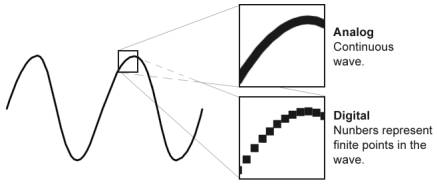
It all depends on your compaction rate. MP3, like CDs and DVDs, captures sound waves and converts them to files. It turns out that in digital recording it is not possible to follow the “curves” of sound waves, so they are recorded with a certain interval, defined by compression. The higher the compression, the greater the range and the less nuances the recording captures.

See the figure above. The black line is the original analog sound. The blue line represents a recording with high compression, the red line with a smaller one. Note that blue does not follow sound curves as much as red.

Compaction eliminates dynamic bands that, in theory, the human ear does not hear, so the tips flatten out. In other words, an uncompressed digital file, such as WAV, will show all these curves, that is, the same quality as the CD. Today there are formats like FLAC, which have compression, but little. They are still bigger than an MP3, but much smaller than a WAV.

Therefore, it can be concluded that, in terms of sound quality, CD is really better than vinyl and MP3.

But what do people prefer?

If we consider the growth in sales of digital copies, as well as the practicality that this brings, people tend to prefer digital copies, be it MP3 or WAV.

But this is an unfair comparison, since you can’t put a CD or vinyl on the iPod and listen in the middle of the street. Today’s people are more dynamic, they live in a world where haste and practicality go together, and in this world, for them, it is important to have music available in their pocket.

It’s not for nothing that people listen to music, just listen. And the difference between listening and listening is clear. Listening is when you listen to music doing other things in parallel, and listening is paying attention only to the album you are listening to.

The music is trivialized, people listen to a song by a certain artist, and if they don’t like it, they are already making a negative judgment about the artist, without even listening to his work, all due to the rush and practicality of being able to hear everything he wants. . at any time through the internet.

And that is exactly why vinyl and CDs cannot compete with digital copying, in terms of the particular taste of most people.

Sound engineers Geringer and Dunnigan presented recordings made in analog (vinyl) and digitally designed (cd) recordings to a group of record label producers, without telling them which recordings were digital and which were analog.

The result was a massacre, since the vast majority of producers preferred digital recording, without knowing if they were voting for digital or analog recordings. Upon listening to the recordings, the producers reported that the digital recordings were of an incomparable quality infinitely superior to the quality of the analog recordings they had previously listened to.

According to them, digital recording sounded better in all aspects: treble, bass, sound quality, frequency, etc.

If the quality of the CD is higher and the MP3 allows more practicality, why do people still listen to vinyl?

Because vinyl, in addition to providing a retro, nostalgic air, is the only device that people, when they stop to listen, really listen carefully. In addition, the vinyl preserves the original recording, that is, if someone coughed or sneezed in the middle of a recording, they will continue in the recording, giving the format a visceral air and better recording than the artist can do, without resources. computerized.

When you listen to an analog recording, you hear it as it was recorded, and this is the charm of vinyl. On the contrary, in the CD, in very rare cases, the final versions are not affected by the sound editing programs.

There are countless artists today who only achieve fame and success because they record digitally. Many of today’s artists would not be able to record analogue as they do not have enough talent to record on tape without changing the recording later.

Digital recording is more accurate, but this is not the only point to consider.

To conclude, it is important to note that each format has its charms. MP3 offers greater practicality, CD has higher sound quality, while vinyl has a better rhythm.

But none of this works if your speaker or headphones aren’t good enough to play any of the 3 formats.