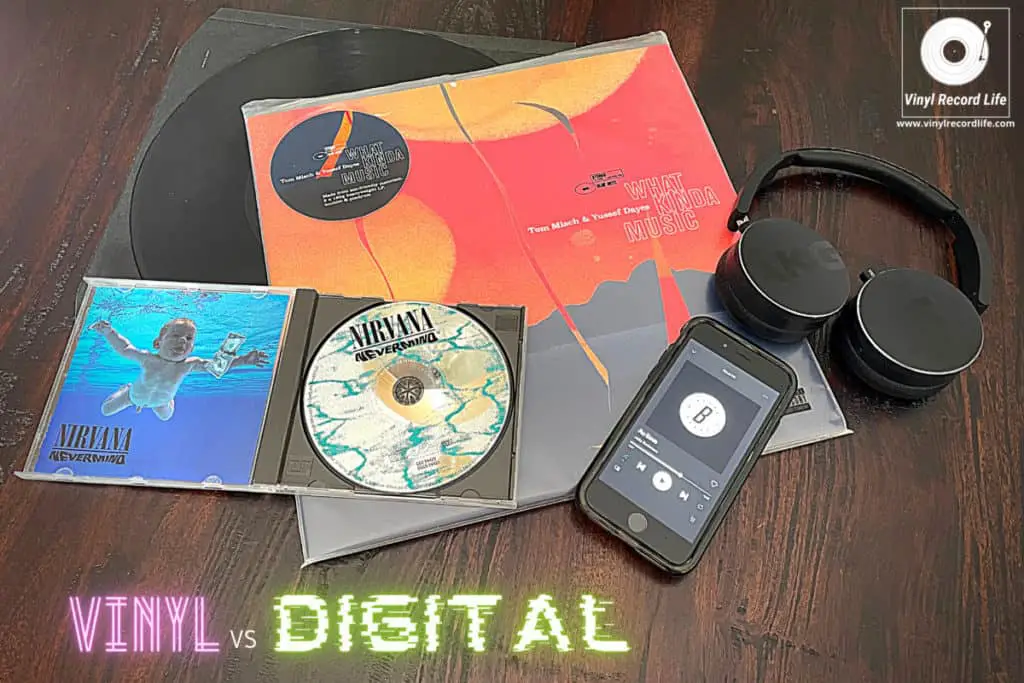
Vinyl vs Digital: The Battle of Lo-Fi vs. High Tech Part 2


Free Download Mp4Gain
picture

Vinyl vs Digital: The Battle of Lo-Fi vs. High Tech Part 2

Vinyl Vs. Digital

What is analog recording technology? In short, it is the musician’s work recorded in the studio on 8 or 16 track tape.

Vinyl vs Digital

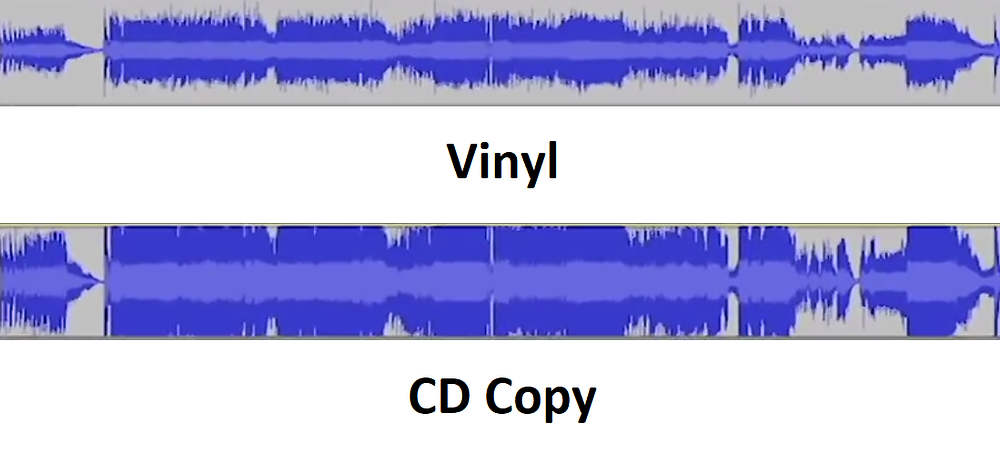
The recording of a song is continuous and the sound is continuous without interruption. In contrast, CDs, which are sound samples from analog or digital recordings, can theoretically capture an extremely high amount of information beyond what the human ear can distinguish.

Interestingly, at least for me, the first band I met to switch to a new digital format was Steely Dan, who had very good recording quality and were said to be the best example of marketing at the time. They recommend and sell this new format to potential buyers, telling them that CDs won’t suffer from the popping, galvanic, or other noises that vinyl normally has, and claiming that CDs are less likely to wear out after multiple plays than vinyl. o The CD is nearly indestructible, and neither scratches nor fast-forwarding will damage it. Well, we all know that’s a lie, and I’ve already re-polished a lot of damaged CDs.

But problems and controversies immediately arose, and the CDs had distinct, audible voices. Some say the sound is cooler, as if it floats aimlessly in midair. I don’t remember what my first CD was, but the difference in sound is fresh in my memory. They all sounded too light and lacked the warmth of analog records.

Now you must remember that stereo technology came into use in music performance and recording at that time, and its several important components included amplifiers/loudspeakers (speakers), and if you ask me what the quality of the speakers is, give it Not the The most important thing is that the speakers provide enough power to turn up the volume, we want more than just volume, to be an accurate and faithful representation of the high and low frequencies, as well as the all-important midrange.

Mono or binaural?

Stereo technology itself was a controversial topic in the mid-1960s. Many people don’t know that The Beatles are recorded in mono, layer after layer on the same track. Believe it or not, Sgt, Pepper was the first song recorded in mono, but since then everyone has stereo speakers and everyone expects the sound of two-track recordings.

Their producer George Martin and talented recording engineer Geoff Emerick (who was 15 when they worked with The Beatles in 1962) were extremely reluctant to meet the label’s stereo requirements, so they simply put the vocals and rhythm guitar on a single channel. and the bass, drums, and lead guitar are placed on the other channel. You can clearly hear these changes in your headphones or earphones. Even today, it’s a bit of a shock to hear John and Paul singing in the right channel with George’s lead guitar buzzing in the left channel.

Most of today’s stereo sound systems are built in TV 6.1 surround sound system, and most people do not use speakers to listen to songs, but use computers to download songs from online music libraries, and phones mobiles have also become the option. of many people. . But the song is not yet recorded for a cinematic surround sound system, it is still based on stereo, so once again the “sound” is broken.

As far as I am right now, there is nothing better than listening to a BOSE ceiling or bookshelf box under a high-end CD player connected to a high-power amplifier.


Free Download Mp4Gain
picture


Mp4Gain Main Window
picture


Mp4Gain Features
picture


Free Download Mp4Gain
picture

Vinyl vs Digital: The Battle of Lo-Fi vs. high-tech

Vinyl vs Digital: The Battle of Lo-Fi vs. high-tech

Vinyl vs Digital

“What I’m doing is trying to save the art that I’ve been in for the last 50 years,” Neil Young told Wired magazine. “We live in the digital age, but unfortunately, instead of progressing, music has gone backwards in this age.”

Vinyl vs Digital

Jobs, the giant who revolutionized MP3 products with his iPod line, was also an audiophile and used to listen to his vinyl records at home. MP3 used to be considered a compromise between loading smaller files and listening quality.

Ironically, we used to grow up listening to music and the way we listened to music was much better than the way we listen now – the sound quality we heard back then was much better than the way it’s now common, whether ripped from CD . MP3s are also bought. from iTunes or Amazon. As digital technology became more widespread and replaced analog recording technology and the number of physical discs consumed, the quality of music slowly declined. For example, an MP3, regardless of whether it is ripped from a CD or downloaded, or downsampled at 192 kbps, only retains 5 of the recorded vinyl records from a master recording studio tape.

You may not notice this difference when listening to songs on the go with normal sound quality headphones, but listening to the same song, your MP3 may not be very good compared to a CD.

The vast majority of modern music turns up the low-frequency volume, with “heavy bass” and “subwoofer” as a trend or selling point, but gets a muffled midrange. It also loses a lot of the dynamics of the high quality format, especially the analog texture that is nowhere to be found.

Heading into the damped midrange

I had a huge vinyl collection a few years ago, but for some reason I’ve been trying to replace them with CDs and digital downloads over the years. I used to be able to hear the vocals before the chorus of a Judybats song, but now that’s gone and the mids are muddy. The 320 kbps sound quality of the song, which was ripped from a CD, lost its inherent dynamics and was attenuated by compression.

And a song with a sample rate of 320 kbps should have no difference to the human ear with a CD. At least that’s how it should be for most people, including me, but with today’s technological advances, photos and videos have reached “diamond” level, but music quality has gone downhill, especially when beginning of the evolution of analog recording. to the birth of the digital format.

Digital sound quality

Digital sound quality.

Sound quality

Sound information. Sound is a wave that travels through air, water, or other medium with a continuously varying intensity and frequency.

Digital Sound Quality

A person receives sound waves (air vibrations) supported by hearing in the form of sound of varying volume and pitch. The greater the intensity of the sound wave, the louder the sound, the higher the frequency of the wave, the higher the pitch of the sound

Dependence of the volume and pitch of sound on the intensity and frequency of a sound wave

The human ear receives sound with a frequency of 20 vibrations per second (small sound) to 20,000 vibrations per second (loud sound).

A person can receive sound in a wide spectrum of intensities, in which the highest intensity is 1014 times greater than the lowest (100 thousand billion times). To measure the volume of sound, a special unit “decibel” (dbl) is used (Table 5.1). Decreasing or increasing the sound volume by 10 dB is suitable for decreasing or increasing the sound intensity by 10 times.

The sound volume
sound in decibels
lower limit of human ear sensitivity 0
leaf whisper 10
Conversation 60
Gudok Vehicle 90
Jet engine 120
Pain threshold 140
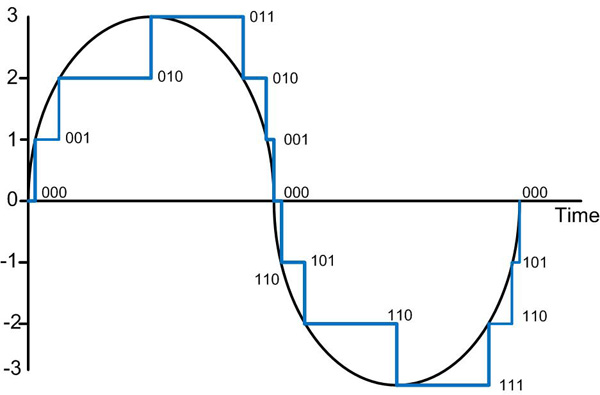
Sound time sampling. In order for a computer to process sound, a continuous audio signal must be converted to a discrete digital form with support for time sampling. A constant sound wave is divided into small separate time sections, for each section a certain value of sound intensity is set.

Therefore, the constant dependence of the loudness of the sound on time A (t) is replaced by a discrete sequence of loudness levels. On the graph, this appears to replace a smooth curve with a sequence of “steps”

Sampling frequency. To record analog sound and transform it into digital format, a microphone is used, connected to the sound card. The quality of the digital sound obtained depends on the number of measurements of the sound volume level per unit of time, that is, the sampling frequency. The more measurements that are made in 1 second (the higher the sampling frequency), the more accurately the “ladder” of the digital audio signal repeats the curve of the dialogue signal.

Audio sample rate is the number of audio volume measurements in one second.

The audio sample rate can range from 8000 to 48000 sound volume measurements per second.

Audio encoding depth. Each “step” is assigned a specific value for the sound volume level. Loudness levels of sound can be viewed as a set of probable states N, for which encoding a certain amount of information I is required, which is magnified by the encoding depth of the sound.

Audio encoding depth is the amount of information required to encode the discrete volume levels of digital audio.

If the encoding depth is known, then the number of digital sound volume levels can be calculated using the formula N = 2I. Let the sound encoding depth be 16 bit, then the number of sound volume levels is the same:

N = 2I = 216 = 65536.

During the encoding process, each sound volume level is assigned its own 16-bit binary code, the lowest sound level will correspond to the code 0000000000000000, and the highest – 1111111111111111.

The quality of digitized sound. The higher the sound sampling frequency and depth, the higher the quality of the digitized sound. The lowest quality of digitized sound, suitable for the quality of a telephone connection, is obtained at a sample rate of 8000 times per second, an 8-bit sample rate, and by recording an audio track (“mono” mode). The highest quality digitized sound, suitable for audio CD quality, is achieved at a sampling rate of 48,000 times per second, a 16-bit sampling rate, and by recording 2 audio tracks (“stereo” mode ).

It should be remembered that the higher the quality of the digital sound, the greater the volume of information in the audio file. You can estimate the volume of information in a digital stereo sound file with a duration of 1 second with an average sound quality (16 bits, 24,000 measurements per second). To do this, the encoding depth must be multiplied by the number of measurements in 1 second and multiplied by 2 (stereo sound):

16 bits 24,000 2 = 768,000 bits = 96,000 b = 93.75 KB.

Audio quality

MP3 generation: today they are young. The most famous digital music format of all time is in people’s mouths and ears, targeted by piracy, and on portable players around the world.

Bitrate

Meanwhile, vinyls have become relics in used bookstores and K7 tapes are left behind in the closet. In fact, it’s not surprising that many of today’s youngsters have never had the pleasure of listening to a good vinyl record on an old record player.

Digital music formats are everywhere and make the soundtrack of every user’s life. But then, do you know how to take advantage of available audio technologies or any MP3 file, regardless of quality, is a good size for your ear?

Bitrate

No matter your musical style, the audio quality in digital music is of great importance. Each format, each size, each file has a different quality and this directly influences how a song is heard.

Find any music CD in your drawer and put it to play on your radio. Now choose an MP3 and listen to it on your computer speakers. Did you notice the difference in noise and compression?

Quality, format and compression.

To transfer songs from an audio CD to your computer, there may be no loss of quality to your music? Quality if you use the WAV (Windows standard) or AIFF (Mac standard) format. The quality is perfect, but the size can give you a big headache: for every minute of music in WAV format, an average of 10 MB is taken up on the hard drive.

So to take up less space, use an audio file compressor like Free MP3 Converter and end up with a low quality, compressed size audio file. How does MP3 get so much smaller? The format basically removes all audio tracks that, in theory, are not perceived by the human ear, compressing instruments and layers of music.

It is as if a steamroller passes over an orchestra: the music sounds like a block of noise, which can cause hearing fatigue. The big problem is that people are so used to this mass of instruments and voice that music is at serious risk of degradation.

Bit rate (bit rate)

An encoded or decoded file is never exactly the same as the original file, as much of the information deemed superfluous is removed. In general, the lower the compression ratio, the better the quality of the file.

The term used to speak of compression is Bitrate, it consists of the average number of bits that in one second of the data will be compressed. The unit used is KBPS or 1000 BITS per second. Check the audio quality below based on the bit rate used.

Vinyl, CD or files: Who wins this historic clash?

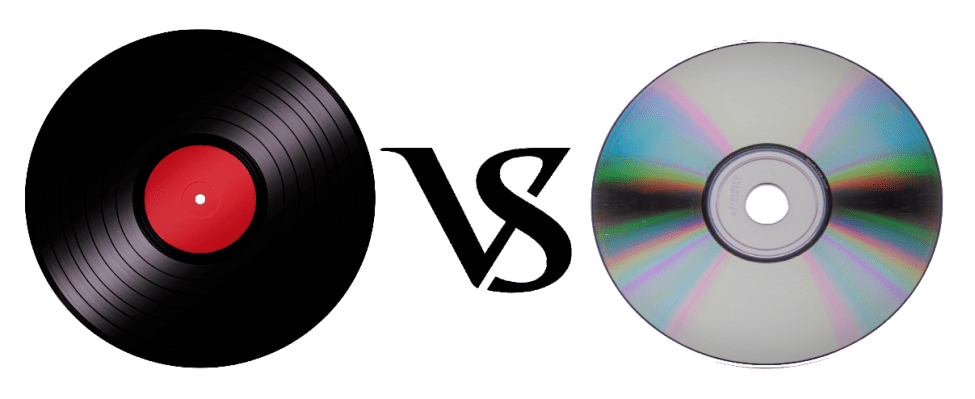
We analyzed the difference and the peculiarities of both CDs and vinyl, reaching a controversial conclusion: vinyl is great, but it is not better than CD.

vinyl vs digital

The return of vinyl has been celebrated around the world, it is a large format, nostalgic, but when it comes to sound quality, there are many steps behind the CD. There is no way to compare something analog with something digital. What can be discussed is the quality of the artists of today, in relation to the artists of the past.

If Led Zeppelin recorded his self-titled album today, digitally, it would be even better when it comes to sound quality. Just as if Justin Bieber recorded “Believe” in the past, similarly, it would be even worse.

In addition to vinyl and CDs, other music distribution formats are also in vogue, such as MP3.

Advantages and disadvantages of vinyl:

vinyl

On vinyl, sound waves are analog, as is vinyl recording. This means that there is not much loss between recording and playback. Many claim that vinyl sound has more body and shows more detail. Since it is an analog process, the EQ naturally has more bass, making it more noticeable.

However, this does not mean that the sound is of higher quality. If the CD has a sample rate of 44 KHz at 16 bits, the vinyl would have 16 KHz at 8 bits.

Vinyl is physically limited in some way. First, in terms of “dynamic range”, which in the case of vinyl is extremely limited.

(Note: Dynamic Range is the difference between the highest note and the softest note.)

And secondly, in terms of “frequency”, because the quality of vinyl’s frequency is not universal, it is variable.

The sound of vinyl sounds better on songs with lower notes, because if the notes of the songs are too high, the needle has difficulty following / playing, which contributes to significant distortions in the sound of the songs. For example, try listening to the letters, whose consonants (s, z, etc.) are sung sharply, the distortion will be clear.

Because they have more groove and clearer, cleaner bass, the vinyl is a favorite for music djs.

Advantages and disadvantages of the CD:

CDs depend on sampling an analog signal, as well as having some limitations regarding the “frequency” element. While on vinyl, encoding is done in an audio waveform, on CD, this audio sampling encoding must be captured in different ways and points, unlike vinyl, which captures it through a single point, for what cd will never be able to present the rhythm that vinyl presents, and this is one of the few advantages of analog over digital.

On the other hand, the CD has a sufficient sampling volume to sound clearer and more defined to the human ear.

The sampling rate of CDs is 44.1, which means that CD recordings can be captured up to 44,100 times per second and can capture frequencies of 20KHZ.

And this frequency is the maximum that the human ear can hear, the human ear is clear, because in the case of dogs, for example, it is still a low frequency, because they have a hearing 4 times higher than ours, and probably even listen to our breathing clearly.
.

Recordings above 21 kHz, only for dogs. This does not mean that the 20 Khz reached by the cd is worthy of an outstanding frequency, no, it is not that the frequency of the cd is clearer and clearer to the human ear.

Also, in the recording studio there is no microphone to capture more than 20 Khz.

MP3:

digital audio

It all depends on your compaction rate. MP3, like CDs and DVDs, captures sound waves and converts them to files. It turns out that in digital recording it is not possible to follow the “curves” of sound waves, so they are recorded with a certain interval, defined by compression. The higher the compression, the greater the range and the less nuances the recording captures.

See the figure above. The black line is the original analog sound. The blue line represents a recording with high compression, the red line with a smaller one. Note that blue does not follow sound curves as much as red.

Compaction eliminates dynamic bands that, in theory, the human ear does not hear, so the tips flatten out. In other words, an uncompressed digital file, such as WAV, will show all these curves, that is, the same quality as the CD. Today there are formats like FLAC, which have compression, but little. They are still bigger than an MP3, but much smaller than a WAV.

Therefore, it can be concluded that, in terms of sound quality, CD is really better than vinyl and MP3.

But what do people prefer?

If we consider the growth in sales of digital copies, as well as the practicality that this brings, people tend to prefer digital copies, be it MP3 or WAV.

But this is an unfair comparison, since you can’t put a CD or vinyl on the iPod and listen in the middle of the street. Today’s people are more dynamic, they live in a world where haste and practicality go together, and in this world, for them, it is important to have music available in their pocket.

It’s not for nothing that people listen to music, just listen. And the difference between listening and listening is clear. Listening is when you listen to music doing other things in parallel, and listening is paying attention only to the album you are listening to.

The music is trivialized, people listen to a song by a certain artist, and if they don’t like it, they are already making a negative judgment about the artist, without even listening to his work, all due to the rush and practicality of being able to hear everything he wants. . at any time through the internet.

And that is exactly why vinyl and CDs cannot compete with digital copying, in terms of the particular taste of most people.

Sound engineers Geringer and Dunnigan presented recordings made in analog (vinyl) and digitally designed (cd) recordings to a group of record label producers, without telling them which recordings were digital and which were analog.

The result was a massacre, since the vast majority of producers preferred digital recording, without knowing if they were voting for digital or analog recordings. Upon listening to the recordings, the producers reported that the digital recordings were of an incomparable quality infinitely superior to the quality of the analog recordings they had previously listened to.

According to them, digital recording sounded better in all aspects: treble, bass, sound quality, frequency, etc.

If the quality of the CD is higher and the MP3 allows more practicality, why do people still listen to vinyl?

Because vinyl, in addition to providing a retro, nostalgic air, is the only device that people, when they stop to listen, really listen carefully. In addition, the vinyl preserves the original recording, that is, if someone coughed or sneezed in the middle of a recording, they will continue in the recording, giving the format a visceral air and better recording than the artist can do, without resources. computerized.

When you listen to an analog recording, you hear it as it was recorded, and this is the charm of vinyl. On the contrary, in the CD, in very rare cases, the final versions are not affected by the sound editing programs.

There are countless artists today who only achieve fame and success because they record digitally. Many of today’s artists would not be able to record analogue as they do not have enough talent to record on tape without changing the recording later.

Digital recording is more accurate, but this is not the only point to consider.

To conclude, it is important to note that each format has its charms. MP3 offers greater practicality, CD has higher sound quality, while vinyl has a better rhythm.

But none of this works if your speaker or headphones aren’t good enough to play any of the 3 formats.