Formats: what is digital sound Part 3


Free Download Mp4Gain
picture

Formats: what is digital sound Part 3

digital sound

JointStereo, which is one of the features of MP3, means that instead of encoding stereo as two independent channels, it encodes calls. center channel and the difference from the original stereo channels.

DIGITAL SOUND

Many audio components on stereo channels are the same, and encoding them on the common channel allows you to free up additional bandwidth for more detailed encoding of the difference, leading to improved quality.

Be sure to mention the variable bit rate or VBR. This means that the encoder changes the compression ratio on the fly, depending on the nature of the sound. This approach results in a smaller total file size or, if quality requirements increase, the same file size may produce better sound.

MP3 Pro

Introduced in 2001, the MP3 Pro codec was developed by Coding Technologies in association with Thomson Multimedia. It is MP3-based and as a result turned out to be fully MP3 backward compatible and only partially forward compatible. It uses SBR (Spectral Band Replication) technology, so the codec provides good quality at low bit rates. However, the encoding quality at medium to high bit rates is inferior to almost all other codecs. As a result, MP3 Pro is used more for streaming on the Internet and demonstrating snippets of new musical compositions.

WMA

The WMA codec, or Microsoft Windows Media Audio, is a serious alternative to MP3. Files in this format have the extensions .WMA and .ASF, have a clear advantage over MP3 at low data rates (bitrates) and lose it when the data feed rate to the codec is increased.

Based on WMA, the WMA DRM standard has been developed to provide copy protection so appreciated by record companies. Files based on this format can be recorded on playback devices such as MP3 flash players, but cannot be copied from there.

ATTRAC

ATRAC (Adaptive TRansform Acoustic Coding) is based on a stereo audio format with 16-bit quantization and a sample rate of 44.1 kHz. When compressed, each frame is divided into 52 frequency bands, resulting in a transmission rate of 292 kbps (1: 5 compression). Used in MiniDisk system.

Ogg Vorbis

The Ogg Vorbis format is a relatively new universal lossy audio recording format. It belongs to the same type of audio compression formats as MP3 and WMA, and the psychoacoustic model that describes the characteristics of the human ear, according to which compression is performed, is similar in principle to MP3. The radical difference of this format was the mathematical processing and the practical implementation of this model. In this format, the maximum threshold sample rate is not 44 kHz as in MP3, but 48, which theoretically improves the sound quality. It should also be noted that the theoretical number of channels is not limited to two, as usual, but reaches 255. Files encoded in this format are smaller than the same MP3 files. The spread of the format was slowed by insufficient support from hardware manufacturers.


Free Download Mp4Gain
picture


Mp4Gain Main Window
picture


Mp4Gain Features
picture


Free Download Mp4Gain
picture

Formats: what is digital sound Part 2

Formats: what is digital sound Part 2

Digital Sound

Historically, digital sound was undoubtedly the initiative of company engineers who adopted Philips-developed Audio-CDs, also called CDDA – Compact Disk Digital Audio.

DIGITAL SOUND

As a result, digital audio media led to a massive transition in recording studios to digital DAT tape recorders and digital editing equipment with S / PDIF and other interfaces. And then digital sound began to penetrate deeper into our lives from CD players, and as it was transmitted via S / PDIF, it became digital switches, equalizers, and noise reduction systems. Today this series ends with Dolby Digital surround sound processors.

Who needs it

CDDA’s sound quality is satisfactory for most end users, ie listeners, but the amount of data required to present sound in this way is critical. As a result, several compressed digital audio formats appear, one of which is the old MS ADPCM, and among which are quite acceptable Sony ATRAC, PASC or Fraunhoffer MP3. Each of the encoding methods has an important characteristic – the bit rate, with which the compressed information enters the decoder when the audio signal is restored.

For example, when you talk on a cell phone, the sound of your voices is digitally converted and compressed, degrading its performance. Various algorithms compress speech hundreds of times, preserving the basic characteristics.

Let’s move on to specific audio file formats and audio compression formats. The most common format today is, of course, MP3. However, historically, to understand the evolution of sound formats, it is necessary to start with a different type of file, with the extension .WAV.

Variety of formats

Wav

It is the primary format for many, many digital audio playback systems and is used as a standard audio file format on personal computers. In addition, it has a strong set of specifications, which has grown considerably lately. Its full name is Microsoft RIFF / WAVE – Resource Interchange File Format / Wave – Resource Interchange File Format / Waveform, and it was created by Microsoft and Intel engineers. In turn, WAV is short for Waveform Audio File Format.

Apple AIFF

This type of file is standard for Apple Macintosh systems and sound processing systems based on it. Apple AIFF stands for Audio Interchange File Format: an audio interchange file format, it is somewhat similar to WAV. Its peculiarity is that it allows additional information to be placed next to the sound wave, in particular WaveTable samples (examples of the instrument sound together with synthesizer parameters), which improves the quality of the final result. Although today Apple computers are capable of playing files in almost any format, including MP3.

RAW

Yes, this is not just the image format in which some digital cameras take pictures. In fact, RAW is the call. “Pure Digitization”, which does not contain a title and only contains a sequence of samples of a sound wave. Typically, the scan is stored in 16-bit format.

MP3

The most popular compression format today is MP3. The MP3 (MPEG Layer 3) format was developed, after several intermediate formats, by the Fraunhofer Institute in Germany. Actually, the .MP3 format is based on fooling the human ear. After some research, it turned out that human hearing tends to adapt to the appearance of new sounds, which is expressed in an increase in the hearing threshold. Therefore, some sounds are capable of masking (that is, making them subjectively inaudible) others. So in this format, some of the sounds that, according to the corresponding theory, are made inaudible, are simply removed from the general sound. The resulting “semi-finished product” is then encoded using the Hoffman method. Be sure to note that in MP3 format, programs that compress the sound of the original are not standardized, that is, each competent programmer can implement their own compression scheme. And only decoders meet the standards, which leads to the fact that the quality of MP3 playback does not always depend on the player that plays this file. Due to the different skills and predilections of implementers of various encoders, some of them are better at handling symphonic music, some with rock and metal, some with rap and rave, etc.

Formats: what is digital sound

Formats: what is digital sound

Digital Sound

Sound plays an increasingly important role in the modern world, having long since separated itself from the close link with the image that emerged during the heyday of television and cinema.

digital sound

Modern multimedia equipment has the widest possibilities not only for playback, but even for changing the sound. It is no longer a dead record, a static reproduction of events from the past, firmly imprinted on its medium. The most important role in transforming our ideas about sound was played by the development of a digital method of recording sound, turning it into a data stream that can be easily and naturally operated with modern devices.

The basics of “numbers”

Each of the multimedia devices on sale today, be it a CD player, a voice recorder or a flash memory player, uses many different types of presentation of data streams, which are then converted into sound. And even more sound formats used for professional purposes have been invented. An inexperienced buyer is forced to gather information about designations on boxes and devices from a variety of sources, often receiving incorrect information or even more confusion.

Almost all devices in the “Portable Audio” section of the ZOOM.CNews.ru catalog support multiple sound formats at the same time, and many devices that do not belong in this category are also tagged with support for playing sound files. To help our reader, we decided to create a short glossary of abbreviations and talk about the most common formats. We plan to leave it open for updates and modifications, adding new formats and describing in more detail the advantages and disadvantages of the already common or forgotten ones.

A little theory

To begin with, remember that digital sound is nothing more than a collection of numbers. The determining factor is the system by which sound as air pressure is converted into data streams and encoded for further processing and reproduction. Consequently, digital sound is usually included in computer files with various extensions, which more often (but not always) can determine their format. And the same concept of format can have, paradoxically, two meanings. First, the format may exist as a general characteristic that includes both the type and the physical characteristics of the medium (disk or cassette), the method of recording, the principles of encoding, and protection against errors. Second, the format can only be understood as the method of audio encoding and compression, as standard means are used for transfer, for example,

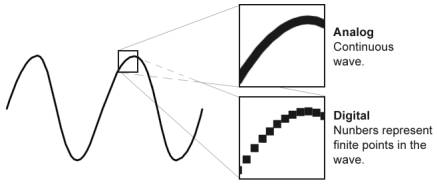
Analog sound, unlike digital, is reproduced on analog devices and has a number of significant differences. While not a data stream, analog audio is represented as a continuous electrical signal that represents a change in the sound wave. To translate it into digital format, the sound is “digitized”, that is, it is divided into certain segments, in which the numerical value of the amplitude is fixed at that moment. We will not delve into the principles of digital sound creation, but it is absolutely necessary to note that the more often a sound segment is divided and its characteristics described, the clearer and more complete the sound image itself is created.

This process generates a large amount of data that describes the sound, and it is clear that each digital audio format is nothing more than a compromise between the need to present the sound as loudly as possible and the memory limitations of a computer or device. Of reproduction.

A little more theory. In most cases, the human ear perceives sound with a frequency no higher than 22,000 Hz and, to describe it fully in digital form, a sampling frequency of at least 44.1 kHz is required. Since it is absolutely impossible to determine the value of the signal at any given moment, during digitization quantization occurs, that is, the replacement of the actual values ​​of the signal by approximate values. The more levels of audio quantization, the more accurately the signal level is described. As a result, each standard CD carries an audio signal with a sampling frequency of the same 44.1 kHz and a 16-bit quantization level, and in some devices, sampling is done at 48 kHz.

The benefits of digital audio

And now, briefly on why this algorithm was developed. Digital sound has enormous advantages over analog, although we must not forget its certain disadvantages. The main value of digital sound is the possibility of infinitely long storage and playback