Introduction to digital sound
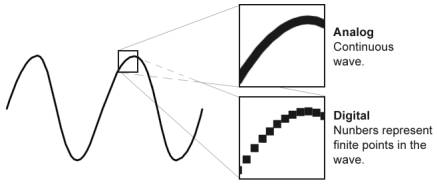
The computer operates on digital data. Therefore, for translation to a computer, an analog audio signal must be converted to digital.

For playback, on the contrary, the digital signal must be converted to analog. For this, special devices are used: an analog-to-digital converter (ADC) and a digital-to-analog converter (DAC). Both devices are built into your computer’s sound card.
Recording scheme: sound reproduction
Recording and digitization
Tape recording is an example of analog recording. The computer operates on digital data. Digital recordings have many advantages over analog ones:
Digital files can be copied as many times as desired without loss of quality.
The digital files can be burned to a CD and posted on the website.
Digital recordings are easier to edit.
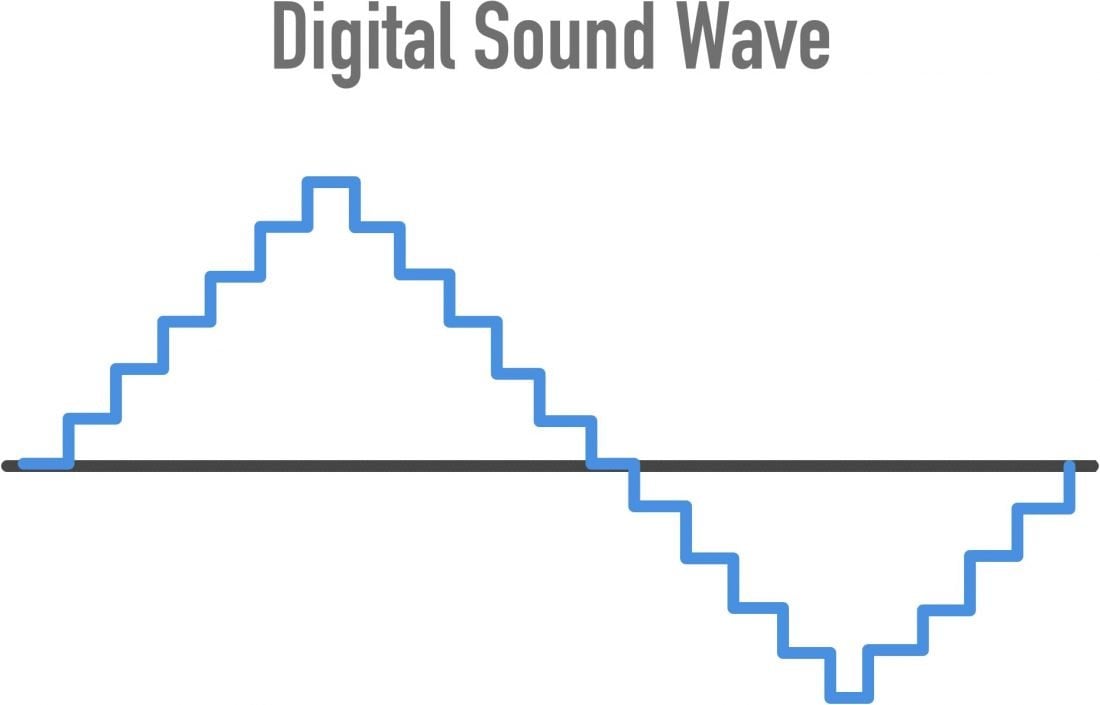
To convert an analog signal to digital, a special device is required: an analog-to-digital converter (ADC). The ADC converts an analog signal into a sequence of digital values that are sent to a computer. The method used to convert the analog signal to a digital technique called pulse coding (PCM pulse code modulation). The essence of this method is that the amplitude of the analog signal is sampled at regular intervals:
Digitized sound
To convert a lossless signal, it is necessary to sample 2xPi times more often than the highest frequency in the signal spectrum:
It’s easy to guess that two parameters determine the quality of a digital recording:
Sampling frequency: the speed at which samples are taken. Measured in Hertz (Hz). 1 Hz = 1 / P.
Audio CDs, for example, use a sample rate of 44,100 Hz.
Resolution (sample format or sample size): the precision of the representation of each sample, that is, what number describes each sample. Audio CD is represented by 16 bits.
Bitrate
The human ear recognizes sounds in the 15 Hz to 20 KHZ frequency range. Therefore, the ideal sample rate is 128 kpc. This frequency is used in DVD format. Recently, the frequency of 192 kHz with sampling of 24 and 32 bits is becoming common. This resolution allows you to transmit completely realistic sound, but requires high-quality acoustics.
For the audio format, the selected frequency is 44,100Hz with 16-bit sampling (see “What is sound”); this corresponds to the ability to reproduce most speaker systems.
The digitization of the analog signal is done using the pulse modulation method (PCM stands for Pulse Code Modulation).
Reproduction
For playback, a digital signal must be converted to analog, amplified, and routed to a sound-reproducing device – speakers or headphones.
To convert a digital signal to analog, one device is used: a digital-to-analog converter (ADC).
Typically ADC and DAC are built into a computer sound card