
How is sound represented digitally?
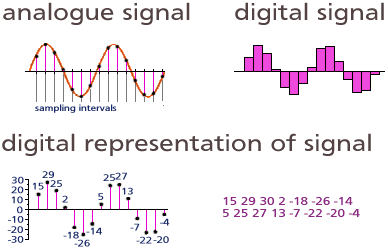
The original shape of an audio signal (a continuous change in amplitude over time) is represented digitally by “cross-sampling”, in time and level.

According to Kotelnikov’s theorem, any continuous process with a limited spectrum can be completely described by a discrete sequence of its instantaneous values, following with a frequency at least twice the frequency of the highest harmonic of the process; the sampling frequency Fd of instantaneous values (samples) is called the sampling frequency.
It follows from the theorem that a signal with a frequency Fa can be successfully sampled in time at a frequency 2Fa only if it is a pure sinusoid, because any deviation from the sinusoidal shape leads the spectrum to go beyond the frequency Fa. Therefore, for temporal sampling of an arbitrary audio signal (which normally has, as is known, a spectrum that falls smoothly), it is necessary to select a sampling frequency with a margin or to forcefully limit the spectrum of the input signal below half the sample rate.
Simultaneously with time sampling, amplitude sampling is performed: measurement of instantaneous amplitude values and their representation in the form of numerical values with some precision. The precision of the measurement (binary width N of the obtained discrete value) determines the signal-to-noise ratio and the dynamic range of the signal (theoretically these are reciprocal values, but any real path also has its own level of noise and interference).
The resulting stream of numbers (a series of binary digits) that describe an audio signal is called Pulse Code Modulation (PCM), since each pulse of a time-sampled signal is represented by its own digital code.
Linear quantization is most often used when the numerical value of the sample is proportional to the amplitude of the signal. Due to the logarithmic nature of hearing, logarithmic quantization, when the numerical value is proportional to the magnitude of the signal in decibels, would be more appropriate, but this is fraught with difficulties of a purely technical nature.
Time sampling and amplitude quantization of the signal inevitably introduce noise distortions in the signal, the level of which is generally estimated using the formula 6N + 10lg (Fdiscr / 2Fmax) + C (dB), where the constant C varies for different types of signals: for a pure sinusoid it is 1.7 dB, for sound signals – from -15 to 2 dB. Thus, it can be seen that a decrease in noise in the operating frequency band 0..Fmax leads not only to an increase in the bit depth of the sample, but also to an increase in the sample rate relative to 2Fmax, as the quantization noise is “smeared” across the band up to the sample rate, and the audio information occupies only the smallest part of this strip.
Most modern digital audio systems use the standard 44.1 and 48 kHz sample rates, but the frequency range of the signal is usually limited to about 20 kHz to keep it clear of the theoretical limit. Also the most common is 16-bit level quantization, which provides a limit signal-to-noise ratio of approximately 98 dB. The studio equipment uses higher resolutions: 18, 20, and 24-bit quantization at 56, 96, and 192 kHz sample rates. This is done to preserve the higher harmonics of the sound signal, which are not directly perceived by the ear, but affect the formation of the overall sound image.
To digitize lower-quality, narrow-band signals, you can lower the sample rate and bit depth; for example, telephone lines use 7 or 8 bit digitization with frequencies 8..12 kHz.
The representation of an analog signal in digital form is also called Pulse Code Modulation (PCM), since the signal is represented as a series of pulses of constant frequency (time sampling), the amplitude of which is transmitted digitally (amplitude sampling ). A PCM stream can be parallel, when all the bits in each sample are transmitted simultaneously over several lines with one sampling frequency, or sequential, when the bits are transmitted one after another at a higher frequency on a line.
Digital sound itself and related elements are often denoted by the general term Digital Audio; The analog and digital portions of a sound system are called the Analog Domain and Digital Domain.


