How Audio Sample Rate Affects Sound Quality


Free Download Mp4Gain
picture

How Audio Sample Rate Affects Sound Quality

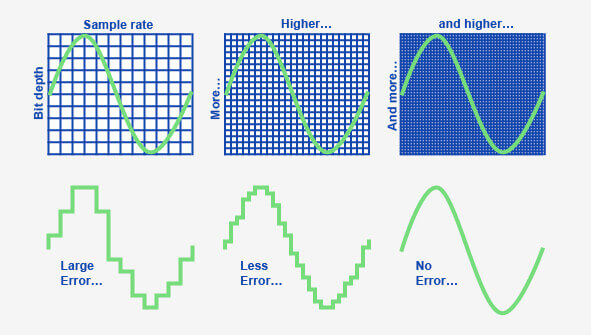
Audio Sample Rate
Audio Sample Rate
Audio Sample Rate
Audio Sample Rate

Audio Sample Rate Explained

When it comes to digital audio, sample rate refers to the number of samples of sound that are taken per second to create a digital representation of an analog signal. In other words, it’s the number of times per second that the analog sound wave is measured and converted to a digital signal. The higher the sample rate, the more accurately the sound can be represented in the digital domain.

Personally, I’ve noticed that when I’m working on a music production project and I choose a higher sample rate, the resulting audio files tend to sound clearer and more detailed. As an avid music listener, I also appreciate the difference in sound quality when listening to high sample rate audio files on my headphones or speakers.

According to Ethan Winer, author of “The Audio Expert”, “In general, using a higher sample rate than the minimum required for the material being recorded or processed is good practice. However, there is no benefit to using a higher rate than twice the highest frequency that needs to be captured or processed.”

The Relationship Between Audio Sample Rate and Sound Quality

As mentioned earlier, the higher the sample rate, the more accurately the sound can be represented in the digital domain. This means that a higher sample rate can lead to a higher quality sound, with more accurate representation of the original analog sound wave.

I’ve also found that the relationship between sample rate and sound quality is not always linear. That is, going from 44.1 kHz to 48 kHz may not make as much of a difference as going from 48 kHz to 96 kHz. This is because the higher sample rates allow for more accurate representation of the sound wave, even in the higher frequency ranges.

As Julian Dunn, author of “Mastering Digital Audio”, explains, “Higher sample rates…provide more ‘headroom’ in the recording, which means that the recording can capture more of the dynamic range of the original sound. This can result in a richer, more natural sound.”

Choosing the Right Sample Rate

When it comes to choosing the right sample rate, it’s important to consider the specific needs of your project. If you’re recording a podcast or a voiceover, a sample rate of 44.1 kHz may be sufficient. However, if you’re recording music or other complex audio, a higher sample rate may be necessary to capture all the nuances and details of the sound.

It’s also important to note that a higher sample rate means larger file sizes, which can impact storage and processing requirements. So, it’s important to find a balance between the sample rate and file size that works best for your specific needs.

As author and sound engineer Bob Katz explains, “The most important factor is not the numbers, but how the system sounds. Choose the sample rate that sounds best to you, taking into account the practical considerations of your production environment.”

Final Words:

In conclusion, the sample rate of digital audio plays a significant role in the quality of the resulting sound. By understanding the relationship between sample rate and sound quality, and choosing the right sample rate for your specific needs, you can ensure that your digital audio sounds as good as possible.


Free Download Mp4Gain
picture


Mp4Gain Main Window
picture


Mp4Gain Features
picture


Free Download Mp4Gain
picture

Bluetooth playback on desktop computer.

Bluetooth playback on desktop computer.

Bluetooth

Recently, more and more wireless headsets and smartphones have been released without a 3.5mm jack, and the latter are getting more and more sophisticated Bluetooth codecs.

Bluetooth audio

However, desktop systems are much more conservative in this regard: here almost all devices are still equipped with a headphone jack, and the cable rarely interferes, therefore, with the transmission of sound via Bluethtooth, here everything is sadder.

However, the customization of a PC is much greater than that of smartphones, so if you bought great wireless headphones, don’t worry, you can also enjoy high-quality sound on the desktop operating system.

What are Bluetooth codecs?

First, a brief introduction to the theory. With wireless sound transmission, everything is more complicated than with a wired one: here you cannot just connect the cable and immediately get high-quality sound; this requires that both the headphones and the device support the desired codec.

Their complete list is quite impressive:
SBC is the basic codec included in the A2DP standard, which is compatible with 99% of all BT devices released in the last 10 years, and absolutely all wireless headphones. Consequently, if you don’t want to understand, you can just buy any BT headset and connect it to your device; the music will be broadcast. It would seem, what is the problem then? And is that SBC is comparable in sound quality to mp3 with a bit rate of 128 kbps: that is, you can listen to podcasts or YouTube videos without any problem, but you can hardly enjoy the music. Therefore, in the last 10 years, more “cooler” codecs have been developed, which transmit sound better.

AptX is perhaps the most qualitative leap after SBC. And while its bit rates are comparable (~ 300 kbps), AptX squeezes sound less harshly, so music in plugs or inexpensive headphones will often sound even better than when the same headphones are connected with a cable to a smartphone. Unfortunately, on a PC, even with a built-in audio card, the sound through the cable can still be better, although you do need some pretty expensive headphones to tell the difference. Therefore, this codec can be considered a basic level – a sufficient number of users listening to music on streaming services in mp3 with bit rates of 250-320 kbps, such BT sound will suit.

AptX LL – Same AptX, but with low latency (low latency). If conventional wireless codecs have a delay of 100-200 ms, here it is below 40 ms, which is important in games. However, in reality, it all largely depends on both your device and the headphones: for example, personally, I do not feel the audio lag in AptX HD in games.
AptX HD is an improved version of AptX with a bit rate almost double (576 kbps). But this is still a lossy transmission of sound, although much less than in the case of previous codecs. As a result, if you listen to music on Spotify, Apple Music, and other services, the sound quality will be indistinguishable from cable or even better if you have high-quality headphones with a good DAC inside. But if you prefer lossless and, most likely, have special equipment to listen to it, unfortunately the cable here will still be noticeably better.

LDAC is Sony’s highest quality codec (available for free on Android 8.0 and above). It has three levels of bitrate: 330, 660 and 990 kbps. The former is similar in quality to AptX, so there is no point in considering it. The second works roughly at the level of Aptx HD. But the third, perhaps the most interesting: it is obvious that for music from streaming services this is excessive, but this is almost the only codec that allows you to transfer without loss with almost no loss of quality. However, problems are already emerging with the stability of transferring music with such a high bit rate; in other words, already behind a wall of the fountain, you will be haunted by the constant stuttering of sound.

LHDC is an analog of Huawei’s LDAC, it has a bit rate of 900 kbps, while only this company’s smartphones and some headphones support it. As a result, in terms of quality, it should work at the LDAC level, but in practice you most likely won’t find it anywhere.
AAC is the only high-quality codec supported by iPhone. Not having the highest bit rate of 256 kbit / s allows you to get quality sound somewhere between AptX and AptX HD due to this being the only psychoacoustic codec between them.

Reasons why Bluetooth can reduce sound quality

Reasons why Bluetooth can reduce sound quality

Bluetooth audio

While Bluetooth technology offers an easy way to listen to wireless audio through speakers and headphones, some people are opposed to Bluetooth because in terms of audio fidelity it is better to choose one of the Wi-Fi based wireless technologies such as AirPlay, DLNA , Play-Fi or Sonos. … While this understanding is generally correct, there is more to using Bluetooth than meets the eye.

audio Bluetooth

A little about Bluetooth technology

Bluetooth was not originally created for audio entertainment, but rather to connect speakerphone and phone headsets. It has also been designed with a very narrow bandwidth, which forces data compression to be applied to the audio signal. While this format may be ideal for phone calls, it is not ideal for playing music. Additionally, Bluetooth can apply this compression over existing data compression, such as digital audio files or sources streamed over the Internet.

Bluetooth 5.0 standard – a new level of wireless communication

But one important thing to keep in mind is that the Bluetooth system should not apply this additional compression. That’s why:

All Bluetooth devices must support low complexity subband encoding. However, Bluetooth devices can also support additional codecs, which can be found in the Bluetooth Advanced Audio Distribution Profile specification. Additional codecs listed: MPEG 1 and 2 Audio, MPEG 3 and 4, ATRAC and aptX.

In fact, the familiar MP3 format is MPEG-1 Layer 3, so MP3 is included in the specification as an additional codec.

Additional Bluetooth codecs

The official Bluetooth standard in section 4.2.2 states: “The device can also support additional codecs to maximize usability. When both SRC and SNK support the same subcode, that codec can be used instead of the required codec. ”

In this document, SRC refers to the source device and SNK refers to the destination (or receiver) device. So the source would be your smartphone, tablet, or computer, and the receiver would be your bluetooth speaker, headset, or receiver.

By design, Bluetooth does not necessarily add additional data compression to material that is already compressed. If both the source and receiver devices support the codec used to encode the original audio signal, the audio can be transmitted and received without change. So if you are listening to MP3 or AAC files that you have saved on your smartphone, tablet, or computer, Bluetooth should not degrade the sound quality if both devices support this format.

This rule also applies to Internet radio and music streaming services that are encoded in MP3 or AAC format, which covers most of what is available today. However, some music services are experimenting with other formats, for example Spotify uses the Ogg Vorbis codec.

According to the Bluetooth SIG, the organization that licenses Bluetooth, compression remains the norm for now. This is mainly due to the fact that the phone has to transmit not only music, but also calls and other notifications related to calls. However, there is no reason why a manufacturer cannot switch from SBC compression to MP3 or AAC if it supports the Bluetooth receiver. This will apply compression to the notifications, but the original MP3 or AAC files will be transmitted without modification.

What about aptX

The quality of stereo sound transmitted via Bluetooth has improved over time. The current aptX codec, which is marketed as an upgrade to the mandatory SBC codec, provides CD-like audio quality via Bluetooth wireless technology.

Just remember that both your Bluetooth source and receiver need to support the aptX codec in order to benefit. However, if you are playing MP3 or AAC material, it is best if the manufacturer uses the proprietary format of the original audio file without additional transcoding via aptX or SBC.

Bluetooth 5.0: new power saving mode

Most Bluetooth audio devices are not made by companies whose employees wear their brand on their chest, but by an original design that you have never heard of. And the Bluetooth receiver used in the audio product was probably not made by ODM, but by another manufacturer. The more complex a digital product is and the more engineers work on it, the more likely it is that no one knows everything about what is actually going on inside the device. One format can easily be transcoded to another and you will never know, because hardly any Bluetooth receiver will tell you what the incoming format is.

WHAT IMPACT DOES BLUETOOTH HAVE ON THE AUDIO QUALITY?

Bluetooth Audio

A must-have brief on Bluetooth, from the basics to daily practice in audio land, was posted on HiFi.nl this summer. That raised a number of questions for readers, which, in short, are almost the same: “Great, that wireless connection, but what is left of the quality of the source file when you send audio over Bluetooth?”

Bluetooth Audio

We know that since the introduction of the current standard in the field of wireless connection, things have evolved considerably. While Bluetooth was never primarily intended to send or receive audio signals, but rather to allow hardware like the mouse and keyboard to communicate with each other, quite a few steps have been taken to exploit and enhance those capabilities. Consider Bluetooth version 4.0 and the arrival of the now-familiar aptX codec. However, the transfer is not (yet) loss-free. Is the quality of the source file sufficiently preserved with a wireless connection via Bluetooth? In other words, does it make sense to play FLAC instead of MP3, for example if you use Bluetooth to send the music to your speaker?

Codecs

The wired versus wireless discussion will likely always persist. After all, there are numerous hi-fi manufacturers that specialize in audio cables and tell a very good story about it (and besides, of course, there’s the good digital cable twist). When talking specifically about wireless audio over Bluetooth, there is always the element of compression. Due to the limited bandwidth of the connection, by definition there will be data compression and therefore loss of quality. (Not to mention, Bluetooth operates within the 2.4Ghz frequency that many other equipment in the house are also ‘connected’ to.)

aptX

The algorithm used also depends on the codecs supported by both the sender and the receiver. The only one that always works is low complexity subband encoding, or SBC. SBC is still used if, for example, the smartphone supports aptX, but the headphones do not; is the backup option. aptX, which has already done a lot to limit compromise, is certainly not the official standard and is still quite rare, regardless of the fact that there are so many different variants of su. What aptX also does exactly to ensure the ‘lossless CD quality’ of the connection is known only to the creator CSR and owner Qualcomm (you know, the American telecom giant), and their interpretation is, at best of the cases, vague. to name. In any case, the transport of audio data is still dependent on the bandwidth of the connection, which does not have the lossless qualities of transmission over optical cables, for example. The essence: With Bluetooth audio streaming, the audio stream is encoded with a lossy algorithm. After all, Bluetooth has insufficient bandwidth for lossless, let alone high resolution.

“It is always recommended to work with lossless FLAC or ALAC files”

Now what?

Well then there is loss of audio quality. And it’s no secret that hi-fi enthusiasts aren’t fans of compression. However, is the commitment so present that there is as much to horrify as with MP3? No, because thanks to innovations in the quality and bandwidth of a Bluetooth connection, much is being done to minimize the audible effect of compression, as this study shows between SBC, the younger aptX, and 320 mp3 Kbps. So the question is whether it can still be heard in an a / b test with, for example, optical cabling as an alternative. However, the main question is whether an a / b test with different source files via Bluetooth has any effect. The answer is really simple: do you prefer the loss of a good file or a less good file? After all: the better the source, given the (for the moment) inevitable but increasingly marginal loss of quality via Bluetooth, the better the end result. So it is always wise to work with lossless FLAC or ALAC files, because no matter what happens behind the scenes with Bluetooth streaming, you certainly won’t have to deal with double lossy compression, which is always a downside.

Finally, you have to put the Bluetooth app in perspective. After all, for many seasoned audiophiles, the above won’t be a discussion at all, for the simple reason that the listening room isn’t set up for an audio connection via Bluetooth (“Wired! Wired! “). Therefore, the use depends on the circumstances.